Railway air brake
Brakes on every car, worked by air from the locomotive
Contents
- 1Brake pipe and hose coupling
- 2Triple valve
- 3Auxiliary reservoir
- 4Brake cylinder
- 5Brake levers and rods
- 6Brake shoe on the wheel
The railway air brake lets the driver brake every vehicle of a train at once from the locomotive. A steam-driven pump compresses air into a reservoir, and a pipe running the length of the train carries it to a brake cylinder on each car. In the automatic form, each car keeps its own reservoir and a triple valve that applies the brakes whenever the pressure in the pipe falls, even if a hose bursts or the train breaks in two. Samuel Cunliffe Lister patented a compressed-air railway brake in England in 1848. George Westinghouse's patent of 13 April 1869 made the air brake practical, and his automatic brake followed a few years later.
What it is
A train is heavy and its wheels grip the rails with little friction, so it needs a long distance to stop. Until the 1870s most trains in North America were braked by hand: brakemen turned a wheel at the end of each car to press its brake blocks against the wheels, following whistled signals from the driver, and on freight trains they did it from the roofs of moving cars. A continuous brake does the same job on every vehicle at once, worked from one place.
The air brake uses compressed air for this. On the locomotive, a pump driven by steam fills a main reservoir, and the driver controls the brakes with a valve. A brake pipe runs under every car from one end of the train to the other, joined between cars by flexible hoses of rubber. Each car carries a brake cylinder whose piston, through a set of levers and rods, presses cast-iron brake shoes against the treads of the wheels. In the automatic air brake used on trains today, each car also has its own air tank, the auxiliary reservoir, and a triple valve that connects the pipe, the reservoir and the cylinder.
How it works
Westinghouse’s first brake, later called the straight air brake, sent air forward to apply the brakes. When the driver opened his valve, air from the main reservoir flowed back along the pipe into every brake cylinder and pushed the pistons out. To release, he shut off the reservoir and let the air in the pipe escape, and springs pushed the pistons back. The air took time to reach the last cars of a long train, and a burst hose let it escape, leaving the train without brakes. The hose couplings had valves that closed by themselves if the cars came apart, so brakes already applied stayed on. If the train parted with its brakes released, the cars cut off from the locomotive had no air to brake with.
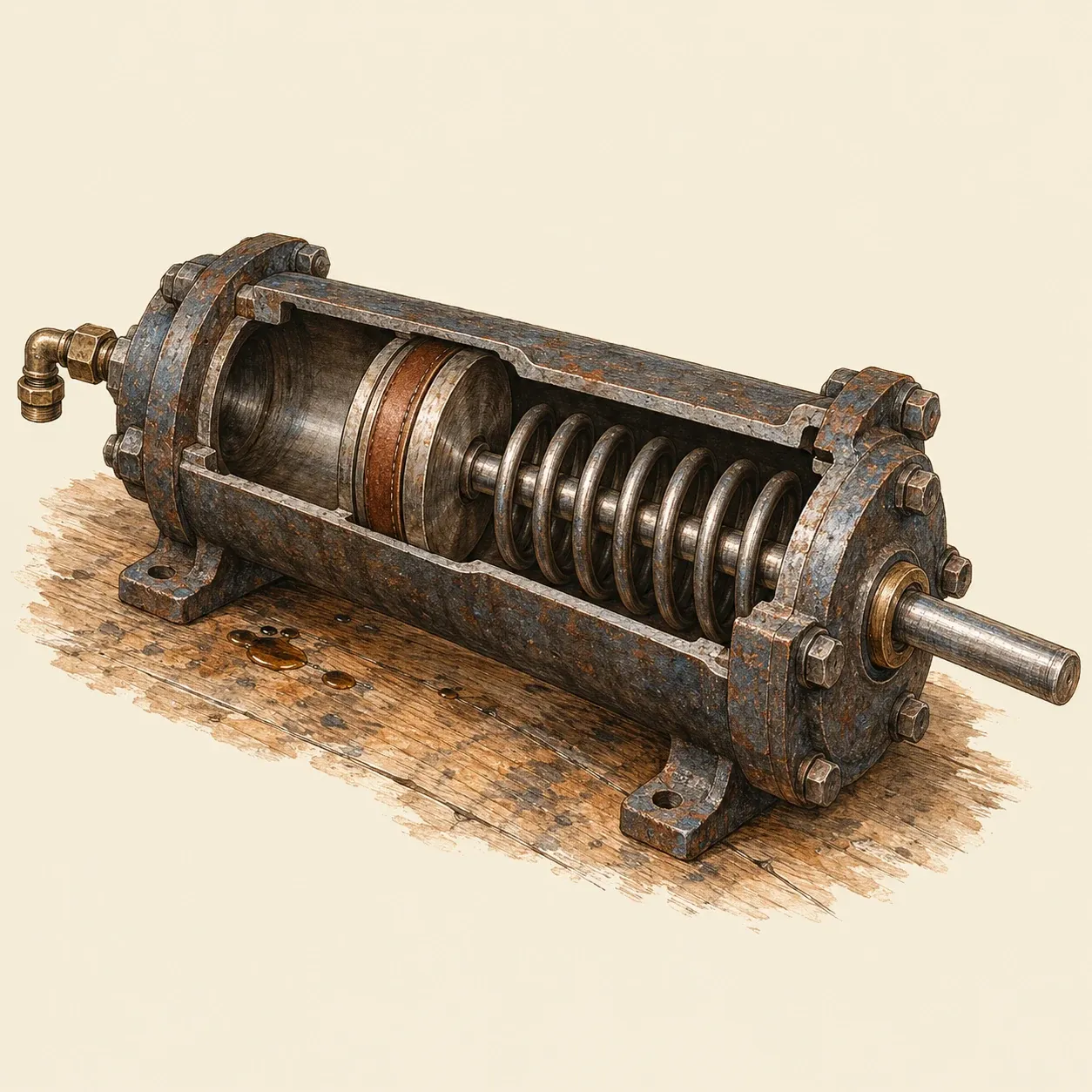 Air entering behind the piston pushes the rod out; when the air is let out, the spring pushes it back.
The automatic brake works the other way round: the air holds the brakes off. While the train runs, the brake pipe and every auxiliary reservoir are kept charged at working pressure. The triple valve on each car has a piston with the brake pipe on one side and the auxiliary reservoir on the other. While the two pressures are equal, the valve lets pipe air flow slowly into the reservoir to top it up and keeps the brake cylinder open to the outside air, so the brakes stay off.
To brake, the driver lets some air out of the brake pipe. The pressure on the pipe side of each triple valve falls below the pressure in the reservoir, and the piston moves towards the pipe. In moving it closes the passage from the pipe, closes the cylinder’s exhaust and opens a passage from the reservoir to the cylinder. Air stored on the car flows into its own brake cylinder and the shoes press on the wheels. A small drop in pipe pressure gives a light application, a larger one a stronger brake. To release, the driver refills the pipe. The pressure on the pipe side rises above the reservoir pressure, the piston moves back, the cylinder empties to the open air and the reservoir fills again.
Because the brakes are applied by a fall in pressure, anything that lets the air out of the brake pipe stops the train: the driver’s valve, a burst hose, or the two halves of a train coming apart.
How to do it
A model with a balloon and a rubber band shows the principle of the automatic brake: air pressure holds the brake off, and losing it puts the brake on. In this model the brake is applied by a rubber band; in a real train it is applied by air stored on each car. You need a shoebox, a jar lid about 8 cm across, a pencil, a craft stick, a small wooden block, a drawing pin, a pencil eraser, a strong rubber band, a small balloon, about 50 cm of thin plastic tube, a 60 ml plastic syringe, a bulldog clip, a few pieces of card, glue and sticky tape.
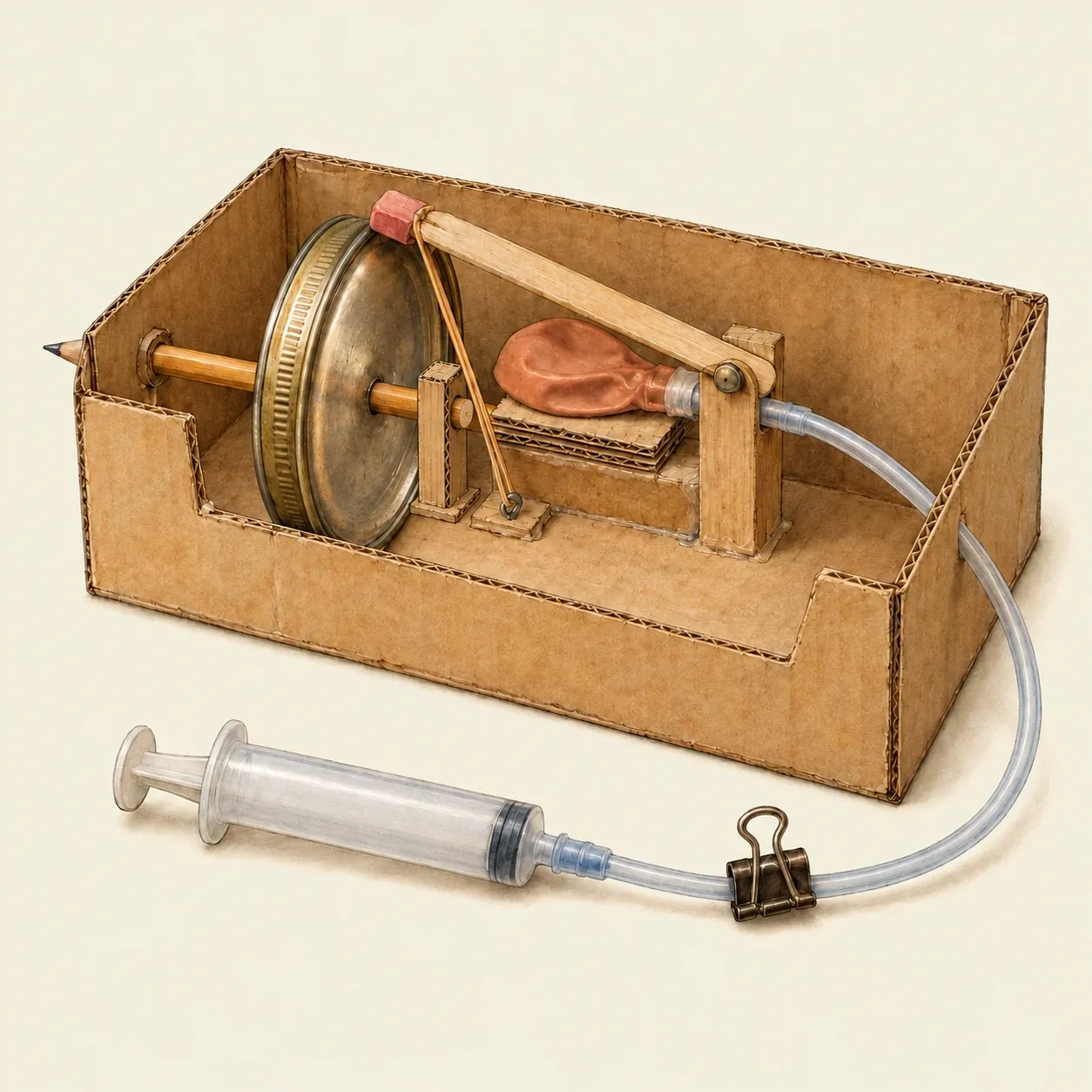 Pushing air into the balloon lifts the brake off; letting the air out lets the rubber band put it back on.
Glue a small post of folded card to the floor of the box near one end. Push the pencil through one end wall of the box, through the centre of the lid and into the card post, so that the lid turns freely inside the box. Glue the block to the floor of the box beside the lid and pin the craft stick to the top of the block so that it can rock. Glue the eraser under one end of the stick so that it rests on the rim of the lid, and hook the rubber band from that end of the stick to the floor of the box so that it pulls the eraser down onto the rim. Tape the tube firmly into the neck of the balloon, set the balloon under the stick between the pin and the eraser, on a small stack of card so that it just touches the stick when empty, and lead the tube out of the box to the syringe. Spin the lid with a finger: the brake stops it. Push the syringe so that the balloon swells and lifts the eraser off the rim, then close the tube with the clip. The lid now spins freely. Pull the syringe off the end of the clamped tube, then open the clip, as if a hose had burst, and the balloon empties and the band brakes the lid.
History and evolution
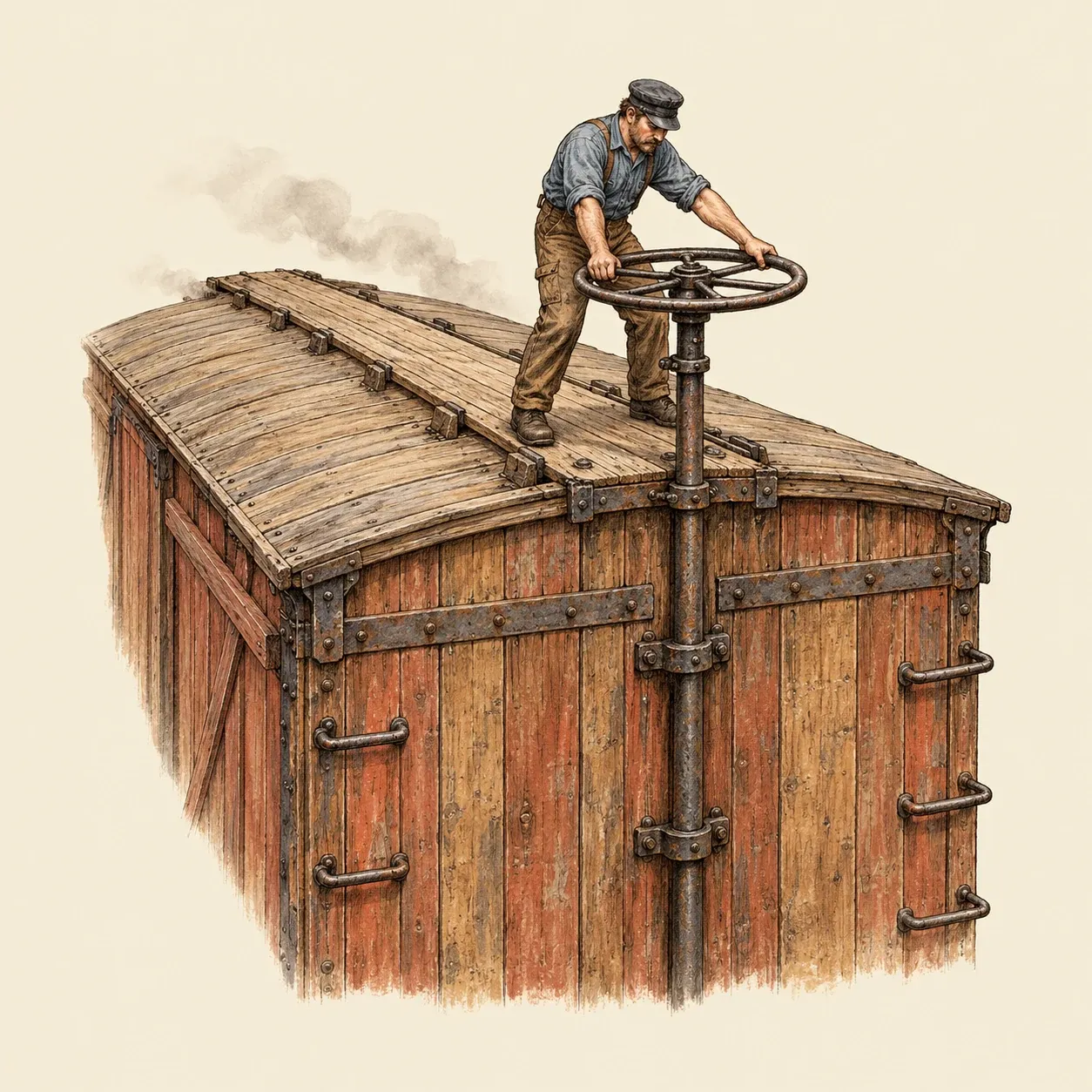 Before the air brake, brakemen on the car roofs turned a wheel on each car to set its brakes.
In England in 1848, Samuel Cunliffe Lister of Bradford patented a railway brake worked by compressed air. Pumps driven by the axles of a carriage compressed air into a chamber under its frame, and the guard worked valves that let this air drive a piston whose rod pressed the blocks against the wheels. George Westinghouse’s patent for the straight air brake, number 88,929, was granted on 13 April 1869, and it was his brake that the railways took up. The Pennsylvania Railroad tested the brake and decided in 1870 to fit it to its passenger trains, and other lines followed. Westinghouse then gave each car its own store of air: his automatic brake of the early 1870s added an auxiliary reservoir and a triple valve to every car, so that a train that broke apart braked itself.
Passenger trains took up the brake first, and freight trains much later. In the United States, the Safety Appliance Act of 2 March 1893 obliged interstate railways from 1 January 1898 to run locomotives with power brakes and trains with enough power-braked cars for the driver to control their speed without brakemen working hand brakes. That deadline was later extended by two years, to 1900. The same law required automatic couplers on cars in interstate traffic.