Automobile
An engine, wheels and the controls to manage them
Contents
- 1Chassis and wheels with solid rubber tyres
- 2Engine and horizontal flywheel
- 3Belt drive, differential and chains
- 4Steering control and front wheel
- 5Drive lever and mechanical brake
Loading the figure…
An automobile brings engine, transmission, steering and brakes together. Benz's three-wheeler lays their connections open to view.
What it is
An automobile carries people or goods along a road using an engine or motor on board. Its wheels must receive driving force, follow a chosen course and slow down when the driver asks. A chassis supports the occupants and holds these working parts in position, and a transmission carries the engine’s rotation to the wheels.
Carl Benz’s three-wheeler makes the arrangement easy to see. Its two large rear wheels flank the engine, while a single front wheel steers. A tubular frame carries a bench seat. Solid rubber tyres cover the spoked wheels; there are no inflatable inner tubes. Built during the 1880s, it borrows its tubular frame, spoked wheels and chains from the bicycle, and its bench seat from the horse-drawn carriage.
How it works
A single-cylinder, four-stroke engine supplies rotation at the rear. Its flywheel turns in a horizontal plane, smoothing the movement between firing strokes. The piston and crankshaft follow the principle described in the internal combustion engine. The automobile adds another problem: transferring that rotation to the road while still allowing the driver to corner and stop.
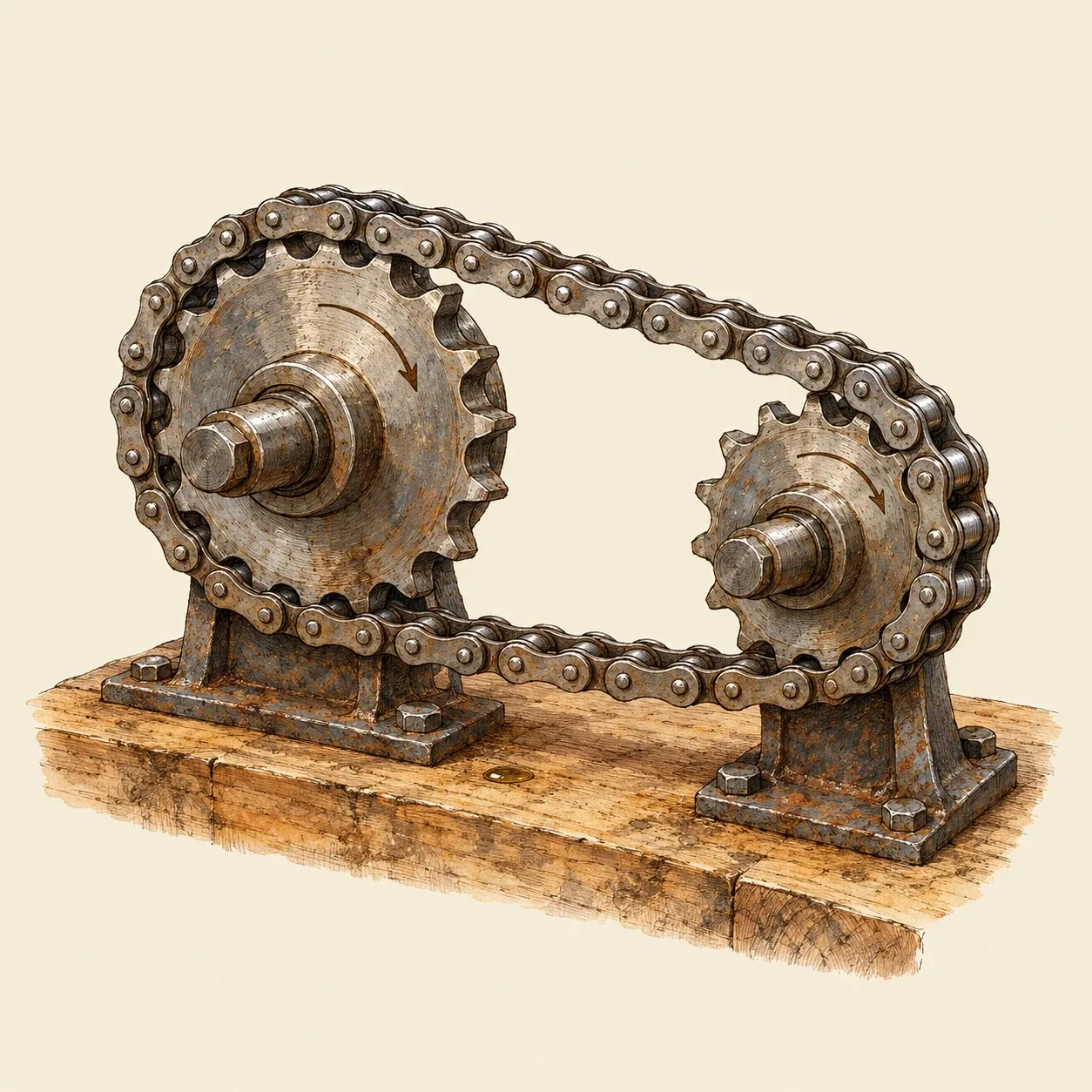 The chain transmits rotation from one sprocket to the other.
A belt connects the engine to the transmission. The driver can shift it between a loose pulley and a pulley attached to the driven mechanism. On the loose pulley, the engine runs without driving the wheels. On the fixed pulley, power passes through gears and then along separate chains to the rear wheels. The differential allows those wheels to turn at different speeds. During a corner, the outside wheel must cover more ground than the inside one. There is a single gear ratio.
The driver turns the front wheel with a hand-operated tiller. The patent also describes a combined lever for engaging the drive, disengaging it and braking. Returning this lever to its middle position shifts the belt onto the loose pulley. Moving it farther applies the brake while the drive remains disengaged. Friction converts some of the vehicle’s motion into heat.
How to do it
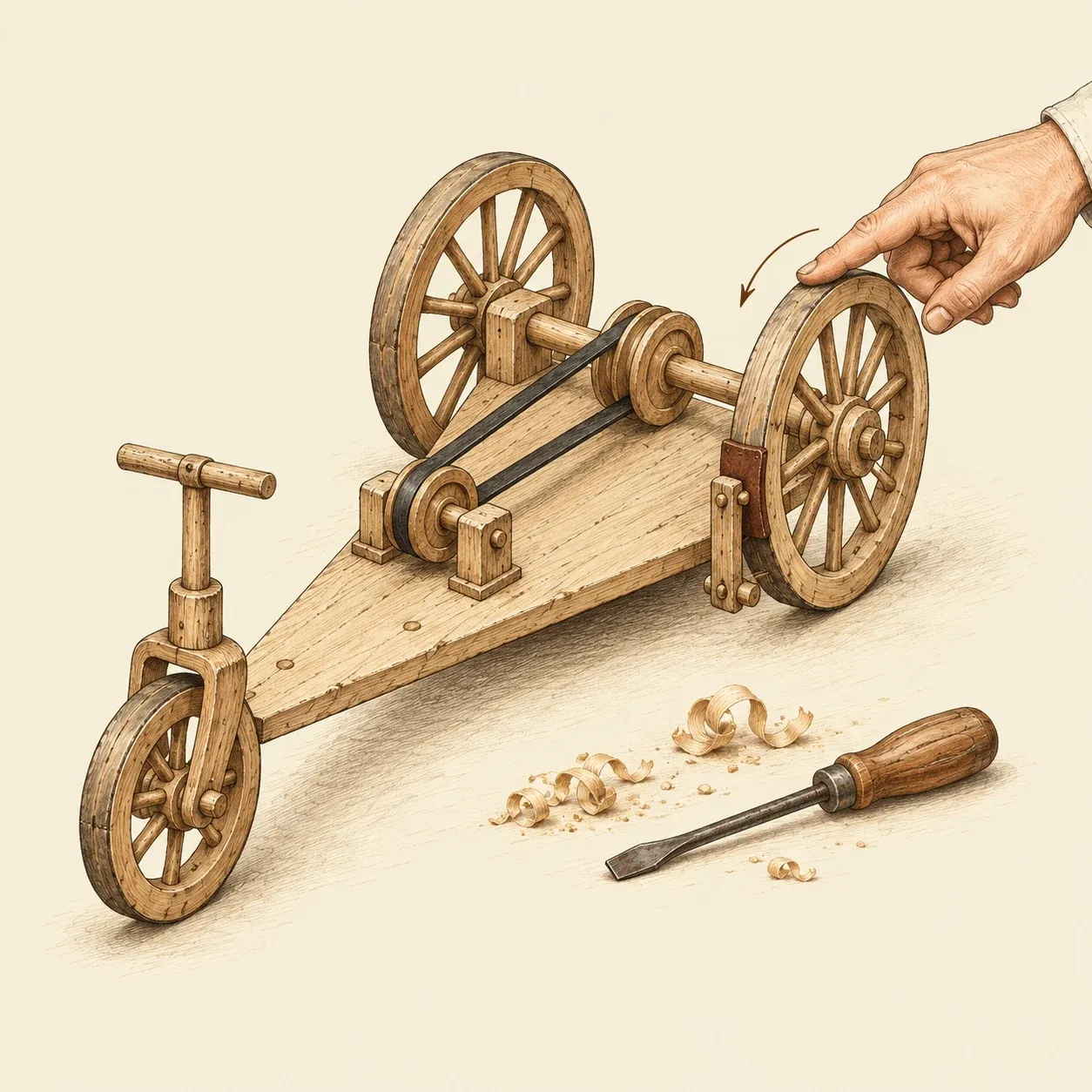 The model is turned by hand, carries no passenger and does not reproduce the differential.
A full-size automobile requires a professional workshop. Its frame must carry the intended loads, the transmission parts must line up, and the wheels, steering and brakes need inspection and testing. Restoring an early tricycle also means working out which version it is and which parts were fitted later.
A small, hand-operated model can demonstrate selected functions without becoming a powered vehicle. Three smooth wooden wheels on securely retained axles represent the tricycle. The front wheel pivots by hand. Turning a rear wheel with a fingertip moves a flexible belt between two pulleys. A leather pad gently brought against a wheel demonstrates friction braking. The model has no engine and carries nobody.
Cutting and assembly require suitable tools and adult supervision. Keep fingers away from pinch points and small loose parts away from young children. Real vehicles bring flammable fuel, toxic exhaust, hot surfaces and exposed moving machinery into the same space. Restoration and operation belong with qualified professionals and the required permissions.
History and evolution
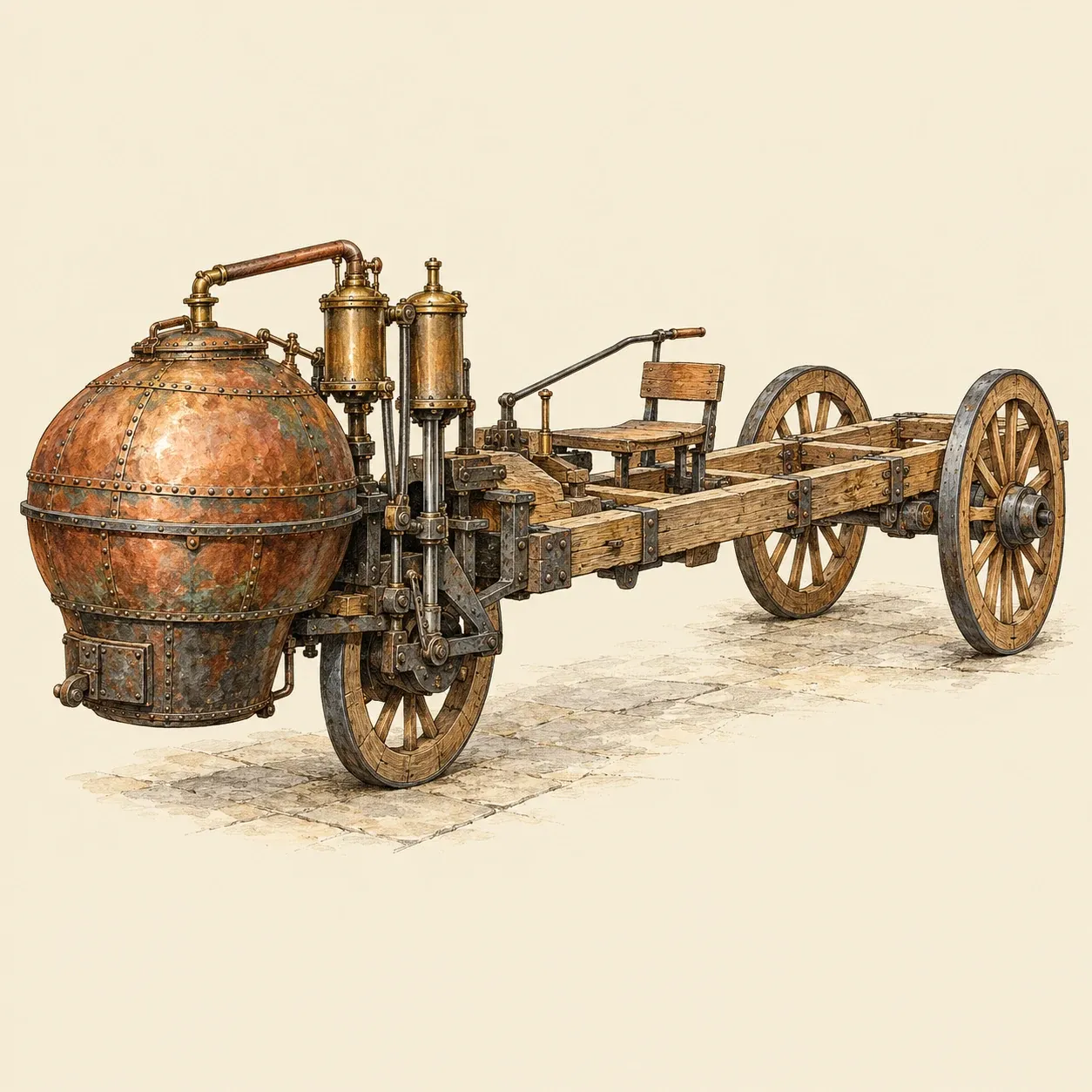 Cugnot’s steam wagon, kept at the Musée des Arts et Métiers, dates from 1770-1771.
Self-propelled vehicles existed before Benz. Nicolas Joseph Cugnot tested a steam vehicle in 1769; the full-size steam wagon preserved at the Musée des Arts et Métiers dates from 1770-1771. Small electric models ran in the 1830s, among them the little cart of about 3 kg built in 1835 for Sibrandus Stratingh in Groningen. Practical electric cars followed in the second half of the nineteenth century.
Benz filed German patent No. 37435 on 29 January 1886. It was granted on 2 November that year. The No. 1 now displayed in Munich was reassembled in 1895, and some parts may have been replaced.
In 1888, Bertha Benz travelled from Mannheim to Pforzheim with her two sons in the improved No. 3. Steam, electricity and petrol remained competing choices around 1900. Mass production, fuel supplies and easier controls later favoured petrol cars. Electric automobiles still have to solve the same problems of steering, transferring driving force and braking.