Cooling tower
Condenser water cooled by letting a little of it evaporate
Contents
- 1Hot water distribution with spray nozzles
- 2Fill, where water falls through the rising air
- 3Air inlets between the supporting columns
- 4Cold-water basin
- 5Reinforced concrete shell
A cooling tower cools the warm water that leaves the condensers of a power station or a factory by letting it fall through a stream of air, so that a small part of it evaporates and carries off the heat. The cooled water goes back to the condenser. A first tower drawing its air by chimney draught, built of timber by Hans Joachim Balcke, was tried at Nuremberg in 1894, and the tall concrete hyperboloid shell came from the Netherlands during the First World War.
What it is
A condensing steam engine or turbine turns its exhaust steam back into water in a condenser, and the condenser needs a constant flow of cold water to do it. Where a river or a lake cannot supply all of it, the plant uses a cooling tower: the warm water from the condenser is pumped into the tower and spread over a packing; it falls through a current of air and collects, cooled, in a basin at the bottom, from which it goes back to the condenser.
The large towers of power stations are shells of reinforced concrete, wide at the base, narrower above and slightly flared at the top, standing on a ring of slender columns. They work without fans: the air moves up through them by itself. Smaller towers on factories, hospitals and office buildings are boxes with fans that drive the air through. In both, most of the heat leaves with the water vapour that rises from the top.
How it works
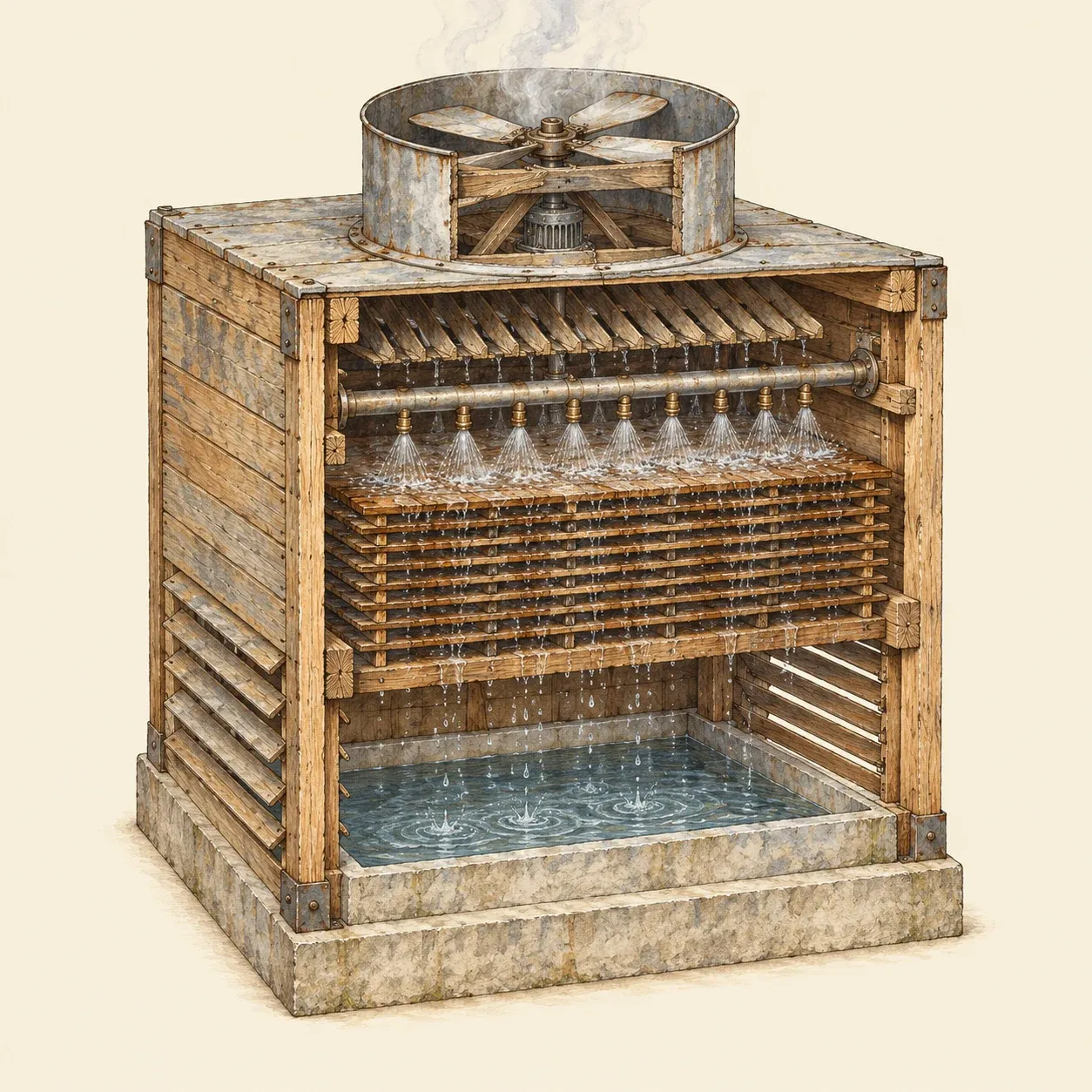 In a mechanical-draught tower a fan on top draws the air through the falling water.
Water needs a large amount of heat to evaporate, and it takes that heat from the water that remains. A cooling tower uses this on a large scale. Nozzles spread the warm water over the fill, layers of sheets or slats that break it into thin films and drops so that as much of its surface as possible meets the air. In counterflow towers the air rises against the falling water; in crossflow towers it passes through the fill sideways. Drift eliminators, rows of baffles above the spray, catch most of the fine droplets that the air would otherwise carry away.
In a natural-draught tower, the sprays and the fill take up only the lowest part of the shell, a little above the air inlets, and the rest is an open chimney. The air that has passed through the fill is warmer and more humid than the air outside, and therefore lighter. It rises up the shell as smoke rises in a chimney and draws fresh air in through the openings at the base. The double curve of the hyperboloid stiffens the thin concrete shell against its own weight and the wind, so that a very large tower needs comparatively little material.
The water lost by evaporation leaves behind the salts that were dissolved in it, and they become more concentrated each time the water passes through the tower. To stop them from forming scale, part of the water is regularly drained off, the blowdown, and fresh make-up water replaces it together with what evaporated and what was lost as drift.
How to do it
 Warm water poured through a packed bottle comes out cooler at the bottom.
A clear plastic bottle and some plastic pot scourers make a working model. Ask an adult to cut the bottom off a large plastic bottle and to pierce a few small holes in its cap. Stand the bottle upside down on three stones in a basin, so that air can enter between the stones and the neck, and pack it loosely with the scourers. Fill a jug with warm tap water, no hotter than is comfortable on the hand, and measure its temperature.
Pour the water slowly over the packing and read the temperature of the water in the basin as soon as the jug is empty. Repeat with the bottle empty, then with the packing and a small battery-powered fan blowing in from below. The more surface the water spreads over and the more air passes through, the cooler it comes out, and the difference is larger on a dry day than on a humid one.
Safety notice. Use warm water only, never hot or boiling water, to avoid scalds. Use only a battery-powered fan, never a mains appliance, near the water. The cut edge of the bottle can be sharp, so an adult should cut it and tape it. Warm standing water can grow Legionella, the bacteria that cause Legionnaires’ disease when droplets are breathed in: do not spray the water into the air, empty the basin and the bottle straight after the test, rinse them and leave everything to dry.
History and evolution
A condensing steam engine needs a great deal of cooling water, and not every factory or early electric station had a river at hand to supply it. The German engineer Hans Joachim Balcke was the first to cool such water in a tower that drew its air by chimney draught, and in 1894 he founded a firm in Bochum to build it. According to the Polytechnisches Journal, the first of these towers, roughly built of timber, went into trial service in 1894 in the yard of the Schuckert electrical company in Nuremberg. In the towers the journal described in 1897, the warm water entered high up in a wooden chimney and fell over many louvred trays, while the air it warmed rose and drew cold air in from below.
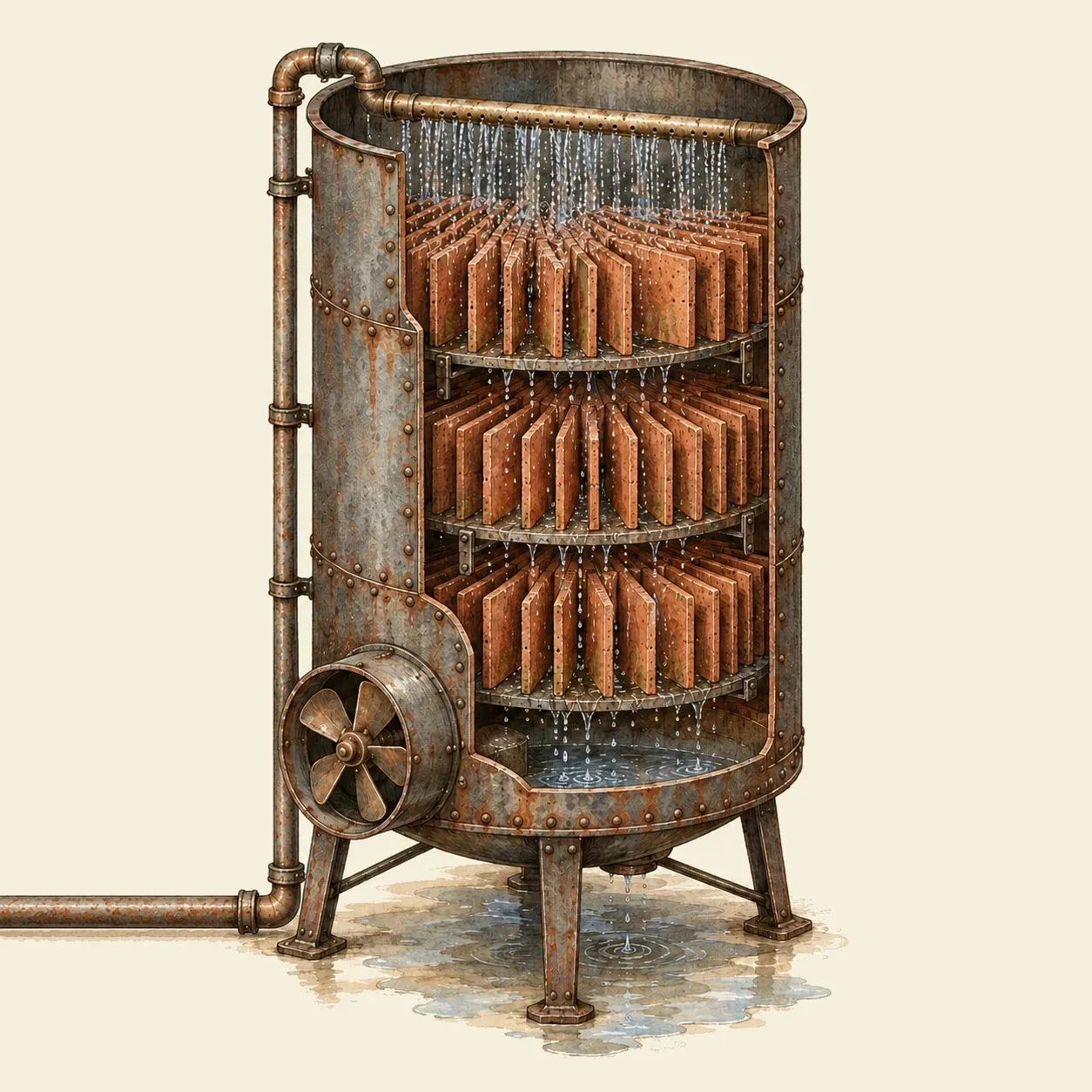 An 1890s tower: a metal stack packed with tiles, with a fan blowing air up through the falling water.
In 1896 American engineers described towers with fans. At the Edison electric station in Brooklyn, a tower was built as a tall metal stack packed with tiles. Hot water from the condensers was spread over the top and trickled down through the tiles, while a fan at the bottom blew air up through them. The water came out of the bottom cold enough to go back to the condensers, cooled chiefly by evaporation.
During the First World War, the Dutch engineers Frederik van Iterson and Gerard Kuypers patented a cooling tower of reinforced concrete whose walls curved in towards the middle and out again towards the top. Such shells, which draw their air without fans and need little material for their size, became the usual cooling towers of large coal-fired and nuclear power stations. Mechanical-draught towers with fans serve factories, refineries and the air conditioning of large buildings.
Because they keep warm water in contact with air and release fine droplets, cooling towers can spread Legionella. Outbreaks of Legionnaires’ disease have been traced to them, and the regular cleaning and disinfection of towers, with drift eliminators to hold back the droplets, are the usual means of preventing it.