Anaerobic digestion and biogas
Fuel gas from waste that rots without air
Contents
- 1Inlet tank for fresh slurry
- 2Brick-lined digester pit
- 3Floating steel gas drum
- 4Central guide pipe
- 5Gas outlet pipe
- 6Outlet for digested slurry
Anaerobic digestion is the breakdown of wet organic matter by microbes in a closed tank with no air. It gives biogas, a fuel made mostly of methane and carbon dioxide, and a digested slurry that is spread on fields. In the mid-1890s gas from a covered sewage tank at Exeter, in England, was burnt in lamps.
What it is
Anaerobic digestion is decay without air. In a closed tank with no oxygen, wet organic matter such as manure, sewage sludge or food waste is broken down by a community of bacteria and archaea. The methane-forming archaea are strict anaerobes, while some of the bacteria that break down the feed and form acids are facultative: they live with or without oxygen. Together they turn much of the carbon of the feed into biogas, a flammable mixture of methane and carbon dioxide with some water vapour and a little hydrogen sulphide. The share of methane depends on what goes in: the US Energy Information Administration gives 45 to 65 percent, the Environmental Protection Agency 50 to 75 percent.
The same decay goes on by itself in the mud of marshes, where the gas rises in bubbles and is lost. A digester encloses it so the gas can be gathered and used. The slurry that leaves the tank, the digestate, keeps most of the nutrients of the feed and is spread on fields as fertiliser. Biogas is burnt for cooking and heating or in engines that drive generators, and once its carbon dioxide and impurities have been removed it can be fed into the natural gas network.
A household digester of the kind long promoted in India is a pit lined with brick and filled with dung mixed with water. A steel drum, open at the bottom, floats upside down on the slurry and slides up and down a central guide pipe. Fresh slurry is poured into an inlet tank and runs down a pipe to the bottom of the pit, and the same volume of digested slurry overflows at the outlet. The gas leaves through a pipe on top of the drum.
How it works
Digestion runs in stages, each carried out by different microbes. First, enzymes released by bacteria split fats, proteins and carbohydrates into smaller molecules: fatty acids, amino acids and sugars. Other bacteria ferment these into volatile fatty acids, then into acetic acid, hydrogen and carbon dioxide. In the last stage, methane-forming archaea turn the acetic acid, or the hydrogen and carbon dioxide, into methane.
The methane makers grow slowly and are easily upset. If a digester is overfed or its temperature changes suddenly, acids build up faster than the archaea can use them, the slurry turns sour and the gas output falls. Digesters are therefore fed steadily and kept at a steady warmth, usually near 35 °C, which suits the mesophilic microbes, or near 55 °C for thermophilic ones, which work faster but are harder to keep stable. The slurry stays inside for weeks, long enough for the slow-growing archaea to keep up. With fibrous feeds such as manure, the first stage, the breakdown of the fibres, is often the one that limits the rate.
In a floating-drum digester the gas collects under the drum and lifts it. The weight of the drum sets the pressure of the gas, which stays nearly constant, and the height of the drum shows how much gas is stored. As gas is drawn off for a stove, the drum sinks back.
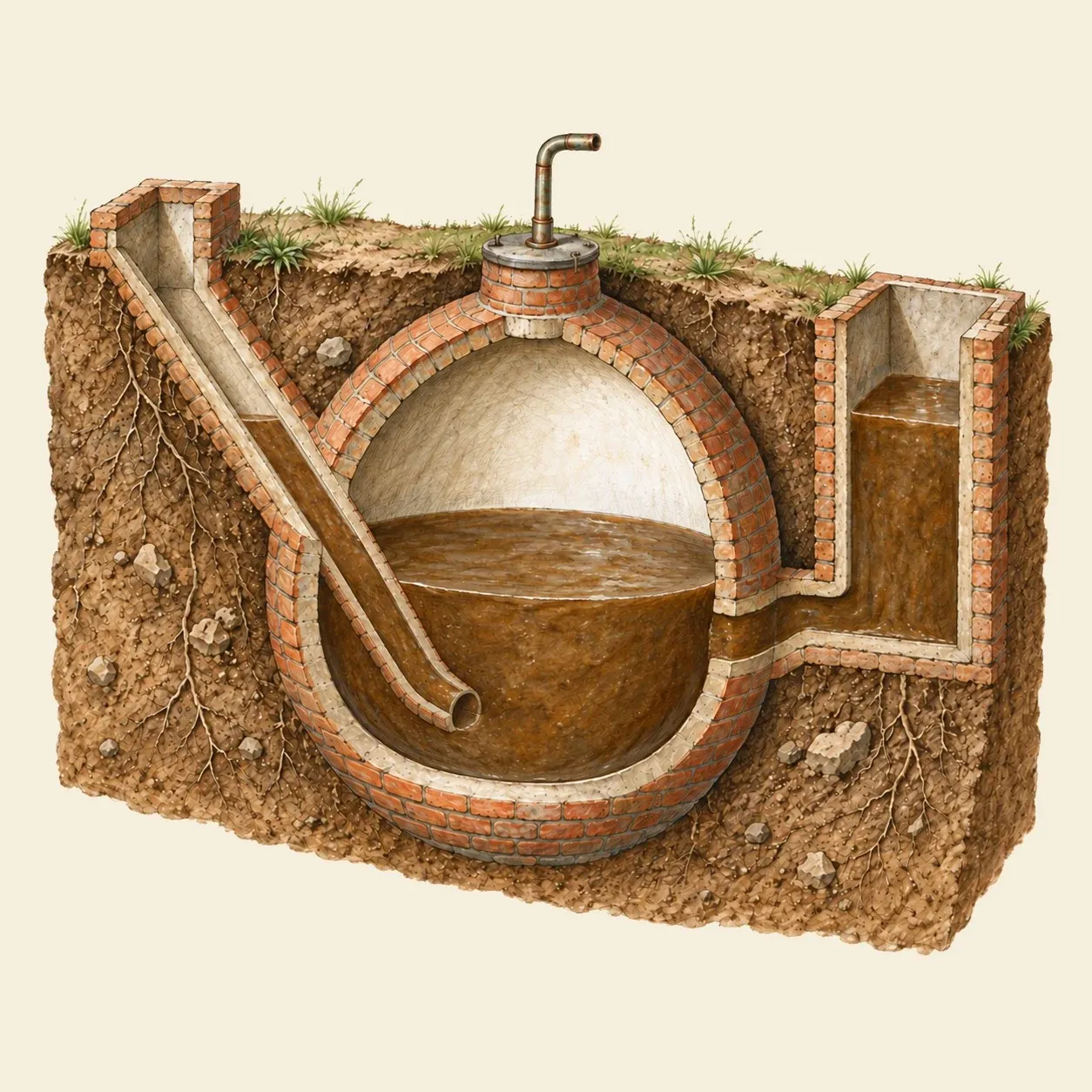 In a fixed-dome digester the gas, trapped under the masonry dome, pushes slurry up into the outlet chamber.
The fixed-dome digester, the usual type of the Chinese household programmes, has no moving part. It is a closed chamber of brick, stone or concrete with a domed top. The gas gathers under the dome and pushes some of the slurry up into an outlet chamber; the pressure rises as gas accumulates and falls as it is used, when the slurry flows back. The dome must be gas-tight, since any crack lets the gas escape.
Raw biogas carries hydrogen sulphide, a gas that smells of rotten eggs and is toxic in high concentrations. It is removed first, together with water vapour. Removing the carbon dioxide as well leaves almost pure methane, called biomethane or renewable natural gas, which can be used wherever natural gas is.
How to do it
 A balloon over the neck of a bottle collects the gas made by the slurry inside.
A plastic bottle and a balloon show digestion at work. Use a clean drinks bottle of 1.5 or 2 litres. Put in finely chopped vegetable scraps and a few spoonfuls of fresh cow or horse manure, or of garden soil, which brings the microbes. Add lukewarm water until the bottle is about a third full, leaving plenty of room for gas, and shake it gently. Stretch a balloon over the neck and wrap the join with tape so it seals.
Stand the bottle somewhere warm, out of direct sun, and check it each day. After a few days the balloon starts to swell. Prepare a second bottle in the same way and keep it in a cold place: comparing the two shows how much warmth speeds up the microbes. Measuring the girth of each balloon every day with a strip of paper gives a growth curve.
Safety notice. The gas in the balloon is flammable and may contain hydrogen sulphide, so never bring a flame or a spark near it and never try to light it. Never close the bottle with a cap, which would let pressure build up; the balloon is the outlet. Manure and rotting scraps carry germs: wear gloves, wash your hands after handling the bottles, keep them away from food and out of reach of young children. To finish, take the bottle outdoors, away from any flame, let the gas escape and empty the contents onto a compost heap.
History and evolution
The flammable gas given off by rotting matter was noticed long before it was used. In the seventeenth century the Flemish physician Jan Baptista van Helmont recorded that decaying organic matter gave off an inflammable gas.
 Volta stirred the mud of a reed bed and caught the rising bubbles in an upturned vessel.
In 1776 Alessandro Volta, out in a boat near Angera on Lake Maggiore, prodded the muddy bottom among the reeds and collected the bubbles that rose. The gas burnt, and he called it the flammable air native to marshes. He concluded that the amount of gas depended on the amount of decaying vegetation.
The first digesters came with the treatment of sewage. At Exeter in 1895 the city surveyor, Donald Cameron, built a large covered tank in which sewage settled and rotted without air, and he named it a septic tank. Gas from the Exeter sewage was burnt in lamps: Penn State Extension dates this to 1895, the FAO to 1896. In the Emscher district of the Ruhr, Karl Imhoff patented in 1906 a tank in which sewage settled and its sludge was digested, and tanks of his type were soon built in North America as well. In the late 1920s Arthur Buswell began the research that, with others in the 1930s, identified the microbes involved and the conditions that favour methane.
Small digesters fed with dung spread in rural Asia in the twentieth century. India promoted floating-drum and later fixed-dome plants for farm households. China launched mass campaigns and by the late 1970s had built about seven million household digesters, but many were poorly built, leaked and were soon abandoned. Large digesters now treat sewage sludge, manure and food waste in many countries, and their gas is burnt for heat and electricity or cleaned and fed into gas networks.