Railway track and points
Rails that guide the wheels, and switches that choose the way
Contents
- 1Stock rail
- 2Switch rails, tapered and joined by a stretcher bar
- 3Point lever
- 4Crossing
- 5Check rail
- 6Sleepers on ballast
A railway track is a road that steers the wheels: two rails held a fixed distance apart on cross sleepers, with flanged wheels running on top. Points, also called switches, move a pair of tapered rails to send a train from one line onto another. The oldest track made to hold wheels is the Diolkos, a paved way with two grooves across the Isthmus of Corinth, built around 600 BCE. Wooden rails served the mines of 16th-century Europe, and in 1767 an English ironworks began covering its wooden rails with cast-iron plates.
What it is
A railway track is a pair of parallel rails fixed to cross pieces called sleepers, or ties, which hold them at a constant distance, the gauge. The sleepers lie in a bed of crushed stone, the ballast, which spreads the load into the ground and lets rain drain away. The wheels of a railway vehicle are fixed in pairs on their axles and each has a raised rim, the flange, on its inner edge. The rail head carries the weight, and the flanges keep the wheelset between the rails, so the vehicle follows the track without being steered.
Since a train cannot turn its wheels to leave the line, the track itself has to change direction. That is the job of points, called switches in North America. At a turnout, one line divides into two: a pair of movable rails at the start sends the wheels one way or the other, and a crossing further on lets the wheels of one route pass over the rail of the other.
How it works
A steel wheel on a steel rail rolls with very little resistance, which is why one locomotive can pull a long train. If the wheelset drifts sideways, the flange of one wheel touches the inner side of the rail head and pushes it back. On curves the outer rail takes this thrust, and on sharp ones a check rail laid inside the inner rail shares it.
At the start of a turnout, two outer rails, the stock rails, run on unbroken. Between them lie two switch rails, planed down to a thin point at their tips and joined by stretcher bars so that they move together. When one switch rail is pressed against its stock rail, the other stands clear of its own stock rail, leaving a gap wide enough for a flange. The wheels on the closed side are led along the switch rail, the flanges on the other side pass through the gap, and the whole train takes the route that has been set. A point lever beside the track, or a motor, moves the switch rails through rods, and the points are locked in position before a train passes over them.
Further on, the inner rail of one route has to cross the inner rail of the other. At this crossing the rails meet in a V-shaped nose, with gaps on each side through which the flanges run. Across the track, a check rail on the opposite running rail holds the other wheel of the pair, so the flange cannot strike the nose or take the wrong side of it. Points that a train meets at their tips, where it can be sent onto either route, are called facing points; points it meets from the other end, as two lines merge, are trailing points.
How to do it
A tabletop model shows how two switch rails tied together choose the route. You need a board about 60 cm long, square wooden strips about 5 mm thick for the rails, wooden coffee stirrers for sleepers, wood glue, two drawing pins, a strip of stiff card, a craft stick, a small saw or craft knife, sandpaper, two wooden toy wheels about 3 cm across, a dowel that fits their holes and a sheet of thin card.
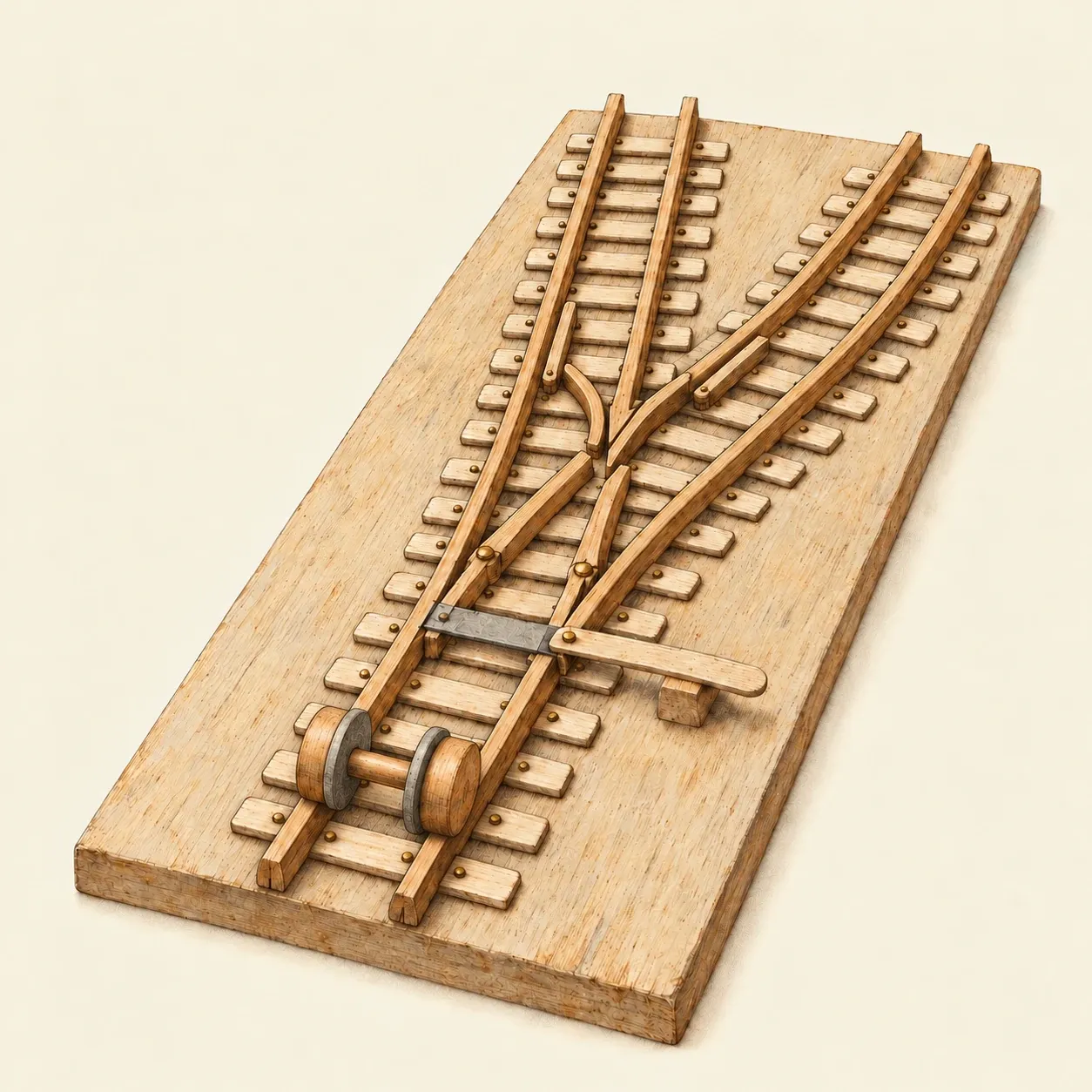 Two switch rails joined by a strip of card choose the route of the wheelset.
Make the wheelset first. Glue the two wheels on the dowel about 4 cm apart, then glue a disc of card a little larger than each wheel to its inner face, as a flange. Glue a row of sleepers across the board and glue on the straight track, setting the rails so that the flanges run just inside them with a millimetre or two to spare. Glue a second pair of rails along a gentle curve, branching off one side. Where the inner rail of the curve meets the inner rail of the straight track, cut both so that they meet in a point with a gap on each side for the flanges, and glue a short check rail inside each outer rail opposite that point. At the start of the turnout, sand two short strips to a tapered tip, lay them between the stock rails and pin each at its thick end with a drawing pin so that it can swing. Glue a strip of card under both, near their tips, so that they move together, and pivot a craft stick beside the track to push the card strip. Set the points one way, roll the wheelset slowly from the tips and watch which line it follows, then set them the other way.
History and evolution
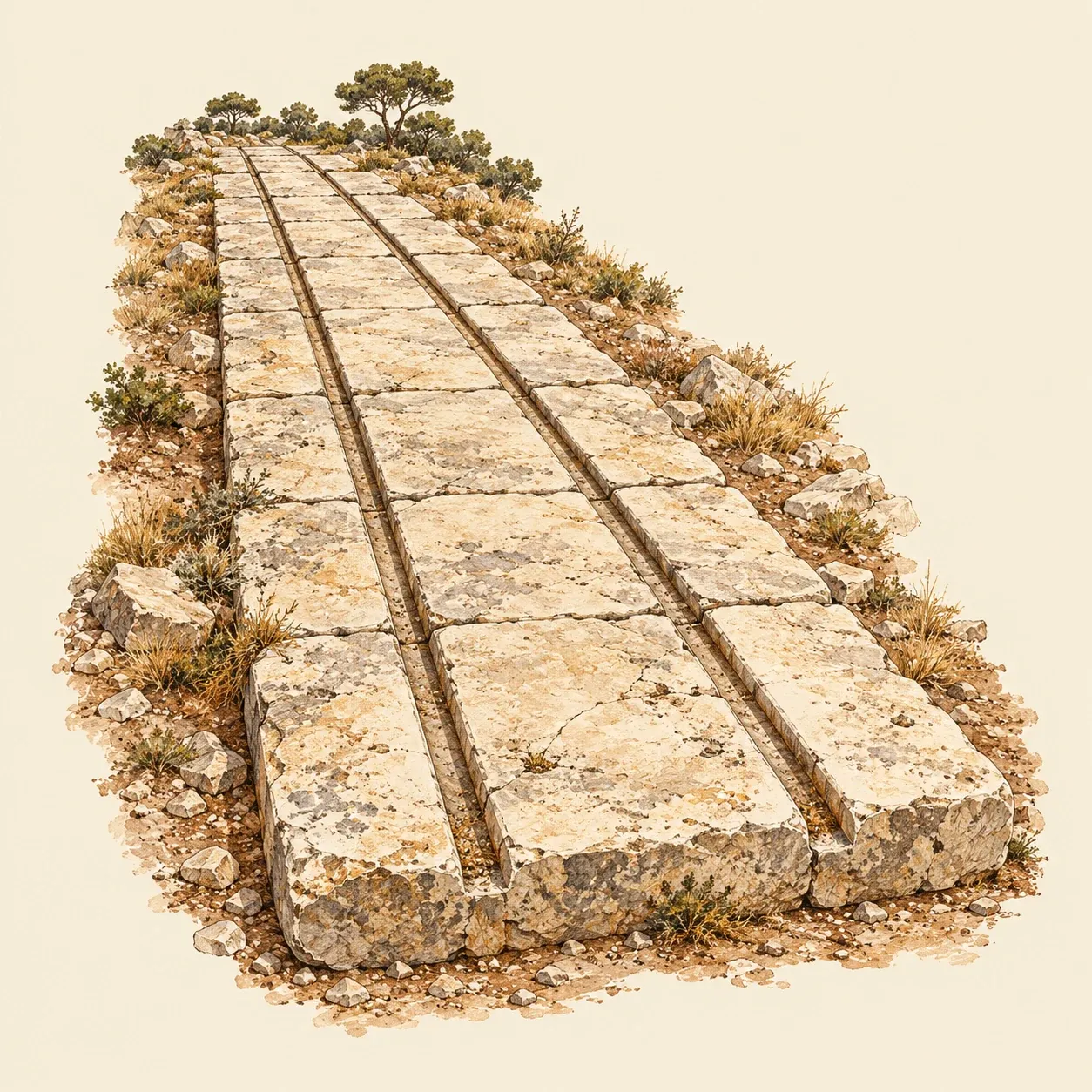 On the Diolkos, two grooves cut in the paving held the wheels of the carriers.
Prepared tracks that held wheels are very old. Across the Isthmus of Corinth in Greece, the Diolkos was a road paved with large stone slabs, used to haul ships and loads overland between the Gulf of Corinth and the Saronic Gulf. Two channels about 1.5 m apart run along it and held the wheels of the carriers. Pottery and letters cut in the stones date its construction to the late 7th or early 6th century BCE, and tradition credits it to Periander, ruler of Corinth. Long stretches of it were uncovered between 1956 and 1962 in excavations led by the archaeologist Nikos Verdelis.
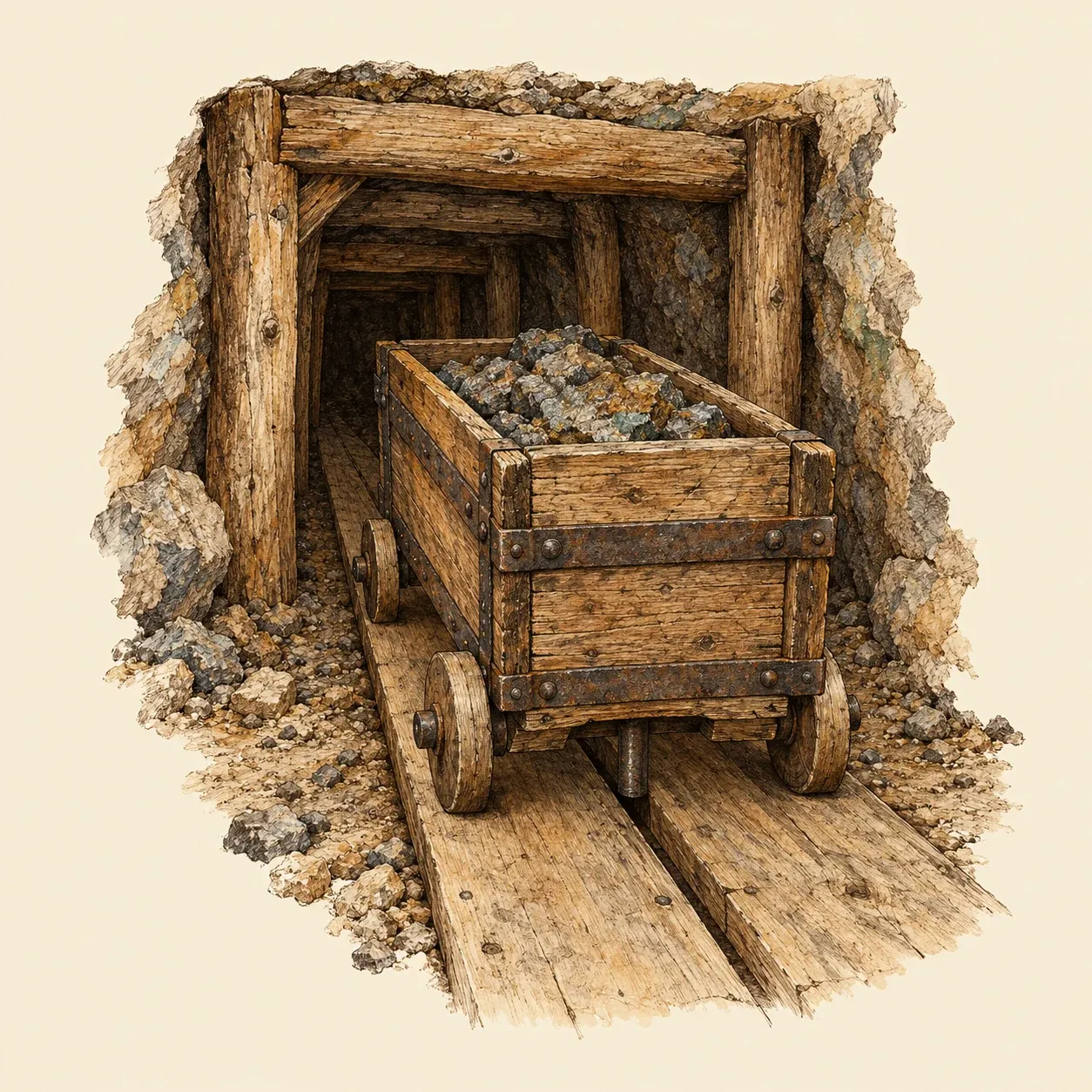 In the mines described by Agricola, a pin under the truck ran in a groove between two timbers.
Wooden tracks returned in the mines of central Europe. In 1556 Georgius Agricola described trucks pushed out of long tunnels on two timbers laid side by side. A blunt iron pin under the truck ran in the groove where the timbers met, so that the truck could not leave the track.
In England, Huntingdon Beaumont laid a wooden wagonway to carry coal from Strelley to Wollaton, near Nottingham, in 1603–1604. Wooden rails were fixed end to end on cross sleepers, and horses drew wagons along them. Iron came in during the 18th century. In 1767 the Coalbrookdale ironworks in Shropshire began fixing flat cast-iron plates on top of its wooden rails, which protected the timber from wear. In 1789, on a line from Loughborough to Nanpantan, the engineer William Jessop laid edge rails standing upright and put the flanges on the wheels, inside the rails, as on railways today. Rails rolled from wrought iron, patented by John Birkinshaw in 1820, were longer and stronger, and George Stephenson used them on the Stockton and Darlington Railway.
The first railways changed route with a sliding rail: a short length of track that was pushed sideways until it lined up with one line or the other. Charles Fox patented a switch with movable tapered rails that replaced it. Grace’s Guide dates his patent to 1832, Rail Engineer to 1838. Tapered switch rails, a fixed crossing and check rails remain the parts of an ordinary turnout.