Dental prostheses and implants
Replacing lost teeth with crowns, bridges and anchors in the bone
Contents
- 1Ring of the gold band round a natural tooth
- 2Replacement tooth
- 3Gold rivet through band and tooth
- 4Titanium implant fused with the bone
- 5Abutment screwed into the implant
- 6Ceramic crown
A dental prosthesis replaces a lost tooth or covers a broken one: a crown caps a tooth, a bridge hangs a false tooth from its neighbours, a denture can be taken out, and an implant anchors a new tooth in the jawbone. The oldest known appliance, a band of pure gold, comes from an Etruscan-period tomb at Satricum, south of Rome, around 630 BCE. Titanium implants that bone grows onto have been placed in patients since 1965.
What it is
A dental prosthesis is anything that replaces a lost tooth or rebuilds a damaged one. A crown is a rigid cap fitted over a tooth that has been ground down to receive it. A bridge carries a false tooth across a gap, held by crowns or bands on the teeth on either side. A denture is a plate of false teeth that the wearer can take out. An implant is a post set in the jawbone that serves as an artificial root for a crown, a bridge or a denture.
All of them solve the same problem: a tooth has to take the force of biting without moving or breaking, and the force has to go somewhere. In a crown it goes into the tooth underneath, in a bridge into the neighbouring teeth, in a denture into the gums and the bone under them, and in an implant straight into the jaw.
How it works
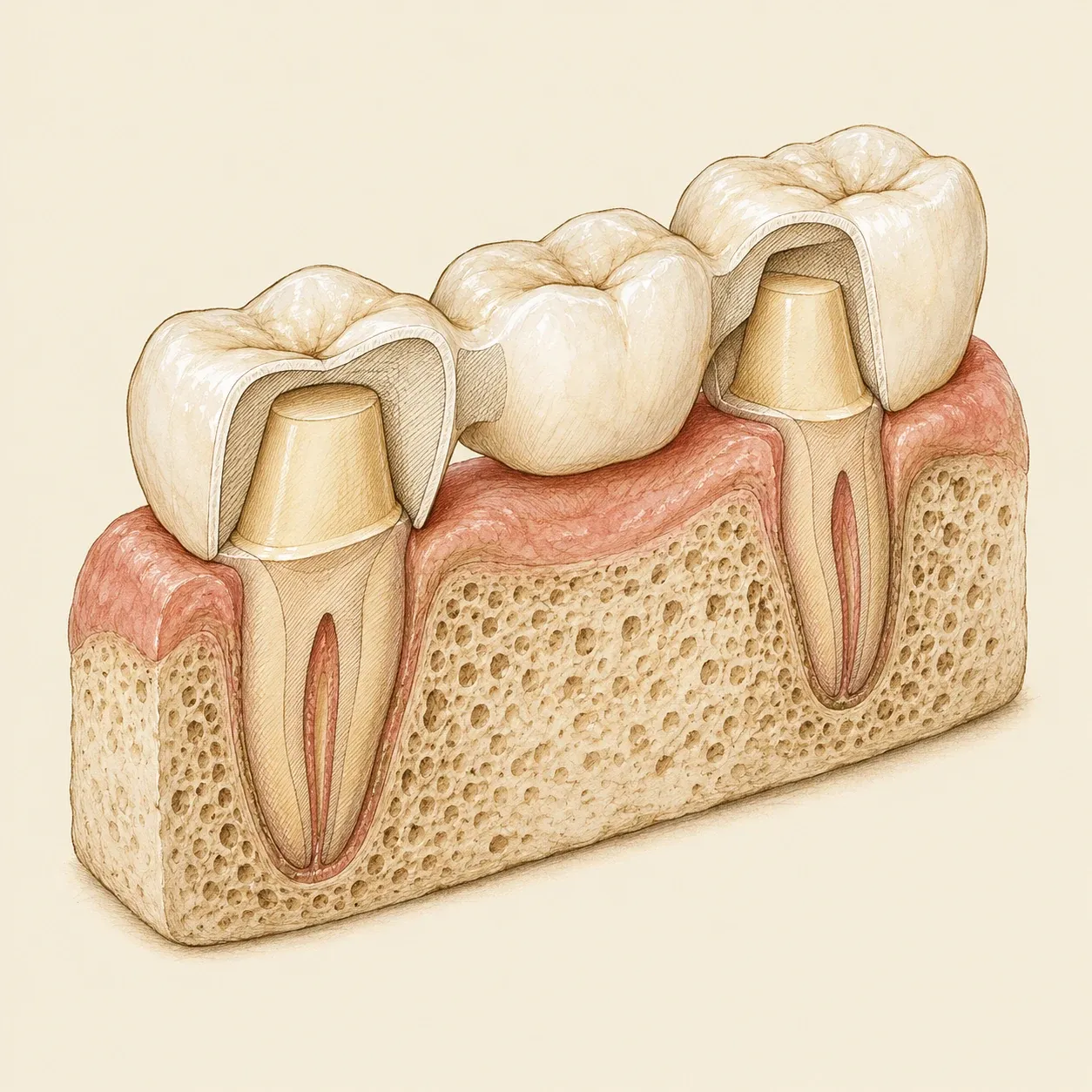 A bridge: two crowns on the neighbouring teeth carry the false tooth between them.
To fit a crown, the dentist grinds the tooth down on top and on all sides with a dental drill, takes a mould of the stump and sends it to a dental laboratory. A temporary crown protects the tooth for about two weeks, then the permanent one is cemented in place. If the tooth is badly broken after a root treatment, a metal or fibre post is first cemented into the root to hold the core on which the crown sits. Crowns are made of metal alloy, of porcelain on a metal lining or entirely of ceramic, and Leeds Teaching Hospitals give them a usual life of about 8 to 10 years. Smaller losses are closed with dental fillings instead.
A bridge works like a beam on two supports. The false tooth in the middle, which has no root of its own, is joined to crowns on the teeth either side, and every time it is bitten the load passes through the crowns into those teeth and their roots. The Etruscan appliances did the same with a band of gold: rings wrapped tightly round healthy teeth, and a replacement tooth fixed to the band by a rivet.
An implant uses a property of titanium that the Swedish anatomist Per-Ingvar Brånemark noticed in 1952. Living bone grows right up against a titanium surface and holds it, which he called osseointegration. A threaded titanium post is screwed into a hole prepared in the jawbone and left to heal. In Brånemark’s method the bone took three to six months to grip the implant before it was loaded. A short piece called the abutment is then screwed into the implant through the gum, and the crown is fixed on top.
How to do it
This exercise builds a model bridge in the Etruscan manner on wooden teeth, to see how a false tooth hangs from its neighbours. It is a model only: never put metal, foil or any part of it into a mouth, and never try to fix a loose tooth yourself.
Pour plaster of Paris into a small box about 10 cm long to make a base 3 cm deep. Before it sets, push in two pieces of 10 mm wooden dowel, each about 4 cm long, upright and about 12 mm apart: these are the natural teeth. When the plaster is hard, cut a third piece of dowel about 2 cm long and round one end: this is the replacement tooth. It must fit in the gap without touching the plaster.
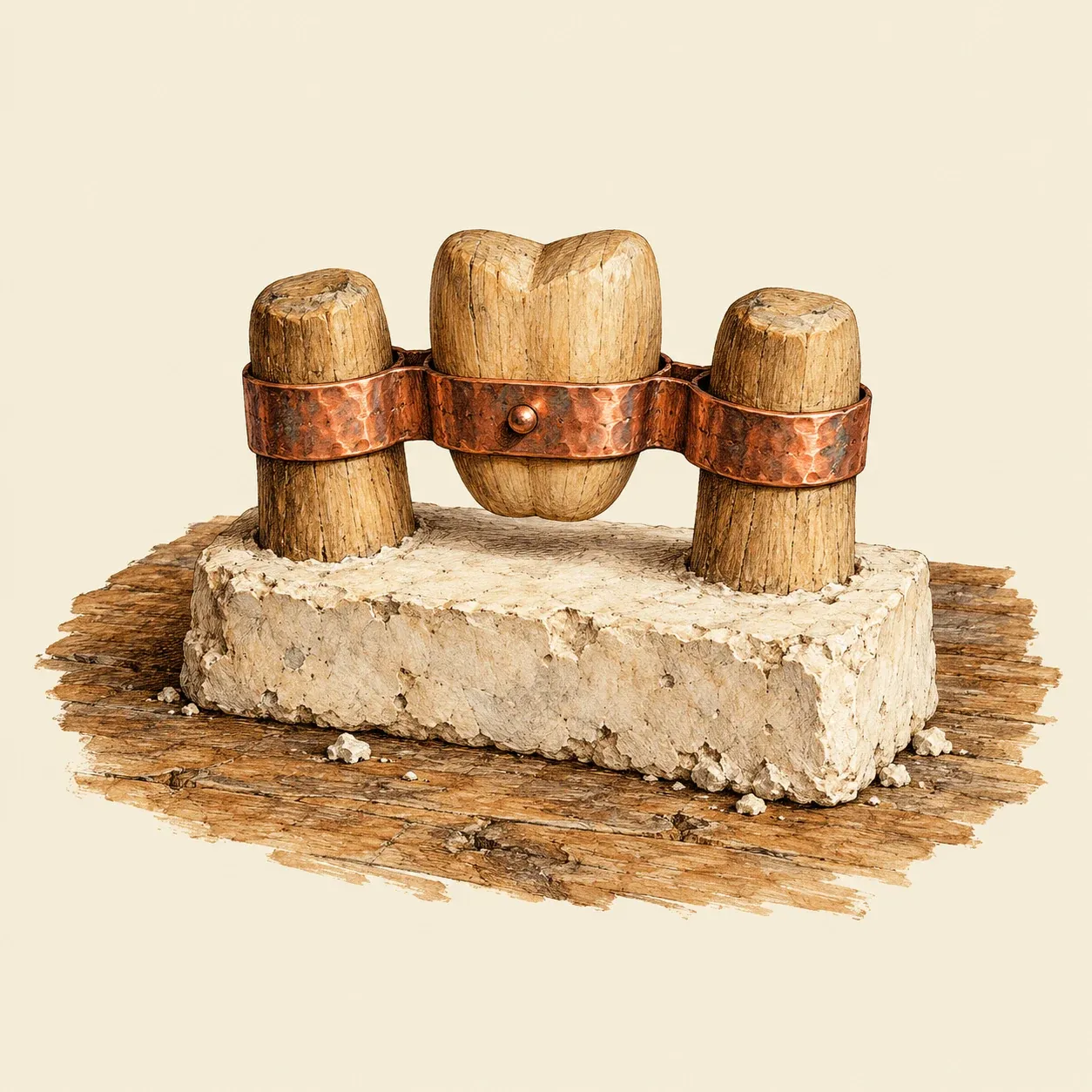 The copper band holds the false tooth only through the two pegs beside it.
Cut a strip of thin copper craft foil about 8 mm wide and 25 cm long. Wrap it tightly round the first peg, then round the false tooth held in the gap, then round the second peg, and back the same way, so that each tooth sits in its own ring. Mark the middle of the false tooth through the foil, take the false tooth out and drill a 1.5 mm hole through it and through the foil. Put it back and push a short piece of copper wire about 1.5 mm thick through band and tooth. Rest the wire end on a hard surface and tap the other end flat with a small hammer, then turn it over and flatten the first end: the wire is now a rivet.
Press down on the false tooth with a finger. It does not sink, because the band hands the load to the two pegs. Now pull one peg out of the plaster and press again: the whole bridge tips over. A real bridge fails in the same way when one of its supporting teeth works loose.
History and evolution
The oldest known dental appliance was found in a tomb at Satricum, a town south of Rome that was part of the Etruscan world when it was made, around 630 BCE. It is a band of pure gold that held a replacement tooth also made of gold. Marshall Becker and Jean MacIntosh Turfa catalogue twenty-one Etruscan gold-band appliances from the seventh century BCE onwards. The band was a strip of very pure gold shaped into rings that gripped healthy teeth, and it either held loose teeth steady or carried replacements riveted in place, usually of bone, ivory or a cut-down tooth. Judging by the size of the rings, all the wearers were women, and Becker suggests that some of their teeth had been removed on purpose. The bands were too weak for hard biting, and a reviewer of the book argues that they served mostly for looks. Roman writers later mocked women who wore false teeth.
Claims of older appliances from Egypt hold up poorly. Two molars tied together with gold wire, found in rubble at Giza and once dated to about 2500 BCE, may come from the Ptolemaic period, and Roger Forshaw, of the KNH Centre for Biomedical Egyptology in Manchester, thinks the wire was probably put on after death. Wire appliances from the eastern Mediterranean, such as those found at Sidon, are later than the Etruscan bands, from about 400 BCE at the earliest.
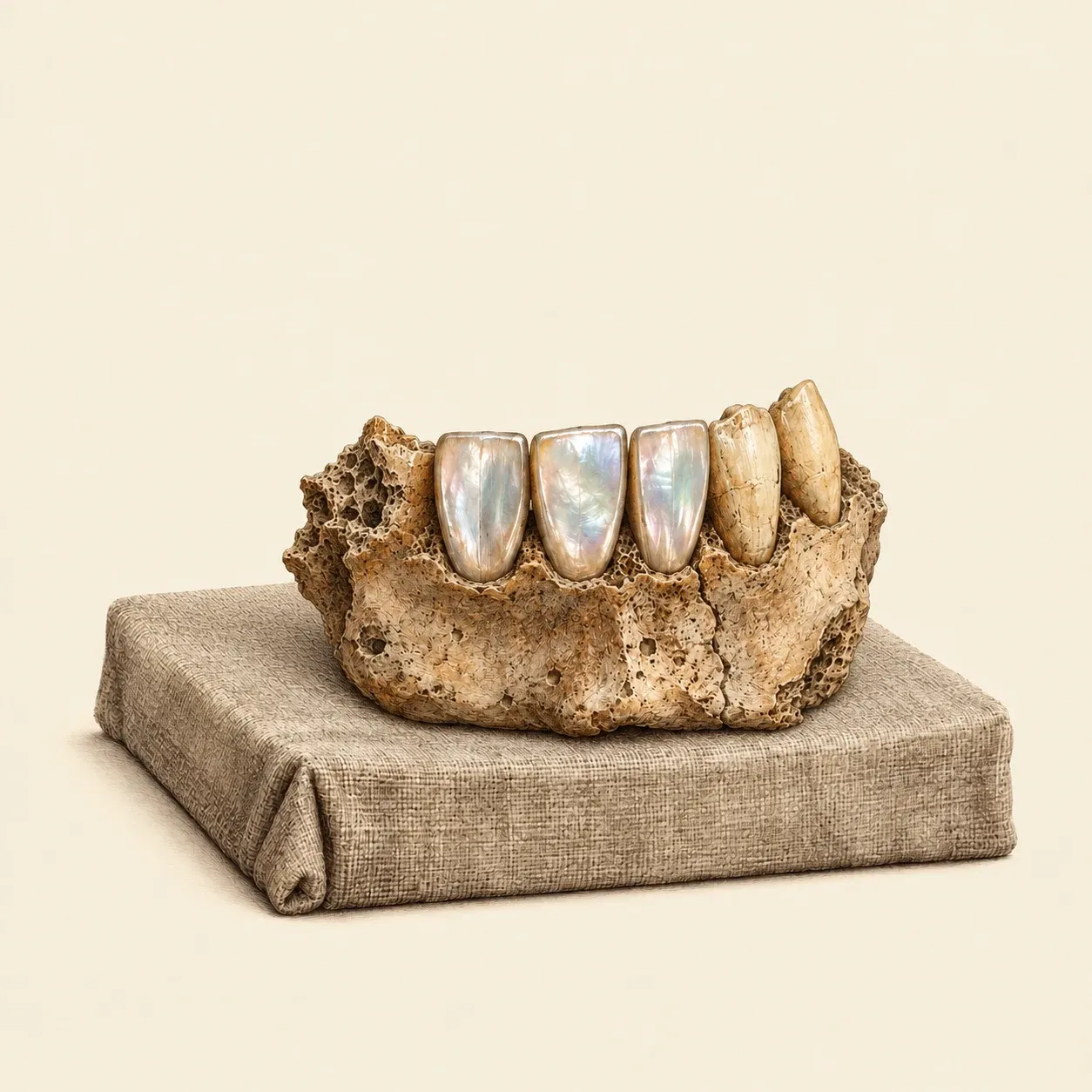 The Maya jaw from Honduras with three teeth of carved shell.
A lower jaw from Playa de los Muertos, in Honduras, dated to about 600 CE, holds three pieces of shell carved into the shape of incisors and set in their sockets. Wilson and Dorothy Popenoe found it in the 1930s, and the shells were long thought to have been put in after death. In 1970 the Brazilian dental researcher Amadeo Bobbio X-rayed it and saw compact bone round the shells, which suggests that they were put in during life.
In Europe, Ambroise Paré made dentures on bases of gold and silver in the sixteenth century, and Pierre Fauchard built dentures held in by springs in the eighteenth. The French dentist Mouton described a gold crown fixed by a post in the root canal in 1746. In 1774 the French apothecary Alexis Duchâteau, whose dentures of ivory and natural teeth decayed and smelled, had a Paris porcelain maker fire a denture for him. The dentist Nicolas Dubois de Chémant improved the method, presented it to the French Academy of Sciences in 1789 and received a patent from Louis XVI. Later in the nineteenth century, dentures came to be moulded on bases of vulcanised rubber. Porcelain crowns improved too: the Logan crown of 1885 fused porcelain to a platinum post, and in 1903 Charles Land devised the porcelain jacket crown.
The earliest recorded metal implant dates from 1809, when J. Maggiolo set a gold tube into the socket of a freshly pulled tooth; the gum around it became badly inflamed. In the late 1930s the Strock brothers of Boston placed screws of Vitallium, a cobalt-chromium alloy, in the jaw, and in 1947 the Italian Manlio Formiggini proposed a spiral post of steel or tantalum wire. In 1965 Brånemark’s team in Gothenburg placed four titanium implants in the lower jaw of Gösta Larsson, who had no lower teeth. They held the teeth fixed on them for the rest of his life, about forty years. Brånemark won wide recognition at a meeting in Toronto in 1982, and titanium implants have since become an everyday treatment.