Dental fillings
Closing a hollowed tooth with a material that sets in place
Contents
- 1Enamel
- 2Dentine
- 3Pulp in its chamber
- 4Cavity wall leaning in, which locks the filling
- 5Amalgam filling seen from above
A filling closes a tooth after the decayed part has been removed, with a material soft enough to pack into the hole that then turns hard. The oldest known fillings, about 13,000 years old, are lumps of bitumen mixed with plant fibres and hairs in two incisors from Riparo Fredian, in Tuscany. Silver amalgam was the usual filling from the nineteenth century until resins bonded to the tooth replaced it.
What it is
Tooth decay is a hole that bacteria dig in a tooth. Acids they make from sugars dissolve the enamel, the hard outer layer, then the softer dentine beneath it, and if nothing stops them they reach the pulp, the living core of nerves and blood vessels. A dentist removes the decayed part, usually with a dental drill, and fills the hole. The filling seals the tooth against bacteria and food and gives it back a surface to chew on.
The material must go in soft and become hard in the mouth, without harming the pulp and without dissolving in saliva. People have used bitumen, beeswax, lead, tin and gold leaf, then silver amalgam, cements and, today, resins and glass-based cements that stick to the tooth. A large loss of tooth is rebuilt with a crown instead, one of the dental prosthetics.
How it works
A filling can stay in place in two ways. The older way is the shape of the cavity. Amalgam does not stick to a tooth, so the dentist cuts the hole with its side walls leaning slightly towards each other as they rise, so that the opening is a little narrower than the floor. Once the filling has hardened, it is locked in like a dovetail. The floor is kept flat and well above the pulp. The Chicago dentist G. V. Black set out these rules for preparing cavities in 1895, and his method removed every soft, decayed part first. Current guidance, such as that of the American Dental Association, prefers to leave the softened dentine nearest the pulp in deep cavities and seal it under the filling.
Amalgam is a mixture of about 50% liquid mercury by weight with a powdered alloy of silver, tin and copper, according to the US Food and Drug Administration. Mixed, it forms a stiff paste that is pressed into the cavity in layers and hardens within minutes as the mercury binds the alloy grains together. It is strong, cheap and tolerant of a damp tooth, which made it the everyday filling for more than 150 years.
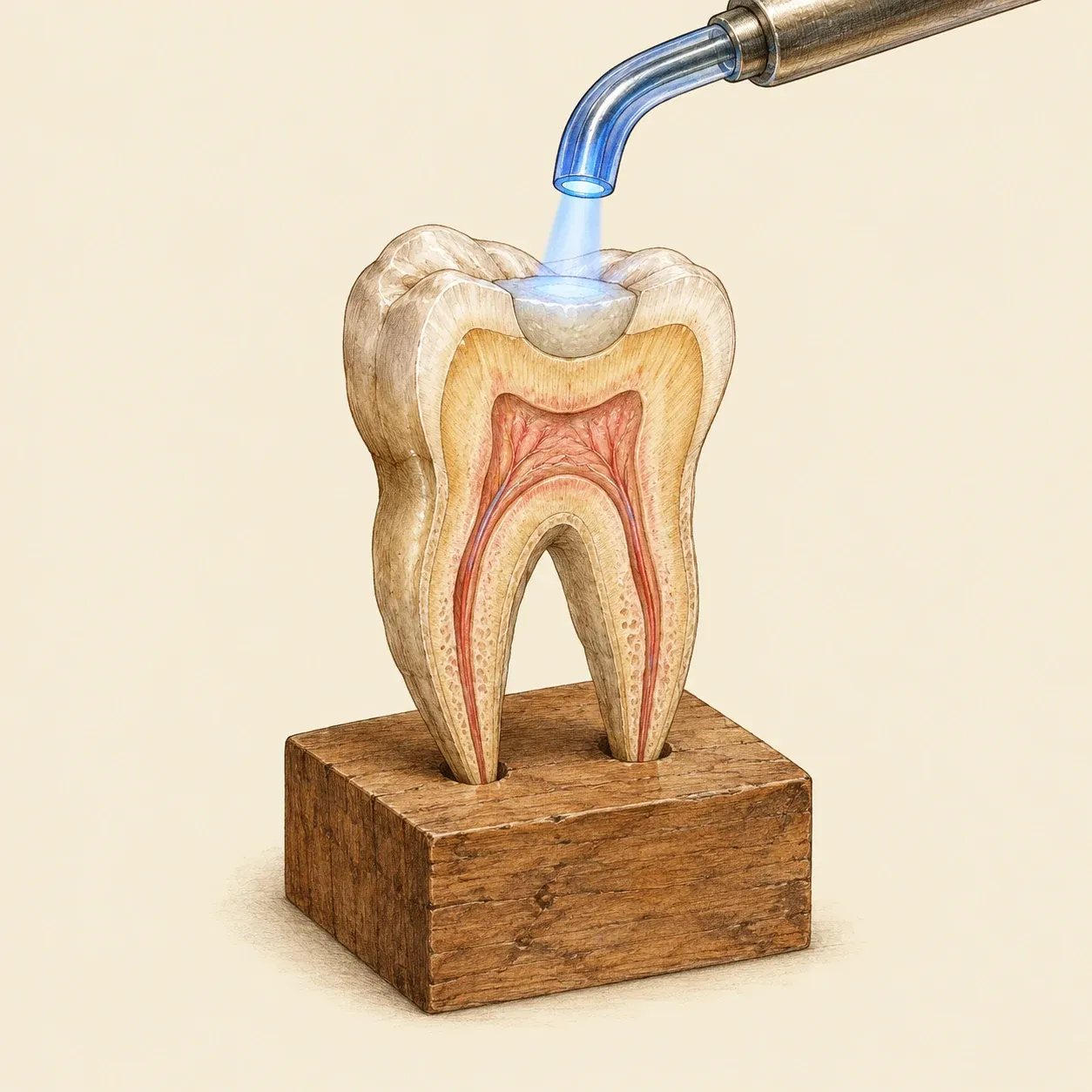 A resin filling hardens in seconds under blue light.
The newer way is to glue the filling to the tooth. The dentist first etches the enamel with a mild acid, which roughens it at a microscopic scale, then coats it with a liquid adhesive. The filling material is a resin loaded with fine particles of glass, a composite, which is laid in thin layers and hardened by shining a blue light on each one: the light starts a reaction that links the resin molecules into a solid network within seconds. Composite comes in shades matched to the tooth, which is why patients call it a white filling. Since it is bonded, the cavity need not be undercut. Glass ionomer cements also stick to the tooth by themselves and release fluoride.
How to do it
This exercise uses soap and plaster to show why the shape of a cavity holds a filling that does not stick. It uses no dental materials: never put soap, plaster or anything else into a tooth or a mouth.
 The plug in the bowl-shaped hole lifts out; the one in the undercut hole stays put.
Take two bars of plain soap. With a teaspoon handle or a small blunt knife, carve a round hole about 2 cm wide and 1 cm deep in the top of each. Make the first hole wider at the top than at the bottom, like a bowl. Make the second hole wider at the bottom than at the top: carve straight down, then scrape the walls outwards near the floor so that the rim overhangs a little.
Mix a few spoons of plaster of Paris with water into a thick cream. Fill both holes to the brim and smooth the tops flat. The plaster turns warm as it sets. Leave it for a day.
Then try to lift each plug out with the tip of the knife or a toothpick. The plug in the bowl-shaped hole comes out whole, because nothing holds it. The plug in the undercut hole stays put, even though plaster does not stick to soap: the rim above it is narrower than the plug. Cut the second bar in half to see the locked shape, as in a section of a filled tooth.
History and evolution
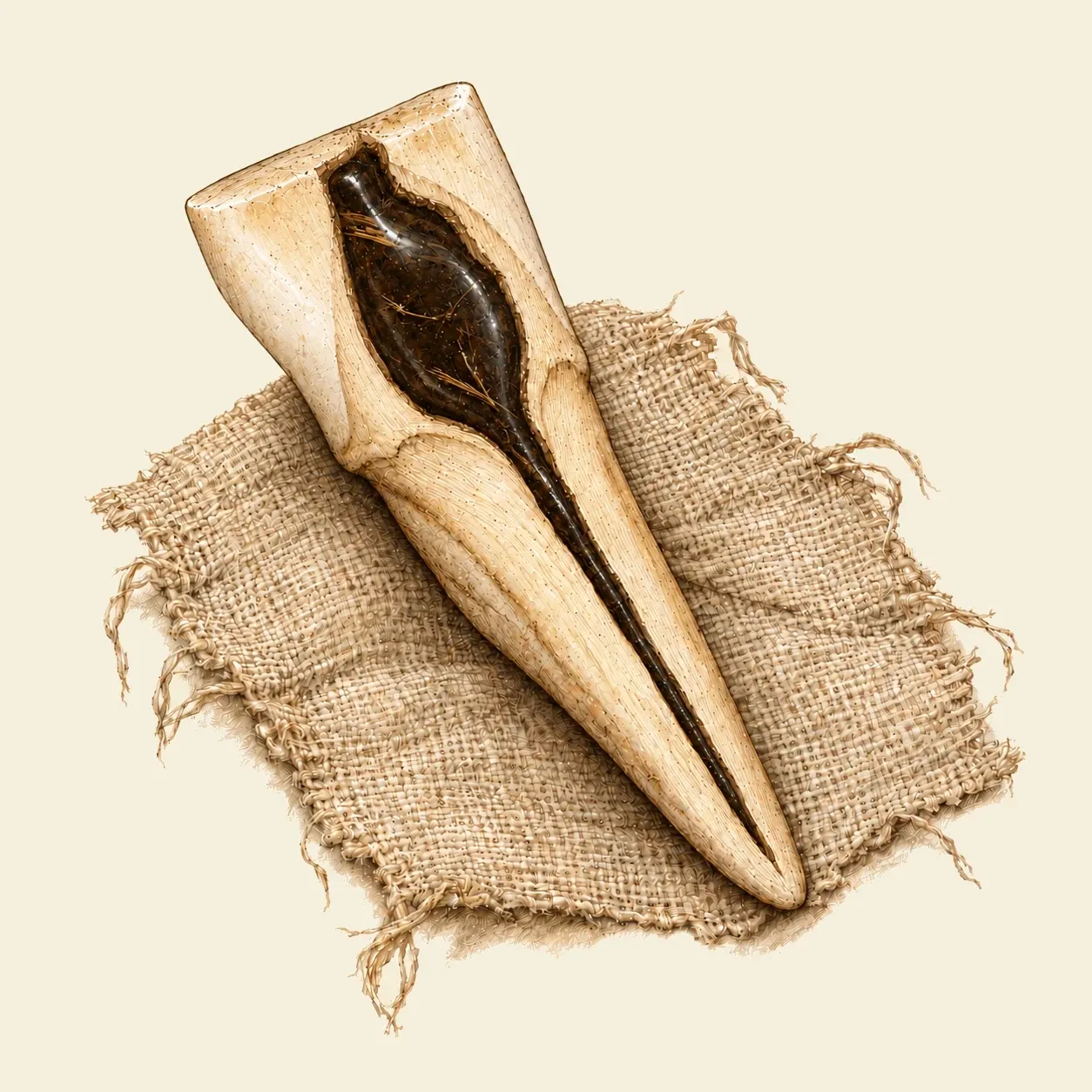 One of the two incisors from Riparo Fredian, with its hole packed with bitumen.
The oldest known treatment of a decayed tooth is about 14,000 years old. On a molar from Villabruna, in northern Italy, Gregorio Oxilia and his colleagues found grooves and chips showing that a large cavity had been scraped with pointed flint tools while the person was alive. The oldest known filling comes from Riparo Fredian, a rock shelter in Tuscany, about 13,000 years ago. Both upper central incisors of one person had their pulp chambers opened and widened before death, and their walls still held a mixture of bitumen, plant fibres and what are probably hairs. The team reads it as an early case of cleaning out an infected pulp and packing the hole. Stefano Benazzi, one of the authors, suggested that the bitumen eased the pain and kept food out.
A man buried about 6,500 years ago near Lonche, in Slovenia, had beeswax on a worn canine, covering exposed dentine and filling a crack. The wax and the tooth are the same age, but the wax may have been put there just after death. In Europe, Giovanni d’Arcoli recommended gold leaf in 1484, and the first printed book on dentistry, published in Germany in 1530, already describes gold fillings. Ambroise Paré used lead or cork, and Pierre Fauchard in the eighteenth century preferred tin or lead.
Silver amalgam came from France. Auguste Taveau used a paste of silver and mercury in Paris in 1826, and in 1833 the Crawcour brothers brought it to the United States as the Royal Mineral Succedaneum. The early pastes were poor, and the quarrel among American dentists that the American Dental Association calls the amalgam wars lasted until about 1850. In 1895 G. V. Black standardised the alloy as well as the cutting of cavities, and amalgam became reliable. Alongside it, dentists packed cohesive gold foil, introduced by Robert Arthur in 1855, and from 1907 cast gold inlays by the method William Taggart described.
Bonding began in 1955, when Michael Buonocore showed that resin holds to acid-etched enamel. In 1962 Rafael Bowen, working for the American Dental Association, patented Bis-GMA, the resin still used in most composites. Concern about mercury in the environment then turned against amalgam. The Minamata Convention on mercury, signed in 2013, asked countries to use less of it, and in 2025 its parties agreed to end its use by 2034. The European Union stopped using amalgam from 1 January 2025, except where a dentist judges it strictly necessary. The FDA advises against removing sound amalgam fillings without a medical reason.