Deadfall trap
A raised weight released by a trigger
Contents
- 1Falling log, raised
- 2Ground log on which it strikes
- 3Pairs of stakes that guide the fall
- 4The same log after it has fallen
A deadfall trap kills by dropping a heavy log or stone on an animal that disturbs its trigger. The weight is raised beforehand and held in a fragile balance, so a light touch brings it down. Wooden sticks from Cougar Mountain Cave in Oregon, about 12,000 years old, are read by the team that dated them as the oldest known deadfall triggers.
What it is
A deadfall is a trap that kills with a falling weight. A log, a slab of stone or a block of wood is lifted and held up by a trigger above the place where an animal will pass or feed. When the animal pulls the bait or brushes against the trigger, the support gives way and the weight comes down on it. Many pitfalls held an animal alive; a deadfall is meant to kill it outright.
Hunters on several continents used deadfalls, built from what the forest offered and often left set for a whole winter. They were made for mice, grouse and hares, for martens and sables whose fur was traded, and in a few heavy forms for bears. Russian trappers in Siberia called one such log trap a kulema. In many countries trapping of any kind is now regulated by law.
How it works
The trap stores energy before the animal arrives. Lifting the log takes work, and that work is stored as gravitational potential energy: the higher the log is raised, the more energy it gives up when it falls. A trigger holds it in an unstable balance, so that a small disturbance releases a much larger load. Two kinds of trigger recorded in North America are the figure-four, named after its shape, and the Paiute deadfall of the Great Basin.
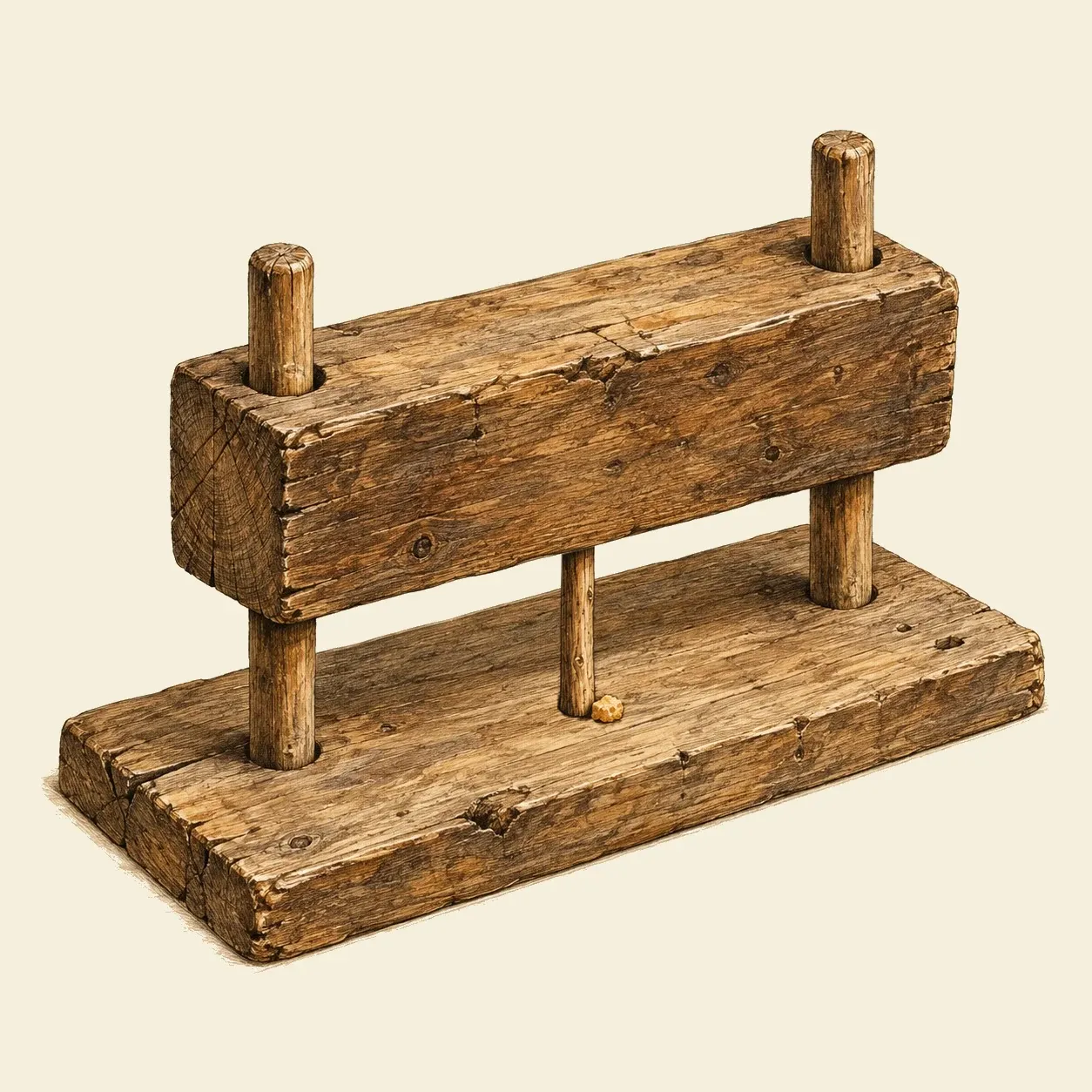 In a household deadfall the block slides between two rods, so it lands where the mouse stands.
Once released, the log falls under gravity. Stakes, a fence or a pair of rods keep it on its downward path, and in the Siberian log traps it comes down on a second log lying on the ground. A heavier load raised higher strikes harder, which is why traps for large animals used long, heavy logs.
A deadfall strikes whatever sets it off. It cannot tell a marten from a dog, a protected bird or a child’s hand, and a badly balanced trap may fall too soon or wound instead of kill. These are the reasons trapping laws control or forbid such traps in many places.
History and evolution
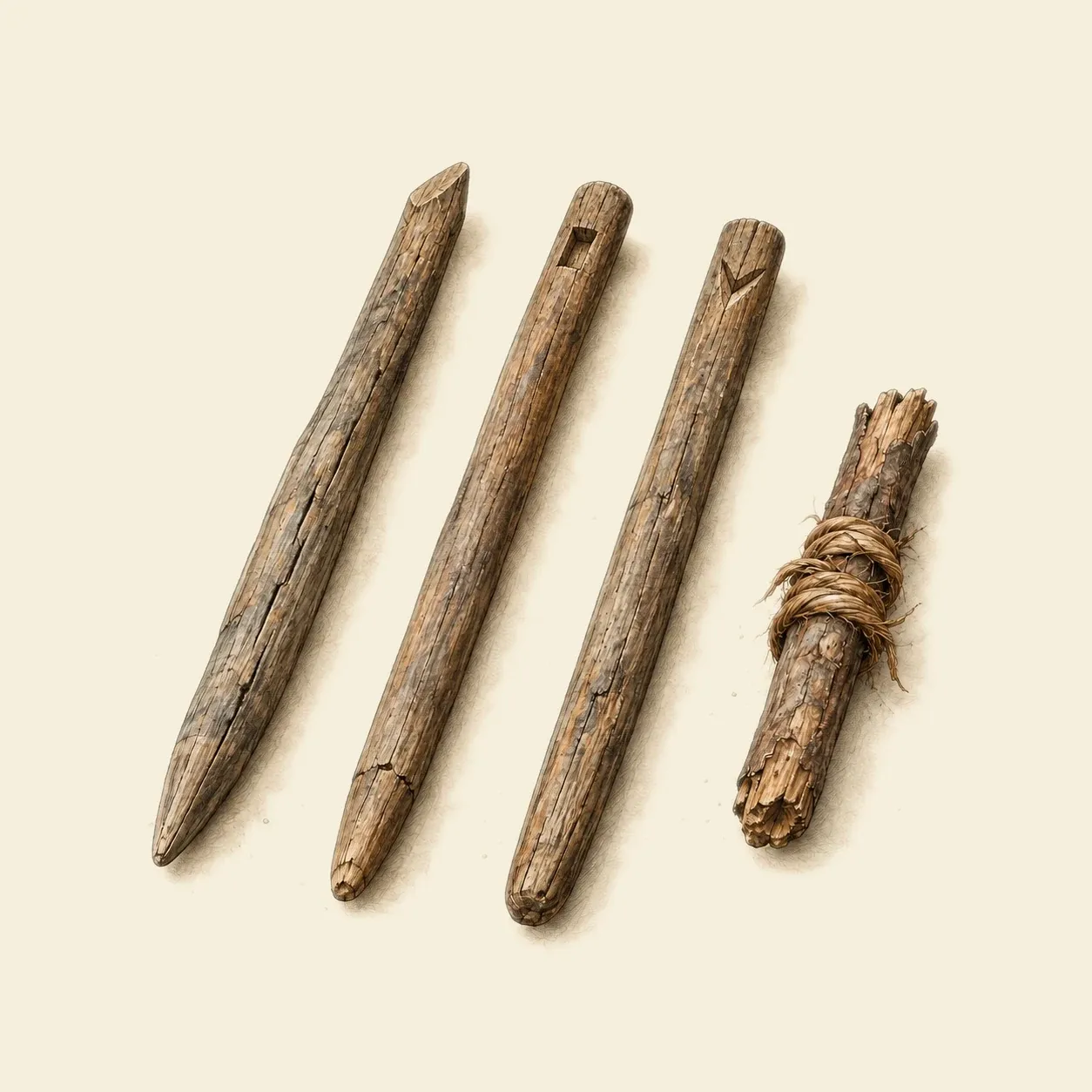 Wooden pieces of this kind, preserved in a dry cave, are among the few traces of ancient traps.
Wooden traps rot where they stand, so ancient ones almost never survive. The oldest pieces that may come from deadfalls were found in Cougar Mountain Cave, in the dry Fort Rock Basin of Oregon. The cave was dug by an amateur, John Cowles, in 1958, and he kept few notes, so in 2026 Richie Rosencrance and colleagues radiocarbon-dated the objects themselves. Three small sticks of willow-family and poplar wood date to between about 12,500 and 11,800 years ago. The team reads them as deadfall triggers because they resemble in size and form the triggers of the Paiute deadfall recorded by ethnographers. In the nearby Paisley Caves a polished stick of about the same age is either a fire drill or part of such a trap. The Penn Museum holds a wooden piece from the Basketmaker culture of south-eastern Utah catalogued as possibly a figure-four trigger.
 The sable, whose fur Russian hunters sought in Siberia.
Written records are much later. In northern North America, a glossary of 1792 described the “deathfall” as a trap made of logs, used mostly for martens. In Siberia, Russian fur hunters caught sable with traps they called kulemniki. The historian Oleg Bychkov writes that by the end of the 17th century the sable was nearly exhausted in eastern Siberia.
The Brockhaus and Efron encyclopedia, published in Russia around 1900, listed several Siberian log traps: the kulema, made with a light log for sable and a heavy one for bear, the past’, used for animals from hares to bears, and the smaller slopets for grouse and hares. In Norway the mårstokk was a log deadfall for pine marten. In English homes, small wooden mousetraps with a falling block worked on the same principle.
Deadfalls are now little used outside remote regions. Canada and the European Community signed an agreement on humane trapping standards in December 1997, and Russia signed it in April 1998. National laws now decide which traps may be used and by whom.