Flywheel
Storing motion in a heavy turning wheel
Contents
- 1Crank
- 2Barrel with the hoisting rope
- 3Bearing on top of an upright
- 4Spokes mortised into the barrel
- 5Rim
- 6Lead weight
A flywheel is a heavy wheel that stores energy while it turns. It takes up the surplus when the drive pushes hard and gives it back when the push weakens, so the machine keeps a steadier speed. The oldest examples are probably perforated pebbles from the Jordan Valley, about 12,000 years old, that served as spindle whorls.
What it is
A flywheel is a wheel made heavy on purpose and fixed to a shaft so that the two turn together. Once it spins, it resists any change of speed. It takes several pushes to start and goes on turning after the pushing stops. A machine uses this to carry energy over from one effort to the next, so that an uneven drive or an uneven load produces a fairly even rotation.
Many machines have one. The whorl on a hand spindle keeps it twisting the fibre, the heavy wheel of a potter’s wheel keeps the clay turning between kicks, and the cast-iron wheels of steam engines and internal combustion engines keep the crankshaft turning steadily from one push of the piston to the next.
A mine windlass of the kind Georgius Agricola described in 1556 uses one in a simple form. One man turns a wooden barrel by a crank to wind up the rope, and the other end of the barrel carries a large spoked wheel weighted with lead. Agricola wrote that the wheel took the place of a second man.
How it works
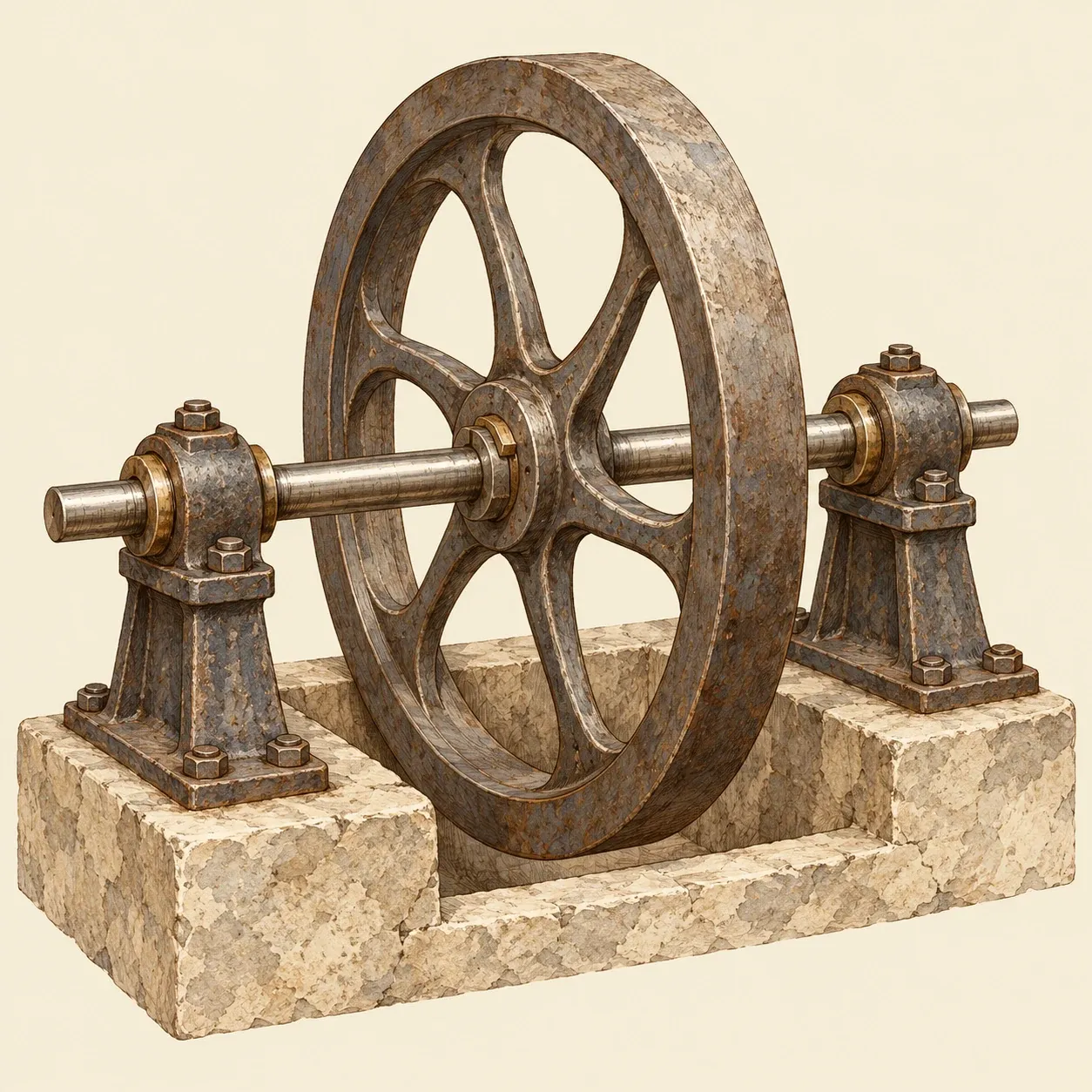 The weight sits in the rim; the spokes are kept light.
A turning wheel holds energy in the motion of its mass, and speed counts most: at twice the speed it holds four times the energy. Where the mass sits counts too. Mass far from the axis travels faster than mass close to it, so for the same weight a thin ring stores twice as much as a solid disc of the same diameter. That is why flywheels have heavy rims and light spokes, and why lead fixed far out on a spoke does more than the same lead near the barrel.
The turning force on a crank is seldom even. When a connecting rod drives the crank, as in an engine, the rod lines up with the crank twice in every turn, and at these two dead points its push cannot turn the crank at all. In a single-acting engine the steam or gas pushes on one side of the piston only, so the shaft has to be carried through the strokes that do no work. In a double-acting steam engine the steam pushes on each side in turn and every stroke does work, but the turning force still rises and falls during each turn and drops to nothing at the dead points. The load changes too, as when a bucket swings or a saw meets a knot. While the drive gives more than the load takes, the surplus speeds the wheel up slightly. When it gives less, the wheel slows slightly and its stored energy makes up the difference. A heavier wheel changes speed less for the same surplus or shortfall.
A flywheel adds no energy and does not control the supply. If the average speed drifts because the load or the steam changes, a governor or the operator has to correct it.
Every part of a spinning rim is pulled outwards and has to be held in by the spokes and by the rim itself. That pull grows with the square of the rim speed, and above a limit set by the material the wheel bursts and its pieces fly off. A report by Sandia National Laboratories notes that the rims of steam engine flywheels seldom moved faster than 20 m/s. Modern storage flywheels with carbon-fibre composite rims run at 500 to 1,000 m/s inside a vacuum casing. In the same report, a 50-tonne flywheel of the industrial age held about 5 kWh, while a modern grid flywheel of about a tonne holds more than 25 kWh.
How to do it
A small hand-cranked wheel on a bench shows both effects: that mass at the rim stores more, and that a flywheel evens out a crank. It is a demonstration only and must never be driven by a drill or a motor.
Make the stand. Screw two blocks of hardwood about 25 cm high and 5 cm square upright on a board, 10 cm apart. Drill them 20 cm above the board for a straight hardwood dowel or a steel rod about 12 mm thick, so that it turns freely without play, and rub wax into the holes. With the axis at that height, the 30 cm wheel clears the board by about 5 cm.
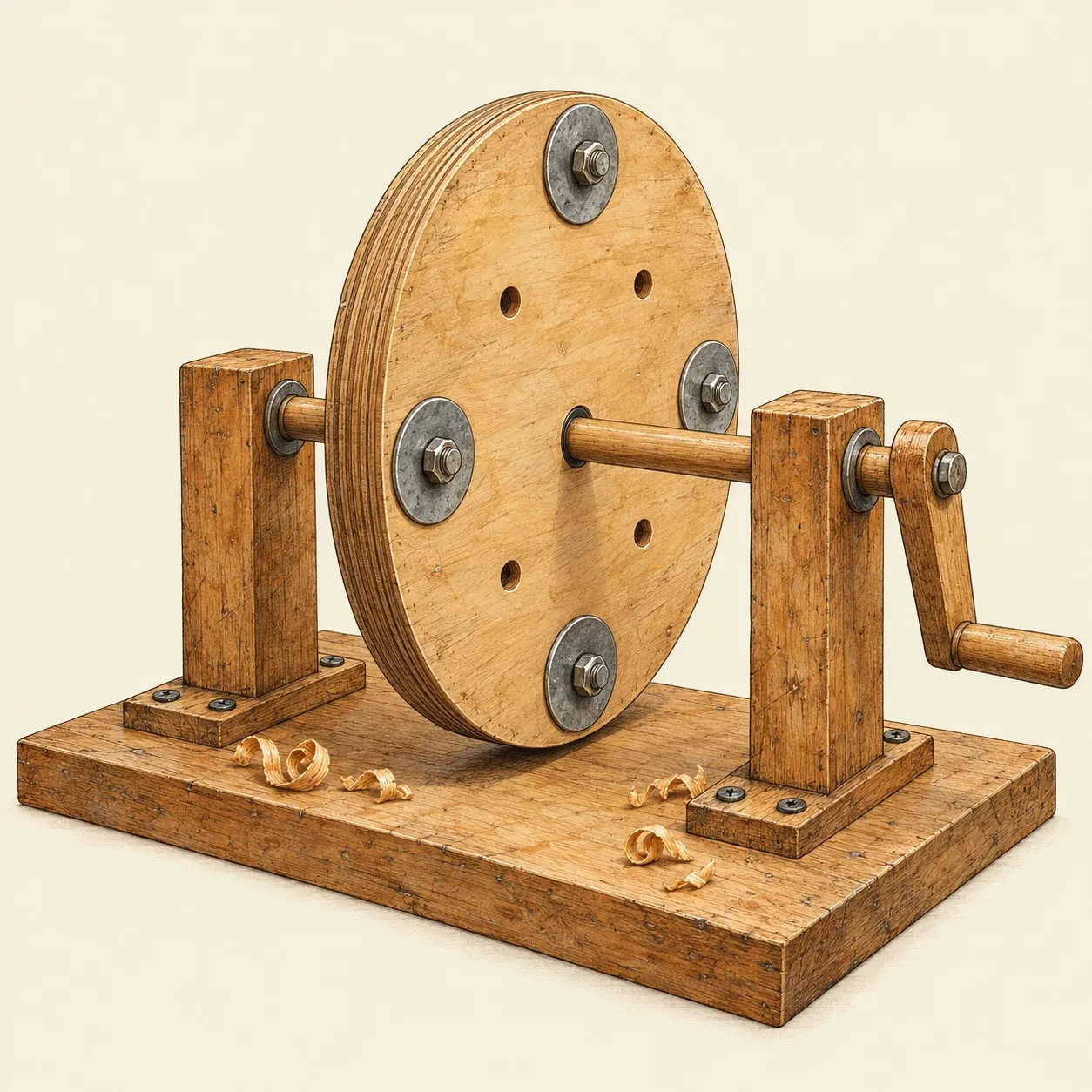 The test wheel: four equal weights, bolted first near the centre, then near the rim.
Make the wheel. Cut a disc of plywood about 30 cm across and 15 mm thick, with a centre hole that fits tightly on the rod, and glue or pin it in place between the blocks. Drill two rings of four holes at right angles, one about 4 cm from the centre and the other about 2 cm in from the edge. Take four identical weights, such as large steel washers held by bolts and nuts, and check on a kitchen scale that they weigh the same. Fix a wooden crank with a round peg for a handle to the end of the rod outside one block.
Test it. Bolt the weights in the inner ring, draw a pencil mark on the edge, give the crank three turns at a steady pace and let go. Count the turns the wheel makes before it stops. Move the same weights to the outer ring and repeat at the same pace. The wheel is harder to start and keeps turning for many more turns. Then push the crank only on the downward half of each turn: with the weights at the rim the wheel goes round much more evenly between pushes.
History and evolution
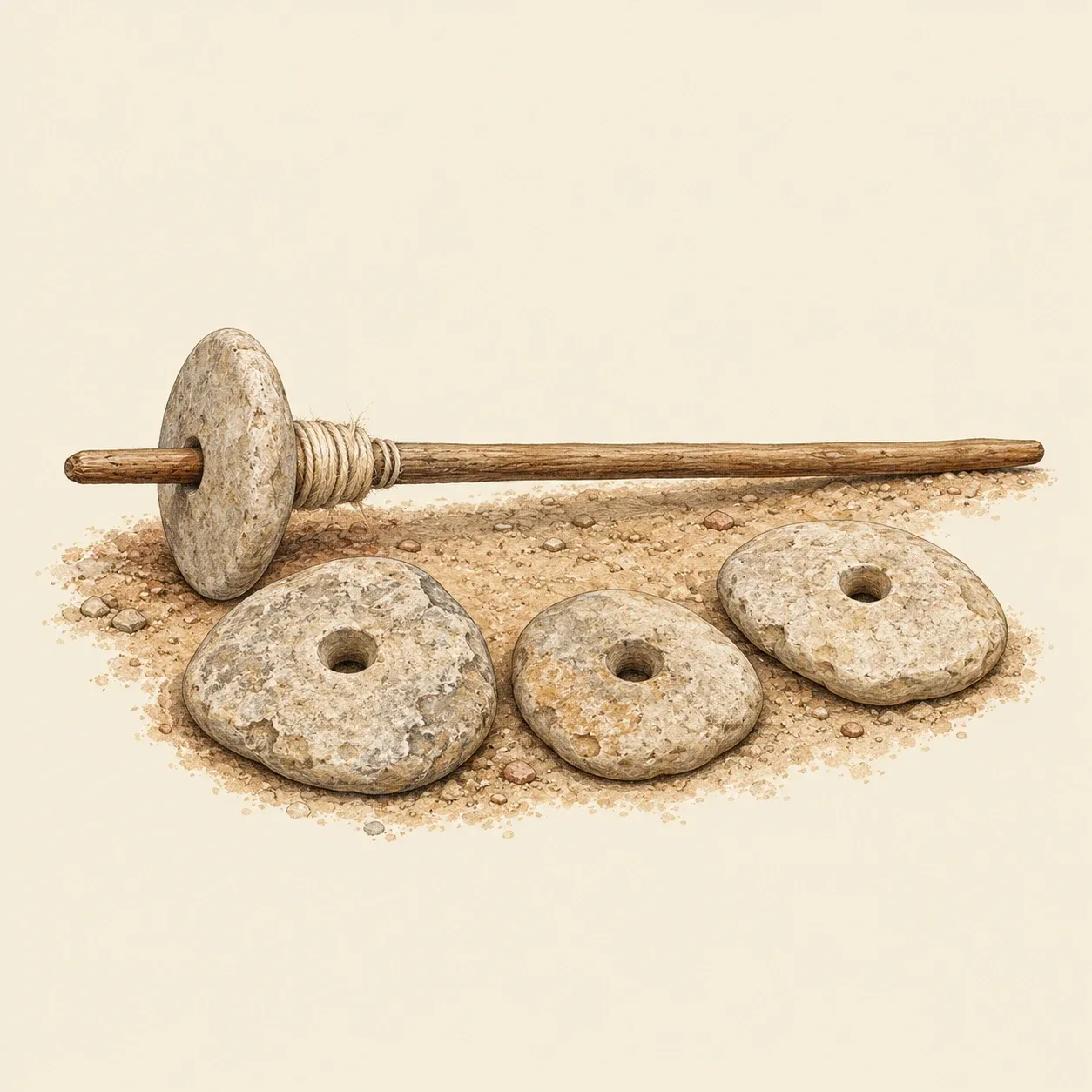 Pierced pebbles of the kind thought to have been spindle whorls; the weight on the stick keeps it spinning.
At Nahal Ein Gev II, a village in the Jordan Valley about 2 km east of the Sea of Galilee, people of the late Natufian culture lived about 12,000 years ago. The excavations yielded 113 perforated pebbles, mostly of soft limestone and weighing from 1 to 34 g: 48 pierced right through, 36 broken, keeping part of their hole and 29 unfinished, with one or two drill marks. The finished holes sit at the centre of the pebble, and nearly all were drilled from both faces. About 60% of the shapes that can be identified are round, the rest angular or irregular, and only 11 pebbles were shaped much beyond the drilling. Talia Yashuv and Leore Grosman argued in 2024 that they were spindle whorls, which act as small flywheels and keep a spindle twisting the fibre after each flick of the fingers. A spinner working with replicas spun flax and wool faster than by hand, and the heavier stones held their spin more easily. Two archaeologists who took no part in the study, Alex Joffe and Yorke Rowan, supported that reading. Carole Cheval, a specialist in prehistoric textiles, wrote that the pebbles may well be whorls and that similar objects, some older, had already been published. Janet Levy, whom Yashuv and Grosman cite, places the first clear evidence of yarn spun with a spindle in the southern Levant later, in the Pottery Neolithic.
Potters later used a heavier wheel. According to Johnny Baldi and Valentine Roux, potters in northern Mesopotamia were shaping vessels with the momentum of a turning wheel by about 3900 BCE, and rotating devices appear in the southern Levant in the second half of the fifth millennium BCE. The large wheel of the spinning wheel did the same work for the spindle.
In his book on mining, printed in 1556, Agricola described a windlass with “a wheel as well as cranks”. Once the barrel was moving, the rapid turns of the wheel helped it round, and on a deeper shaft three men with the wheel did the work of four. Masses of lead were hung on the wheel or fastened to its spokes. The wheel had no hub: its spokes were mortised straight into the thick barrel. He also described a hand-cranked machine that raised water with a chain of dippers and had “a wooden fly-wheel” on its lowest axle, so that it could be turned more easily. Agostino Ramelli’s book of machines of 1588 shows hand-cranked pumps with flywheels.
In 1779 Matthew Wasbrough, an engineer at Bristol, patented a steam engine that turned a shaft through ratchet wheels, and he added a flywheel. John Farey, writing in 1827, called it the first flywheel used on a steam engine. The ratchets kept failing, and in 1780 the men running one of these engines at Birmingham replaced them with a plain crank and kept the flywheel. James Pickard’s patent of 23 August 1780 covered a crank with a revolving counterweight. Crank and flywheel became the usual way of getting steady rotation from an engine.
Flywheels grew with the engines, and some of the cast-iron wheels of the nineteenth century were several metres across. Sandia’s report notes that bursts were fairly common, often after a governor failed. In 1896, at a wire mill in Cleveland, a flywheel 24 feet (7.3 m) across, weighing about 50,000 lb (about 23 tonnes) and turning at 75 revolutions a minute, burst after the governor belt broke and the engine ran away.
Since the late twentieth century, flywheels have also been built purely to store electricity. A motor-generator speeds the rotor up to store energy and slows it down to recover it, and the rotor spins in a vacuum to cut air drag. At Stephentown, New York, a plant opened in 2011 with 200 flywheels with carbon-fibre rims, each turning at up to 16,000 revolutions a minute on magnetic bearings and holding 25 kWh. Together they can deliver or absorb 20 MW within seconds, to keep the frequency of the grid steady.