Stethoscope
Carrying sound through a hollow tube
Contents
- 1Internally flared collecting opening
- 2Cylindrical wooden body
- 3Axial acoustic passage
- 4Detachable joint between the two parts
- 5Ear end with a central opening
Loading the figure…
A stethoscope carries sound to the ear. Laennec’s rigid wooden tube preceded the flexible, two-ear instrument; interpreting the sounds requires clinical training.
What it is
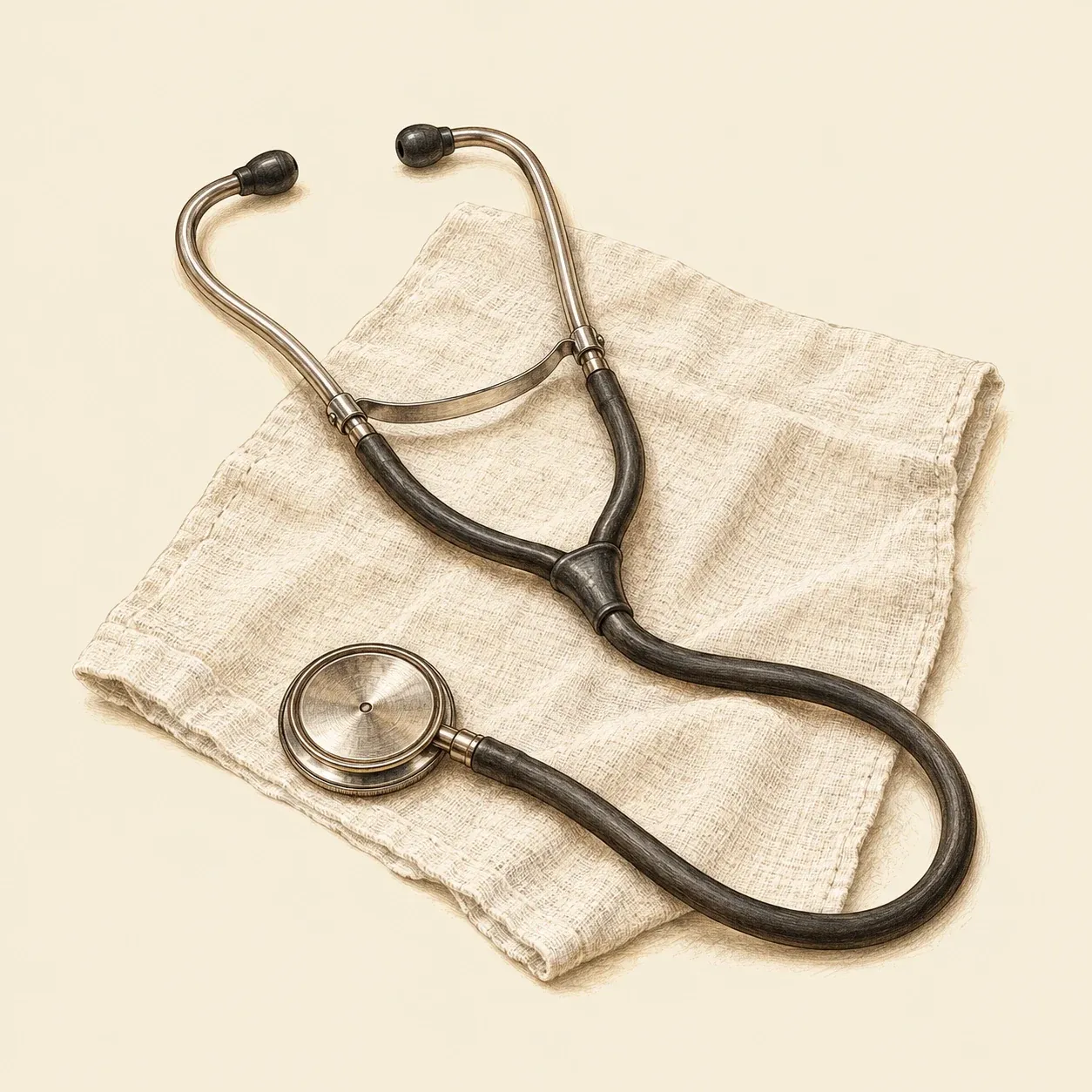 The flexible two-earpiece instrument familiar today came after Laennec’s rigid tube.
A stethoscope carries sounds from within the body to a listener’s ear. In medical practice, trained professionals use it to examine the heart and lungs, among other things. Laennec’s early instrument was monaural: a rigid tube connected the area being examined to one ear. The flexible instrument with two earpieces familiar today belongs to a later stage of its development.
Laennec’s wooden instrument has a straight cylindrical body of constant diameter; the collecting opening widens inside that cylinder. An axial passage runs through two detachable parts, meeting at an aligned joint. At the opposite end is a small central opening. There is no external trumpet bell, membrane or stopper in this configuration. The instrument does not produce an image of an organ. What a sound means depends on the examination and the listener’s training; hearing something, or failing to hear it, cannot by itself establish a diagnosis.
How it works
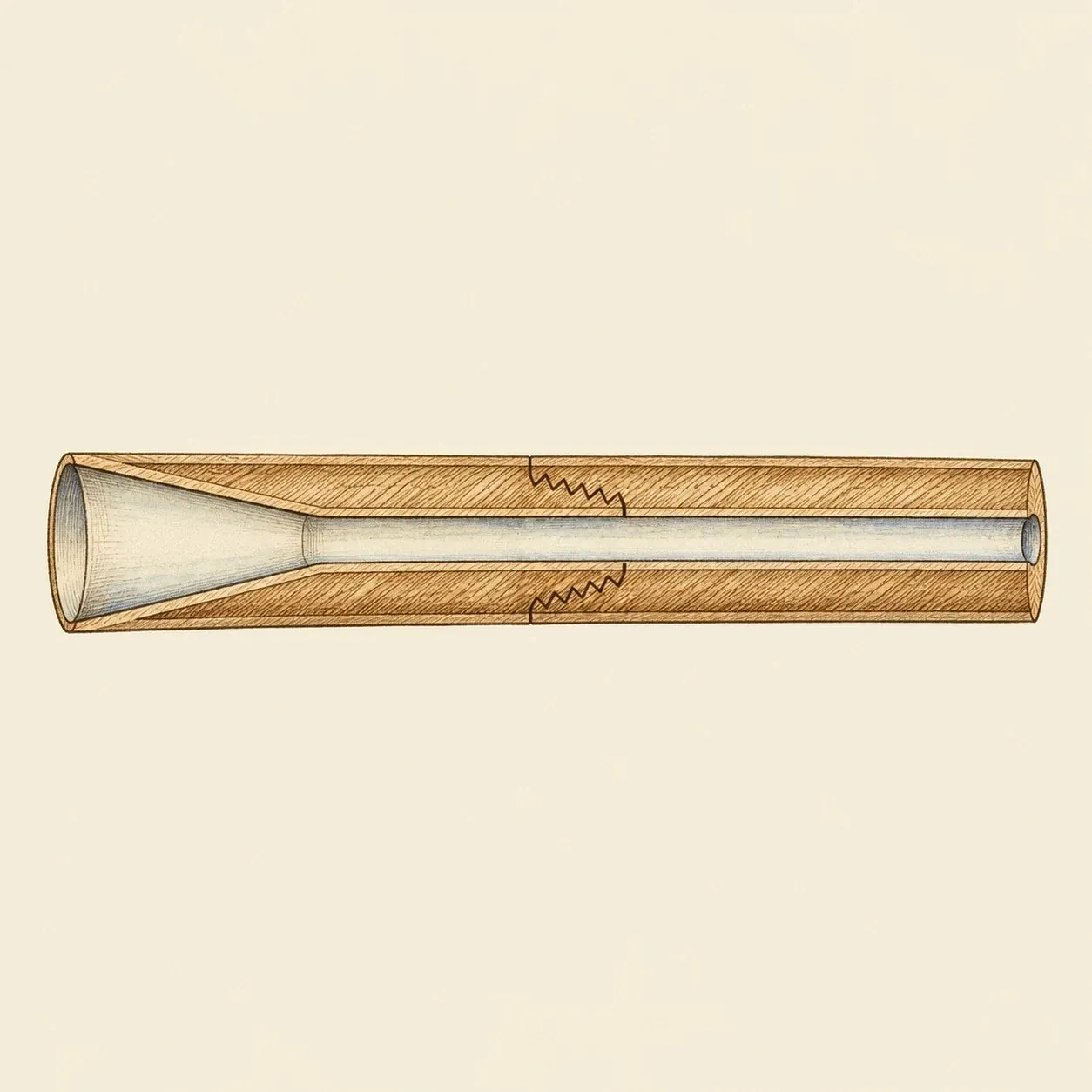 The open passage connects both ends; the collecting cone lies within the cylindrical body.
A vibration produces small pressure changes in the air. The passage carries these changes towards its other opening, while the tube material can also transmit vibration. The shape of the ends, the width of the passage and contact with the source affect the sound that reaches the listener. Leaks and rubbing can obscure it, as can noise in the room. An acoustic stethoscope supplies no electrical energy and does not increase every frequency by the same amount. There is no single gain figure that applies to all tubes and listening conditions.
The flared collecting opening covers a larger area than the narrow central bore. In the open configuration, it connects directly to that bore. Other historical arrangements have a removable stopper at the collecting end. The detachable joint should leave the passages aligned. Modern binaural instruments introduce a flexible connection and branches leading to both ears. Many also use a diaphragm to collect vibration; that diaphragm is absent from Laennec’s wooden tube.
How to do it
Producing a clinical instrument is professional work. Material selection, contact surfaces, assembly and acoustic performance all require control. Cleaning and maintenance follow the manufacturer’s instructions and the institution’s procedures. A paper tube must not be used to examine a person or animal, or to decide whether someone needs care.
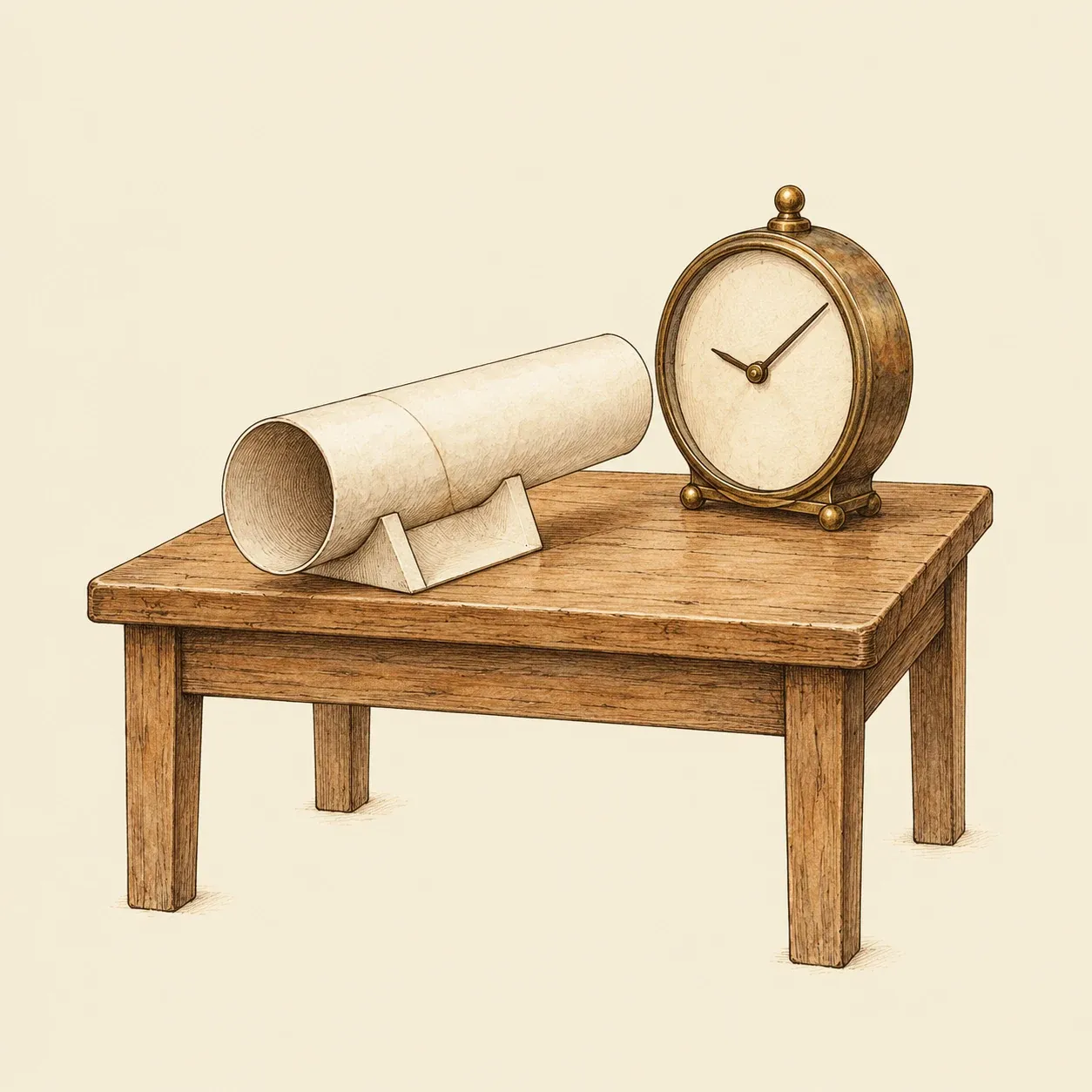 Acoustic comparison using a closed clock, without any medical measurement.
For a demonstration, roll clean paper around a smooth cylindrical former. Fasten the outside edge with adhesive tape, then remove the former. Check that the passage is open from end to end. Reject torn paper or a tube with a stiff, uneven rim. The rolled paper forms a lightweight channel with an opening at each end. Set a closed mechanical clock on a stable table, well away from its edge. Leave the case closed throughout the comparison.
Bring one end of the tube near the clock case. Listen near the other end without inserting it into the ear or pressing it against the face. Compare listening with and without the tube at a similar distance, in a quiet room. Move the tube slightly to explore the effect of position, keeping the same source. Do not touch the clock while comparing: handling introduces extra noise. Do not blow, shout or strike into the tube, and avoid loud sound sources. Stop if listening becomes uncomfortable. Nothing goes into an ear, nose or mouth, and a tube brought near the face must not be shared. Keep the model separate from any health assessment.
History and evolution
Doctors listened directly with an ear against the body before Laennec developed his instrument. In Paris in 1816, René Théophile Hyacinthe Laennec tried rolled paper to hear the heart without placing his ear directly against the patient. Wooden tubes followed, alongside his study of chest sounds. Listening through an instrument became known as mediate auscultation.
Laennec published his treatise in 1819. He compared sounds heard during examinations with lesions studied after death. The published instrument could be taken apart. Surviving wooden instruments differ in their length and construction details. Flexible versions appeared later, and binaural instruments became commercially available and spread during the 1850s. Several proposals and improvements contributed to that change. Diaphragms and, later, electronic devices further changed sound collection and reproduction. Clinicians interpret the sounds in the context of the examination.