Fresnel lens
A thin lens made of concentric steps of glass
Contents
- 1Central lens
- 2Stepped rings
- 3Flat back
- 4Outline of the solid lens it replaces
- 5Flame at the focus
- 6Beam of parallel rays
A Fresnel lens is a converging lens with most of its glass taken away. Its curved face is cut into concentric rings, each keeping the slope of the matching zone of an ordinary lens, so the lens bends light in the same way while staying thin and light. Buffon proposed a lens ground in steps in 1748, for a burning glass. Augustin Fresnel had such lenses built from separate pieces of glass, and the first one lit a lighthouse at Cordouan, in France, on 25 July 1823.
What it is
A Fresnel lens does the work of a thick convex lens with a thin plate of glass or plastic. Seen from the front, it is a central lens surrounded by concentric rings. Seen in section, its back is flat and its front is a series of narrow steps, like a saw blade bent into a circle. Each step is a ring of glass whose sloping face has the same angle as the surface of the solid lens at that distance from the centre.
The idea was first proposed for burning glasses, which concentrate sunlight, and was first put to work sending the light of a lamp out to sea. It is now used wherever a lens has to be large, light or cheap: the lighting of cars, stage spotlights, overhead projectors and solar concentrators all use moulded versions. The same name covers the lighthouse lens and the flat plastic sheet sold as a page magnifier.
How it works
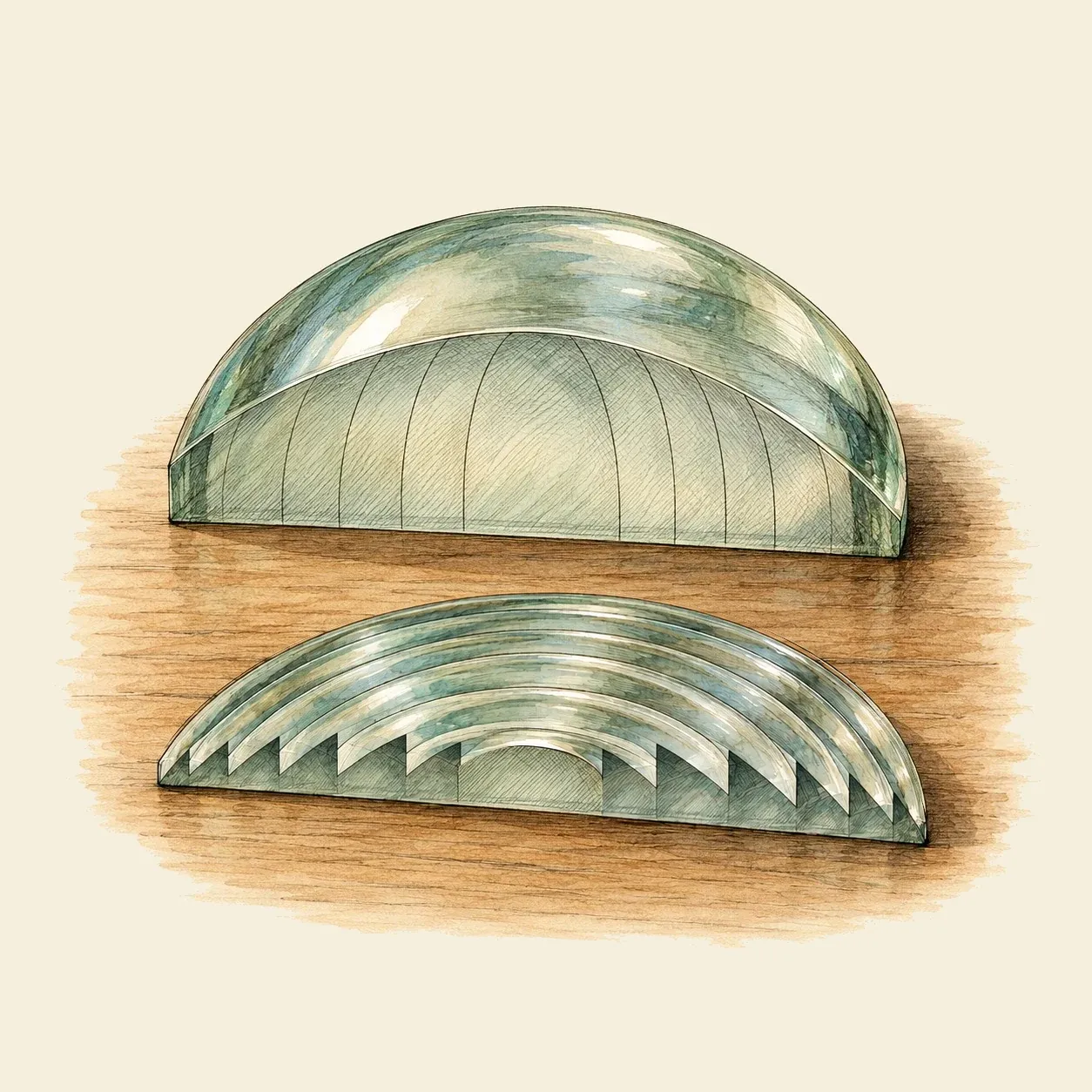 Lowering each zone of a thick lens onto its flat back keeps the slopes that bend the light and removes most of the glass.
Light changes direction only where it crosses a surface between air and glass. Inside the glass it travels in a straight line, so the thickness of a lens does nothing except hold its two surfaces apart. In a converging lens, the angle of the surface grows from the centre to the rim, and the rays crossing near the rim are bent the most. To keep the bending and lose the bulk, the lens is divided into rings and each ring is moved down onto a flat back while keeping its slope. The result is a central lens and a set of steps whose sloping faces grow steeper towards the edge.
A thick lens is heavy, expensive to make in large sizes and absorbs part of the light that passes through it. A stepped lens of the same diameter and focal length uses far less material, so it can be made much wider. Placed with a small light at its focus, it turns the rays that spread from the flame into a beam of rays parallel to each other, which keeps its brightness over a long distance. Used the other way, it gathers parallel sunlight into a small hot spot.
The steps have a cost. Their vertical faces send a little light in wrong directions, and the image seen through the lens is less sharp than through a well-made solid lens. For a lighthouse or a spotlight that matters little. Far from the axis, the rays meet the glass at too steep an angle to be bent enough, so lighthouse lenses add outer rings of prisms that turn the light by reflection inside the glass.
How to do it
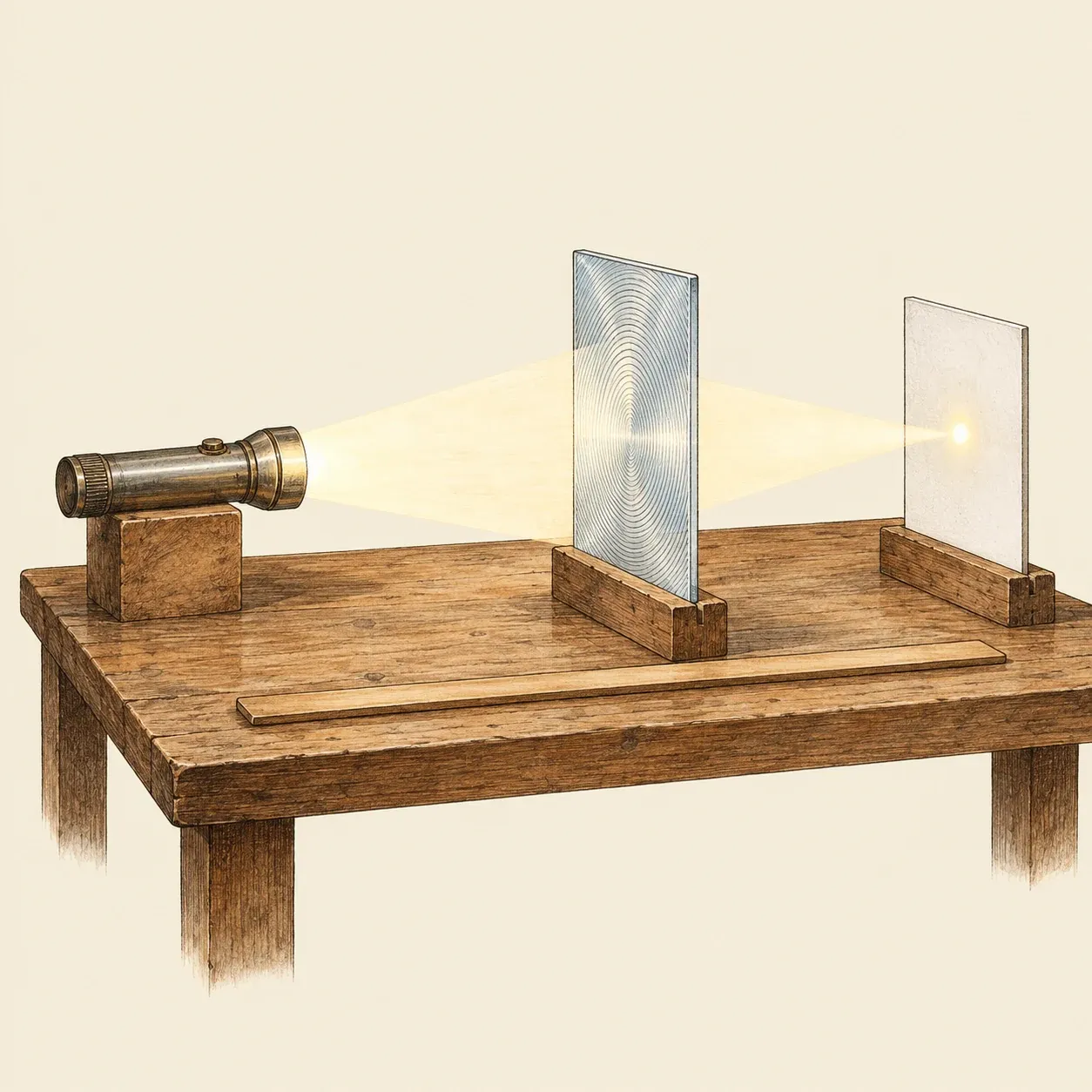 With the lamp further back than the focus, the light narrows to a point on the card.
A plastic sheet magnifier of the kind sold for reading is a Fresnel lens and is enough to see how it works. Hold it up to the light and look at the rings along its edge, then run a fingernail across the ridged side. Set it upright in a slot cut in a block of wood.
To find its focal length, stand at the far side of a room from a window and hold a white card behind the lens. Move the card until a small, sharp, upside-down image of the window appears on it. The distance between lens and card is close to the focal length. Measure it with a ruler.
Now put a small torch or LED lamp on the axis behind the lens at that distance, in a dark room, and look at the patch of light on a card on the other side. If the lamp is too close, the light spreads; if it is too far, it narrows to a point and spreads again. When the patch stays the same size as you move the card away, the beam is parallel, as in a lighthouse. Compare the sheet with a glass magnifying lens of similar focal length and see how much thicker and heavier the glass one is.
Safety: never look at the sun through any lens, as it can blind. A Fresnel lens left in sunlight can focus it into a spot hot enough to start a fire, even through a window; store it in a drawer or a sleeve and never use it to light fires. The edges of a cut plastic sheet can be sharp.
History and evolution
The French naturalist Georges-Louis Leclerc de Buffon, who also experimented with large burning mirrors, proposed in 1748 a lens ground in steps from a single piece of glass. He saw that only the surfaces of a lens bend the light and that the inner thickness could be removed. His lens was meant to be a burning glass, to concentrate the sun’s heat. A report published in 1823 by the Société d’encouragement pour l’industrie nationale judged such a lens impossible to make in one piece. It noted that Condorcet had already suggested building it from several pieces, but that no large stepped burning glass had yet been made.
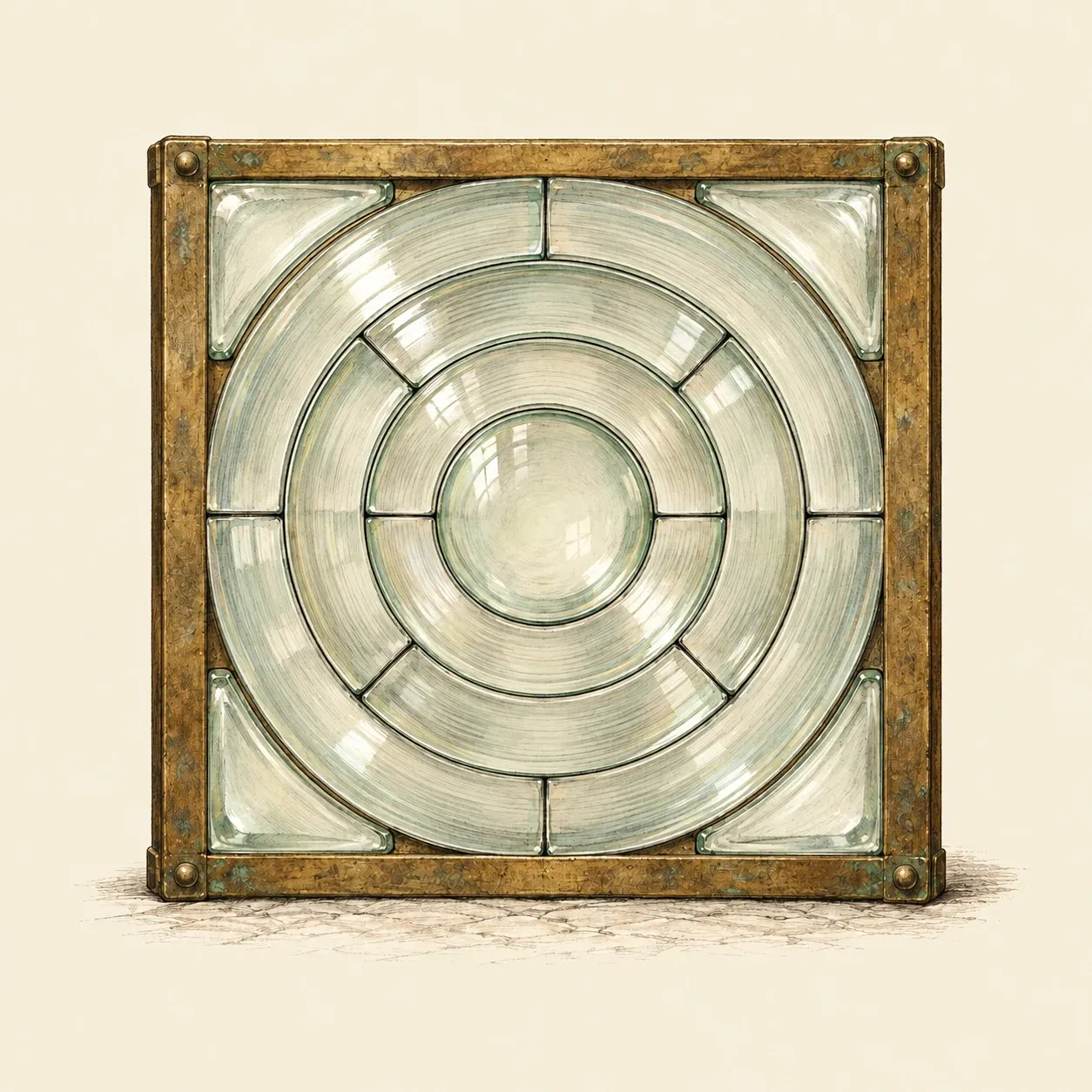 Fresnel had the central disc and each ring of the lens made separately, then assembled them in a square frame.
The next step came from lighthouses. In 1819 François Arago brought Augustin Fresnel, an engineer known for his work on the wave theory of light, onto the French lighthouse commission. In his memoir of 1822 on a new system of lighting lighthouses, Fresnel called his lens the reverse of a burning glass. Unlike Buffon, he had each ring made separately and assembled in a frame; Daniel Hennequin and Philippe Verkerk, physicists at the University of Lille, see this choice as what made the lens practical. The Paris optician François Soleil took on the making of the glass. In July 1823 the lighthouse of Cordouan, at the mouth of the Gironde, received the first of these lenses: eight stepped panels around a lamp with concentric wicks. The French Ministry of Culture gives five wicks; the 1823 report and the US Lighthouse Society give four.
Fresnel then added rings of prisms that turned stray light back towards the horizon by reflection inside the glass. Lighthouse lenses were made in standard sizes, called orders, from the first, the largest, for major coastal lights, to the sixth for small local lights. The lighthouse plate tells how these lenses spread around the world’s coasts. Lenses moulded in plastic later made the stepped lens cheap enough for car lamps, projectors, stage lighting and solar collectors.