Molten salt thermal storage
Solar heat kept in tanks of hot salt for the night
Contents
- 1Cold salt tank
- 2Receiver at the top of the tower
- 3Hot salt tank
- 4Steam generator
- 5Turbine and generator
Molten salt thermal storage keeps the heat of a solar power plant in large insulated tanks of melted nitrate salt, so that the plant can make steam and electricity after sunset or under clouds. Cold salt at about 290 °C is heated in the receiver to about 565 °C and kept in a hot tank until it is needed. The French Thémis tower, connected to the grid in 1983, used molten salt both to carry and to store its heat.
What it is
A solar thermal power plant collects heat only while the sun shines, but people use electricity at all hours. Molten salt storage separates the two. The plant heats more salt during the day than its turbine needs at that moment and keeps the surplus in a tank. In the evening, or when clouds pass, it draws on that hot salt to go on making steam for the steam turbine.
The salt is a mixture of sodium and potassium nitrates. It does not burn and gives off almost no vapour even when very hot, so it can be kept in large tanks at atmospheric pressure instead of in pressure vessels. Its drawback is that it starts to crystallise at about 240 °C and is fully solid at about 220 °C, so it must always be kept above that range in the pipes.
How it works
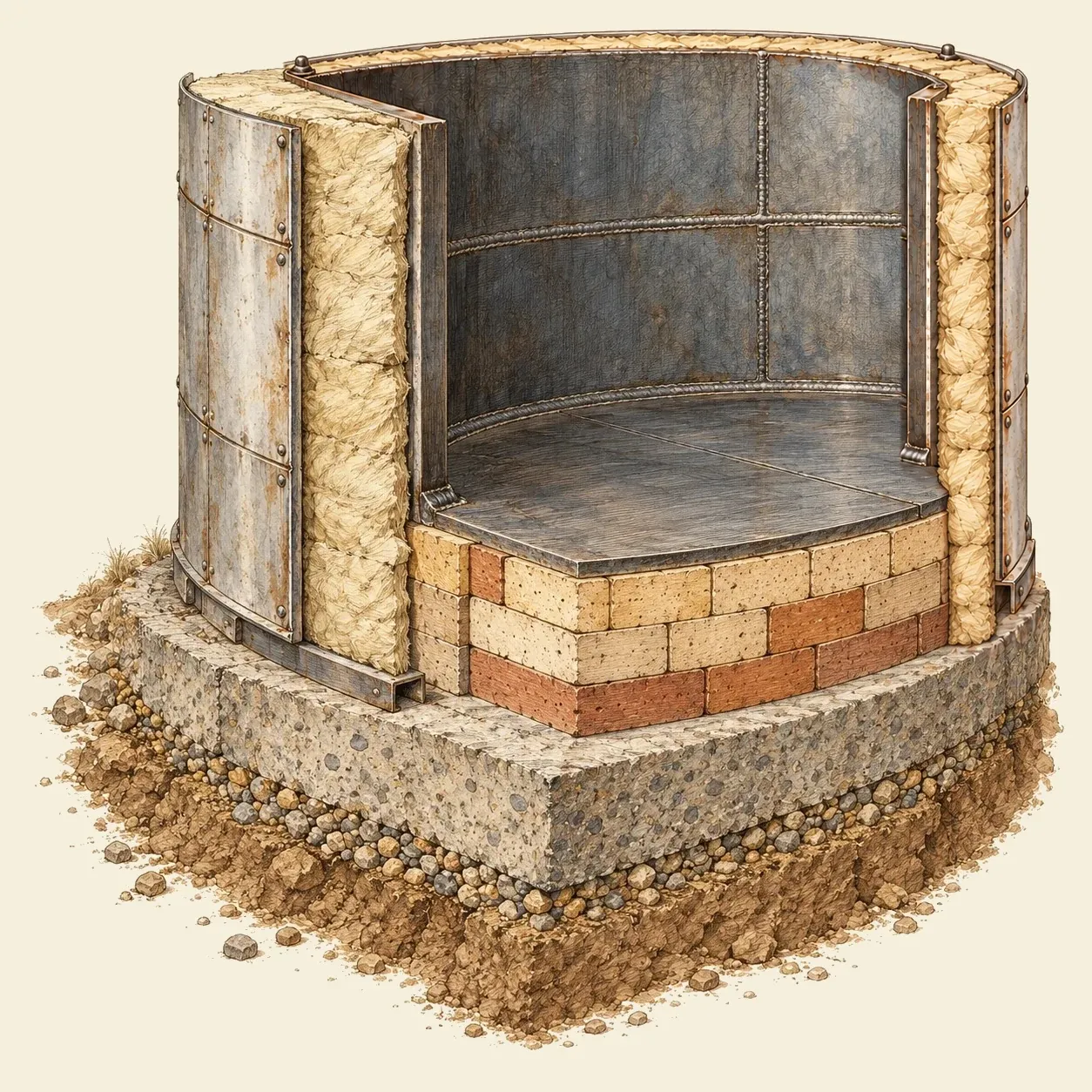 The hot tank is a steel shell wrapped in insulation and set on an insulated foundation.
The usual arrangement has two tanks. Salt from the cold tank, at about 290 °C, is pumped to the receiver, heated there to about 565 °C, and flows into the hot tank. When the plant needs power, hot salt is pumped through a steam generator, where it boils water into steam, and comes out cooled to the cold tank again. Collecting heat and making electricity can then run on separate timetables. Because the salt itself carries the heat from the receiver and also stores it, this is called a direct system.
The two tanks are built from different metals. Hot nitrate salt corrodes ordinary steel, so the hot tank is made of stainless steel; the cold tank, at a lower temperature, can be of cheaper carbon steel. Both are covered with thick insulation. If the salt is kept much hotter than the 565 °C of the hot tank for long, the nitrate slowly breaks down, giving off oxygen and turning partly into nitrite; this sets the upper limit of the store.
Freezing is the main operating risk. A plug of solid salt can block a pipe or a receiver tube, so pipes, valves and the receiver must be kept above the temperature at which crystals begin to form with electric heaters or drained when they are not in use.
How to do it
 Two vacuum flasks of warm and cool water show how an insulated tank keeps its heat.
Two vacuum flasks and two thermometers show how a well-insulated store keeps its heat. Mark one flask with red tape for the hot tank and one with blue tape for the cold tank. Fill the red flask with warm tap water and the blue one with cool tap water, close both with a stopper through which a thermometer passes, and note the two temperatures. Fill an open cup with the same warm water and put a thermometer in it.
Read all three thermometers every half hour through an afternoon and into the evening. The water in the open cup cools quickly, while the warm water in the red flask stays warm for hours, as the hot salt does in its insulated tank. The blue flask stays cool for just as long, because insulation slows the flow of heat in both directions.
Safety notice. Use warm tap water only, never boiling water, to avoid scalds, and check that the flasks are sound and stand where they cannot be knocked over. Never try to melt nitrate salts or any other salt at home: molten salt causes severe burns, and nitrates are strong oxidisers that can make wood, paper or clothing burn fiercely.
History and evolution
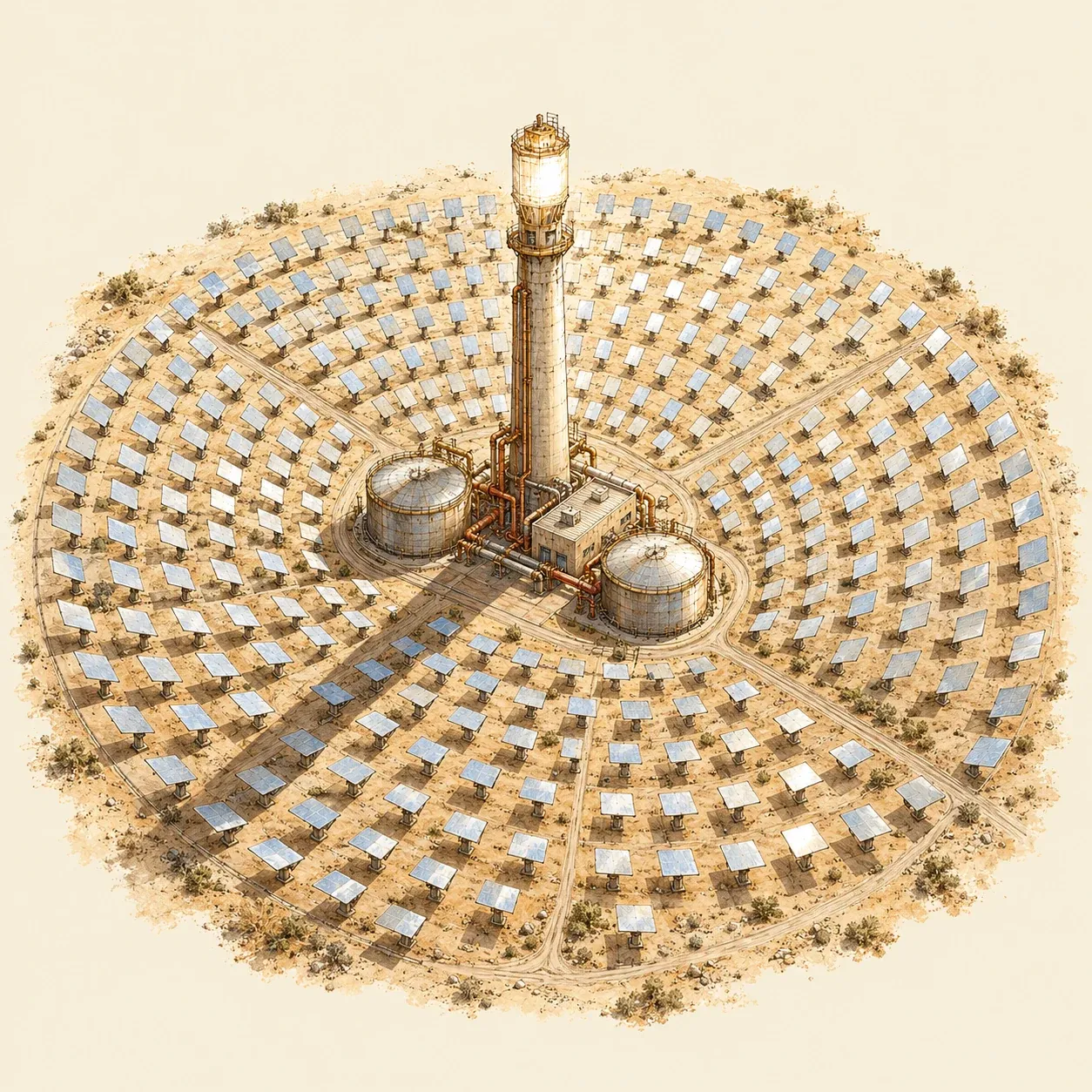 A tower plant with storage seen from above: the mirror field, the tower and the two salt tanks beside it.
In the United States, engineers in the solar programme designed central receiver plants that would carry and store their heat in molten nitrate salt. At the Central Receiver Test Facility in Albuquerque, New Mexico, a research store with a cold tank and a hot tank was built and tested, and the tests showed that the idea worked. The same two tanks then served in the Molten Salt Electric Experiment, a small complete plant built at the site, which was tested in 1984 and 1985 and ended with a month of power production.
In France, the Thémis tower at Targassonne, in the Pyrenees, was connected to the grid in 1983. Molten salt carried the heat from its receiver to the steam generator and also served as the plant’s heat store.
Solar Two, built in California on the site of the earlier Solar One tower, ran in the late 1990s with a molten salt receiver and two storage tanks. It showed that a tower plant could collect heat by day and deliver power through clouds and after sunset.
Gemasolar, near Seville in Spain, began operating in 2011 with a salt receiver on its tower and tanks large enough to keep the turbine running for about 15 hours without sun. In its first summer it supplied electricity through a whole day and night without stopping.