Solar power tower
A field of mirrors that heats a boiler at the top of a tower
Contents
- 1Heliostat mirror
- 2Two-axis drive on its pedestal
- 3Tower
- 4Receiver at the top of the tower
- 5Steam generator and turbine hall at the foot of the tower
A solar power tower uses a field of sun-tracking mirrors, the heliostats, to send sunlight onto a receiver at the top of a tower. The concentrated light heats water into steam, or heats molten salt that can be stored, and the heat drives a steam turbine. Giovanni Francia built the first tower plant at Sant'Ilario, near Genoa, in the mid-1960s.
What it is
A solar power tower, also called a central receiver plant, gathers sunlight from a large area of ground with hundreds or thousands of flat mirrors, the heliostats. Each heliostat turns through the day so that it keeps reflecting the sun onto the same target: a receiver at the top of a tall tower in the middle or at the edge of the field. The concentrated light heats a fluid flowing through the receiver. In some plants it is water, which turns into steam; in others it is molten salt, which carries the heat down the tower.
At the foot of the tower the heat drives an ordinary power station. Steam, raised directly in the receiver or in a steam generator heated by the hot salt, spins a steam turbine coupled to a generator. A solar cell turns light straight into electricity; a tower turns it into heat first, and heat stored in hot salt lets a plant go on producing after the sun has set or behind clouds.
How it works
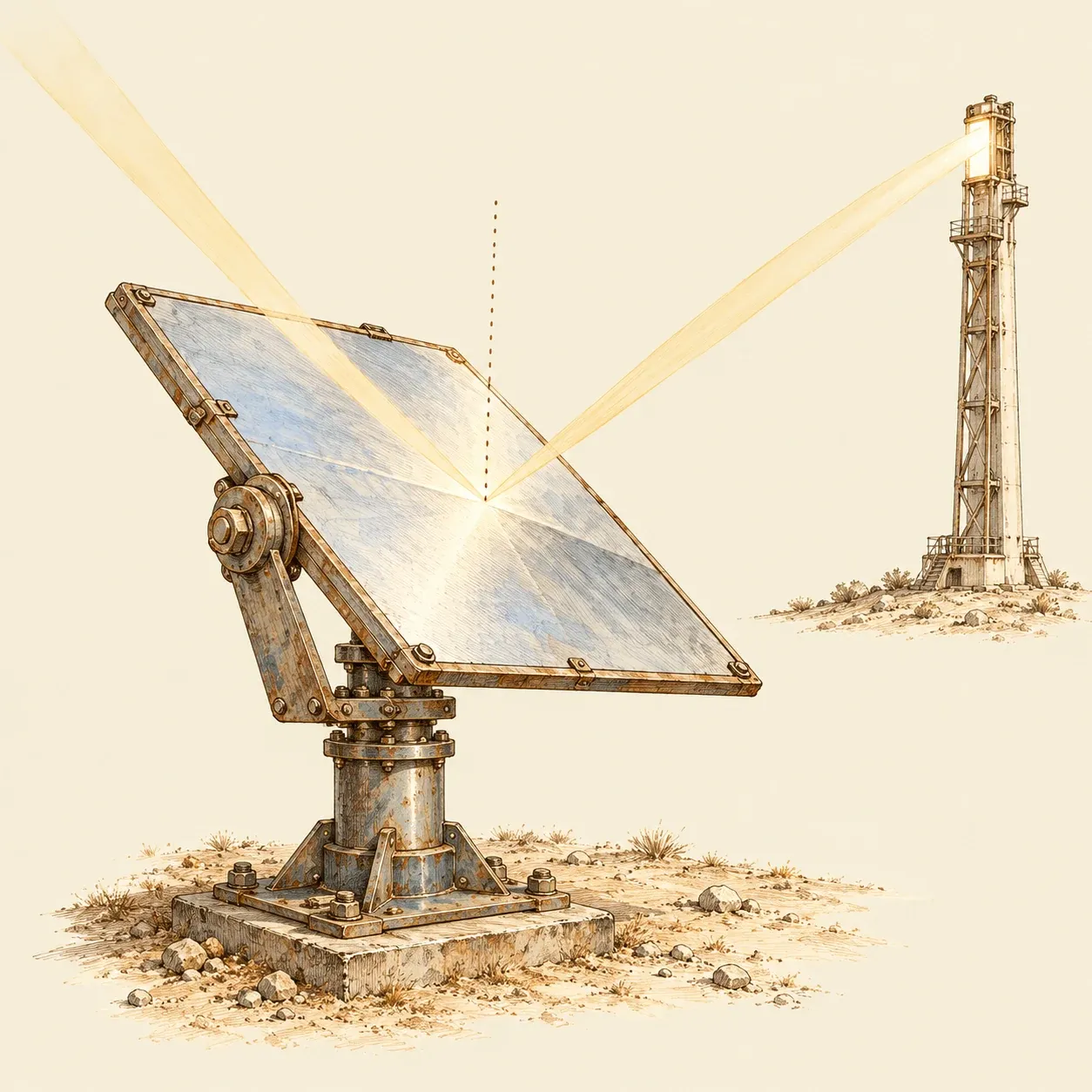 A heliostat must face halfway between the sun and the receiver for the light to land on target.
A mirror sends light away at the same angle at which it arrives. To keep the reflected beam on the receiver, a heliostat must therefore face a direction halfway between the sun and the receiver, and since the sun moves across the sky, that direction changes all day. Each heliostat sits on a pedestal with drives that turn it about two axes, usually a vertical one for direction and a horizontal one for tilt. Because every heliostat stands at a different place in the field, each follows its own path. A controller works out the two angles of each heliostat from the date, the hour and its position in the field.
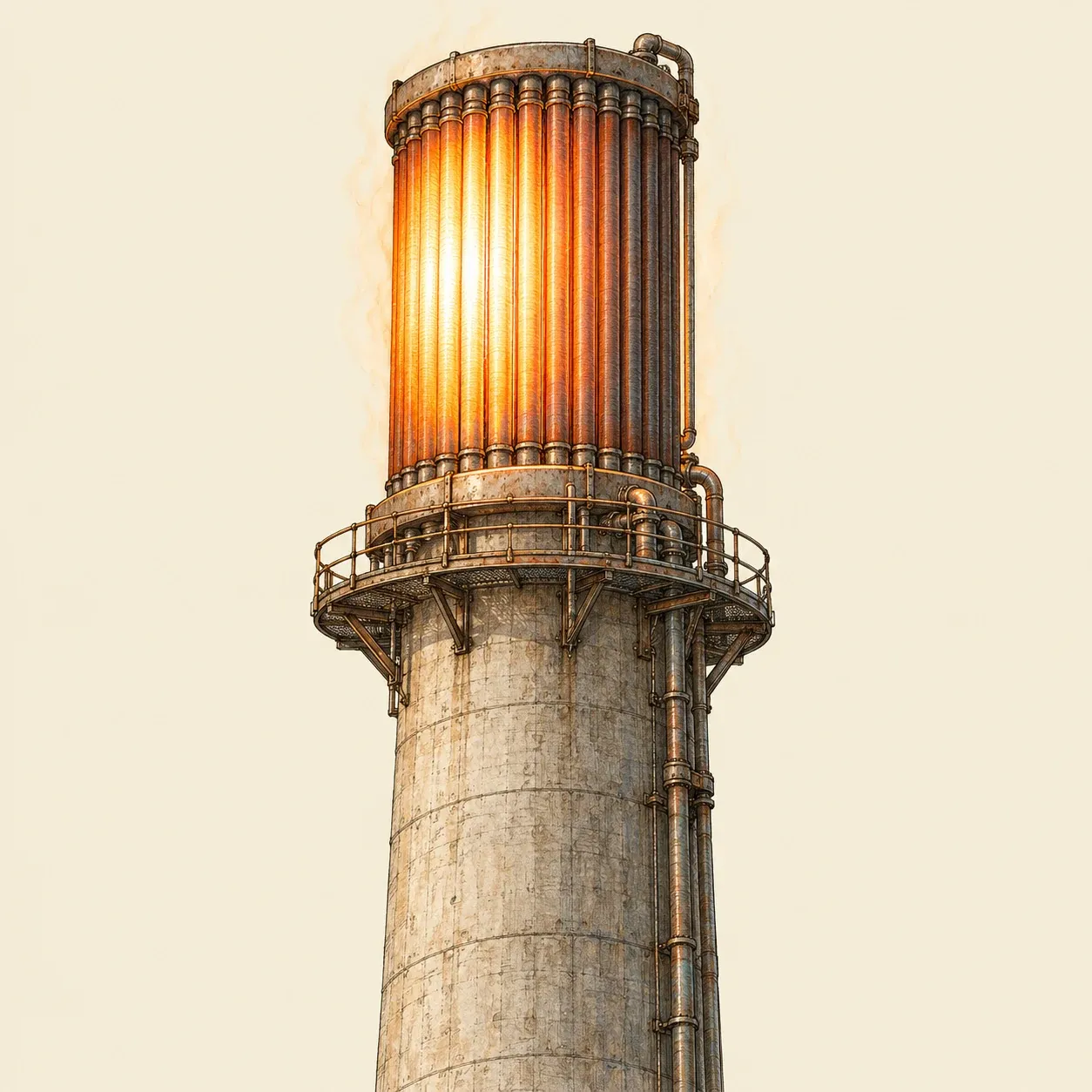 The receiver is a wall of tubes on which all the reflected beams converge.
The receiver is a heat exchanger made of tubes. At Solar Two, in California, it was a cylinder of tube panels around the top of the tower, and molten salt pumped up from a cold tank came out at about 565 °C before flowing down to a hot tank. From there it was pumped through the steam generator and back to the cold tank. In plants of this kind the salt usually stays between about 290 °C and 565 °C. Plants that heat water make steam in the receiver itself, as Solar One did in California and PS10 does in Spain. Either way, the receiver has to take an intense and changing flux of light. When a cloud passes, the light on it falls at once, and a plant without storage loses power with it.
How to do it
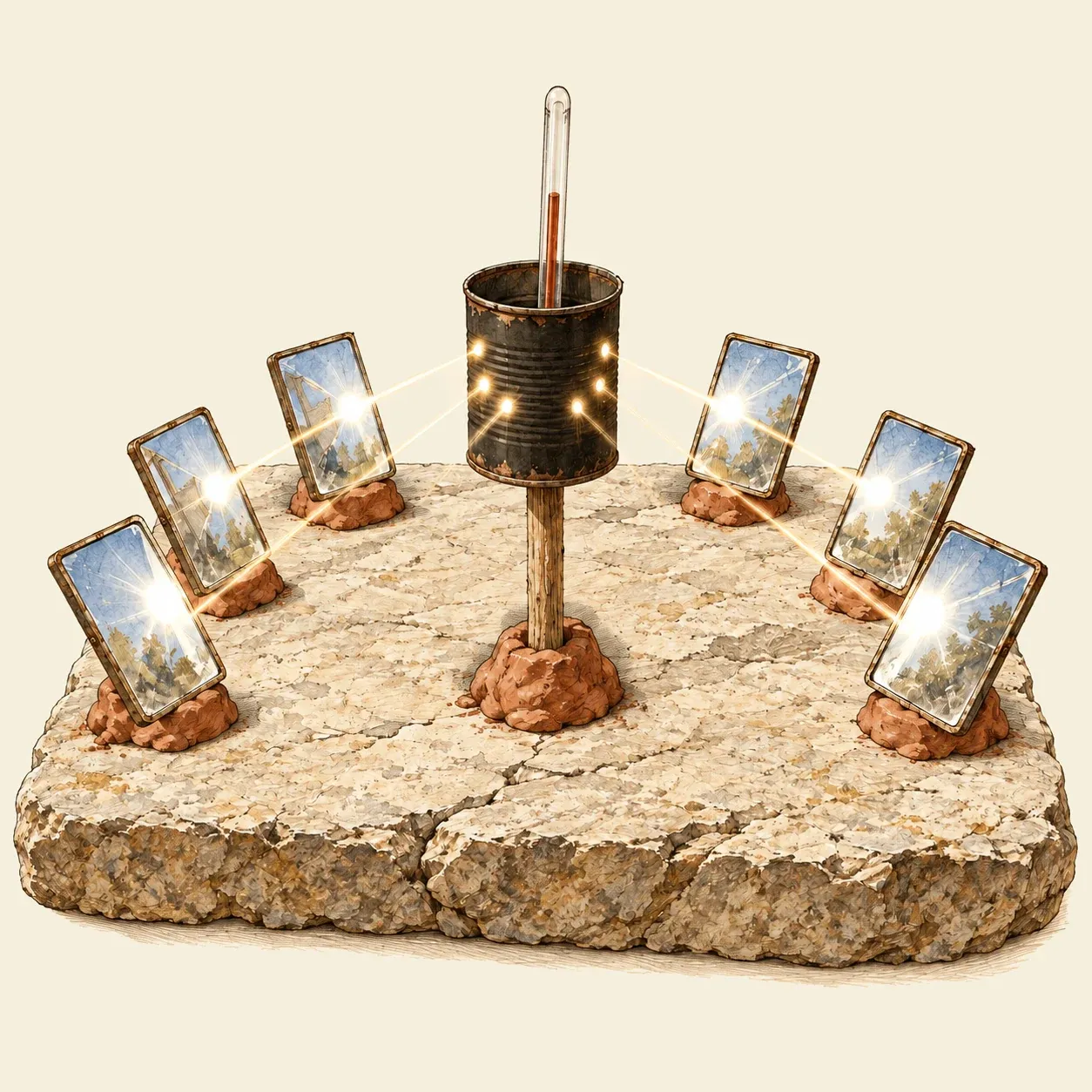 A few pocket mirrors and a black can make a small tower whose temperature can be read.
A few small flat mirrors and a dark can make a working model on a sunny day. Paint a small empty tin can matt black, half fill it with water and put a thermometer in it. Fix the can on top of a stick or a stack of bricks, about knee height, on a paved or stony surface outdoors. Set four to six pocket mirrors on lumps of modelling clay on the ground around it, a step or two away.
Note the water temperature, then turn one mirror until its bright spot falls on the can and read the thermometer every two minutes. Add the other mirrors one by one, each aimed at the can. The water warms faster with each mirror added, and a white can or one in the shade warms more slowly, which shows why receivers are dark and fields are large.
Safety notice. Never look at the sun or into a mirror’s reflection, and never point a reflected spot at a person, an animal, a window or a car: concentrated sunlight can damage the eyes and burn the skin. Use only small flat mirrors, never a magnifying glass or a curved mirror, which can set fire to dry material, and keep paper, grass and wood away from the can. Tape the edges of the mirrors, and let the can cool before touching it. Children should do this only with an adult, and the mirrors should be laid face down when the test is over.
History and evolution
The Italian mathematician and engineer Giovanni Francia worked in Genoa on ways to collect solar heat at high temperature. He turned to mirrors that concentrated the sun, and in the mid-1960s, at Sant’Ilario near Genoa, he built a field of nearly flat mirrors that reflected sunlight onto a boiler and produced steam. Accounts of his work date its first tests to 1965, while the agricultural institute on whose grounds it stood dates its installation to 1964. Francia described his pilot plants in the journal Solar Energy in 1968.
Towers built to generate electricity came in the early 1980s. Eurelios, a 1 MW plant at Adrano in Sicily, went into service in 1981. Solar One, near Barstow in California, generated 10 MW from 1982 to 1988 with a receiver that turned water into steam. It was then rebuilt as Solar Two, which ran in the late 1990s with a molten salt receiver and stored its heat in tanks of hot and cold salt, so that it could deliver power after sunset.
Commercial towers followed in Spain. PS10, near Seville, generates 11 MW with water and steam. Gemasolar, commissioned in Andalusia in 2011, produces about 20 MW and stores enough hot salt to run for about 15 hours without sunshine, which has let it supply electricity around the clock.