Mirror
Sending light back to form an image
Contents
- 1Polished reflecting face
- 2Slightly convex profile of the obsidian
- 3Rough, unpolished back
- 4Ray of light from the object
- 5Ray reflected towards the eye
- 6Virtual image behind the face
A mirror is a surface smooth and bright enough to send light back in good order, so that the eye sees an image of whatever stands in front of it. The oldest securely dated mirrors are pieces of polished obsidian, a black volcanic glass, laid in graves at the Neolithic town of Çatalhöyük in Anatolia during the first half of the seventh millennium BCE. Later mirrors were made of copper and bronze, then of glass backed with metal: lead under the Roman Empire, an amalgam of tin and mercury in Venice from the early sixteenth century, and from 1835 a thin film of silver.
What it is
A mirror sends back the light that falls on it without scattering it. Most surfaces return light in every direction, which is why they can be seen from anywhere in a room. A surface that is smooth and bright enough keeps the returning rays in order, so the eye receives them as if they came from objects lying behind it.
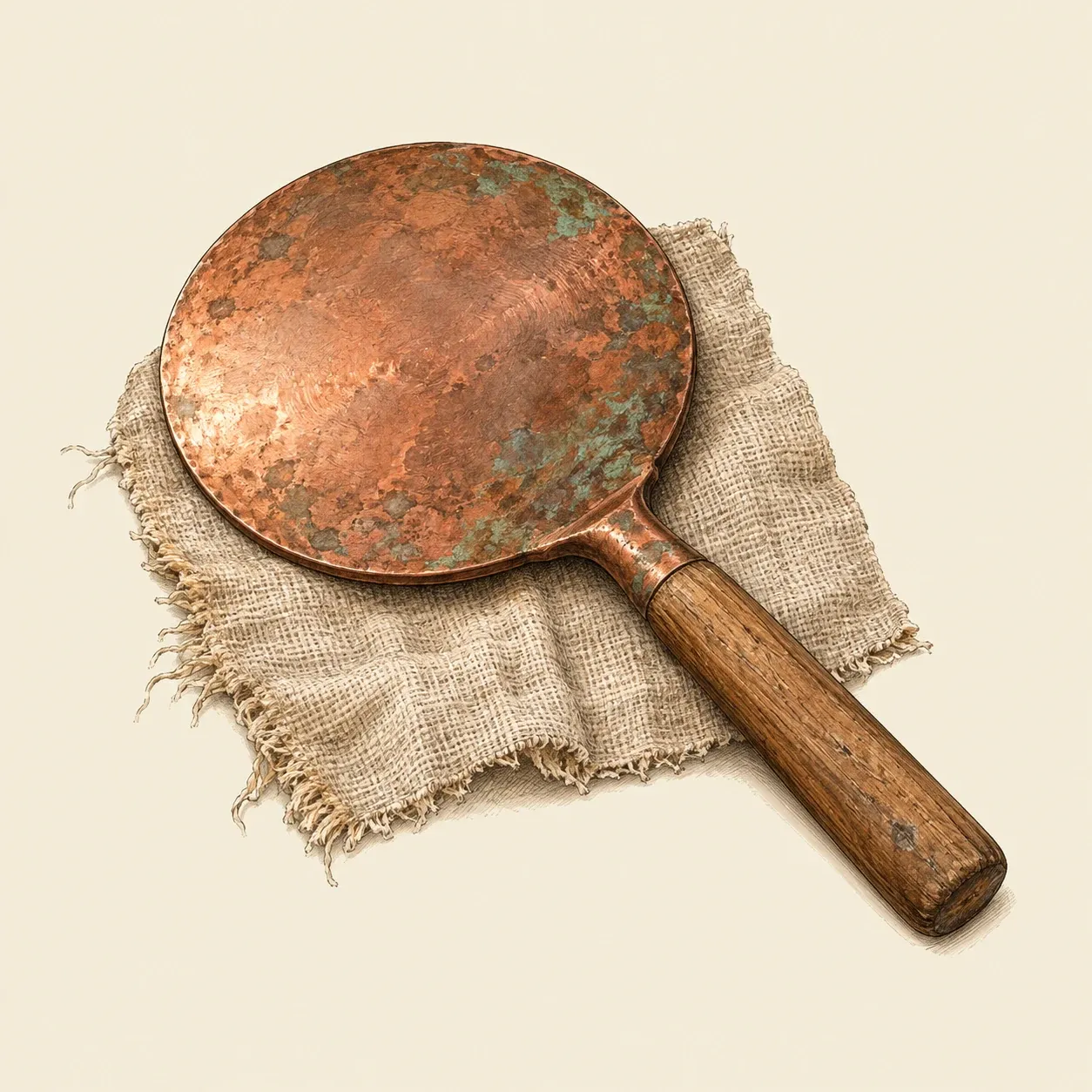 Egyptian mirrors were discs of copper or bronze on a handle of wood, bone or ivory.
The first mirrors were made of stone. Obsidian, a natural volcanic glass, can be ground flat and polished until it gives a sharp image, and its dark body absorbs the light that enters it, so the eye sees only the reflection from the surface. Copper and bronze were later polished in the same way. A modern mirror is a sheet of glass with a very thin layer of metal on its back, covered by paint: the glass gives a flat, hard face and shields the metal from air and wear. Still water in a dark bowl or a polished blade can also serve as a mirror.
How it works
Light striking a mirror leaves it at the same angle as it arrived, both angles being measured from a line perpendicular to the surface. Rays spreading from a point in front of a flat mirror therefore still spread after reflection, as though they came from a point behind it, as far behind the surface as the object is in front. The eye traces them back to that point and sees the object there. Nothing stands behind the mirror, and a screen placed there would catch no picture, which is why this image is called virtual.
The image is upright and the same size as the object, but front and back are exchanged: a hand pointing at the mirror meets a hand pointing back out of it, and so a right hand looks like a left one. A face that bulges slightly outwards, like the ground obsidian of Çatalhöyük, spreads the reflected rays a little more, and the image looks slightly smaller and closer to the surface.
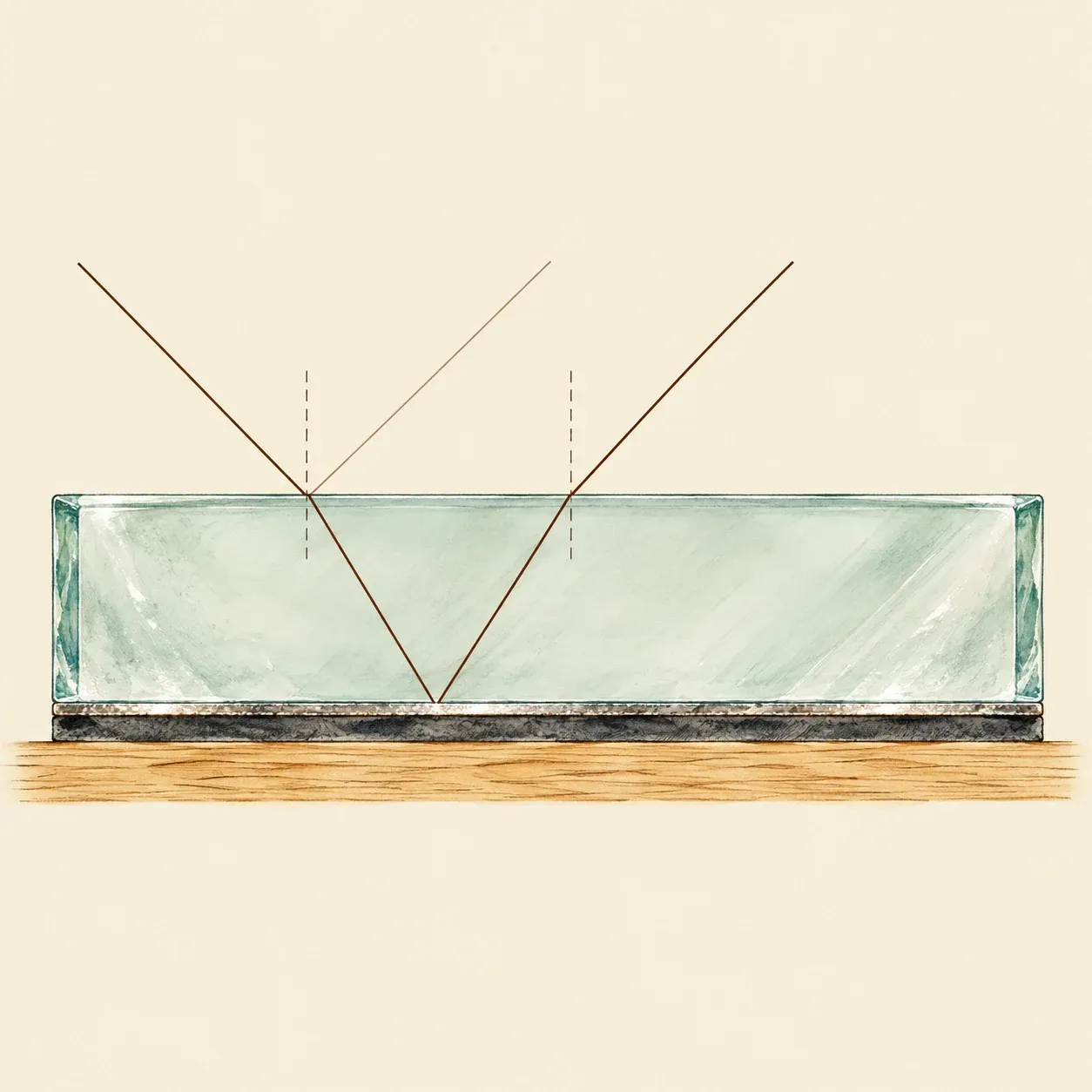 In a glass mirror the light crosses the glass twice, and the front of the pane returns a faint second image.
In a glass mirror the reflecting metal lies behind the pane. Light passes through the glass, reflects from the metal and crosses the glass again on its way out. The front of the glass also sends back a small part of the light, which gives a faint second image that can be seen near the edge of a thick mirror looked at from an angle. The metal layer is fragile. If water creeps between the glass and the silver, the silver tarnishes, and the mirror turns black along its edges.
Old mirrors made with mercury still contain some of it, and its vapour is toxic: their care is work for a conservator. Never try to coat glass with metal yourself, because amalgams and silvering solutions are dangerous, and broken mirror glass cuts deeply.
History and evolution
The oldest securely dated mirrors come from Çatalhöyük, a Neolithic town in central Anatolia. According to the archaeologist Alice Vinet, those laid in its graves as offerings lie in levels of the first half of the seventh millennium BCE. Adnan Baysal, who excavates nearby Canhasan, dates a mirror found there to about 8500 years ago and holds it to be of the same age. Vinet also lists two mirrors picked up on the surface at Sırçalıtepe in Cappadocia, a site occupied in the middle of the eighth millennium BCE, but a surface find is not tied to a dated layer. The Çatalhöyük mirrors are small pieces of obsidian with one face ground and polished. The optometrist Jay Enoch notes that their faces are convex and of good optical quality. James Vedder examined eight of them in the museums of Konya and Ankara: all come from the middle levels of the town, and their faces are badly scratched, probably by use. The copies he made in his experiments also came out slightly convex, from the pressure of the hand near the edges.
By about 2000 BCE, Enoch writes, mirrors were in use in Egypt, Mesopotamia, China and the Americas. Egyptian tombs held flat discs of copper or bronze with a tang that fitted into a handle of wood, bone or ivory. One in the Pitt Rivers Museum in Oxford comes from Dendera and dates from the Sixth Dynasty, in the late third millennium BCE.
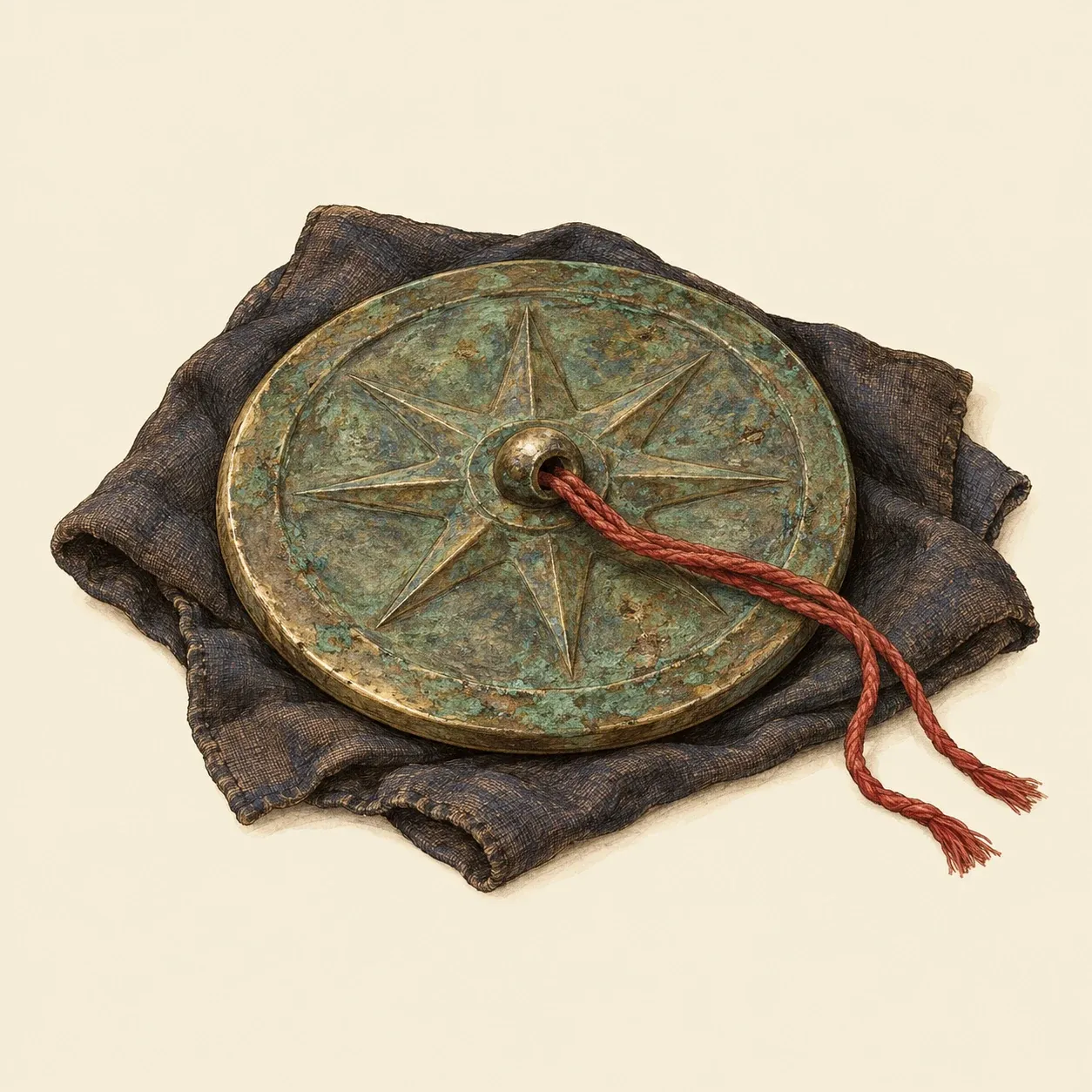 Chinese bronze mirrors were held or hung by a pierced knob on the decorated back.
In China, the earliest bronze mirrors belong to the Qijia culture of the upper Yellow River, between about 2200 and 1600 BCE. A Chinese mirror is polished on one face. The other face is decorated and carries a pierced knob by which the mirror was held or hung. Under the Warring States, the Qin and the Han, mirror making became a regulated industry, with workshops overseen by an imperial office.
Glass backed with metal appeared under the Roman Empire. About 2000 small mirrors of this kind are known, from the first century CE to the Byzantine period: a piece of convex glass with a thin reflecting coat, set in a lead frame. One found in Padua in 2015 measures less than 6 cm across.
Large, flat glass mirrors began in Venice. According to the conservator Kathleen Payne de Chavez, the first metal backings gave a dim, rough image. In the early sixteenth century the Dal Gallo family of Murano backed the glass with an amalgam of tin and mercury instead, which reflected far better. The mercury poisoned the workers, and in 1713 the physician Bernardino Ramazzini described the sick mirror makers of Murano cursing their trade. Venice forbade its glassmakers to leave with the secret, but some reached France in the seventeenth century. The 357 mirrors of the Hall of Mirrors at Versailles, built from 1678 to 1684, showed that a French workshop could now rival Venice.
In 1835 the German chemist Justus von Liebig deposited a thin film of metallic silver on glass by a chemical reaction. Silvered mirrors and amalgam mirrors were made side by side until silver won in the early twentieth century. In 1932, at Caltech, John Strong developed a coating of aluminium evaporated in a vacuum, which lasts much longer than silver, for the mirrors of optical instruments such as the reflecting telescope.