Stroboscopic animation
Making drawings move with slits and flashes
Contents
- 1Card disc
- 2Viewing slit near the rim
- 3One of the twelve successive drawings
- 4Pin serving as the pivot
- 5Wooden handle
- 6Mirror
A stroboscopic animation device shows a series of pictures, each drawn a little further along a movement, one after another and each for an instant in the same place, so that the eye sees a single figure in motion. The Belgian physicist Joseph Plateau described the first, a slotted disc viewed in a mirror, in 1832. Simon Stampfer made the same discovery independently in Vienna: Thomas Renoldner dates his device to 1832, and Stampfer published it and obtained an imperial privilege for it in 1833. In the slotted disc, the zoetrope and the film projector a moment of darkness separates the pictures, while the praxinoscope replaces the slits with a ring of mirrors.
What it is
Stroboscopic animation devices make drawings move. A movement, such as a dancer turning or a horse running, is broken down into a dozen or so pictures, each showing the figure a little further along. The device shows these pictures to the eye one after another, each for a brief moment and always in the same place. In the slotted disc and drum, darkness falls between two pictures; the praxinoscope shows each picture in its own mirror instead. Seen in quick succession, the pictures merge into a single figure that moves.
The first of these devices, the phenakistiscope, is a disc of card with drawings round one face and a ring of narrow slits near its edge. The viewer holds it by a handle in front of a mirror, with the drawings facing the glass, spins it, and looks through the slits at the reflection. Later devices put the pictures on a strip inside a slotted drum, replaced the slits with mirrors, or projected photographs on a screen with a rotating shutter.
How it works
If a disc of drawings is spun and watched directly, the pictures smear into a grey ring. The slits prevent this. Each time a slit passes the eye, it opens a view for an instant, and during that instant one picture is seen almost still, in the place where the previous picture stood. Between two slits the view is dark. The eye thus receives a series of sharp, still images instead of a blur, and since each image shows the figure a little further on, the brain links them into continuous movement.
Plateau and his contemporaries explained the effect by the persistence of the image on the retina, and the zoetrope patent of 1867 repeats this explanation. Researchers today reject it: the impression of movement comes from the way the visual system links nearby positions seen in succession, which is a different process from the lingering of light in the eye. The number of pictures shown each second still matters. If the dark intervals come too slowly, the image flickers.
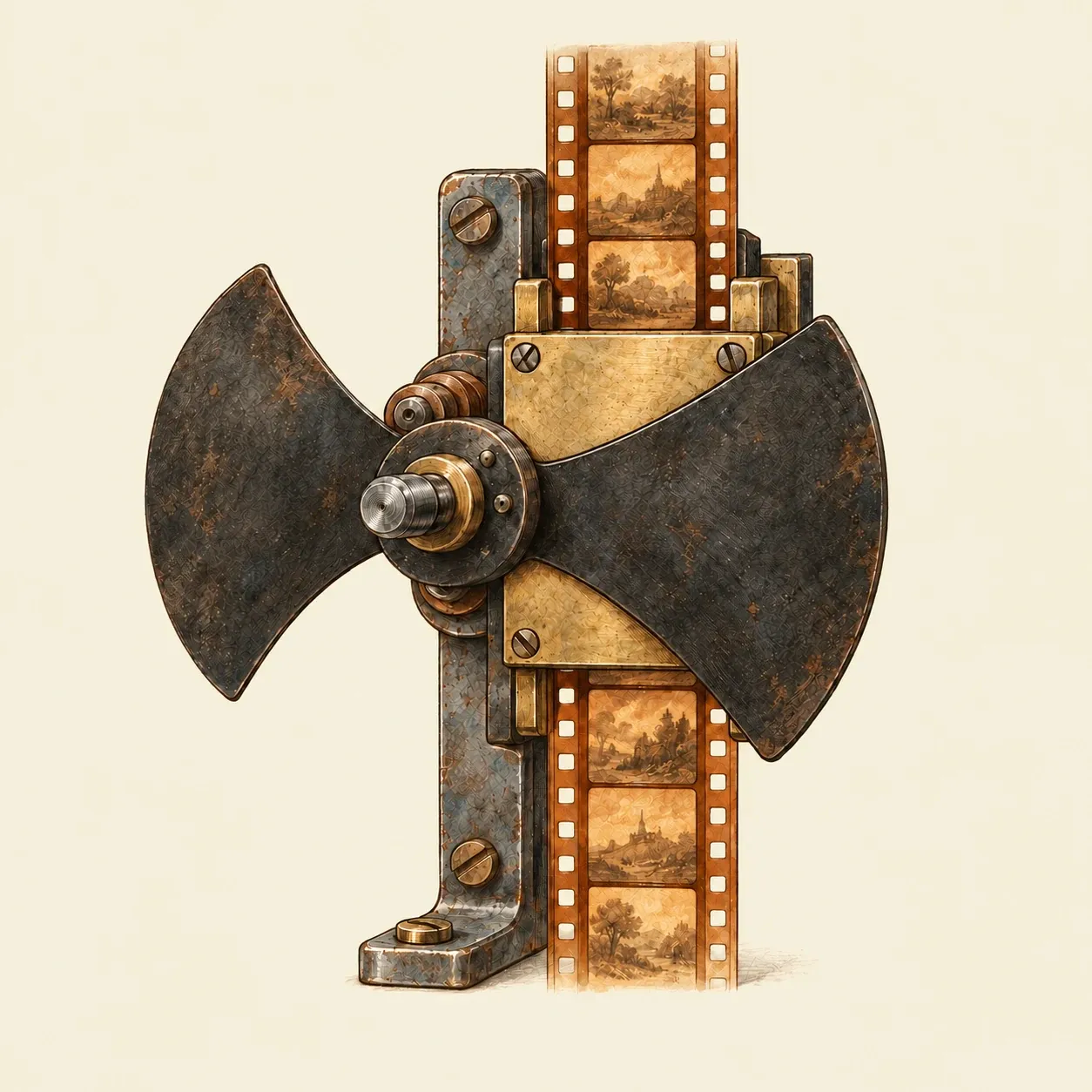 A two-blade shutter hides the film while it moves and cuts the light once more in the middle of each frame.
A film projector applies the same principle to photographs. The film moves down one frame at a time, and a rotating shutter hides the gate while the film moves, so the screen shows a series of still frames separated by darkness. Silent films ran at about 16 frames a second, which flickers if each frame is shown once, so projectors used three-blade shutters that cut the light 48 times a second. Sound films ran at 24 frames a second, because the soundtrack needed the film to travel faster, and a two-blade shutter showed each frame twice, again 48 flashes a second.
How to do it
A phenakistiscope can be made from a sheet of stiff dark card, a pencil, a pin and a mirror. Draw a circle about 20 cm across and mark its centre. With a protractor, divide it into twelve equal sectors of 30 degrees. Near the edge, on each dividing line, mark a slit about 3 mm wide and 2 cm long, ending about 1 cm from the rim. An adult should cut out the disc and the slits with scissors.
In each sector, between the slits and the centre, draw the same simple figure, moving it a little further each time: a ball that rises and falls, or a stick figure that waves its arm. The twelfth drawing should lead back smoothly to the first. Light lines on the dark card show up well. Push the pin through the centre of the disc into the eraser of a pencil, leaving the disc free to turn, and make sure the point of the pin is buried in the eraser.
Stand in front of a mirror and hold the pencil upright with the drawings facing the mirror. Bring your eye close behind the slits, keeping the disc about a hand’s width from your face, and spin it gently with your other hand. Looking through the slits at the reflection, you should see the figure move. If it drifts round the disc, check that the drawings are evenly spaced. At about one turn a second, the disc shows twelve pictures a second.
Safety: keep pins and scissors away from young children, and do not bring the spinning disc against your face or eyes. Flicker between about 3 and 30 flashes a second is the range most likely to trigger seizures in people with photosensitive epilepsy, and this toy flickers in that range, so they should not use it.
History and evolution
In 1832 the Belgian physicist Joseph Plateau, who had studied in his doctoral thesis how long an impression of light lasts in the eye, described a disc with slits that, spun in front of a mirror, showed a dancer turning. He called it the phenakistiscope, and he sent one to Michael Faraday in London. In Vienna, the Austrian professor of geometry Simon Stampfer made the same discovery independently. The animation researcher Thomas Renoldner dates his stroboscopic discs, or “magic discs”, to 1832; Stampfer published them and obtained an imperial privilege for them in 1833. In London, Ackermann and Co. sold printed and coloured discs under the name Fantascope from 1833, and the Science Museum Group keeps a set whose dancer is the subject first drawn by Plateau. The Belgian painter and lithographer Jean-Baptiste Madou drew some of the first discs for Plateau.
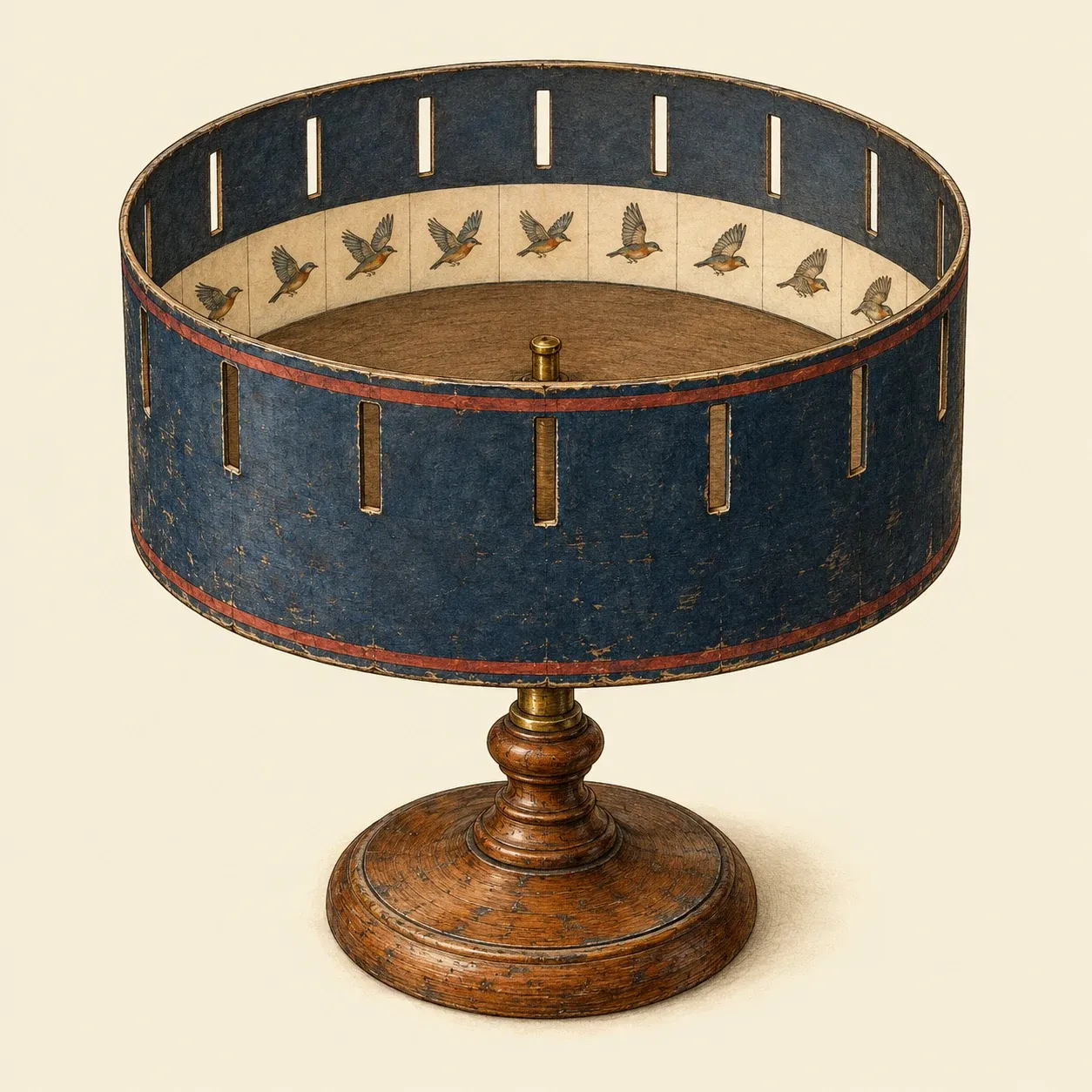 In a zoetrope the pictures are on a strip inside the drum, seen through slits in its wall.
The British mathematician William Horner proposed a drum in place of the disc: pictures on a strip round the inside wall, seen through slits above them. Melbourne’s Australian Centre for the Moving Image dates his “Daedaleum” to 1834, the History of Science Museum in Oxford to 1833. The idea became a popular toy in the 1860s. Each figure on the strip is drawn a little further along the motion than the one before. On 23 April 1867 William E. Lincoln of Providence, Rhode Island, patented a “zoetrope”, a revolving pasteboard cylinder with slits, assigned to the Milton Bradley Company; several people could watch it at once.
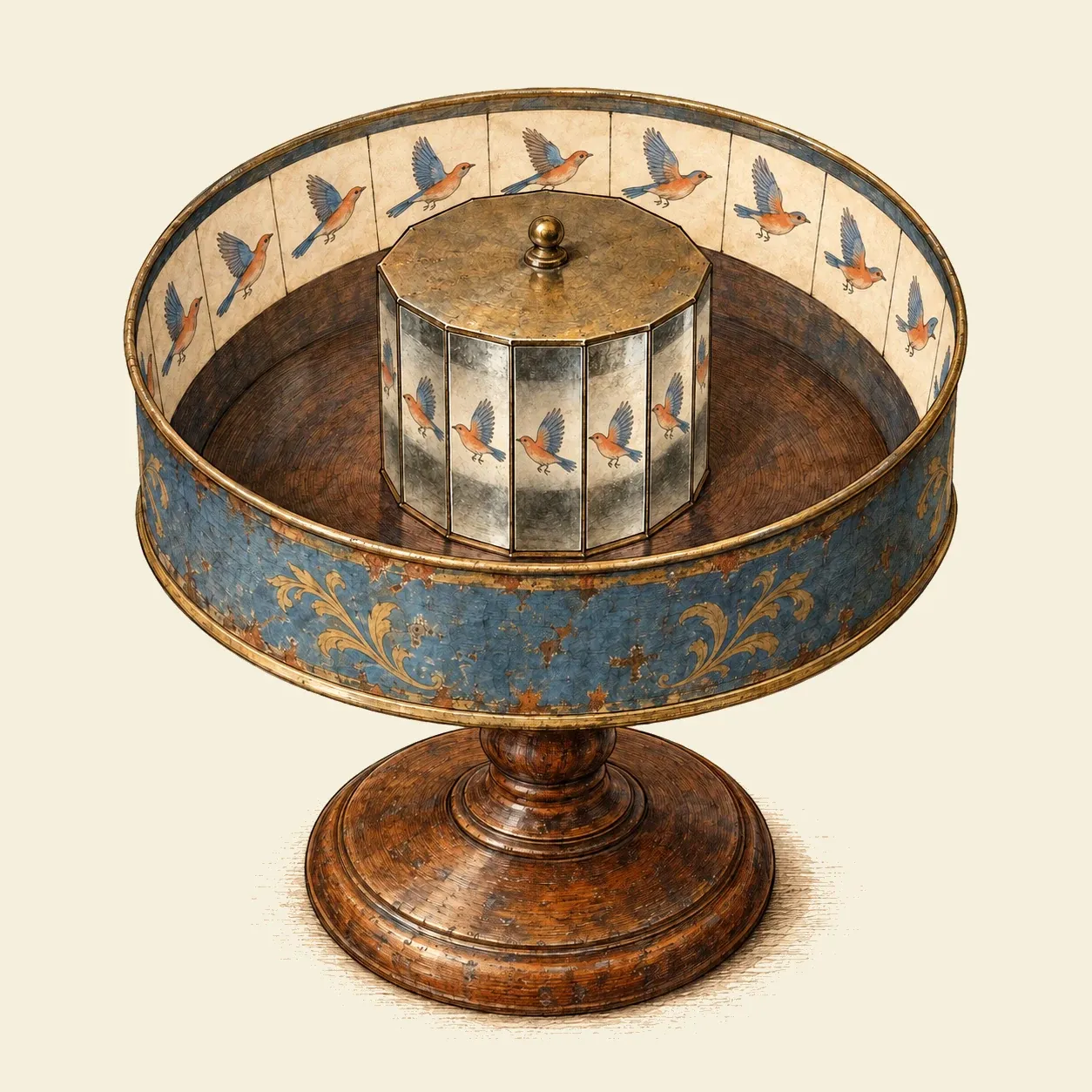 In the praxinoscope a ring of mirrors at the centre replaces the slits.
In 1877 the French teacher Émile Reynaud patented the praxinoscope. In place of slits it has a ring of flat mirrors at the centre of the drum, one for each picture, so that each picture is seen in its own mirror while the drum turns. The image is brighter than through slits and does not appear squeezed. Several people can watch it at the same time. When photography could record a movement in a series of frames, the projector took over the same principle and put stroboscopic pictures on a screen in front of a whole audience.