Vertical greenhouse
A glass tower that carries its plants up and down on moving trays
Contents
- 1Glass walls on a steel frame
- 2Electric motor and drive
- 3Endless chain over its pulleys
- 4Hanging tray of plant pots
- 5Trough of nutrient solution
A vertical greenhouse grows plants in a tall glass tower and keeps them moving. Two endless chains carry hanging trays of pots up one side and down the other, so that every plant takes its turn in the bright upper part of the tower and passes a trough of water or nutrient solution at the bottom. The Austrian engineer Othmar Ruthner put the first one to work in 1963, and towers of his design were built in Austria, Germany and several other countries.
What it is
A vertical greenhouse stacks its plants in height instead of spreading them over the ground. One kind is a glass tower with a carousel inside: trays of pots hang from moving chains and travel slowly up and down, so that no plant stays for long in the shade of the others. The tower stands on a small patch of ground, and the gardener works at its foot, where the trays come down to him one after another. The first towers of this kind were built in Austria in the 1960s by the engineer Othmar Ruthner.
An ordinary greenhouse keeps all its plants on one level under the glass, where each gets about the same light. Stack shelves on top of one another and the lower ones sit in shadow while the upper ones catch the heat. Keeping the trays moving shares out the good and bad places. Each tray spends part of its circuit near the top, where the sun reaches longest, part near the bottom, where it is watered or fed, and the rest on the way between. Light, water and feed are shared by all the plants, wherever they started.
How it works
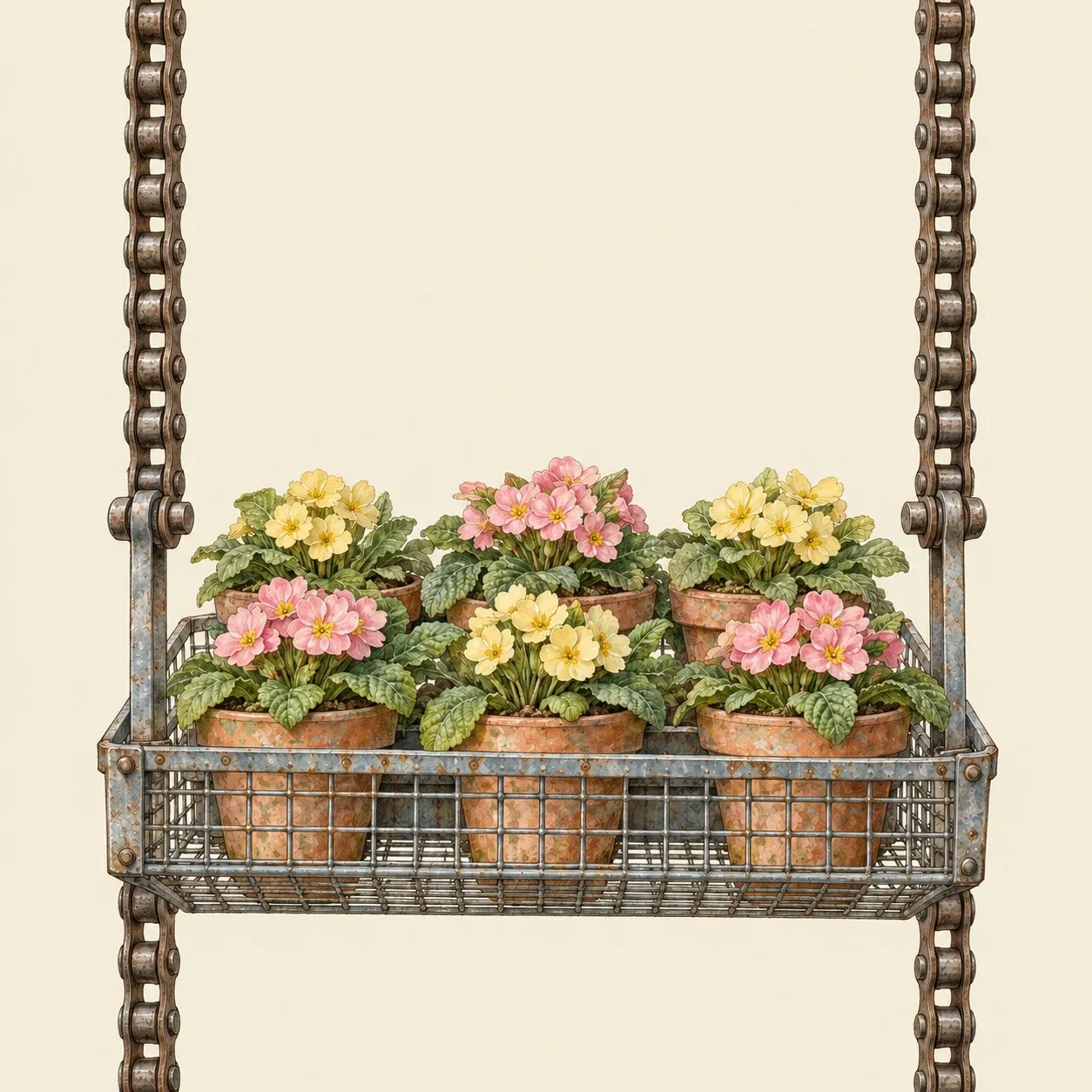 Each tray hangs from one pin on each chain and stays level as it rises, turns over the pulley and comes down.
Two endless chains run side by side up the inside of the tower, one along each wall. Each passes over pulleys near the roof and under pulleys near the floor, so that it forms loops that climb and descend. An electric motor with reduction gearing, set on a platform under the roof, turns one of the upper pulleys and keeps the chains crawling round. Between the two chains hang the trays, each held at its two ends by a pin on which it can swing. Gravity keeps it level all the way round, the way the seats of a big wheel at a fair stay upright, and the pots never spill their soil. In Ruthner’s tower at Wiener Neustadt the trays moved at about 1.8 metres a minute and took around twenty minutes to complete a circuit.
At the bottom of the circuit the trays pass over a long, shallow trough. In Ruthner’s design each one dipped the base of its pots into water or nutrient solution, which soaked up into the soil, and a sloping pan caught the drips and led them back. Other towers sprayed the plants instead. Warm air gathers under a glass roof, so fans pushed it back down to give plants at every height the same climate, and lamps could take over from the sun at night. The gardener sat at the foot of the tower. He could stop the carousel when a tray reached him, plant, prune or pick, and start it again, so that the plants came to him.
How to do it
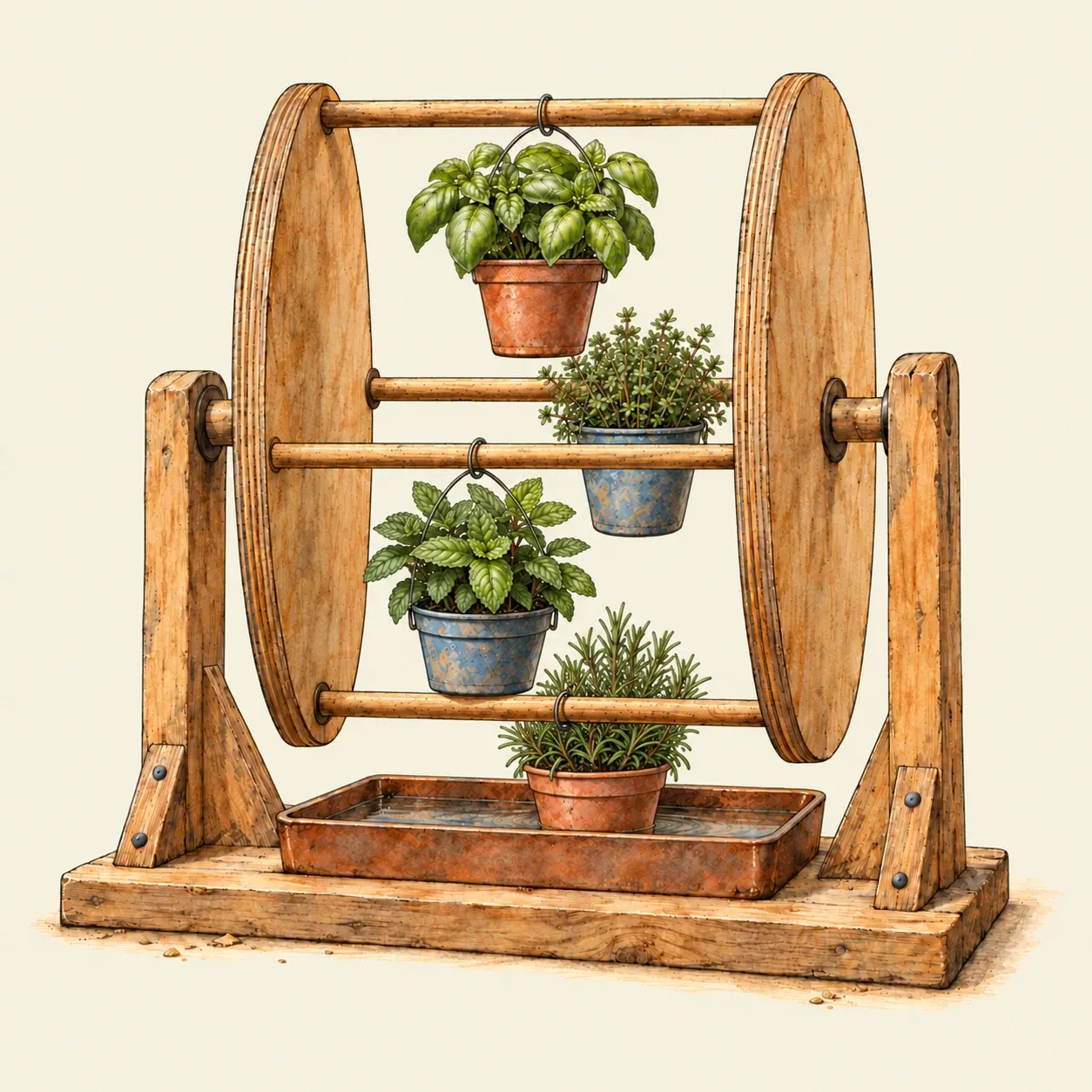 Turning the wheel now and then carries every pot through the window light and down to the water.
This windowsill wheel works on the same principle, turned by hand. You need a wooden base board, two uprights, two plywood discs of the same size, four wooden rungs, two short lengths of dowel for the axles, wood glue and screws, galvanised wire, four small plastic pots with drainage holes, potting compost, herb seedlings and a shallow plastic tray.
Drill four holes in each disc, at the same distance from its centre and a quarter turn apart, to take the rungs. Glue the rungs between the two discs so that the discs stay parallel, and glue an axle to the centre of the outer face of each disc. Nothing crosses the middle of the wheel, so the pots can pass over the top. Drill each upright high enough for the hanging pots to clear the base, making the hole a little wider than the axle so that it turns freely, fit the axles into the holes and screw the uprights to the ends of the base. Bend a wire handle for each pot and hook it over a rung so that the pot hangs free and level. Plant the pots, set the tray under the wheel and pour in enough water to wet the base of the lowest pot. Turn the wheel now and then, so that each pot takes its turn at the top, in the light, and at the bottom, in the water. Adjust a handle if its pot touches the base or another pot.
Use the saw and drill with the wood clamped, keep your hands behind the cutting edge and wear eye protection when drilling. Keep your fingers out of the gap between the rungs and the uprights when you turn the wheel, and turn it slowly so that the pots do not swing into each other. Check that the base is wide enough not to tip when the pots are full of wet compost, and do not stand it on a narrow sill above a drop. If you add a grow lamp, keep the plug and cable well away from the water tray, and do not fit a mains motor to the wheel.
History and evolution
Othmar Ruthner (1912–1991) was a Viennese engineer whose firm built plant for steelworks. In the late 1950s he turned to what he called industrial plant growing, with the aim of raising crops on a small area of ground all year round. His first tower, a small hexagonal prototype, went to work in 1963 at the nursery of the horticultural school in Langenlois, in Lower Austria. At the Vienna International Garden Show of 1964 visitors could enter a round glass tower about 40 metres high, whose trays dipped into a trough of water and nutrient solution at the lowest point.
Towers followed in Austria, Germany and several other countries, used by nurseries for young plants and flowers and by research stations for test crops. The small hexagonal tower of the municipal nursery of Wiener Neustadt, about 10.5 metres high, was built in 1964 and 1965 and ran until 2006. Most did not last that long. The chains moved all day and the larger towers needed fans to push warm air down from the top, so the electricity bills were high, and they rose further with the energy crises of the 1970s. The towers were also expensive to build and to maintain, and none is in use today.
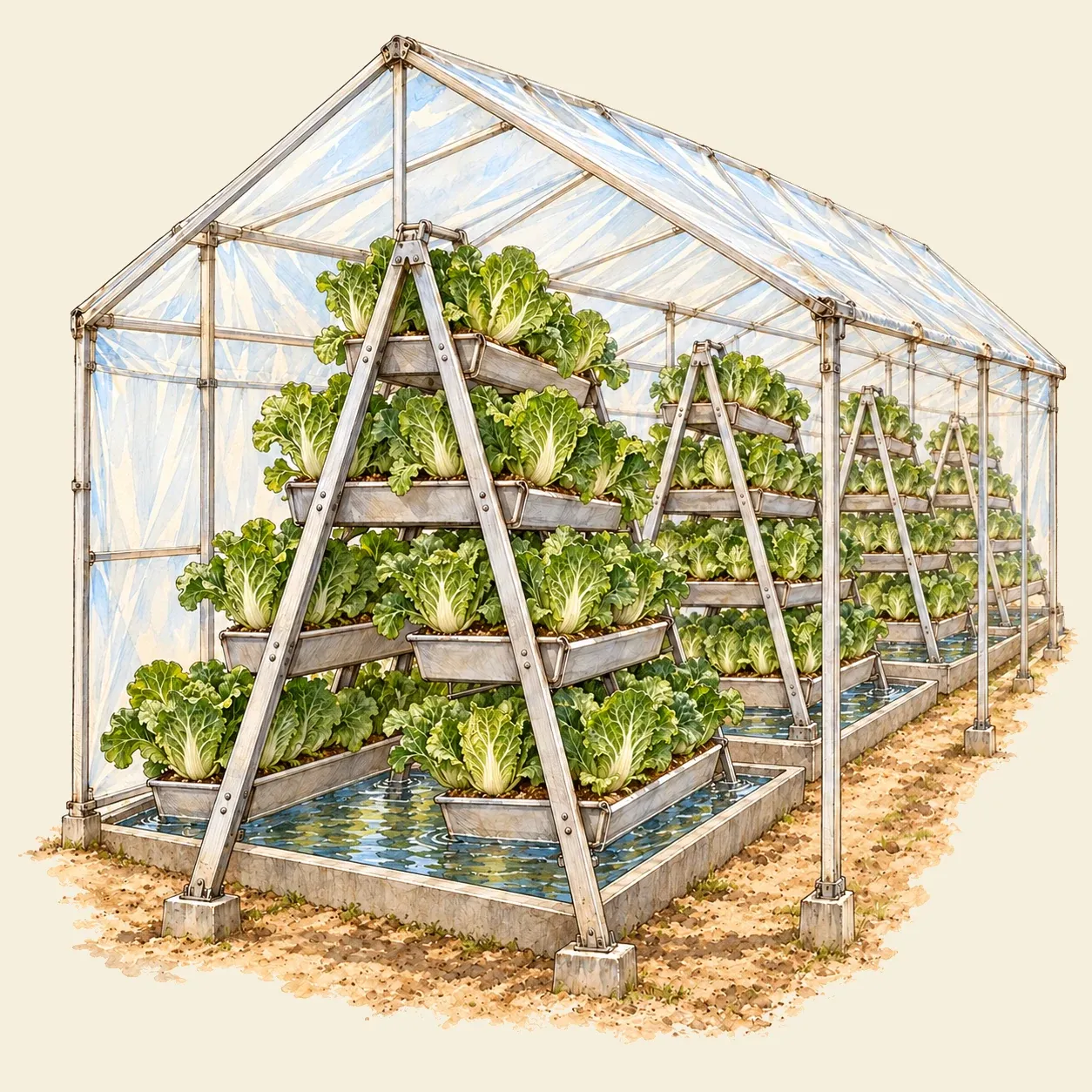 Tall A-frames turn their troughs of leafy vegetables through the sunlight and down to the water.
Half a century later the carousel came back in the tropics. In Singapore the Sky Greens farm went into commercial production in 2012 with rows of tall aluminium A-frames set inside greenhouses. Each frame carries tiers of troughs planted with leafy vegetables such as Chinese cabbage and bak choi, and turns them slowly round so that every tier takes its turn in full sunlight. At the foot of the frame the troughs pass through water, from which the plants take up their feed. The frames are turned by water power, and the farm sells its greens to a supermarket chain in the city.