Sand Casting
A mould packed round a pattern, used once and broken up
Contents
- 1Drag, the lower box
- 2Cope, the upper box
- 3Parting line
- 4Pouring basin and sprue
- 5Cavity left by the pattern
- 6Riser
Sand casting shapes metal by pouring it into a hollow left in packed sand by a pattern. The sand mould is broken up after each casting, while the pattern can be used again and again, so the same object can be made many times. In China, coins were being cast in two-part sand moulds under the Northern Wei, a dynasty that ended in 534.
What it is
Sand casting is a way of shaping metal in a mould made of sand. Sand on its own will not hold a shape, so it is bound with a little clay and water, or with oil, until it packs firmly and keeps every detail pressed into it. A model of the object, called the pattern, is packed round with this sand in a box, then lifted out, and molten metal is poured into the hollow it leaves. When the metal has set, the sand is broken away and can be prepared and used again.
The pattern survives, and that is the strength of the method. In lost-wax casting, used for much ancient bronze, the wax model melts away with every casting, while a single wooden pattern can make many identical sand moulds. Sand also lets the steam and gases of the pour escape through it. The cost is a slightly grainy surface, which is filed or machined where it matters.
Most moulds are made in two boxes, called a flask. The lower box is the drag and the upper box the cope; pins keep them in line when they are put together. The surface where they meet is the parting line, and the pattern is shaped so that it can be drawn out of the sand on both sides of it.
How it works
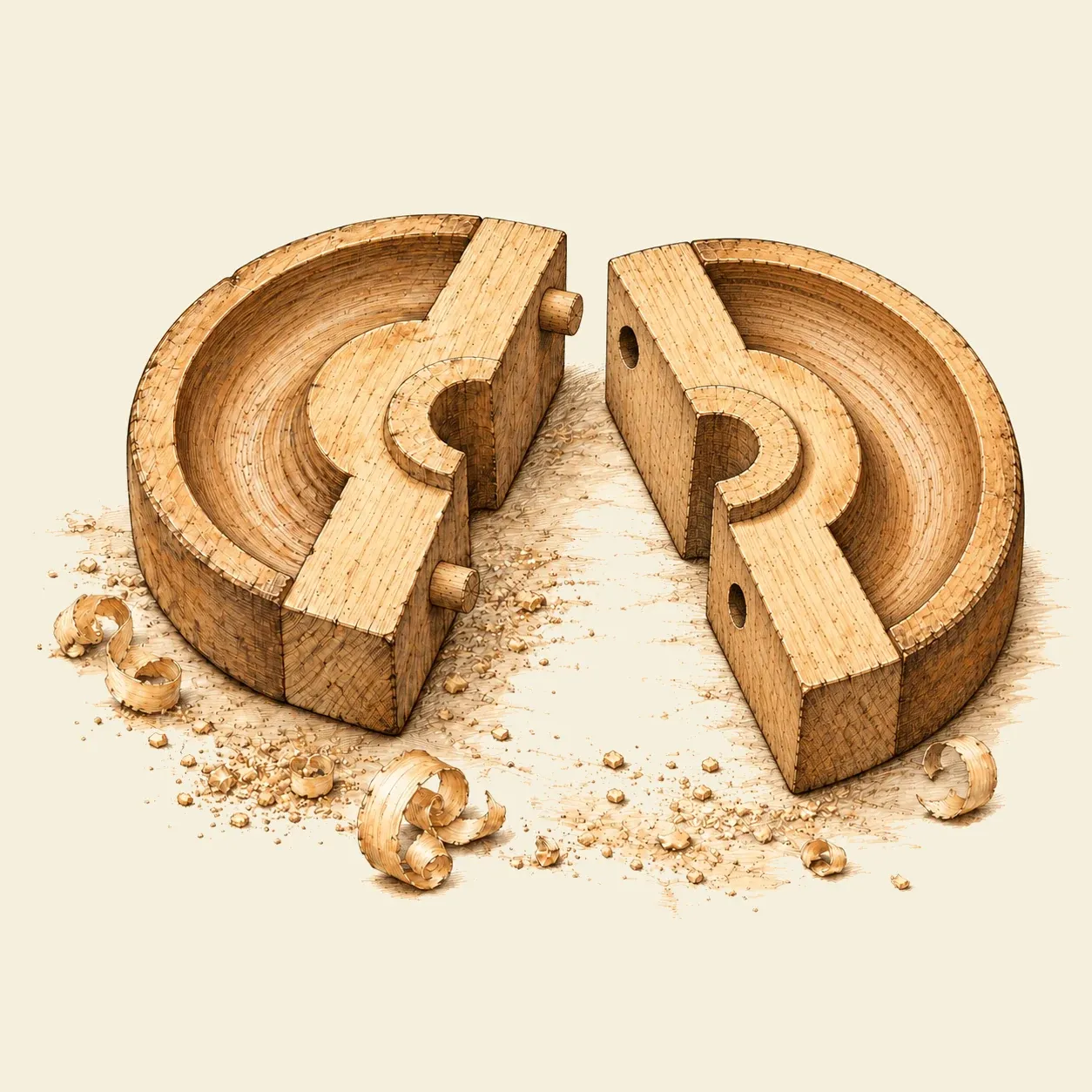 A split pattern for a pulley: each half is moulded in one box, and the pegs keep the two halves in line.
The pattern is not an exact copy of the finished part. It is made a little larger, because metal shrinks as it cools, and the allowance depends on the metal. Its sides are tapered slightly, the draft, so that it can be lifted out without tearing the sand. A pattern for a round part such as a pulley is often split in two along the parting line, with pegs to keep the halves together.
To make the mould, the founder lays half the pattern on a board inside the drag, dusts it with a fine parting powder so the sand will not stick, fills the box with sand and rams it hard. The drag is turned over, the cope is set on top with the other half of the pattern, and that box is rammed in its turn round two round sticks that will leave a sprue for pouring and a riser. The boxes are lifted apart, the pattern is drawn out, a short channel called a gate is cut from the foot of the sprue to the cavity, and the mould is closed again.
Molten metal poured into the basin runs down the sprue and along the gate into the cavity, pushing the air out ahead of it through the riser and through thin vent holes pricked in the sand. The riser is a reservoir. As the casting cools and shrinks, it draws liquid metal from the riser, which is placed and sized to freeze last, so that the hollow forms in the riser and not in the part. A hollow object, such as a pipe or a bell, needs a core: a separate shape of bonded sand set in the mould to keep metal out of the space it fills.
How to do it
This casting uses lead-free pewter, a tin alloy that melts at a much lower temperature than bronze or iron, low enough for a small gas torch, as in school design and technology workshops. It is still hot enough to cause deep burns.
Gather the materials. You need a small wooden flask of two boxes with locating pins, two small clamps or a heavy flat weight to hold it closed, prepared foundry green sand, a fine parting powder such as talc, a rammer or a short round stick, a smooth flat board, a riddle (a coarse sieve), two round wooden sticks for the sprue and the riser, a thin wire, a steel ladle or melting pot with a long handle, a gas torch or burner, and a few hundred grams of lead-free pewter sold for casting. For a first pattern, choose a simple solid shape with no undercuts, such as a disc, a plain medallion or a small block with sloping sides.
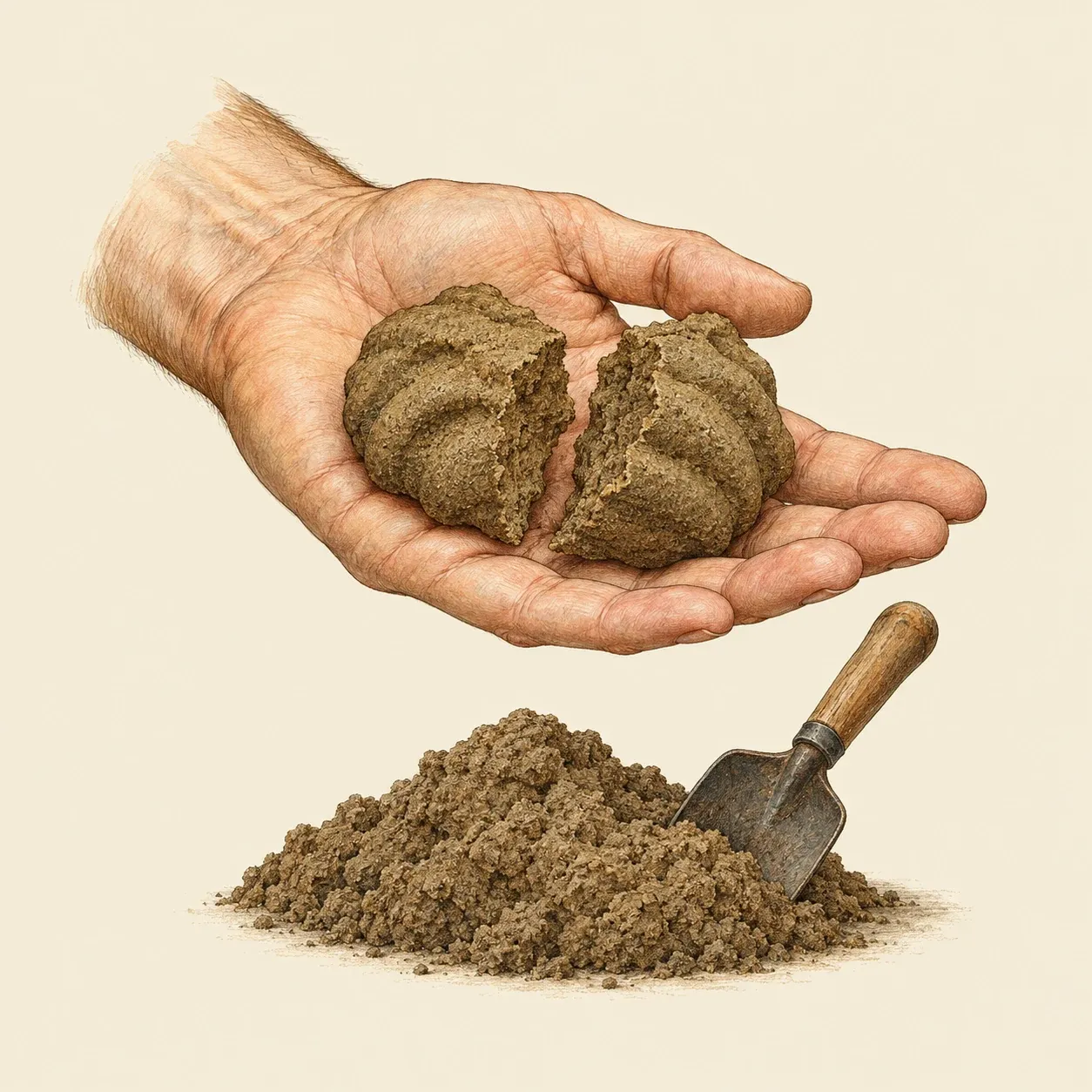 Sand ready for moulding keeps the shape of the fist and breaks cleanly in two without crumbling or sticking to the hand.
Prepare the sand. Riddle the sand to break up lumps. Squeeze a handful: it should hold the shape of your fist and break cleanly in two without crumbling. If it smears or sticks to your hand it is too wet; spread it out to dry a little. If it falls apart, add a little water, mix and wait before testing again.
Ram the drag. Put the drag upside down on the board, set the pattern flat on the board in the middle, and dust it with parting powder. Riddle a layer of sand over the pattern, press it round it with your fingers, then fill the box and ram it firmly all over, more gently near the pattern. Scrape the top flat with a straight edge. Turn the drag over with the board.
Ram the cope. Dust the exposed sand and the pattern with parting powder. Put the cope on the drag, stand the sprue stick on the drag sand a little to one side of the pattern and the riser stick on top of the pattern at its far side, and ram the cope the same way. Pull out the two sticks with a slight twist and shape a small funnel at the top of the sprue. Prick a few vent holes with the wire down to just above the pattern.
Open, draw and close. Lift the cope straight up and set it aside. Tap the pattern lightly so that it loosens, and lift it out cleanly. Cut a shallow gate in the drag from the foot of the sprue to the cavity, mend any broken edge, and blow away loose grains. Put the cope back on its pins and set the closed mould on a bed of dry sand. The pins only keep the boxes in line: clamp the two boxes together, or lay the weight on the cope clear of the pouring basin and the riser, so that the liquid metal cannot lift the cope during the pour.
Melt and pour. Melt the pewter in the ladle with the torch, then skim off the dross with a dry steel spoon. Pour in one steady stream into the basin until metal shows at the top of the riser, without stopping halfway. Leave the mould to cool for several minutes, break it open, cut off the sprue and riser, and file the edges.
Safety. Wear safety glasses with a face shield, leather gloves, a leather or heavy cotton apron, closed leather shoes and long clothes of cotton or wool, as synthetic fabrics melt onto the skin. Every tool and every ingot must be dry and warm before it touches molten metal: water trapped under hot metal turns to steam and throws it out. Use only lead-free pewter sold for casting; never melt lead, old pewter, solder or scrap of unknown composition, as some of them give off toxic fumes.
History and evolution
Sand leaves little trace once a mould is broken, which makes its early history hard to follow. Shaped moulds of stone and clay survive from the beginning of metalworking. In China, coins with designs on both faces were being cast in two-part sand moulds under the Northern Wei, who ruled until 534, replacing the stone and clay moulds of earlier mints. From the Sui and Tang dynasties to the Qing, Chinese mints cast their coins in sand moulds impressed with master coins.
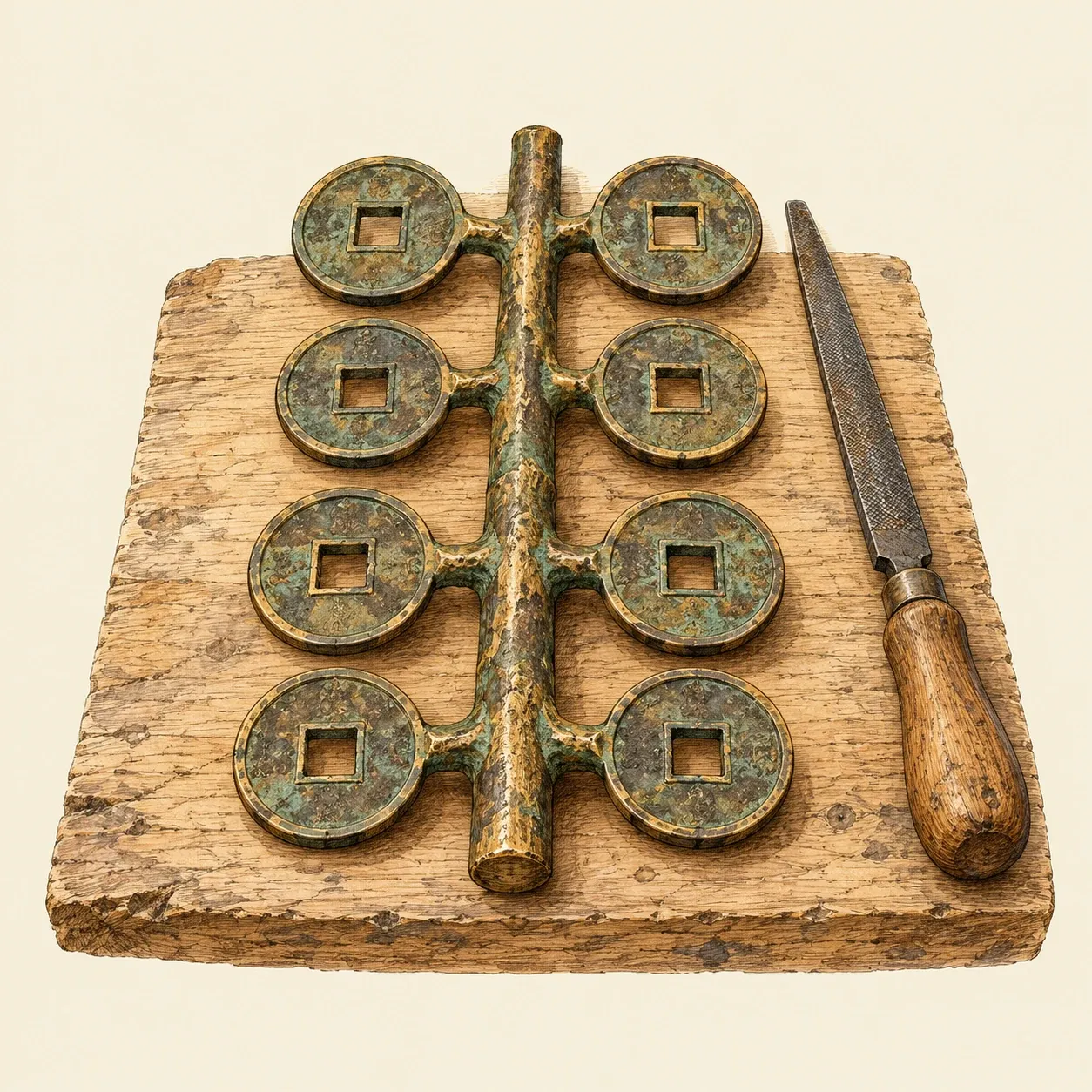 A coin tree: the coins come out of the mould still joined to the metal that filled the channels, and are broken off and filed.
In Europe, the clearest early accounts of sand moulding are found in Renaissance treatises. In 1540 the Pirotechnia of the Sienese founder Vannoccio Biringuccio described moulding small objects in boxes and in frames, with ash dusted over the pattern to keep the sand from sticking. Founders came to use sand for metals of all kinds. In eighteenth-century France, mints poured their gold and silver into frames of sand to make the strips from which coin blanks were cut.
In 1707 Abraham Darby, then working in Bristol, patented a way of casting iron pots in sand alone, without loam or clay, using patterns that could be moulded again and again. Cast-iron pots had been made before, but in loam moulds that had to be built and baked for each casting; Darby’s damp green sand moulds were much quicker to make, and from 1709 the iron of his coke-fired furnace at Coalbrookdale suited them well. Sand casting went on to make the engine blocks, pump bodies, machine frames and pipes of the industrial age, and foundries now pack their moulds with machines.