Kite
A wing held on a line
Contents
- 1Spine, the long upright stick
- 2Cross spar, lashed to the spine
- 3Paper sail glued over the edge string
- 4Bridle, meeting at the towing knot
- 5Tail of paper bows
- 6Flying line on a wooden reel
A kite is a light wing held against the wind by a line. Air flowing past the tilted sail pushes it up and back, and the pull of the line holds it in place. The oldest clear account comes from China in 549, when paper kites carrying an edict on a long cord were flown from a besieged palace city.
What it is
A kite is a craft heavier than air that stays up only while it is tied to the ground. A frame of light sticks holds a sail of paper, silk or cloth. A short cord, the bridle, joins the sail to the flying line, and the person on the ground lets that line out or winds it in on a reel. Many kites also trail a tail. A glider has to keep moving to stay aloft. A kite stays in one place and lets the wind move past it, while the line holds it there.
Kites take many shapes. The flat diamond on two crossed sticks is one of the simplest; others are shaped as birds, or built as boxes with open cells, which at the end of the nineteenth century carried instruments and even people into the air. A kite differs from a parachute, which only slows a fall, and from a windsock, which turns on a mast to show where the wind comes from.
How it works
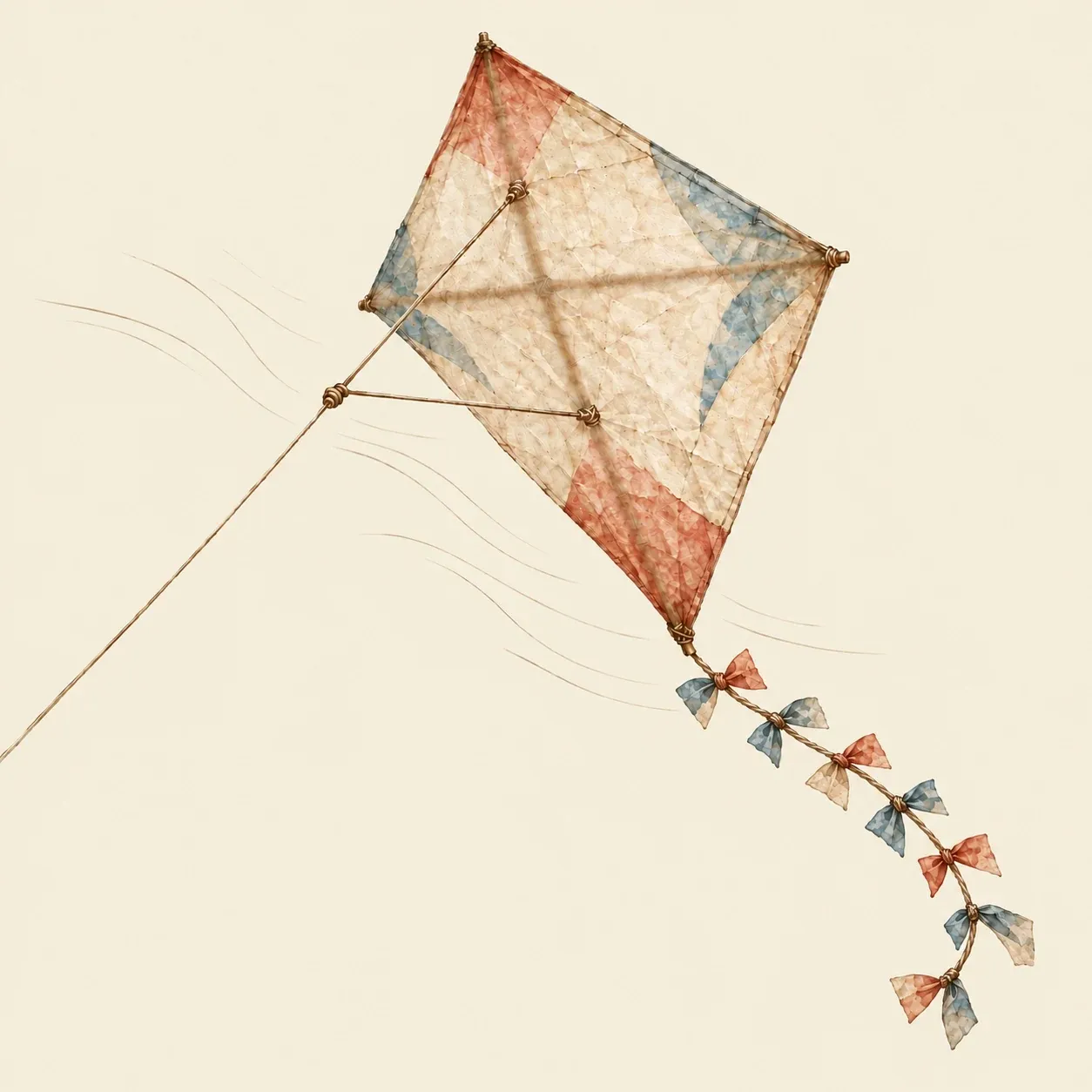 The sail meets the wind at a slant and turns the air downward.
The sail meets the wind at a slant. Air striking its front face is turned downward, and in return the sail is pushed up and downwind. Engineers split that push into two parts: lift, at right angles to the wind, and drag, along it. The kite also has weight. In steady flight the forces balance. The line pulls down and toward the flyer, and that pull together with the weight matches the lift and the drag. When a gust strikes, lift and drag both grow, the kite climbs, and it settles again at a new balance.
The bridle sets the slant. The line is knotted to it at the towing point, and the kite turns about that point like a weathervane on its pin. The weight acts at the centre of gravity and the push of the wind at the centre of pressure, and each tries to turn the kite one way or the other about the towing point. With the knot in the right place these turning efforts cancel, and if a small disturbance tips the sail, the change in the wind’s push turns it back. Moved toward the top, the towing point lets the sail lie flatter, and the kite rides higher on its line but less steadily. Moved down, it turns the sail to face the wind more squarely, and the kite flies lower and pulls harder.
A tail adds drag low at the back of the kite. When a gust swings the kite sideways or starts it spinning, the tail resists and brings the nose back into the wind. A light kite with too short a tail loops and dives, and one with too much tail hangs low. The line itself has weight and catches the wind, so on a long line the kite flies lower than it would on a short one.
How to do it
A small diamond kite needs two straight sticks of split bamboo or thin wooden dowel, strong thin paper, cotton thread, glue and a ball of light line. Make the upright spine a little longer than the cross spar, for instance 60 cm and 50 cm. Cut a shallow notch across each end of both sticks. Lay the spar across the spine about a quarter of the way down from the top, centre it, bind the crossing with thread wound diagonally in both directions, and dab the binding with glue.
Run a thread around the four notches, just taut enough to keep the frame true, and tie it off. Lay the frame on the paper, cut the paper 2 cm outside the thread, fold the margin over the thread and glue it down. The sticks lie on the back of the kite. On the front, tie the bridle from the top of the spine to its bottom, through small holes reinforced with tape, so that it stands off the sail in a loose triangle. Tie a tail of folded paper bows on a string to the bottom point.
Attach the line to the bridle with a loop that can slide, starting a little above the crossing of the sticks. With your back to the wind and a helper holding the kite a few steps away, let the breeze lift it and pay out line as it climbs. If it spins or loops, lengthen the tail. If it hangs low and will not climb, shorten the tail or move the towing point a little toward the top, one small step at a time.
Safety. Fly only in open ground, far from overhead power lines, roads, railways and airfields. If a kite catches on a power line, let go of the line, keep away and call the electricity company: current can run down a damp line and can jump across a gap. Never use wire or metallic line, never fly a wet kite, and come down at the first sign of rain or thunder.
History and evolution
Two Chinese books written before 221 BCE tell of flying birds made by craftsmen. The Mozi says that Gongshu Ban carved bamboo and wood into a magpie that flew for three days without coming down, and the Han Feizi says that Mozi spent three years on a wooden kite-bird that flew for a day and broke. Neither mentions a line. Some modern accounts call these the first kites, while the philosopher Wang Chong, in the first century CE, already accepted that a wooden bird might be flown but rejected the three days without landing. No early kite has survived.
The first account in which a kite clearly hangs on a line dates from 549. Rebels led by Hou Jing were besieging Taicheng, the palace city of Jiankang, today’s Nanjing, and messengers could no longer get through. A man named Yang Che’er proposed making a bird of paper, tying it to a long cord and hiding an edict inside, with a reward promised to whoever carried it to the relief armies. The crown prince flew it from in front of the palace on a north-west wind. The rebels took it for sorcery and shot it down. The episode is told in the History of the Southern Dynasties, completed in 659, and in Sima Guang’s chronicle of 1084. Ten years later, according to the same chronicle, Emperor Gao Yang of the Northern Qi made prisoners fly from a tower, each on a paper kite, and only one, Yuan Huangtou, flew as far as Zimo before he fell. Under the Sui and Tang dynasties paper became the usual material for kites.
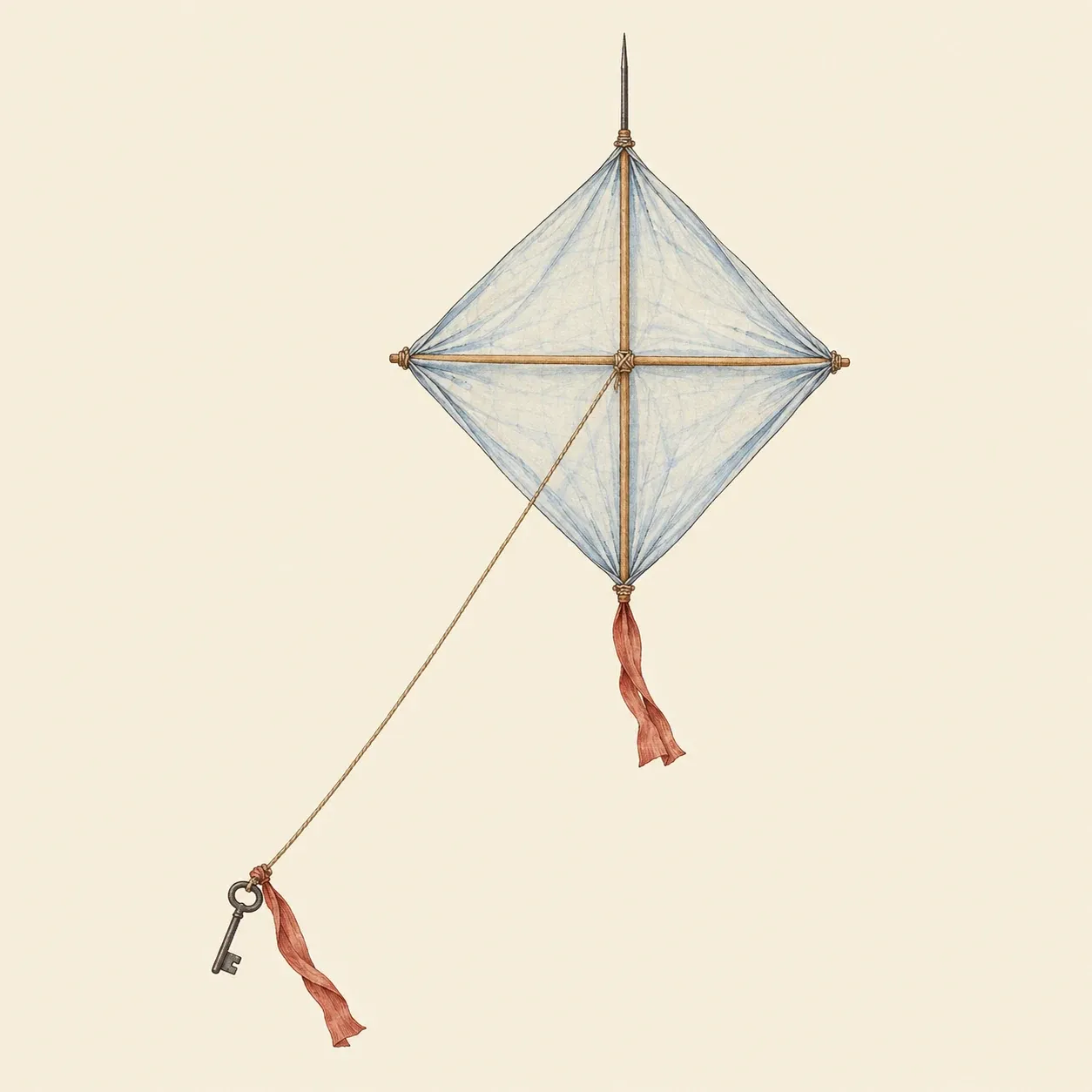 The kite of Franklin’s plan of 1752: a pointed wire at the top and a key where the twine met a silk ribbon.
In Europe, Giambattista della Porta described how to build a kite held on a line in the twentieth book of his Natural Magic, published in 1589. In the summers of 1749 and 1750, Alexander Wilson and Thomas Melvill raised thermometers on kites near Glasgow to measure the air above the ground. In 1752 Benjamin Franklin published a plan for a kite made of two light cedar strips and a silk handkerchief, with a pointed wire at the top and a key tied where the twine met a silk ribbon, to draw electricity from a thunder cloud. In 1804 George Cayley flew a model glider that was in effect a kite fixed on a pole, with a cross-shaped tail.
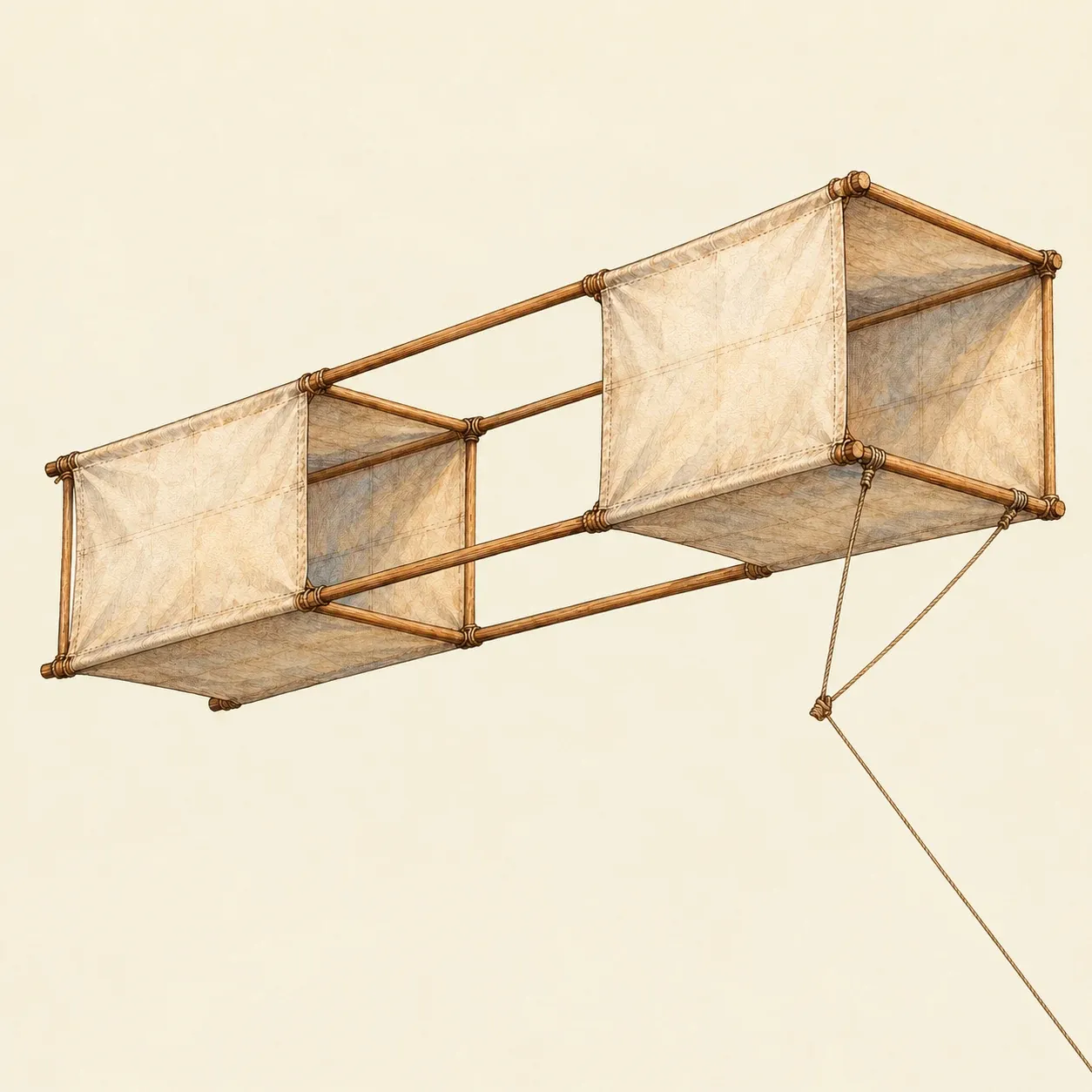 A box kite of the 1890s: two open cells of cloth on a light wooden frame.
In the 1890s Lawrence Hargrave, in Australia, developed the box kite, and on 12 November 1894 a train of four of them, moored to sandbags, lifted him off the beach at Stanwell Park. The same year, at the Blue Hill Observatory near Boston, William Eddy flew a train of kites carrying recording instruments to about 1,400 feet. In 1899 the Wright brothers tested their method of twisting the wings to steer on a biplane kite with a span of five feet, before building their gliders. The United States Weather Bureau flew box kites on piano wire with recording instruments until June 1933, when its last kite station closed and aircraft took over the soundings.