Vernier scale
Reading between divisions
Contents
- 1Fixed main scale
- 2Sliding scale
- 3Sliding zero
- 4Aligned marks
A sliding scale turns the alignment of two marks into a fraction of a main scale division.
What it is
A graduated rule shows whole units. A vernier adds a short scale that slides alongside it, allowing a fraction of a division to be read. The principle works for angles as well as lengths.
How it works
In a metric model the fixed marks are 1 mm apart. Ten vernier intervals span 9 mm, so each is 0.9 mm long. The difference between the two spacings is 0.1 mm.
If the sliding zero is past 2 mm and its third mark after zero (the fourth mark including zero) lines up with a fixed mark, add 0.3 mm: the reading is 2.3 mm. This mark is at 2.3 + 3 × 0.9 = 5 mm. The reading increment alone does not guarantee accuracy: play, line thickness and zero error matter too.
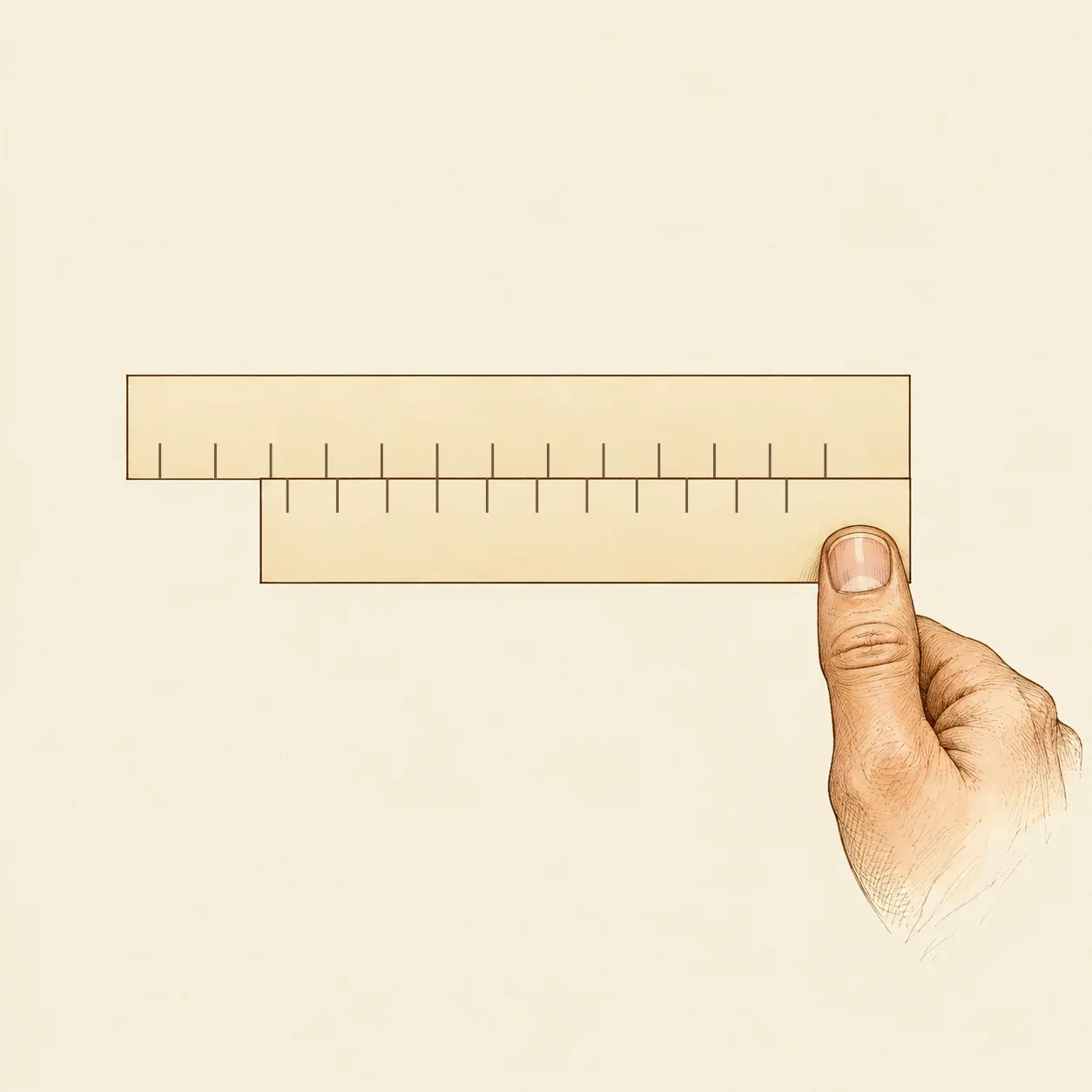 A sliding strip runs beside a fixed rule.
On a caliper, one jaw is fixed to the main scale and the other to the slider carrying the vernier. The moving zero therefore tracks the separation between the measuring faces. Clean the faces, close the jaws gently and check that the zeros coincide. To measure a part, bring the faces into contact without tilting them and with consistent pressure. A zero error offsets the readings; play in the slider can tilt the jaw and change its contact with the part.
Read squarely above the graduations. If the scales lie at different heights, an oblique view shifts their apparent alignment: this is parallax. The 0.1 mm resolution here is the increment distinguished by the graduations. Trueness concerns bias relative to a reference and also depends on the instrument’s condition and calibration. Fine graduations cannot correct a worn jaw or a false zero.
How to do it
Draw a fixed scale from 0 to 12 mm on paper: twelve intervals and thirteen marks. On another strip divide 9 mm into ten equal intervals with eleven marks. Slide the strips edge to edge. Place the moving zero at 2.3 mm and find the alignment of the third mark after zero. Enlarging the scale makes the idea easier to see, but does not make a calibrated instrument.
History and evolution
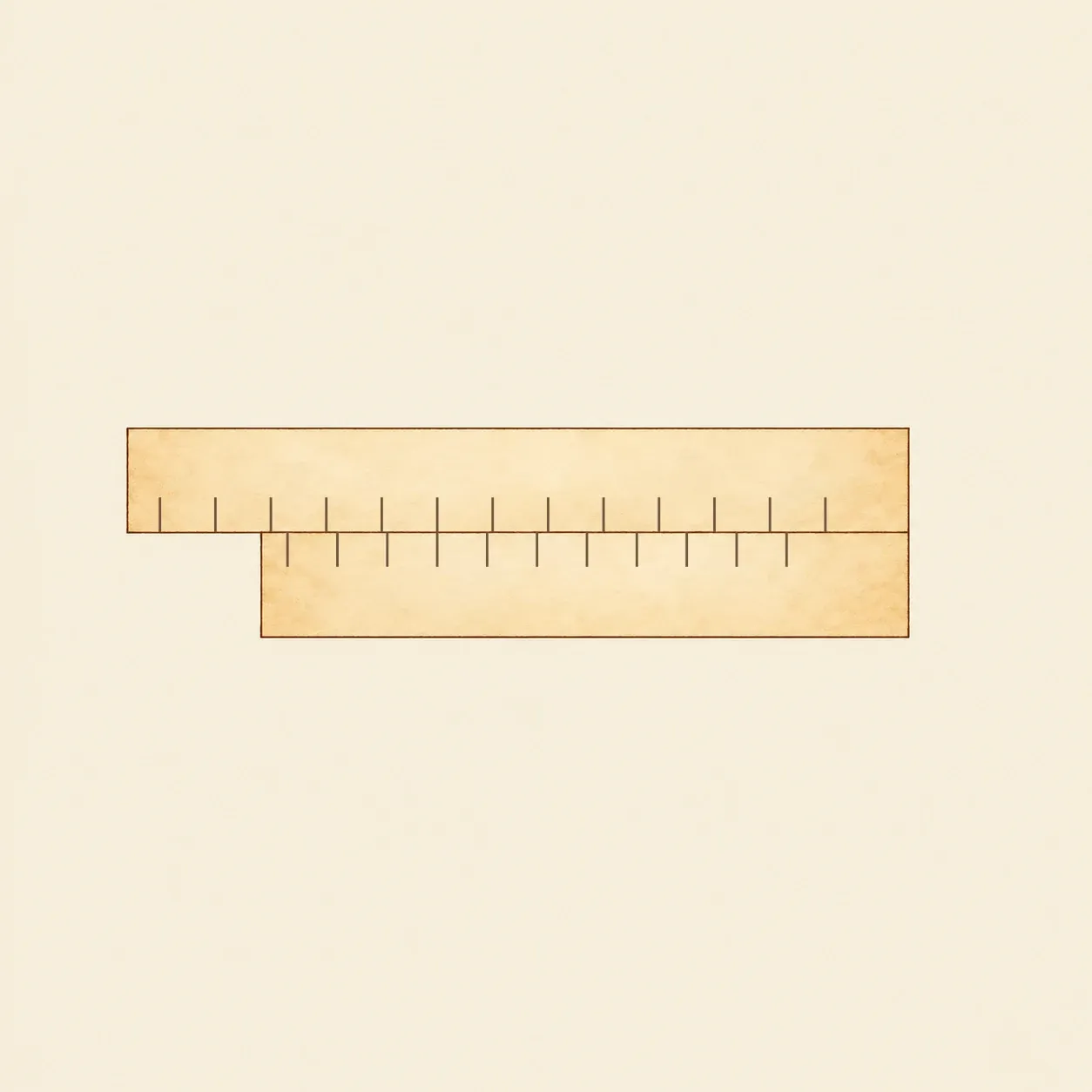 Two scales and a pair of aligned marks.
Pedro Nunes used several fixed concentric arcs with different divisions, seeking a suitable mark on one of them for the reading. In 1631 Pierre Vernier described a movable auxiliary scale for angular instruments. A vernier obtains the fraction from the relative displacement of two scales. The word “nonius”, still used for this scale in several languages, comes from Nunes’s Latinized name; the two historical devices have different constructions. The sliding principle was later used on rules and calipers. The Science Museum holds a much later brass workshop caliper with steel jaws.