Neonatal incubator
A warm, closed box for babies born too early
Contents
- 1Glazed lid with knobs
- 2Cushioned upper compartment where the baby lay
- 3Stoneware hot-water bottles
- 4Low air inlet, half closed by its small door
- 5Gap in the partition, with a wet sponge and a thermometer
- 6Air outlet tube with its little vane
A neonatal incubator is a closed box of warm, moist air in which a newborn, most often one born too early, is kept and watched. A baby born before term loses heat faster than it can make it, and many once died of cold in their first days. A double-walled tub warmed with water was in use at the St Petersburg foundling hospital by 1835, and Paris doctors made the closed incubator a hospital tool from 1880.
What it is
A baby born before term cannot hold its body temperature steady and cools quickly in an ordinary room. In nineteenth-century maternity wards, many such babies died in their first days from cold, infection or weight loss. An incubator is a closed box that keeps the air around the baby warm and steady while the staff can see the child at all times.
The simple incubator tried at the Paris Maternité in 1883 shows the parts of an incubator in their plainest form. It was a thick-walled wooden box divided into two floors by a horizontal partition. The lower floor held stoneware bottles of hot water, slid in through a door along the side. The upper floor, lined with cushions, held the baby under a glazed lid with two knobs to lift it. Air came in through a small door at one end of the lower floor and left through a tube high in the same end.
How it works
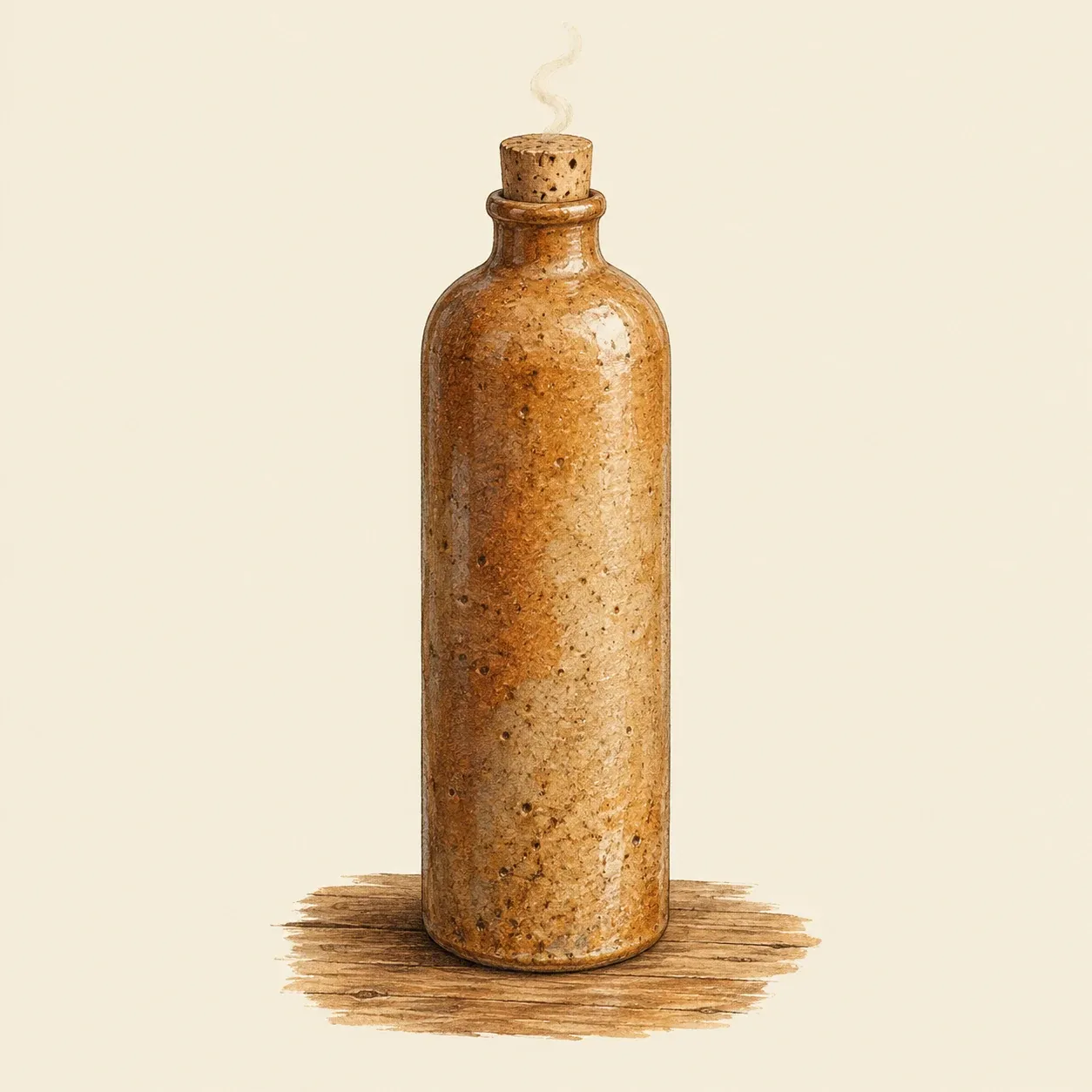 Stoneware bottles of boiling water, changed one at a time, kept the incubator warm.
The heat came from stoneware bottles filled with boiling water. The nurse warmed the box with a few bottles before the baby was laid inside, then refilled the coolest one with boiling water every few hours, so that the bottles never all cooled at once. If the box grew too warm, she lifted the glass lid slightly for a few moments. The thick wooden walls slowed the loss of heat, and the larger Maternité model had walls filled with sawdust.
The box was not sealed, because the baby needed fresh air. Cool air entered at the bottom of one end through a door smaller than its opening, so that it never closed completely. It flowed along the hot bottles, rose through the gap at the far end of the partition and passed back over the baby before leaving by the outlet tube. A small vane inside the tube turned in the slightest draught and showed the nurse that air was moving. In the gap between the floors sat a sponge soaked in water, which moistened the air, and a thermometer, read through the glass.
A modern incubator does the same work with other means. An electric heater and a fan warm and circulate the air, a water container adds humidity, a valve lets in oxygen when the baby needs it, and ports in the clear walls let nurses reach in without opening the whole box.
How to do it
This model shows how a two-floor box with hot water underneath holds a steady warmth and why it needs refilling. It is for measurements only. No baby, animal or other living thing must ever be put in it. Incubators for newborns are regulated medical devices, run by neonatal nurses and doctors.
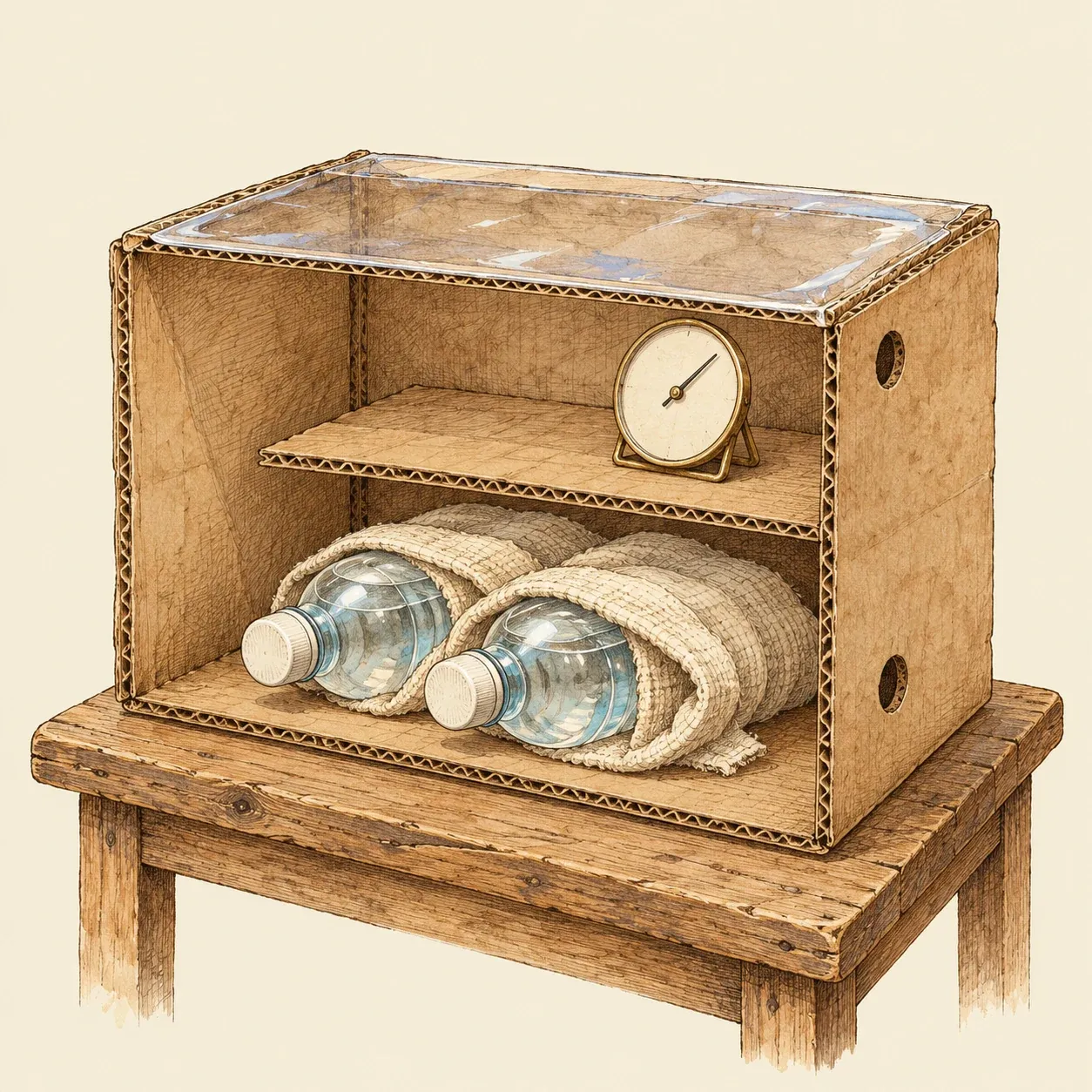 Warm air rises through the gap at the far end of the partition, as in the 1883 incubator.
Take a sturdy cardboard box about 40 cm long and cut a piece of card to make a horizontal shelf 12 cm above the bottom, leaving a gap 5 cm wide at one end. Tape it in place. Cut a hole 2 cm across low down in the opposite end, and another high up in the same end. Replace the top of the box with a sheet of clear plastic taped along one edge so that it lifts like a lid. Fill two plastic bottles with hot water from the tap, screw the caps on firmly, wrap them in a tea towel and lay them on the lower floor. Put a kitchen thermometer on the upper floor where you can read it through the lid.
Close the lid, note the room temperature, then read the thermometer every 15 minutes for two hours and write the readings down. The temperature rises, levels off and then slowly falls as the water cools. Repeat with the box wrapped in several layers of newspaper, which act like the sawdust of the Maternité incubator, and compare the two sets of readings. Then refill one bottle when the temperature has fallen by 2 °C and see how the curve changes. A small strip of tissue paper held at the top hole shows the air leaving.
History and evolution
Before incubators, a premature baby might be kept in a basket padded with blankets and warmed with hot-water bottles. By 1835 the Imperial Foundling Hospital in St Petersburg warmed such babies in a double-walled metal tub, made at the suggestion of the court physician Johann Georg von Rühl, with warm water in the space between the walls. A modified version was later used at the Moscow Foundling Hospital. In 1857 Jean-Louis-Paul Denucé, a physician in Bordeaux, published the description of a “cradle incubator” for babies born before term: a large zinc tub with a smaller one inside, the two joined at the top edge, with hot water poured into the space between them through an opening and drained out at the bottom. In Leipzig, the obstetrician Carl Credé used a double-walled tub in which hot water circulated from the 1860s.
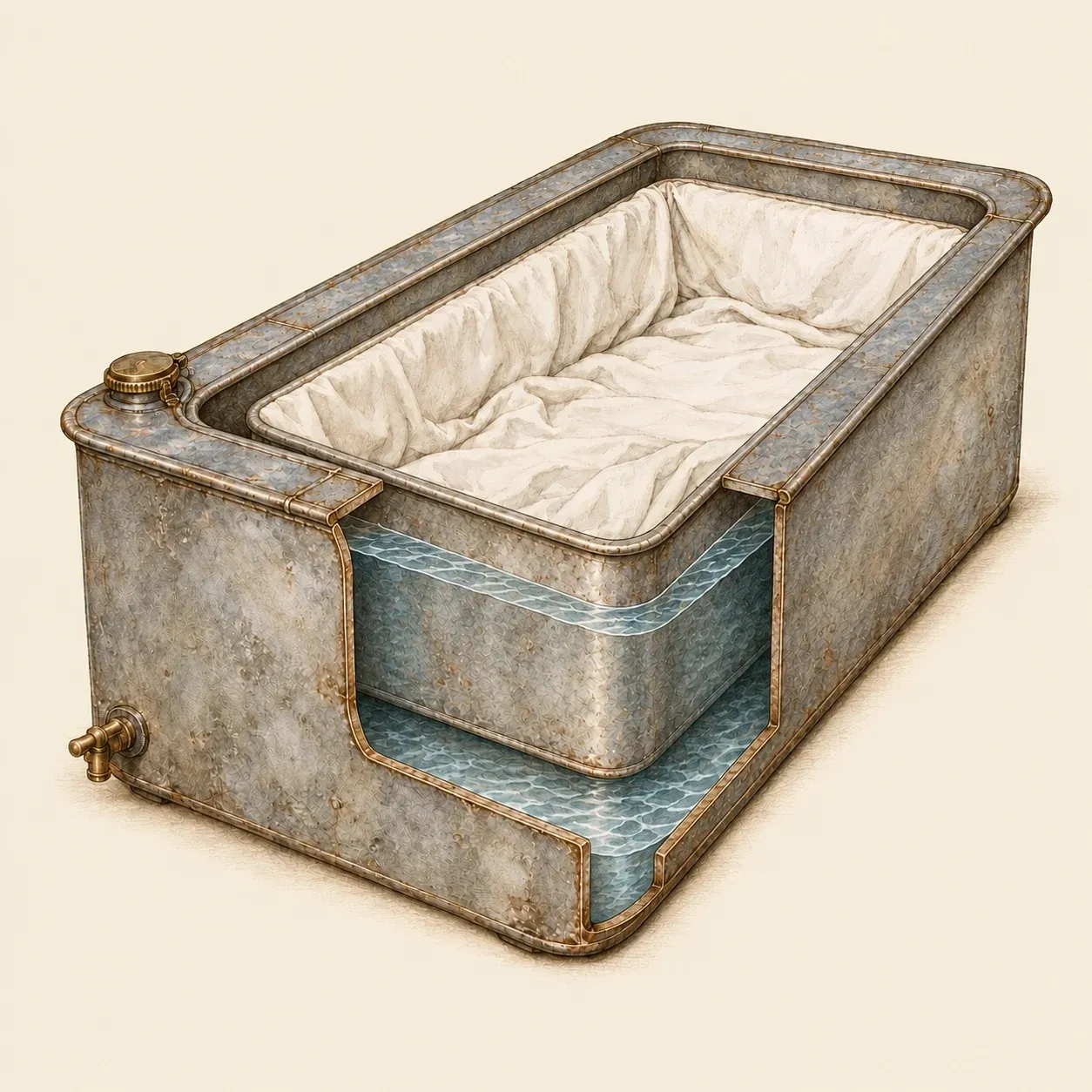 In Denucé’s incubator, hot water filled the space between two zinc tubs set one inside the other.
In Paris, the obstetrician Stéphane Tarnier looked for a way to save the many premature babies who died of cold on the wards of the Maternité. After seeing the chicken incubators at the Paris zoo in 1880, he had Odile Martin, who made them, build a version for the infants of the Maternité. It held several babies above a tank of hot water heated by a lamp through a thermosiphon. Tarnier and his student Pierre Auvard then designed the simpler box warmed by stoneware bottles, which any joiner could make for a family at home. Auvard reported in 1883 that the incubator had halved mortality. Credé objected that warming tubs were nothing new, and closed boxes were criticised for poor ventilation.
In the 1890s Alexandre Lion in Nice built incubators with heating that regulated itself and forced ventilation, and in 1896 he showed premature babies in incubators at the Berlin industrial exhibition. Such shows, among them those of Martin Couney in the United States, drew crowds for decades. In Chicago, Julius Hess introduced an electrically heated bed in 1914 and set up a station for premature babies run by specially trained nurses. In 1947 the Air-Shields company released the Isolette Model C-35, a closed incubator with clear walls designed by the Philadelphia paediatrician Charles Chapple. Its tight seal made it easy to give high concentrations of oxygen, and in the 1940s and 1950s this caused retrolental fibroplasia, a disease of the retina that blinded thousands of premature babies. After a cooperative study in 1953 and 1954 tied it to oxygen, its routine use was restricted.