Synthetic plastics
Materials built from long molecules made in chemical plants
Contents
- 1Press ram
- 2Heated platens
- 3Lower half of the steel mould
- 4Upper half of the steel mould
- 5Charge of moulding powder
- 6Moulded part
Synthetic plastics are materials made of very long molecules built by chemists from small ones, which can be shaped while soft and then keep their form. Some soften again each time they are heated; others set for good in the mould. The first fully synthetic plastic was Bakelite, which Leo Baekeland made from phenol and formaldehyde in 1907. Today more than 400 million tonnes of plastics are produced each year, mostly from oil and natural gas.
What it is
A plastic is a material made of polymers, molecules built as long chains of small units, often the same unit repeated many times over, sometimes several different ones. The length of these chains and the way they lie together let a plastic be shaped while it is soft and keep its form once it has set. Nature makes polymers too: cellulose in wood and cotton, the proteins of horn, the resin of shellac and the gum of rubber trees.
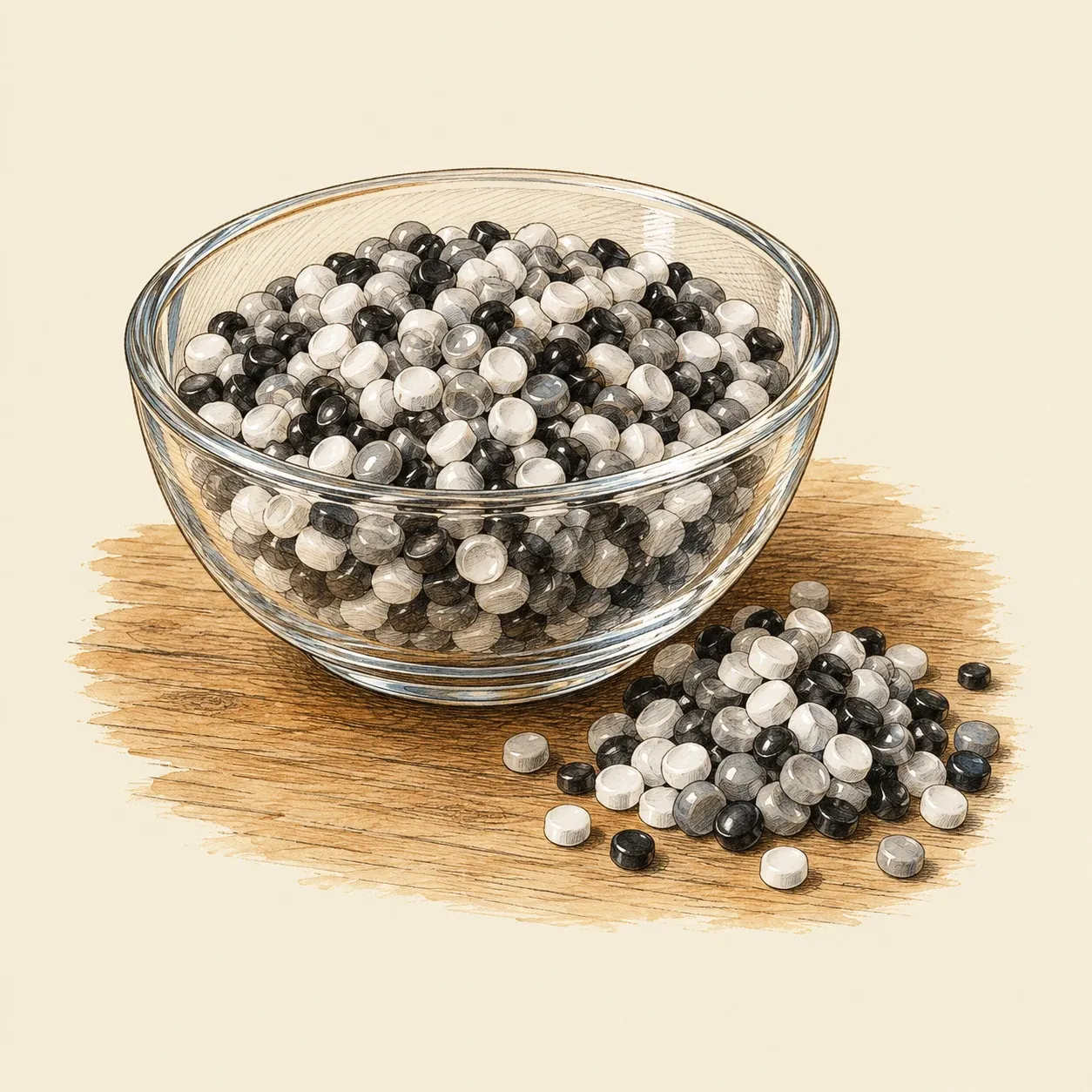 Plastics leave the chemical works as granules or powder, ready to be melted and moulded.
Plastics fall into three groups. Natural plastics are used much as they are found, like horn or shellac. Semi-synthetic plastics are natural polymers changed by chemistry, like celluloid, made from cellulose, or vulcanised rubber. In fully synthetic plastics, the polymer itself is made by chemical synthesis from small molecules instead of being taken from a natural polymer, even when fillers such as wood flour are added. Bakelite was the first; polyethylene, PVC, polystyrene and nylon followed.
More than 400 million tonnes of plastics are made each year, most of them from fossil fuels, mainly oil and natural gas. Their lightness and low cost come with a problem of waste: studies by the OECD and by Roland Geyer’s team both found that only a small share of plastic waste is recycled. Most of the rest is buried, burnt or lost to the environment.
How it works
Plastics split into two families by how their chains behave in heat. In a thermoplastic, the chains are held to each other only by weak forces. Heating loosens them, so the material softens and flows, and it hardens again as it cools; it can be remelted and reshaped many times. Polyethylene, PVC, nylon and most packaging are thermoplastics. In a thermoset, the chains are joined to each other by chemical bonds into one network while the part is being moulded. Once that has happened, the material cannot melt again: heated, it chars instead. Bakelite and melamine are thermosets.
The two families are shaped differently. Thermoplastics are melted and forced into a cold mould by injection, pushed through a shaped opening as rods, tubes and film by extrusion, or blown into hollow shapes such as bottles. Thermosets are moulded only once. In compression moulding, the usual method for Bakelite, a measured charge of moulding powder is placed in a two-part steel mould held between heated platens. The ram of a press closes the mould, the heat and pressure soften the powder so that it fills the cavity, and the same heat completes the reaction that sets it.
The moulding powder of Bakelite was the resin mixed with a filler, usually wood flour, which let it mould faster. Moulders pressed it in hydraulic presses into radio and telephone cases, electrical plugs, sockets and switches, saucepan handles, ashtrays and boxes, objects that had to stand heat and keep electricity in its wires.
How to do it
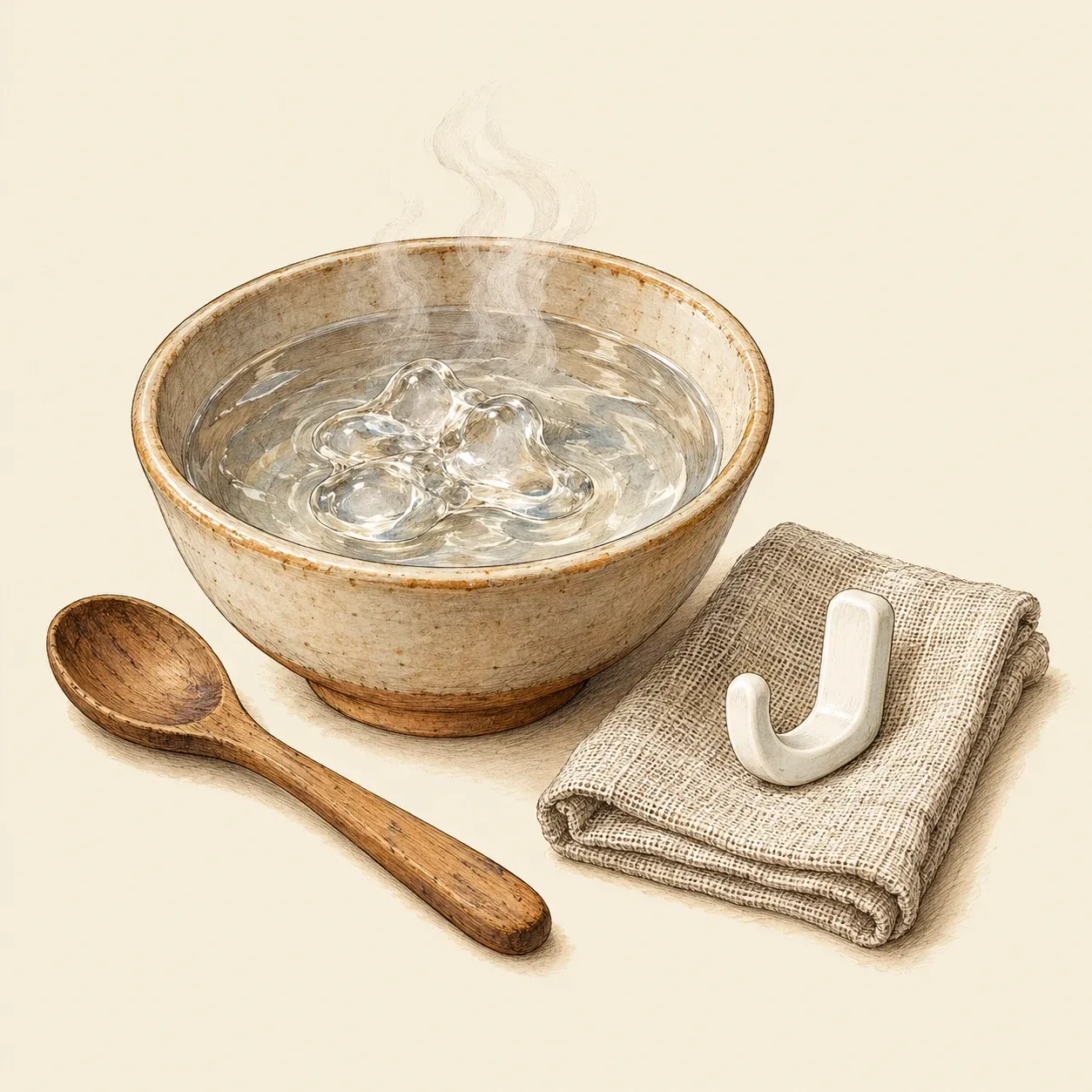 Polycaprolactone pellets turn clear in hot water and can then be shaped by hand into a hook.
A thermoplastic that softens in hot water shows what makes plastics workable. Polycaprolactone, a synthetic polyester made by Wallace Carothers’s team at DuPont in the early 1930s, melts at about 60 °C and is sold in pellets for modelling and repairs, often under names such as polymorph. Bring water to the boil, pour it into a heatproof bowl and let it cool for a few minutes to about 60 °C. Tip in a spoonful of pellets and wait until they have all turned from white to clear and stuck together into one lump.
Lift the lump out with a spoon or tongs and wait until it is cool enough to touch. Knead it and shape it: roll it into a rod, wrap one end round a pencil to make a hook, or press it round the end of a loose drawer handle. It turns white again and sets hard as it cools; a dip in cold water speeds this up. If the shape is wrong, put it back into hot water and start again. A thermoset could not be reworked this way.
Water just off the boil scalds, and the inside of the lump stays hot after the outside feels cool. Handle the pellets with a spoon or tongs, test the lump against the back of your hand before kneading it, and keep the bowl out of reach of young children.
History and evolution
People shaped natural plastics long before chemistry made new ones. Horn and tortoiseshell were softened by heat and pressed into shape, and shellac, gutta-percha and vulcanised rubber were moulded in the nineteenth century.
The first plastics made in a factory were semi-synthetic. In 1862 Alexander Parkes showed Parkesine, made from cellulose nitrate, at the International Exhibition in London, but the company he founded in 1866 to make it failed. In 1869, in the United States, John Wesley Hyatt softened cellulose nitrate with camphor and obtained celluloid, which could imitate ivory, horn and tortoiseshell. Hyatt and his brother began making it at Albany in 1870.
 A telephone of the 1930s, one of the objects made of moulded Bakelite.
Leo Baekeland, a Belgian chemist working in New York, was looking for a substitute for shellac, a natural resin used as an electrical insulator. In 1907 he found how to control the heat and pressure applied to a resin made from phenol and formaldehyde, which then came from the distillation of coal tar and from wood spirit. The result, mixed with fillers, was a hard plastic that could be moulded and would not melt again. Bakelite was the first fully synthetic plastic. Baekeland filed his patent in 1907 and it was granted in 1909. The material found its first large markets in electrical goods, radios and cars.
Chemists then learned what polymers were. Hermann Staudinger argued that they are giant molecules, or macromolecules, and received the Nobel Prize in Chemistry in 1953 for this work. Chemical firms set out to design new plastics, and in 1935 Wallace Carothers at DuPont invented nylon, a synthetic substitute for silk. Production of plastics rose steeply after the Second World War.