Zipper
Two rows of teeth locked and unlocked by a slider
Contents
- 1Fabric tape with a corded edge
- 2Identical metal elements
- 3Projection and hollow of one element
- 4Slider with a Y-shaped channel
- 5Central wedge of the slider
- 6End stop
A zipper closes an opening with two fabric tapes, each carrying a row of identical small elements. A slider running along them brings the rows together at an angle so that each element locks into the next, and a wedge inside it parts them again. Whitcomb Judson of Chicago applied in 1891 for a patent, granted in 1893, on the first fastener of interlocking clasps worked by a slider. Gideon Sundback replaced the hooks with identical nesting elements in a patent granted in 1917, the form still in use.
What it is
A zipper, or slide fastener, joins two edges of cloth or leather that must open and close many times. Each edge carries a woven tape, and along the inner border of each tape runs a row of small elements, often called teeth. All the elements are alike, and those of one tape sit opposite the gaps of the other. A slider runs along both rows. Pulled one way it locks them into a single flexible band, and pulled back it parts them.
In Gideon Sundback’s design, patented in 1917, each tape has a thickened, corded edge. Every element is stamped from flat metal with two jaws that are pressed shut around the cord, so it cannot slide or come off. Its head has a projection on one face and a matching hollow on the other. Stops at each end keep the slider on the tapes.
How it works
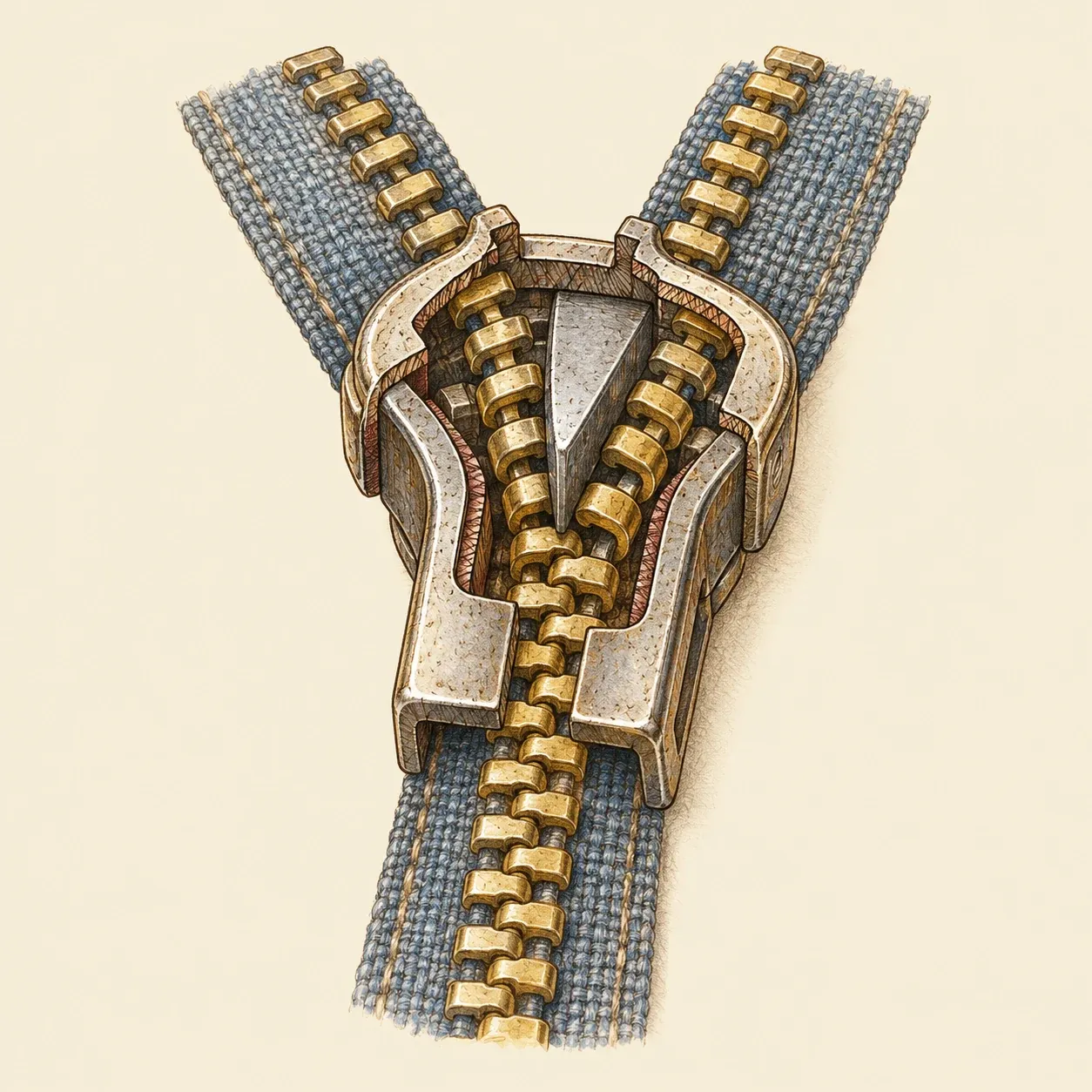 The arms of the Y bring the rows in at an angle; at the bottom of the channel they leave locked together.
Inside the slider, the channel has the shape of a Y. Each row of elements enters one arm, and the two arms meet in a single channel. As the slider moves up, the arms guide the two rows towards each other at an angle. Because the elements of the two tapes are staggered, each one swings into the gap between two elements of the other row. Its projection slips into the hollow of the element beside it. When the rows straighten in the narrow part of the channel, the projections are trapped in the hollows and the elements can no longer come apart.
The interlocking holds because of that angle. Judson’s patent, filed in 1891, already describes clasps that can engage only when they meet at an angle to the line of strain. Once a closed zipper is flat, a pull across it presses each element against its neighbours and the rows stay locked. To open it, the slider moves down. The wedge at the top of the channel, between the arms, pushes between the rows and bends them apart again at an angle, and each element lifts out of the hollow it was nested in.
A zipper therefore only works with its slider. The slider of a zipper that splits behind it has usually been spread open by wear and no longer presses the two rows into the narrow channel. An element that is bent or missing breaks the sequence, and the rows part from that point.
How to do it
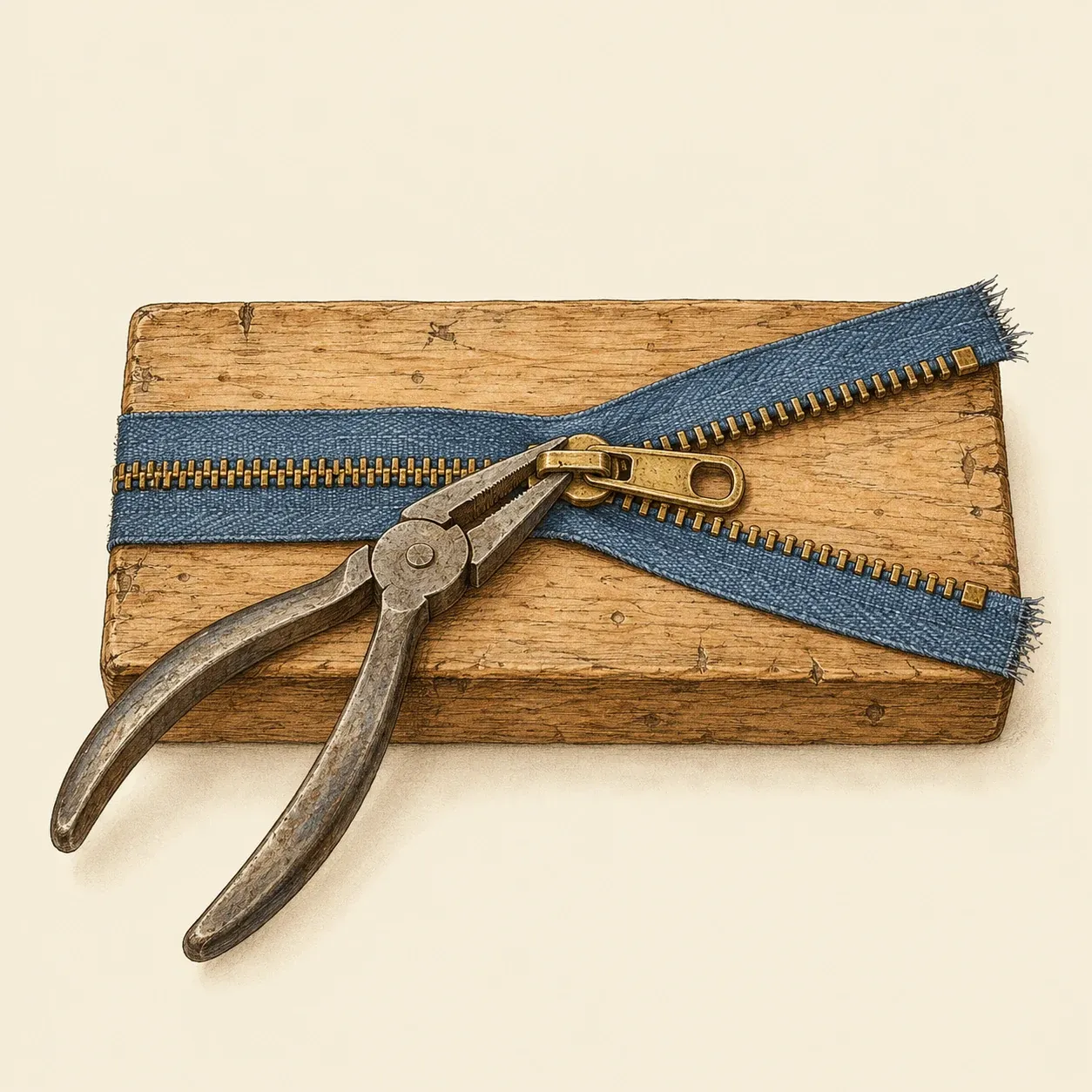 Squeezing the narrow end of a worn slider brings its sides back together.
A zipper is made by machines that stamp the elements and clamp them on the tape, but anyone can take one apart to see how it works and repair a common fault. Cut an old metal zipper out of a worn garment. Close it, pull the two tapes apart across the closed part, then fold it almost back on itself: the rows stay locked, as Sundback’s patent says they should. Open it a little and look into both ends of the slider: at the wide end the wedge holds the rows apart, and at the narrow end they come out nested together. Look along the edge to see the elements alternating between the tapes, and pry one element off its cord with a small screwdriver to see its jaws, its projection and its hollow.
If a zipper opens behind the slider, the slider has spread. Move it to the top, then squeeze its two sides together at the narrow end with flat-nosed pliers, a little at a time, testing after each squeeze. Too much pressure jams it or cracks it. If the top stop is missing and the slider runs off, a new stop clamped onto the tape just above the last element will keep it on.
Safety: pliers and screwdrivers can pinch or slip, so keep fingers clear of the jaws and point blades away from you. Sliders, stops and loose elements are small enough for a young child to swallow; keep them out of reach. If a zipper catches skin, do not pull it; ask for help, and seek medical care if it cannot be freed easily.
History and evolution
Elias Howe, who had patented a sewing machine, received a patent in 1851 for fastenings for garments: a series of clasps joined by a cord and pulled together along an opening. It had no slider.
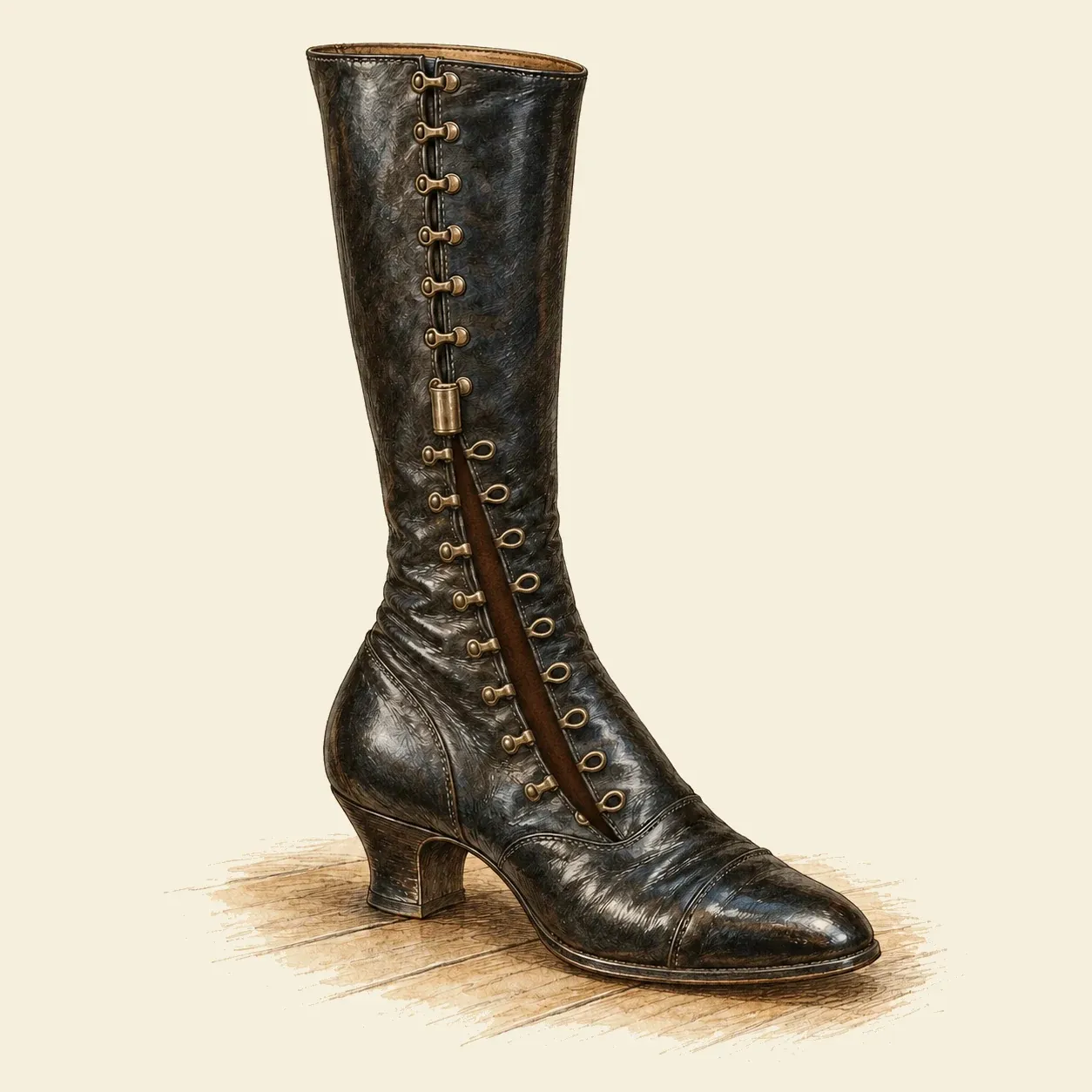 An early slide fastener closed a row of hook clasps on a boot in one movement.
The first fastener worked by a slider came from Whitcomb L. Judson, an engineer from Chicago. His patent for a clasp locker or unlocker for shoes, filed in 1891 and granted on 29 August 1893, describes a guide that engages or releases a whole series of clasps in one continuous movement. He designed it to close tall shoes, and suggested it for mail bags, belts and seams. The fasteners were made by hand until 1902, when Judson patented a machine to make them.
Gideon Sundback, a Swedish engineer, joined the Automatic Hook and Eye Company of Hoboken, New Jersey, in 1906. His patent of 1913 still improved the hook and eye. He later said that the great need was to eliminate the hooks. His patent granted in 1917 did so: identical elements stamped from flat metal, each nesting in the next, on tapes with a corded edge, worked by a slider with a Y-shaped channel. The company moved to Meadville, Pennsylvania, as the Hookless Fastener Company and took the name Talon in 1937.
In 1923 the B. F. Goodrich Company fitted slide fasteners to rubber overshoes and registered the name Zipper as a trademark. The word has since become the common name of the fastener in English.