Braille
Reading with the fingers
Contents
- 1Enlarged six-position cell
- 2Dot 1, upper left
- 3Dot 4, upper right
- 4Sheet of paper
- 5Reading finger
Braille arranges raised dots in a six-position cell for reading and writing by touch.
What it is
Braille is a tactile writing system. Raised dots on paper represent letters and other signs, and readers follow the cells with their fingertips. The same principle also serves music and mathematics.
How it works
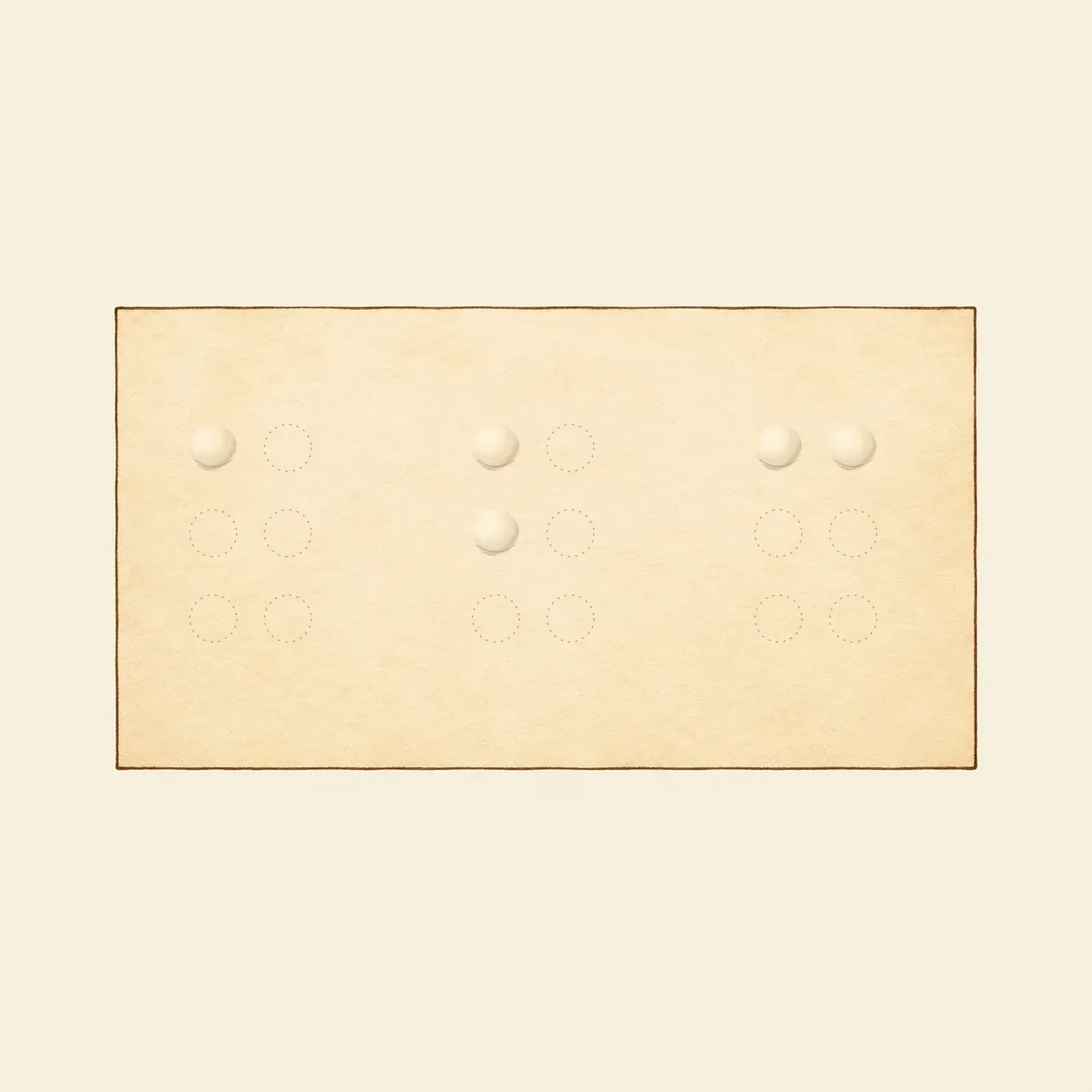 Dashed circles mark positions that are not embossed.
A cell has three rows and two columns. As read, dots 1, 2 and 3 run down the left; dots 4, 5 and 6 run down the right. Each position can be raised or empty, giving 64 patterns including the blank cell. A sign’s meaning depends on the code and its context.
On the reading face, a uses dot 1; b uses dots 1 and 2; c uses dots 1 and 4. A finger distinguishes where the dots lie as well as how many there are. Additional signs indicate numbers according to the code in use.
These examples use basic French braille. One cell alone cannot encode every accented letter, number and specialist notation in every language. Indicators and sequences of cells establish meaning; music and mathematics have their own coding rules. Learning these three letters is only a beginning for reading a complete text.
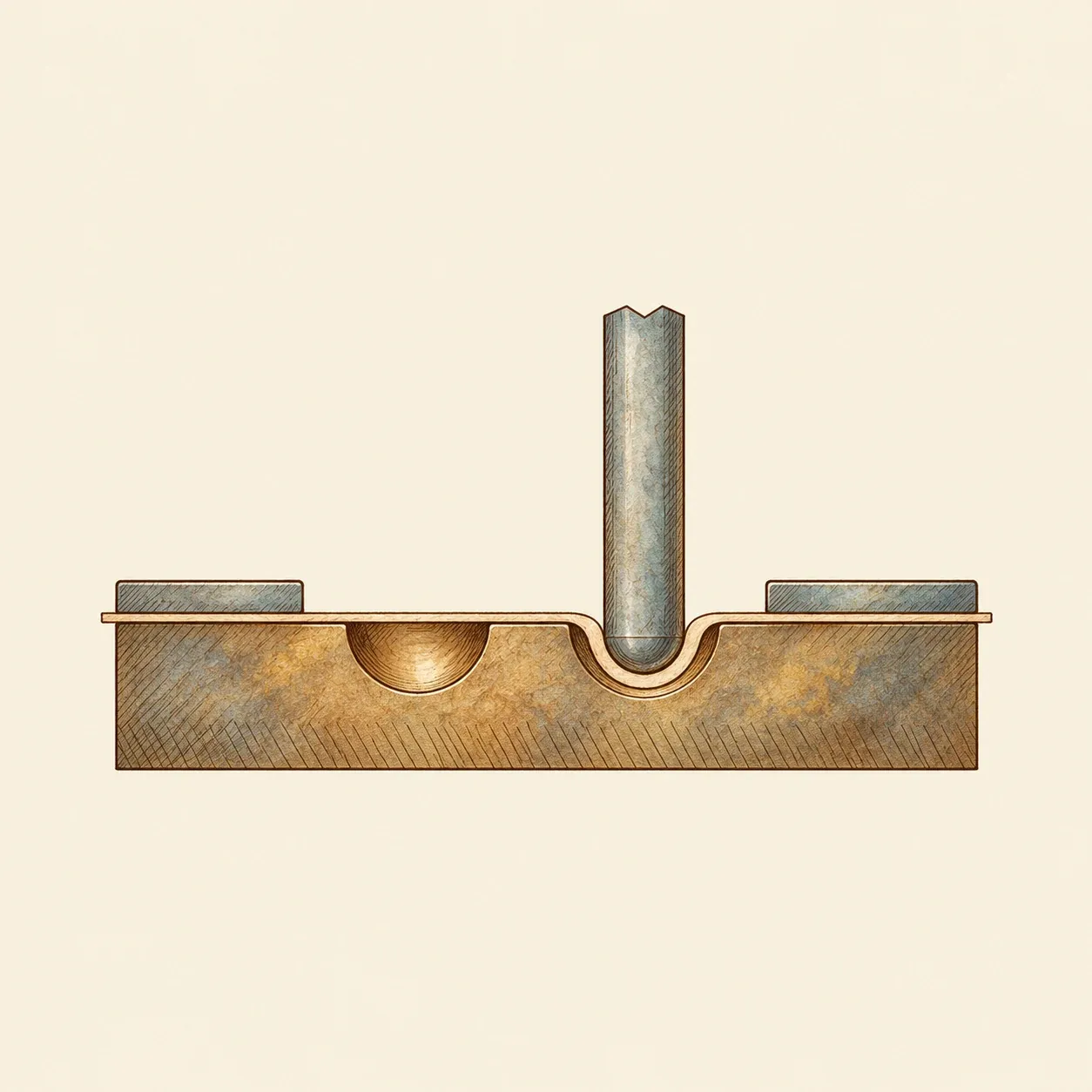 Only one row of the cell is shown. The stylus shapes the paper without piercing it.
A slate holds the paper between a backing plate and a guide with cell openings. The stylus presses the paper into recesses in the plate without piercing it. From the writing side, dot 1 is at the upper right: turning the sheet sideways puts it at the upper left on the reading face. Consistent dot relief and spacing help the reader follow a line from left to right and distinguish successive cells.
A braille writer such as the Perkins forms a cell when the relevant keys among its six dot keys are pressed together. It advances to the right, and the embossed dots can be read as writing proceeds. Electronic braille displays raise and lower pins; some use eight-dot cells, which differ from the six-position cell described here.
How to do it
To try it, mark six positions in three rows and two columns on thick paper. Glue small, even dots in the positions for a, b and c in three separate cells. Let them dry and follow the raised dots with a finger. A slate and stylus can also emboss paper from the back: write from right to left with the positions mirrored, then turn the sheet over to read from left to right.
History and evolution
Before dots, pupils at the Paris school for blind children read raised ordinary letters. Charles Barbier’s dot system was introduced there in 1821. Louis Braille then developed a six-position writing system; the Association Valentin Haüy dates its development to 1825. His method, published in 1829, already included musical notation. Publication made earlier work available more widely, while codes and writing tools continued to change.