Camouflage
Paint and patterns that make an object hard to see
Contents
- 1Shadow under the plain cylinder
- 2Countershaded cylinder, which looks flat
- 3Patch that touches the edge of the wing
- 4Patch of the same colour as the bark
- 5Dazzle stripes crossing the hull line
Camouflage is the art of making a made object hard to see by painting it. It uses three main principles found in animals: matching the colours of the background, breaking up the outline with contrasting patches, and shading the object darker on top and lighter below so that it looks flat. Around 390 the Roman writer Vegetius advised dyeing the sails and ropes of scout ships a sea-blue colour so that they would not be seen. In 1898 the naturalist Richard Kearton described an imitation tree trunk of painted cloth that hid a photographer and his camera from birds, and in 1902 the painter Abbott Thayer and Gerome Brush patented a way of painting ships with countershading. During the First World War, the French army set up a unit of artists to apply it.
What it is
Camouflage is a way of painting or covering a made object so that it is harder to see or harder to recognise. It borrows its principles from animals, whose colours were studied by naturalists in the 19th century. The first is background matching: the object takes the colours and the texture of what lies behind it, as a moth does on bark. The second is disruptive coloration, a set of contrasting patches that break up the outline. The third is countershading, which paints the object darker on the surfaces that receive the most light.
Naturalists used them to hide cameras and painters proposed them for warships before they were applied to guns, roads and observation posts during the First World War. Biologists now test the same principles in the field with artificial prey.
How it works
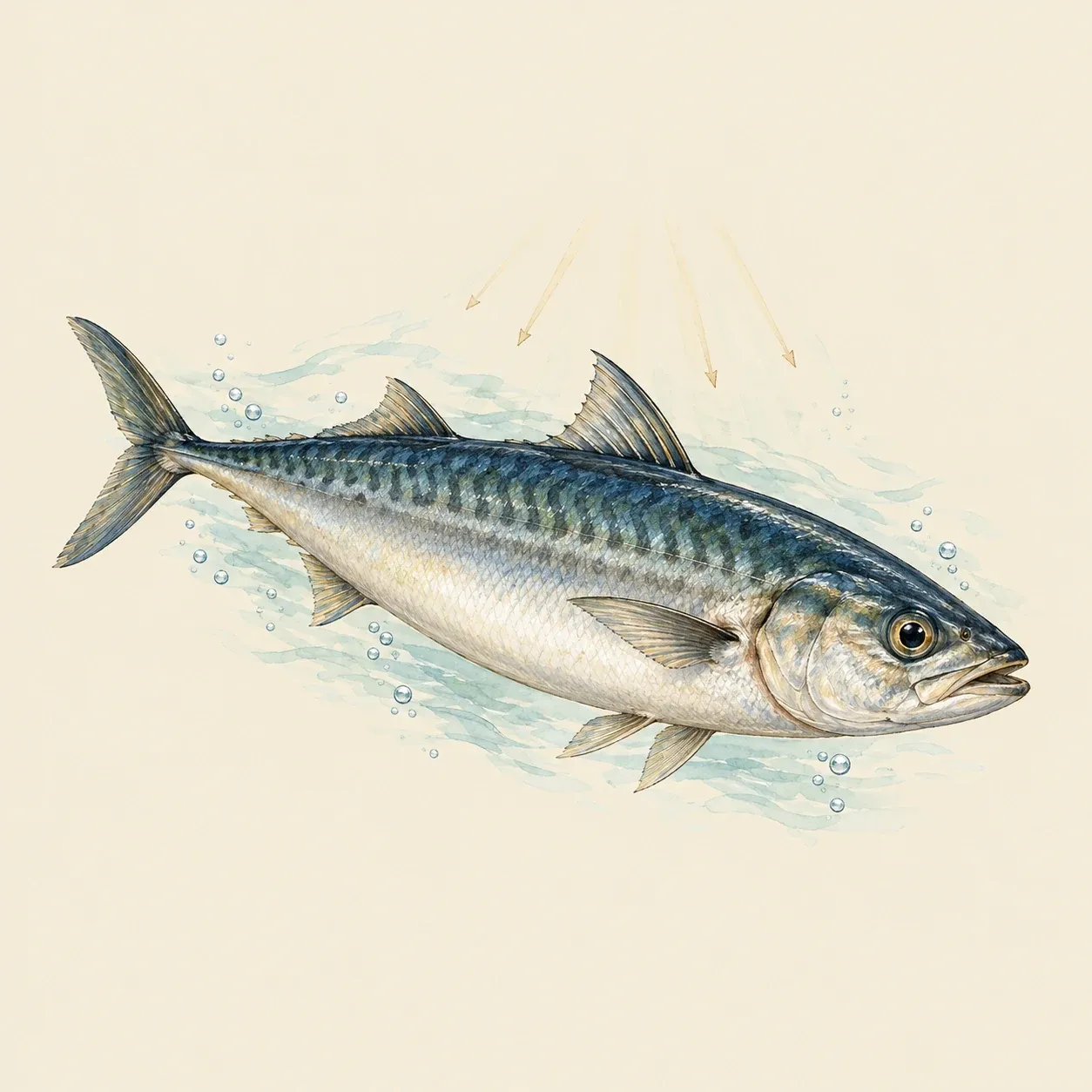 A fish is dark on the back and pale on the belly, the opposite of the light it receives.
An object lit from above is brightest on top and darkest underneath, and this gradient of light and shade shows the eye its shape. Abbott Thayer noted in 1896 that many animals are coloured the other way round, darkest on the parts most lit by the sky. In his patent of 1902 he applied this to ships: the surfaces facing up were painted dark, the vertical sides lighter and the surfaces facing down white, with a gradual blend on curved hulls. The two effects cancel out and the object looks flat and even. Thayer wrote that a ship painted this way tended to look transparent at sea.
Disruptive coloration works on the outline, which helps the eye pick out an object. If bold patches run right up to the edge, and some of them match the background while others contrast with it, the eye no longer follows a single contour and the shape falls apart into several unrelated pieces. In 2005 Innes Cuthill and his colleagues set out moth-shaped targets in the field, each with a dead mealworm as bait. Targets whose patches touched the edge survived birds better than targets with the same patches inside the wing, and high-contrast patches did better than faint ones.
The dazzle painting of ships in the two World Wars aimed at something else. Its bold stripes and zigzags were claimed to disguise the size, shape, course, distance and speed of a ship rather than to hide it. Royal Museums Greenwich adds that it also helped to conceal ships in poor visibility.
How to do it
A tabletop test shows countershading at work. You need two cardboard tubes of the same size, such as kitchen-roll tubes, a sheet of grey card, white, grey and black water-based paint, a brush, a desk lamp and a craft knife.
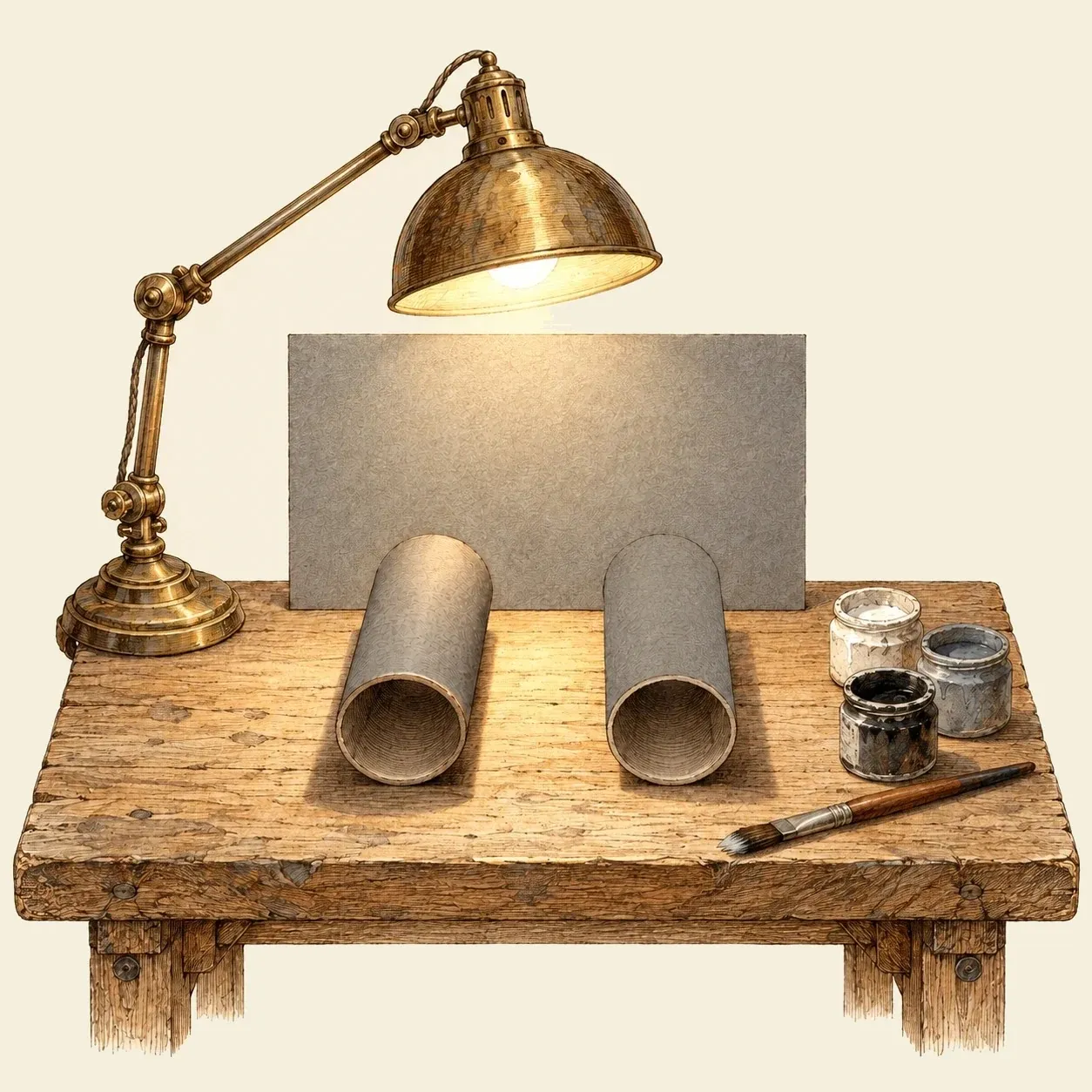 Under a lamp from above, the shaded tube looks flatter than the plain one.
Paint the first tube an even mid-grey. Mix three tones for the second tube: dark grey, mid-grey and almost white. Paint the top of the tube dark, the sides mid-grey and the underside almost white, and blend the borders while the paint is wet. When both are dry, stand the grey card upright at the back of the table, lay the tubes side by side in front of it and switch on the lamp directly above them. Turn off the other lights and crouch to look at the tubes from the side, at their own height. The plain tube shows a bright top and a dark shadow along its underside, so it looks round. The shaded tube looks much flatter and blends into the card.
History and evolution
The oldest written advice on hiding a made object by its colour comes from Vegetius, a Roman writer whose Epitome of Military Science was written after 383, most probably in the late 380s, although some scholars place it around 430–435. For the small scout boats that went ahead of the war galleys, he advised dyeing the sails and ropes a Venetian blue, the colour of the sea waves, colouring the wax used to coat the hulls in the same way, and dressing the sailors and soldiers in blue, so that the scouts could stay hidden by day as well as by night.
Abbott Thayer, a painter from New Hampshire, published his idea of countershading in the ornithology journal The Auk in 1896, and he presented it as a law of animal colouring. According to Air & Space magazine, he tried to get the US Navy to adopt his ideas for concealing ships during the Spanish-American War of 1898. On 17 April 1902 he and Gerome Brush filed the patent for painting the outside of ships to make them less visible, granted on 2 December 1902. In 1909 his son Gerald summed up his discoveries in the book Concealing-Coloration in the Animal Kingdom, which also dealt with the patterns that break up an outline. The historian Roy Behrens connects these theories to Thayer’s training as a painter.
In 1898 the naturalist Richard Kearton described in his book Wild Life at Home an imitation tree trunk that he had built so that his brother could photograph birds without being seen. Cloth was stretched over split bamboo, wooden hoops and wire netting, painted to look like bark and dressed with moss and lichen, and the photographer stood inside with his camera. Reviewing the book in 1899, The Spectator singled out this tree trunk of painted cloth and ivy branches.
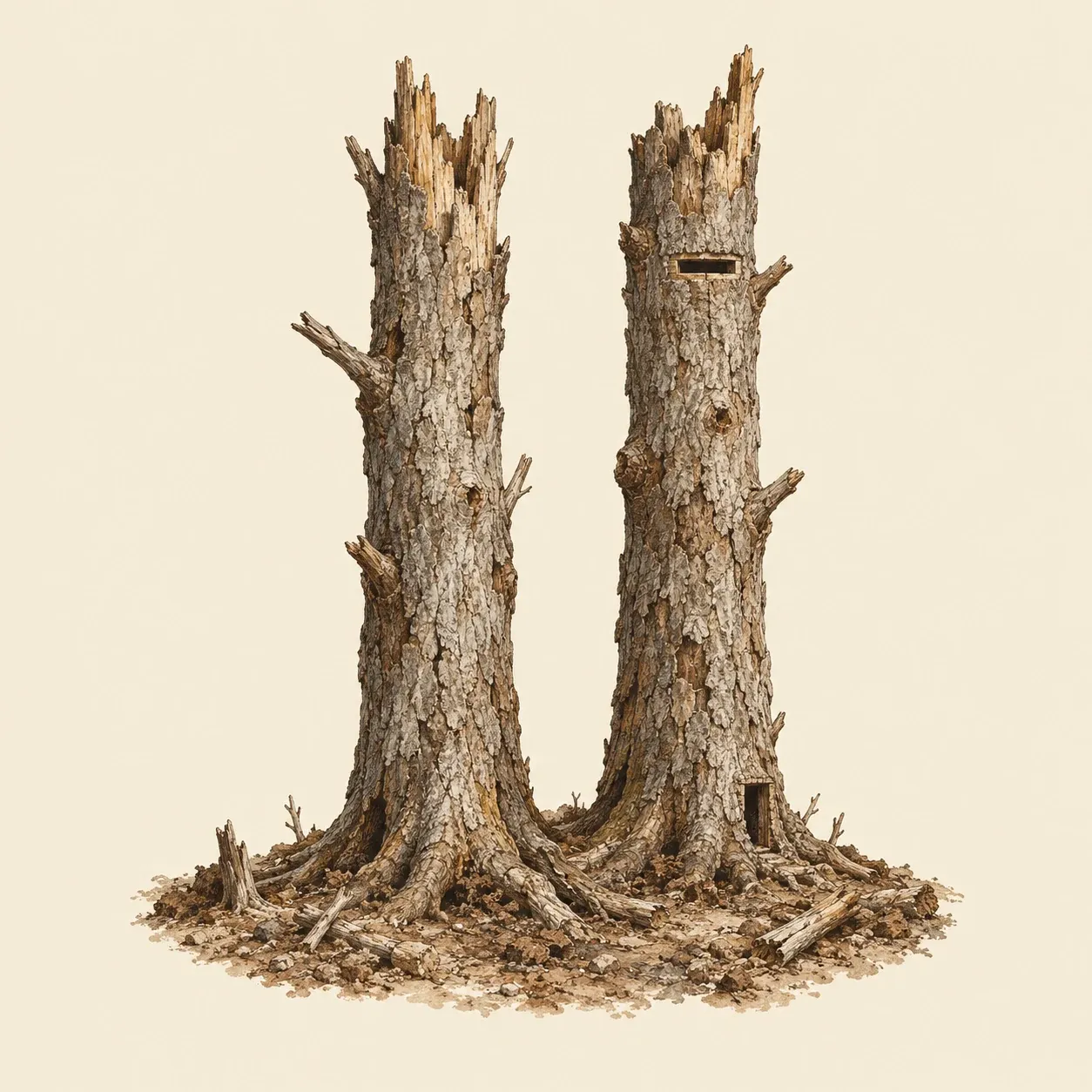 Artificial trees with observation posts inside replaced real ones overnight.
In August 1915 the French army created a camouflage section led by the painter Lucien-Victor Guirand de Scévola, who had inspired the first camouflage experiments. The French Ministry of the Armed Forces notes that he and the decorator Louis Guingot are regarded as the inventors of camouflage. According to the Musée de l’Armée, the section hid communication routes with painted canvas, mesh and netting, and installed artificial trees at night that held observation posts. Painters, sculptors and theatre designers worked in its workshops, among them those of Paris and Nancy. In Britain, the painter Norman Wilkinson devised dazzle painting to protect ships from submarines and surface raiders. A British Admiralty analysis of shipping losses in 1918 could not show whether it worked.
Since then, biologists have tested the principles that the painters took from nature. Martin Stevens and Sami Merilaita gave a formal definition of disruptive coloration in 2009, and field studies with artificial targets have measured which patterns survive best. In 2011 Nicholas Scott-Samuel and colleagues at the University of Bristol showed observers patterned targets moving across a screen. High-contrast zigzag and check patterns made a fast target look slower, while slow targets and low-contrast patterns showed no effect. The speed that counts is how fast the image crosses the eye, so it depends on the viewing distance: their fast condition matches a vehicle at about 13 km/h seen from 10 m. At the ranges typical of naval warfare, the authors found no evidence that dazzle disguised the speed of ships in the two World Wars.