Paint
Coloured grains held in a binder
Contents
- 1Lump of red ochre
- 2Muller on the grinding slab
- 3Egg yolk, the binder
- 4White ground on the panel
- 5Grain of pigment
- 6Dried binder around the grains
Paint is a coloured powder, the pigment, carried in a binder that turns from a liquid into a solid film once it is spread. Ochre, charcoal and chalk were ground and bound with fat, milk, egg, glue, gum, oil or lime to colour bodies, objects and walls. About 100,000 years ago, at Blombos Cave in South Africa, people mixed ground ochre with crushed bone and charcoal in two abalone shells.
What it is
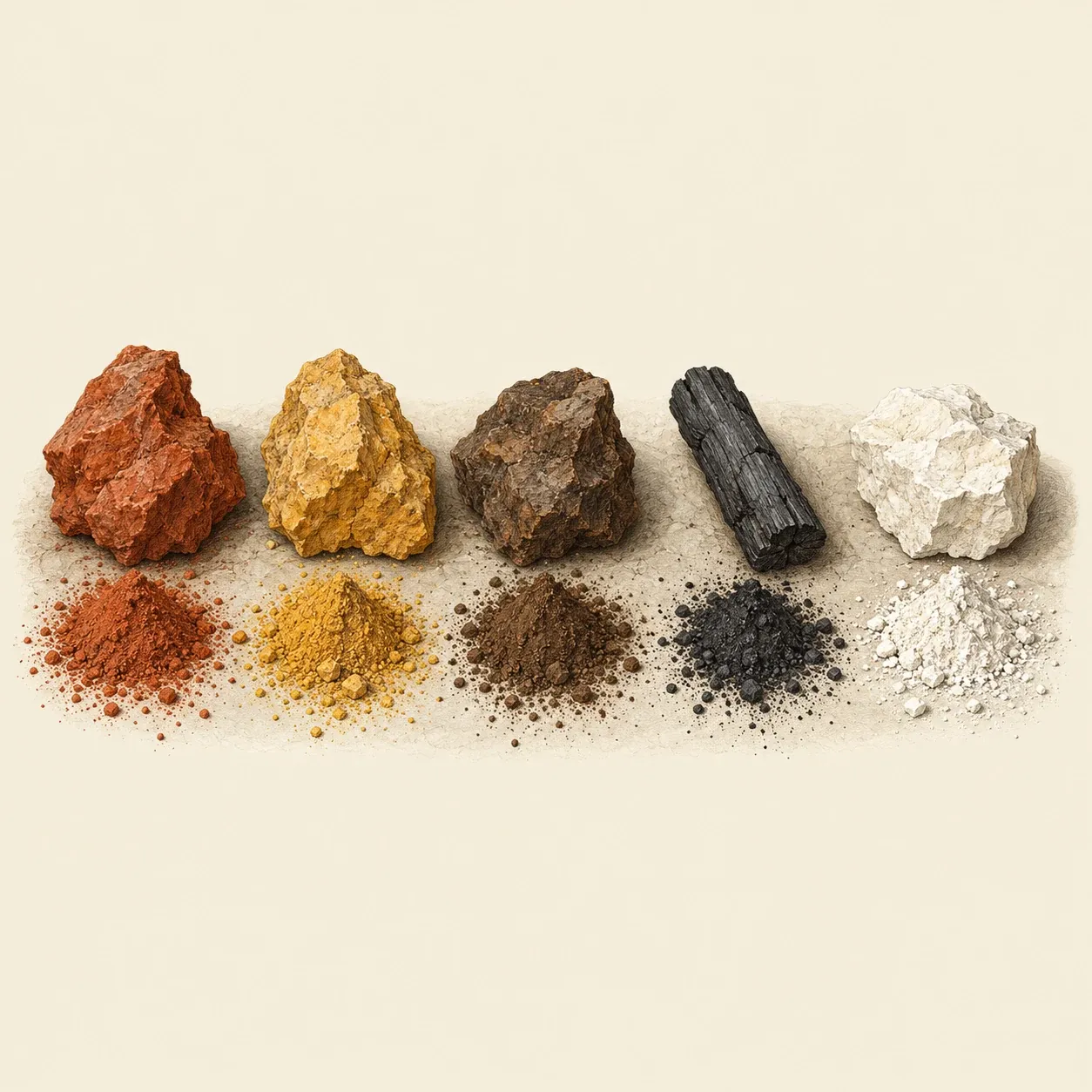 Red and yellow ochre, umber, charcoal and chalk, each beside the powder it gives when ground.
Paint has two parts. The pigment is a fine coloured powder that does not dissolve in the liquid around it. The binder, also called the medium, holds the grains together and fixes them to the surface. When the mixture is spread thin, it changes from a liquid into a solid film. Painters often thin it with water or oil so that it flows from the brush; that extra liquid leaves or sets as the paint dries.
The oldest pigments come from the ground and from the fire. Ochre is an earth or a soft rock coloured by iron oxides: hematite makes it red, goethite yellow. Charcoal gives black, chalk white. They only need crushing, grinding, washing and sieving. Other pigments are crushed minerals, dyes fixed on a powder, or compounds made in the workshop or the factory. The binder decides how the paint behaves. Painters have used fat, milk, egg, animal glue, plant gum, drying oil and lime, among others.
How it works
Each grain of pigment must end up wrapped in binder, and the binder must form a continuous film that sticks to what lies beneath. How much binder goes with how much pigment changes how the paint spreads, its colour and how fast it dries. Binders reach the solid state in three main ways.
Some simply dry. Animal glue and plant gum are dissolved in water. Milk holds its casein as tiny particles in water, and casein taken out of milk dissolves only with an alkali such as lime. As the water evaporates, the dissolved binder is left as a thin solid skin around and between the grains. Gum arabic, the binder of watercolour, stays soluble in water after it has dried.
Others change chemically. A drying oil such as linseed, walnut or poppy oil reacts with the oxygen of the air and, in a thin layer, sets into a solid, elastic film. The reaction is slow, which leaves the painter time to blend colours on the picture. Egg yolk does both: its water evaporates quickly and its protein coagulates, then its fats go on hardening slowly. The dry film resists water.
In true fresco no binder is added at all. The painter lays pigments mixed with water on fresh lime plaster. The slaked lime in the plaster takes up carbon dioxide from the air and turns back into calcium carbonate, the stuff of limestone. Its crystals grow around the grains and lock them into the surface of the wall. Paint laid on dry plaster, a secco, needs a binder such as glue or egg, and it lasts less well.
A painted panel or wall is rarely bare. Painters first lay a ground, often chalk or gypsum bound with glue, which gives a smooth, white and absorbent surface for the thin layers of paint.
How to do it
This makes a small amount of egg tempera, the paint of many medieval panel paintings, whose binder is egg yolk. You need a pigment sold for artists whose label states its composition: a natural red or yellow ochre is ideal. Add a fresh egg, a little clean water, a sheet of thick glass or a smooth flat stone, a muller (a glass or stone grinder with a flat base) or a flat-bottomed glass, a palette knife or teaspoon, a small brush and a piece of wood, card or thick paper to paint on.
Put a small heap of pigment on the slab, make a hollow in it and add a few drops of water. Wet all the powder before you start grinding. Move the muller in slow circles over the paste, scraping it back to the middle now and then with the knife, until it feels smooth under the muller and no grit is left. Add drops of water if it gets dry.
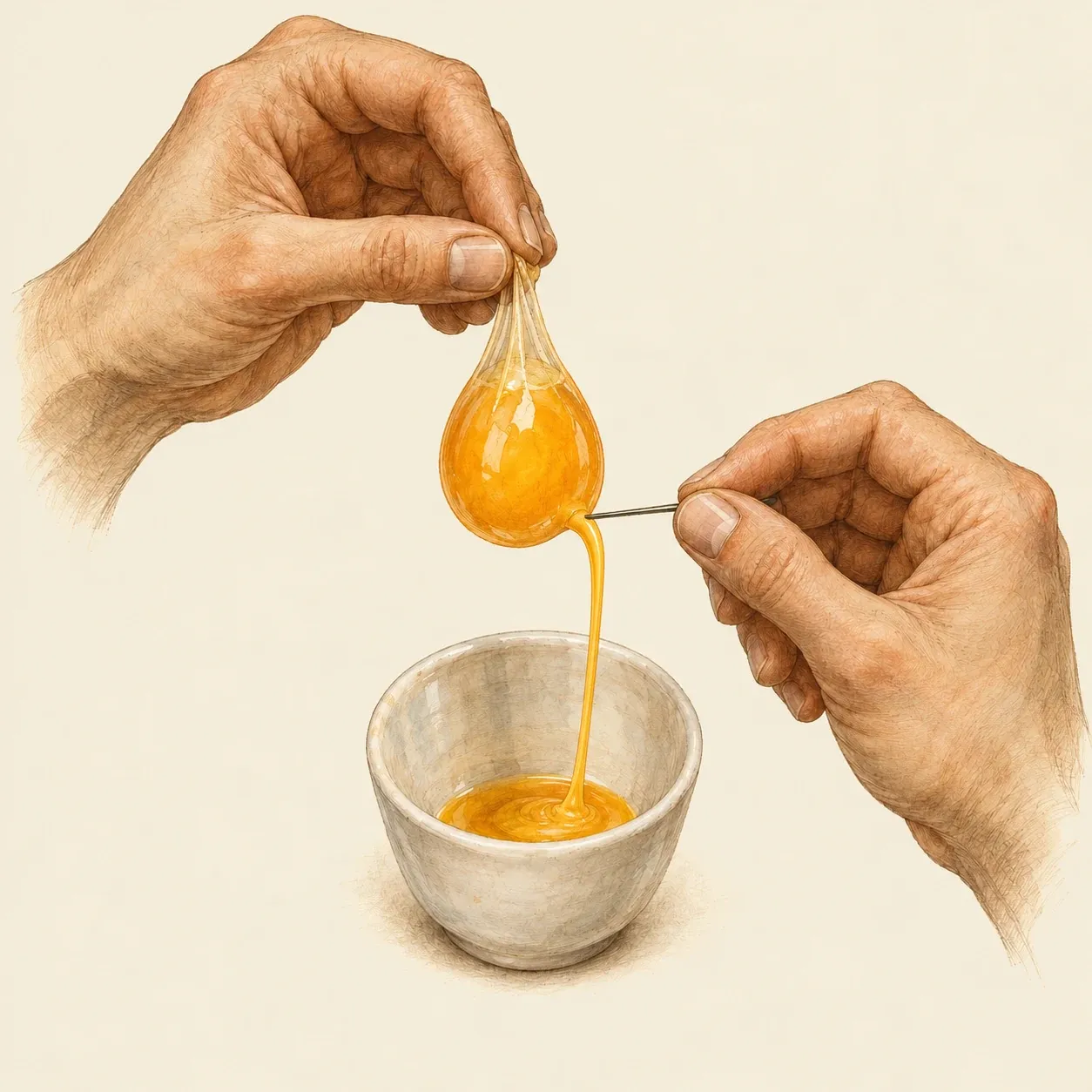 Held by its skin and pierced with a pin, the yolk runs out into the cup.
Separate the egg and keep only the yolk, without its skin. One way is to roll the yolk on your palm until it is dry, hold it over a cup by the skin, pierce the skin with a pin and let the yolk run out. Put a little paste on the slab and work in a small amount of yolk with the knife. Add more yolk bit by bit until the paint runs smoothly from the brush, and thin it with a drop of water if needed.
Paint a stripe and let it dry for a few minutes. Rub it gently with a finger. If colour comes off as powder, the paint needs more yolk. If the stripe is shiny, sticky or cracks, it has too much. Tempera dries quickly, so mix small amounts, and keep the yolk covered while you work.
Safety. Use only earth pigments of known composition. Never use old or unlabelled pigments, nor those based on lead, mercury, arsenic, chrome or cadmium, such as lead white, vermilion, orpiment, emerald green or chrome yellow: they are poisonous when swallowed or breathed in. Dry pigment is a fine dust, so do not breathe it: open bags gently, wet the powder before grinding and wipe the work surface with a damp cloth, never with a brush. Raw egg can carry salmonella. Wash your hands after work, do not eat, drink or put a brush in your mouth while painting, throw away leftover paint at the end of the day, and keep the materials out of reach of young children.
History and evolution
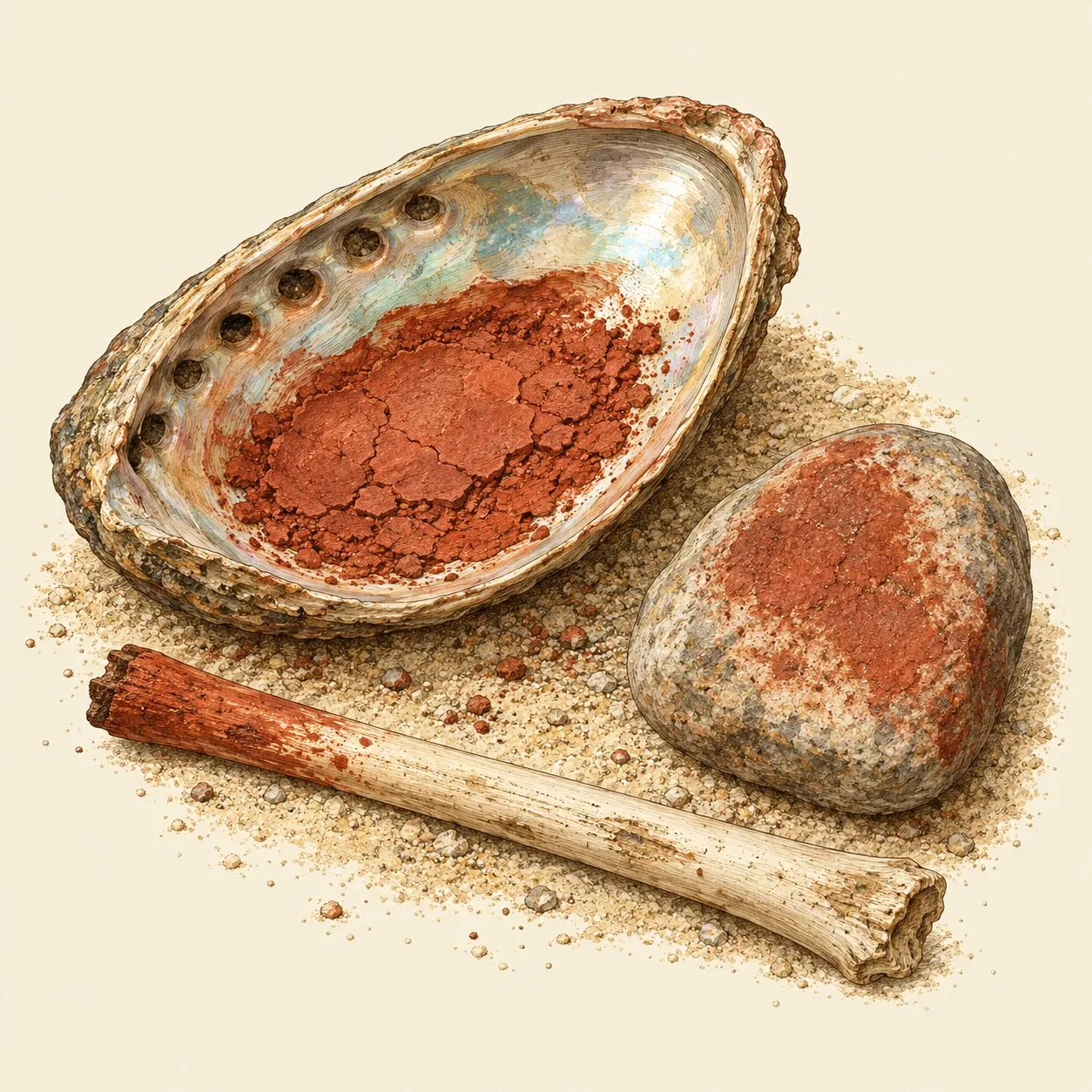 Blombos Cave, about 100,000 years ago: ochre ground with bone and charcoal and kept in an abalone shell.
Worked pieces of ochre and the stones used to grind them are older than any surviving paint. A mixture made on purpose appears at Blombos Cave, on the south coast of South Africa. In a layer dated to about 100,000 years ago, Christopher Henshilwood’s team found two abalone shells holding a dried red compound. It contained ground ochre, crushed spongy bone, charcoal, chips of quartz and quartzite, and had been stirred with a liquid. The bone was probably heated before it was crushed, perhaps to release its marrow fat as a binder. A quartzite cobble stained with ochre still sat in the opening of one shell. The team did not establish what the mixture was used for; decorating a surface or protecting the skin are among their suggestions.
The Roman architect Vitruvius, writing in the first century BCE, describes walls coated with three layers of sand mortar and three of marble dust, and notes that colours laid carefully on damp plaster do not fade. Around 1400 the Florentine painter Cennino Cennini wrote a handbook that covers fresco, painting on dry walls with glue or egg, grinding pigments and painting with oil.
Painting with drying oil is older than its European fame. In 2008 a team from Tokyo, Paris, the Getty and the European Synchrotron in Grenoble found drying oils, perhaps walnut or poppy, in murals of twelve caves at Bamiyan in Afghanistan, painted in the middle of the seventh century.
For centuries painters or their assistants ground their own colours. In 1841 the American painter John Goffe Rand patented a collapsible metal tube, and by 1842 the London colour makers Winsor & Newton were selling paint in it. Ready-made paint was now easy to carry outdoors. Some old pigments were poisonous. Lead white, long the usual white, harmed the painters who used it, and the International Labour Organization convention of 1921 required the states that ratified it to ban white lead from the interior painting of buildings, with exceptions such as artistic painting and fine lining. The World Health Organization still counts lead paint as a major source of poisoning for young children.