Hydrometer
Reading density from a float
Contents
- 1Ballast of lead shot in the bottom bulb
- 2Hollow body filled with air
- 3Narrow stem with the paper scale inside
- 4Reading point, where the liquid surface crosses the stem
- 5Glass jar holding the sample
A hydrometer is a weighted float with a scale on its stem. It sinks deeper in a light liquid than in a dense one, so the depth at which it settles gives the density. The oldest description is in a letter from Synesius of Cyrene to Hypatia around 400, and the alcoholometer applies it to the strength of spirits.
What it is
A hydrometer measures the density of a liquid: how heavy a given volume of it is, usually compared with water. It is a closed float, most often of glass, weighted at the bottom so that it stays upright, with a long thin stem that carries a scale. Lowered into a sample, it sinks until it floats freely, and the mark level with the surface gives the reading.
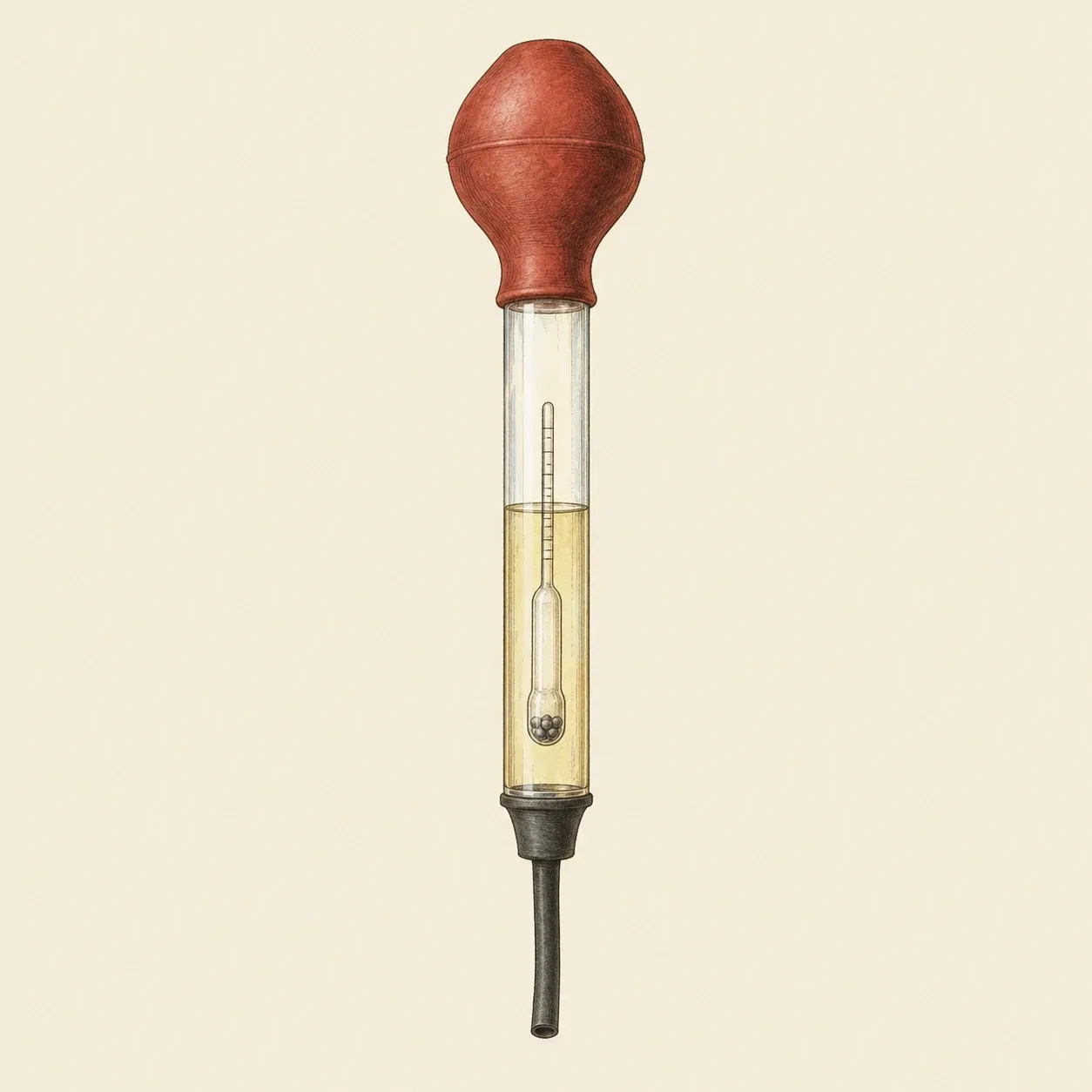 A battery hydrometer reads the acid of a lead-acid battery to show how charged it is.
Each trade has its own scale. The alcoholometer is graduated in percentage of alcohol by volume for mixtures of water and ethanol, and is used to check and tax the strength of spirits made by distillation. Brewers use one to follow the fermentation of beer, and a battery hydrometer reads the acid of a lead-acid battery to show how charged it is. Some older instruments worked the other way round: small weights were added until the float sank to a fixed mark, and the weight needed gave the density.
How it works
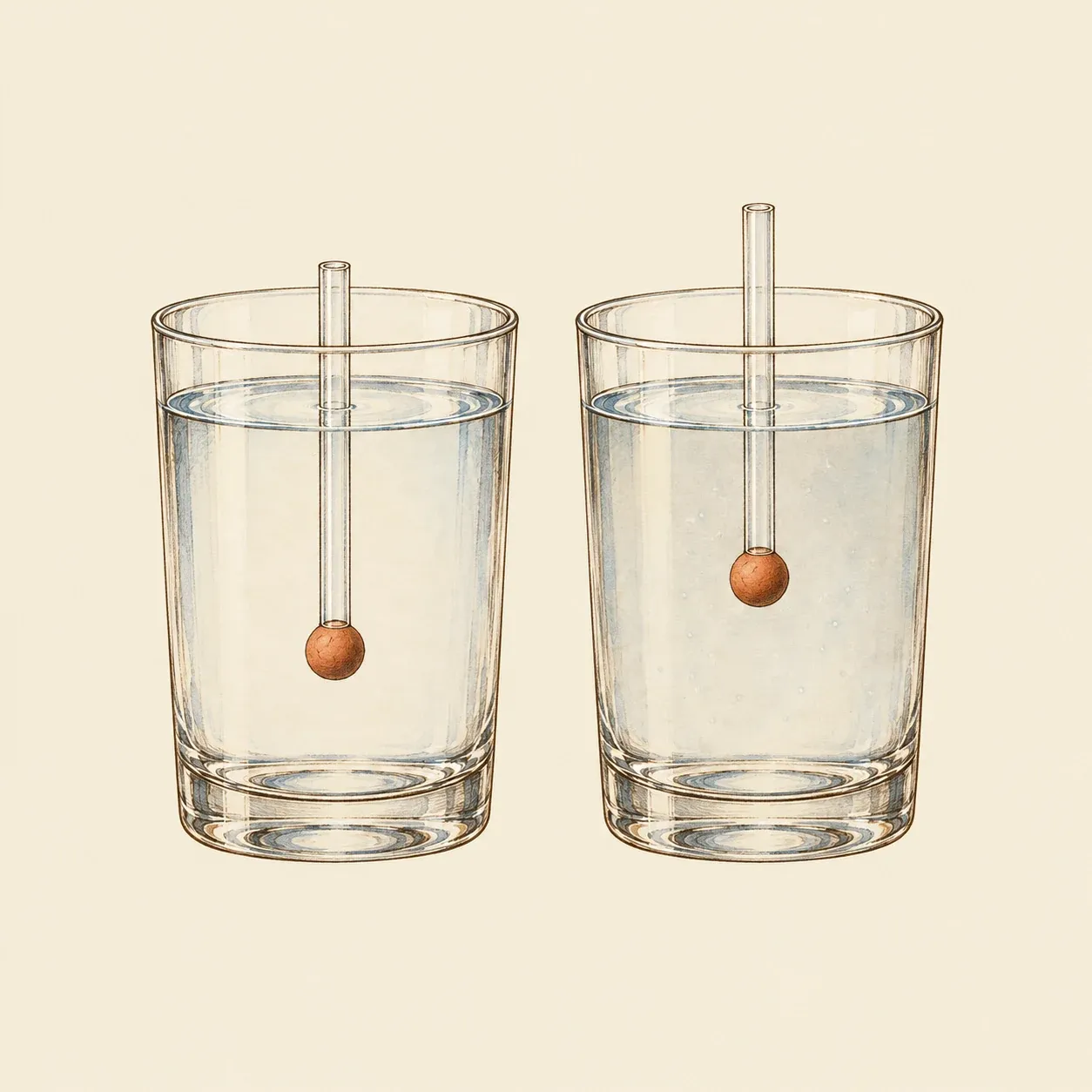 The same float rides higher in salt water, which is denser than fresh water.
A floating body sinks until it has pushed aside its own weight of liquid. A hydrometer always weighs the same, so it must displace the same weight in every liquid. In a dense liquid a small volume is enough and it rides high. In a light liquid it has to sink further. Ethanol is lighter than water, so an alcoholometer sinks deeper as the strength of a spirit rises.
Each part has a task. The ballast at the bottom, mercury or lead shot fixed in place, keeps the weight low so that the instrument floats upright. The hollow body, full of air, gives most of the buoyancy. The stem is narrow, so a small change in density moves the surface a long way along it and the scale can be read closely. The paper scale is sealed inside the stem, where the liquid cannot reach it. The reading is taken where the flat surface of the liquid meets the stem, below the small curve where the liquid creeps up the glass.
Warm liquid expands and becomes lighter, so a hydrometer reads true only at the temperature it was graduated for. For Gay-Lussac’s alcoholometer this was 15 °C, while alcoholometers made to the current international recommendation are graduated at 20 °C. Tables correct readings taken at other temperatures, which is why a thermometer goes with the instrument.
Water and alcohol do not mix simply. Fifty millilitres of each make only about 97 mL, because the two liquids pack together more closely than either does alone. The strength of a mixture therefore cannot be worked out from the densities of water and alcohol by proportion, and the scale of an alcoholometer is drawn from tables of densities measured on mixtures of known strength. Anything else dissolved in the liquid changes its density too. Sugar in a sweetened spirit gives a false reading, so such drinks are distilled before their strength is measured.
How to do it
A straw hydrometer is far less precise than a glass instrument, but it shows the principle and can be marked against known liquids. You need a clear plastic drinking straw, modelling clay, two tall narrow glasses or clear jars, water, table salt, a spoon, a fine waterproof marker and, to calibrate it, a hydrometer from a home-brewing shop if you have one.
Press a plug of clay into one end of the straw so that no water can get in, and mould a small ball of clay around that end as ballast. Fill a jar with tap water at room temperature and lower the straw in, clay end first. It should float upright with part of its length above the surface. If it leans over, add clay, and if it sinks, take some off. Bring your eye level with the water and mark the straw where the surface crosses it.
Stir two or three spoonfuls of salt into the second jar of water until they have dissolved, and float the straw in it. It rides higher, so the water line falls lower down the straw. Mark this line too. With a commercial hydrometer, float it in each liquid and write its reading beside the matching mark on the straw. Solutions with more or less salt give marks in between. Keep all the liquids at the same temperature while you mark them, because warm water is lighter than cold.
History and evolution
The rule that a floating body displaces its own weight of liquid goes back to Archimedes’ treatise On Floating Bodies, in the third century BCE.
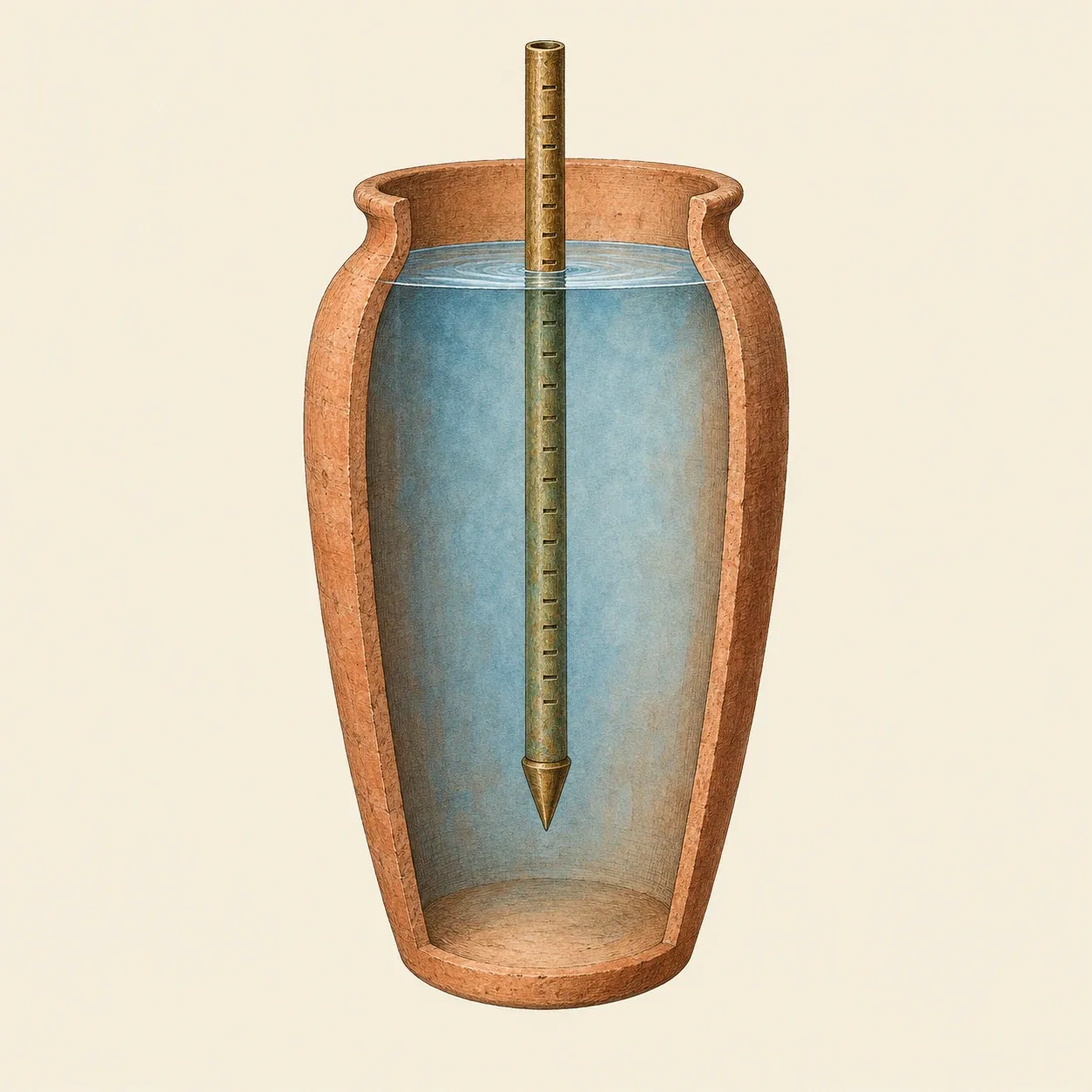 The instrument as Synesius describes it: a notched bronze tube closed by a cone.
The oldest description of a hydrometer is in a letter that Synesius of Cyrene wrote around 400 to his former teacher Hypatia, a mathematician and philosopher in Alexandria. He asked her to have a “hydroscope” cast in bronze for him: a tube the shape and size of a flute, with a straight line of notches along it, closed at one end by a cone of the same width, which he calls the baryllion. Placed in water, it stood upright, and the notches gave the weight of the water. The invention was once credited to Archimedes or to Hypatia herself, but no text supports either. A Latin poem on weights and measures from about the same time, once attributed to the grammarian Priscian, also describes the instrument.
Galileo described a hydrometer in a letter of 1612, and the Accademia del Cimento in Florence used glass floats with graduated stems as well as floats that carried small pans for weights. In 1675 Robert Boyle described a small glass bubble with a long slender stem for comparing liquids, then turned the idea round to test whether gold coins were genuine.
Taxes on spirits made the instrument an official one. In London, John Clarke made a spirit hydrometer from the mid-1720s, a hollow copper or brass globe with a graduated stem and a set of weights, and it became the legal standard in 1787. An Act of Parliament of 1816 replaced it with the hydrometer of the exciseman Bartholomew Sikes, which needed only nine weights and came with tables for temperature. Sikes’s hydrometer stayed in British use until the 1970s. From the later eighteenth century many patented hydrometers were made for industry, and Antoine Baumé and William Nicholson were among their best-known designers.
In 1821 the French government asked the chemist Joseph Louis Gay-Lussac for a practical and accurate way to measure the strength of spirits. His centesimal alcoholometer, described in 1824 and made with the instrument maker Collardeau, reads 0 in pure water and 100 in pure alcohol. At 15 °C the figure is the percentage of alcohol by volume, and tables correct readings taken at other temperatures. France, Germany and the United States used glass alcoholometers of this kind, with the tables of Gay-Lussac or the German tables of Tralles. Instruments made to the international recommendation OIML R 44 are graduated at 20 °C, while American hydrometers for spirits are still graduated at 60 °F, about 15.6 °C. Electronic instruments have partly replaced both.