Food smoking
Drying and flavouring food in wood smoke
Contents
- 1Small fire of damp sawdust on the floor
- 2Timber bearer set into the wall
- 3Pair of split haddock on a tenter
- 4Louvred ventilator on the roof ridge
- 5Brick wall of the kiln
Smoking treats meat, fish and cheese with the smoke of smouldering wood. The smoke dries the surface and leaves phenolic compounds that slow some microbes and the souring of fats, as well as colour and flavour. It does not sterilise food. The oldest written instructions are those of Cato the Elder, about 160 BCE, for salted hams hung in smoke for two days.
What it is
Smoking is the treatment of food with the smoke of wood that smoulders without flaming. Meat, fish and some cheeses are hung or laid in an enclosure filled with smoke, usually after salting or soaking in brine, as in salting and curing. The smoke dries the surface and deposits compounds on it that slow the growth of some microbes and the oxidation of fats. It also gives the food its brown or golden colour and its taste.
Curers distinguish two main kinds. In cold smoking the air stays cool enough that the flesh does not cook: finnan haddock leaves the kiln raw and is cooked before eating, while smoked salmon is eaten as it is. In hot smoking the heat rises high enough at some stage to cook the food, which is then ready to eat. Smoked food keeps longer than fresh food, but smoking does not sterilise it, and most smoked products today must be kept in the refrigerator and eaten by a set date.
How it works
Smoke forms when wood is heated with too little air to burn with a flame. In the glowing zone, at about 300 to 450 °C, the wood breaks down into gases carrying droplets of tar and fine particles. Chemists have identified more than 300 compounds in wood smoke.
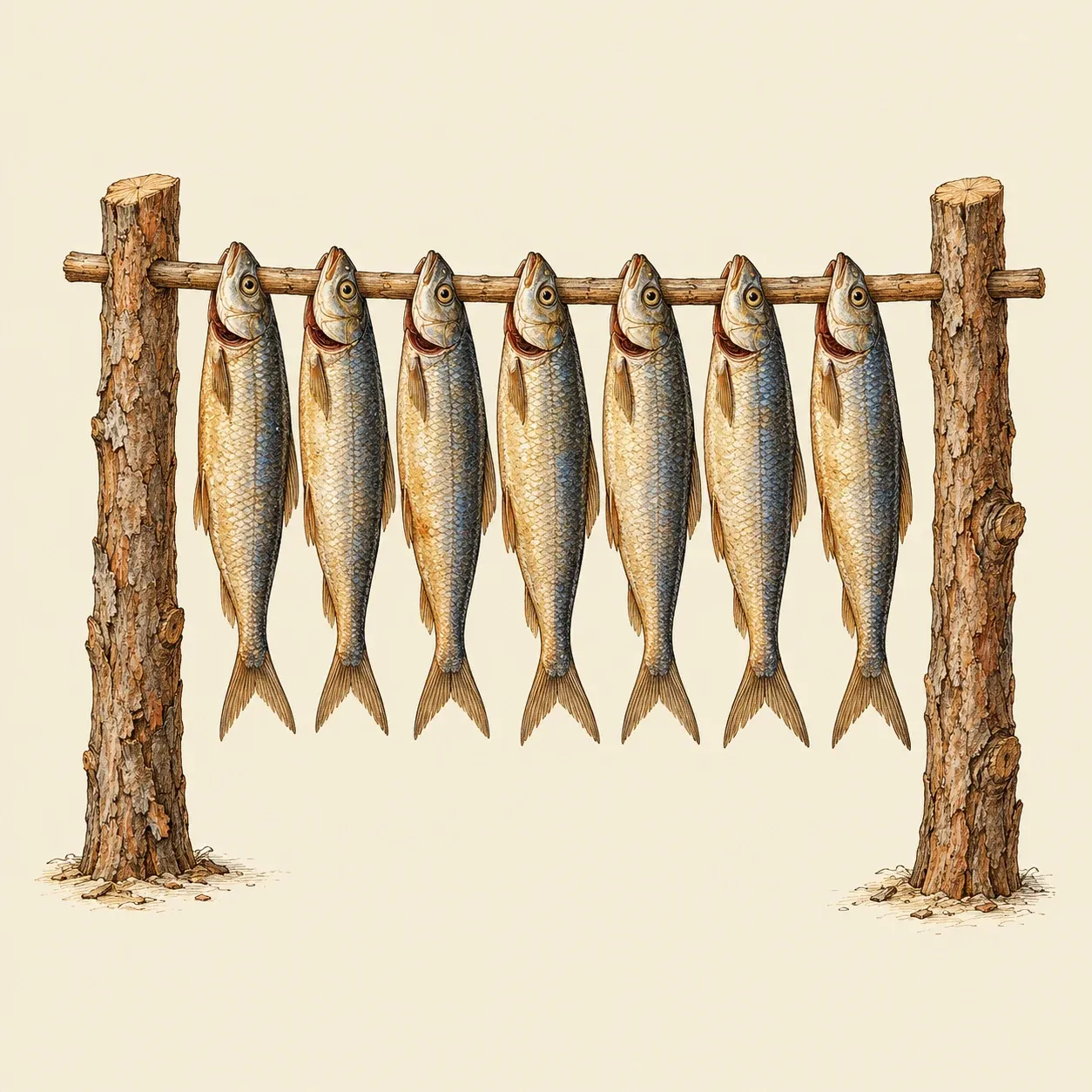 Herring were threaded on rods through the gills and hung in rows, so that the smoke could reach both sides of every fish.
The food is protected in several ways at once. Salt applied beforehand draws water out of the flesh and makes it firmer. The warm air moving through the kiln then dries the surface, and the smoke leaves phenolic compounds there that act against some bacteria and slow the oxidation that makes fats rancid. The dried, smoked skin also takes on its colour and sheen.
The temperature decides the kind of product. The Torry Research Station in Aberdeen, a British government laboratory for fish preservation, defined cold smoking as smoking in air no warmer than 33 °C, so that the proteins of the flesh do not set, and hot smoking as smoking that reaches 70 to 80 °C at some stage, enough to cook the fish. A Codex Alimentarius code of practice uses slightly different bands: 18 to 25 °C for cold smoking, around 40 °C for semi-warm smoking of bacon and some fish, and 70 to 90 °C for warm smoking.
Smoke also carries hazards. Incomplete burning forms polycyclic aromatic hydrocarbons, some of which cause cancer. They are found at higher levels in food from traditional kilns, where the fire burns in the same chamber as the food, than in food smoked with smoke made in a separate generator. A fire starved of air also gives off carbon monoxide, a danger to the people who tend it. Cold smoking reduces the bacterium Listeria monocytogenes without eliminating it, and this bacterium can multiply slowly in the refrigerator, so cold-smoked fish eaten uncooked can cause listeriosis.
How to do it
In the fish-curing towns of north-east Scotland, smokehouses, or kilns, were tall, narrow rooms of brick with a ventilator on the roof ridge. Timber bearers set into the walls crossed the chamber in tiers. Split haddock were hung in pairs from wooden bars called tenters, which rested across the bearers; herring were threaded through the gills on rods called speats.
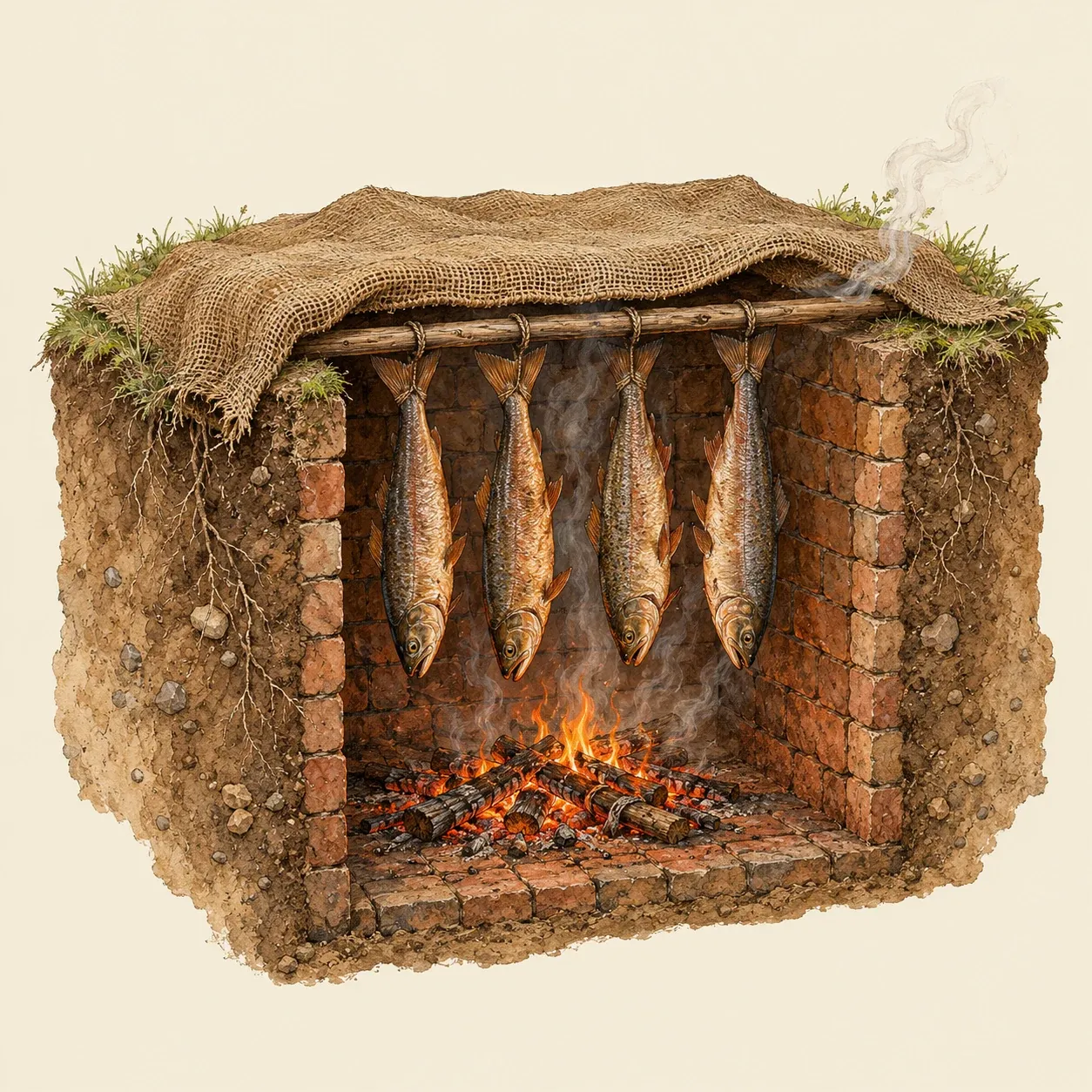 For hot smoking, the fish hang over a fire in a brick-lined pit, under sacking that holds in the heat.
On the earth floor, the curer lit small fires of wood and damped them with sawdust so that they smouldered, since an open flame would have cooked the fish instead of smoking them. Louvres or trapdoors in the ventilator, worked by strings from below, let the smoke out, and the curer opened those on the side away from the wind so that smoke would not blow back into the kiln. Finnan haddock smoked overnight, and the curer judged by eye and by touch when they were done. For hot-smoked fish, fires burned in brick-lined pits about 60 cm deep, with the fish hanging over them and sacking laid across the opening to hold in the heat.
The Torry Research Station later designed a mechanical kiln, first for cold smoking and then, with extra heaters and better smoke producers, for hot smoking as well. Modern industrial kilns make the smoke in a separate generator, which can clean it and control its flow before it reaches the food.
Safety. To smoke food at home, follow a tested method from a food-safety authority, keep raw and smoked food chilled, and treat hot-smoked food as cooked only when it has been heated right through. Cold-smoked fish and meat stay raw and are made safely only on premises with controlled salting, temperatures and hygiene.
History and evolution
At Makhadma, on the Nile in Upper Egypt, fishers of the Late Palaeolithic left layers rich in charcoal, ash and fish bones, mostly of tilapia and catfish, together with shallow pits and postholes, between about 12,500 and 12,000 BCE. Wim Van Neer, Etienne Paulissen and Pierre Vermeersch suggest that the catch was too large to eat fresh and that part of it was cured, the fish being either charred or smoke-dried over the pits, and they compare the pits with fish-smoking pits used in recent times around Lake Chad. They state that the evidence is not conclusive.
The oldest written instructions come from Rome. In his treatise on farming, written about 160 BCE, Cato the Elder explains how to cure hams: after a long salting, they are hung in a draught for two days, rubbed with oil and hung in smoke for two more days, then rubbed with oil and vinegar and stored in the meat-house. In the late first century CE the poet Martial wrote a two-line epigram on smoked cheese, saying it had flavour only when it had taken the smoke of the Velabrum, a market quarter of Rome.
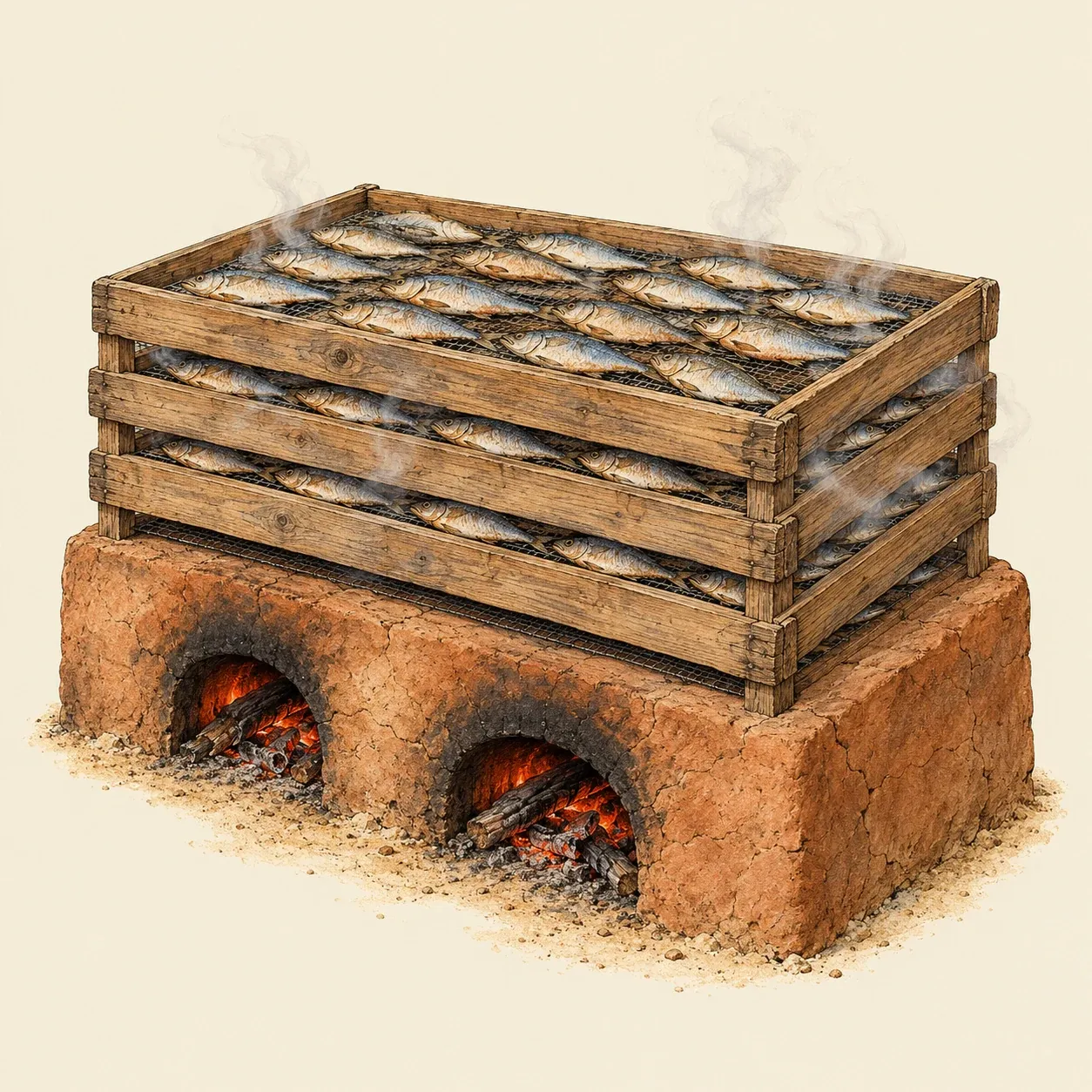 On the Chorkor oven, trays of fish are stacked above the fire and smoked together.
In Aberdeen, brick kilns stood among the fish-curing works of the city, and in 1904 the Duke of Connaught visited the extensive works of Allan & Dey on Raik Road. In the twentieth century, electric smoking developed at the Torry Research Station, first used by the MacFisheries company, took the place of the old kilns. Hygiene rules and the demand of supermarkets for uniform products then closed nearly all of them by the end of the century.
In West Africa, where much of the catch is smoked hot, the Food Research Institute of Ghana and an expert of the FAO began in 1968 to improve the rectangular clay ovens of the women fish smokers of Chorkor, in Accra. The fish was laid on removable trays of wire mesh in wooden frames, stacked over the fire, and in 1969 the oven went out to its users. By 1989 about forty fishing towns and villages used it. It is still the most common smoking oven among Ghana’s fish processors, but studies have found levels of polycyclic aromatic hydrocarbons in its fish above international limits, and the institute was testing cleaner ovens in 2026. Industrial smokehouses now often use smoke made in separate generators, and some foods get their smoky taste from smoke flavourings instead.