Gelatin production
Dissolving the collagen of skin and bone in hot water, then setting and drying it
Contents
- 1Vat where skin parings soak in lime water
- 2Copper cauldron over the fire, where the collagen dissolves
- 3Cloth-lined basket that strains the liquor
- 4Box where the cooled liquor sets into jelly
- 5Slices of jelly drying on nets
Gelatin is the collagen of skin, bone and fish skin taken apart by heat and dissolved in hot water. The raw material is first steeped to loosen it, the warm extract is cleared and thickened, and on cooling it sets into a jelly that is then dried. Crude gelatin is hide glue. In the cave of Nahal Hemar, in Israel, a coating of collagen and plant resin on a human skull has been dated directly to 8920 to 8430 BCE, and baskets from the same layer are lined with cattle collagen.
What it is
Gelatin is a protein obtained from collagen, the fibrous protein that makes skin tough and gives bone its spring. Collagen does not dissolve in water, but long heating in water takes it apart into shorter, looser chains that do. That solution, cleared and thickened, sets into a jelly when it cools and dries into hard, clear sheets or grains. Those dried pieces are gelatin.
The same substance, less purified, is the oldest glue made from animals. Glue makers boiled parings of hide and sinews, and their brown cakes of hide glue are a crude gelatin. Refined gelatin goes into jellies and sweets, into capsules for medicines and, from the 1870s, into photographic film and paper.
The raw materials are by-products of meat and leather. In Europe most gelatin now comes from pig skin, and most of the rest from the split inner layer of cattle hide, with a little from bones and fish.
How it works
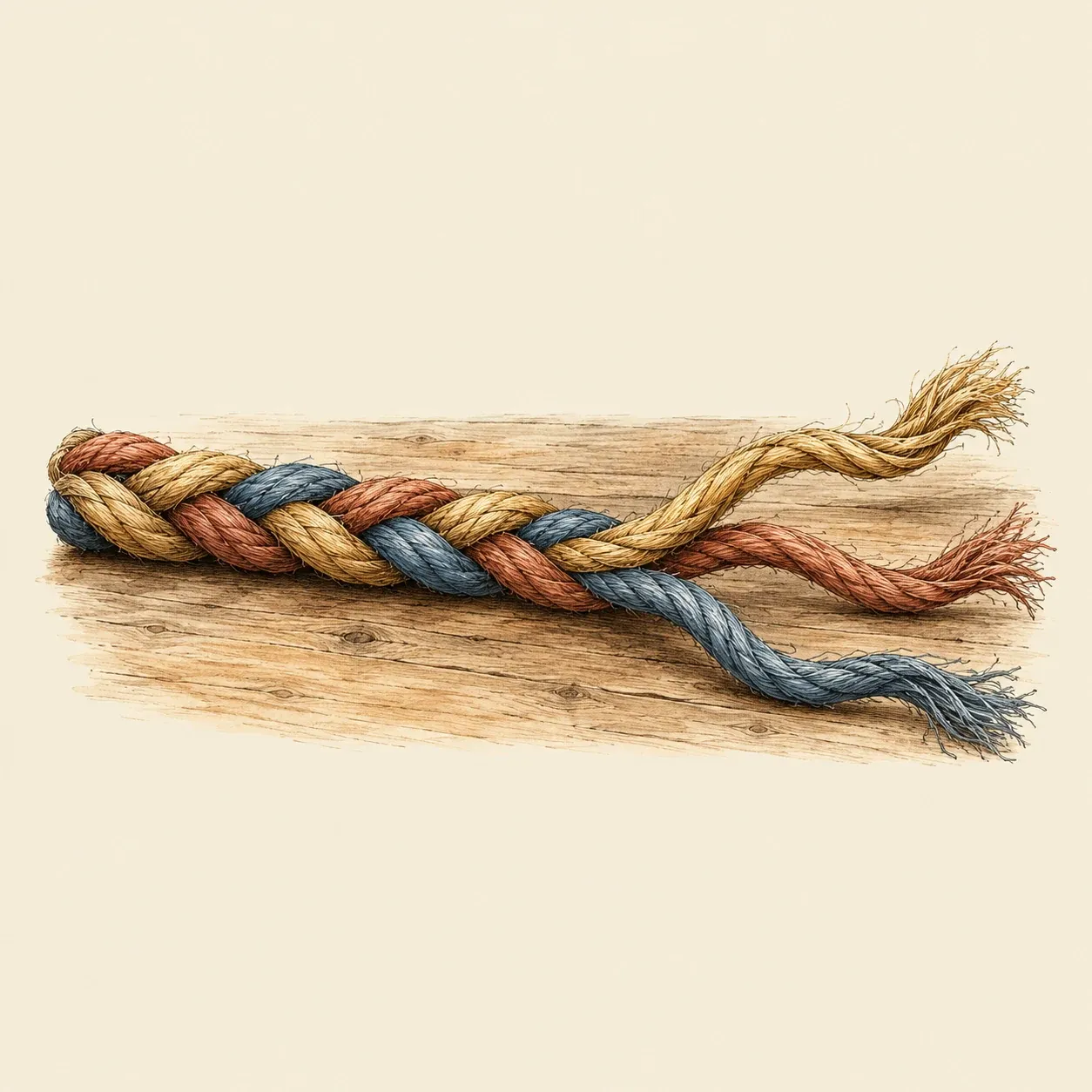 Collagen is a tight triple helix; heat in water unwinds it into loose chains of gelatin.
Collagen is built from three protein chains wound round one another in a stiff helix. In skin and bone, these helices are packed into fibres and tied to their neighbours by many chemical links, which is why a hide can be soaked for days without dissolving. To make gelatin, those links must first be loosened.
That is the purpose of the steeping. Cattle hides and bones are usually soaked for several weeks in an alkaline bath of lime, pig skins for about a day in a dilute acid. The collagen swells, some links break, and fat, hair and other proteins are washed away. Bones are also stripped of their minerals first, which leaves the soft collagen of the bone.
Hot water does the rest. The steeped material is heated in water in several stages, each hotter than the last, and the helices unwind and the freed chains go into solution. The first, gentlest extractions give the firmest jelly; the later, hotter ones give weaker grades. Glue makers did the same in one cauldron, drawing off the liquor in batches.
The warm liquor is then filtered, cleared of fat and salts, and thickened by evaporating water, in modern plants under vacuum, until it is as thick as honey. It is sterilised, and on cooling the chains find each other again: here and there, short stretches wind back into helices that tie the chains into a network, and the water is trapped inside it. The liquid becomes a jelly. Warmed, the network comes apart and the jelly melts; cooled, it sets again. Factories extrude the jelly into strands, dry them in warm air and grind them; older works cut it into slices and dried them on nets.
How to do it
Making gelatin from skins or bones takes long lime or acid baths, then extraction in hot water, with careful control of hygiene, which belong in a factory. Leaf gelatin from a shop shows every step after the extraction: swelling, dissolving, setting, melting and setting again.
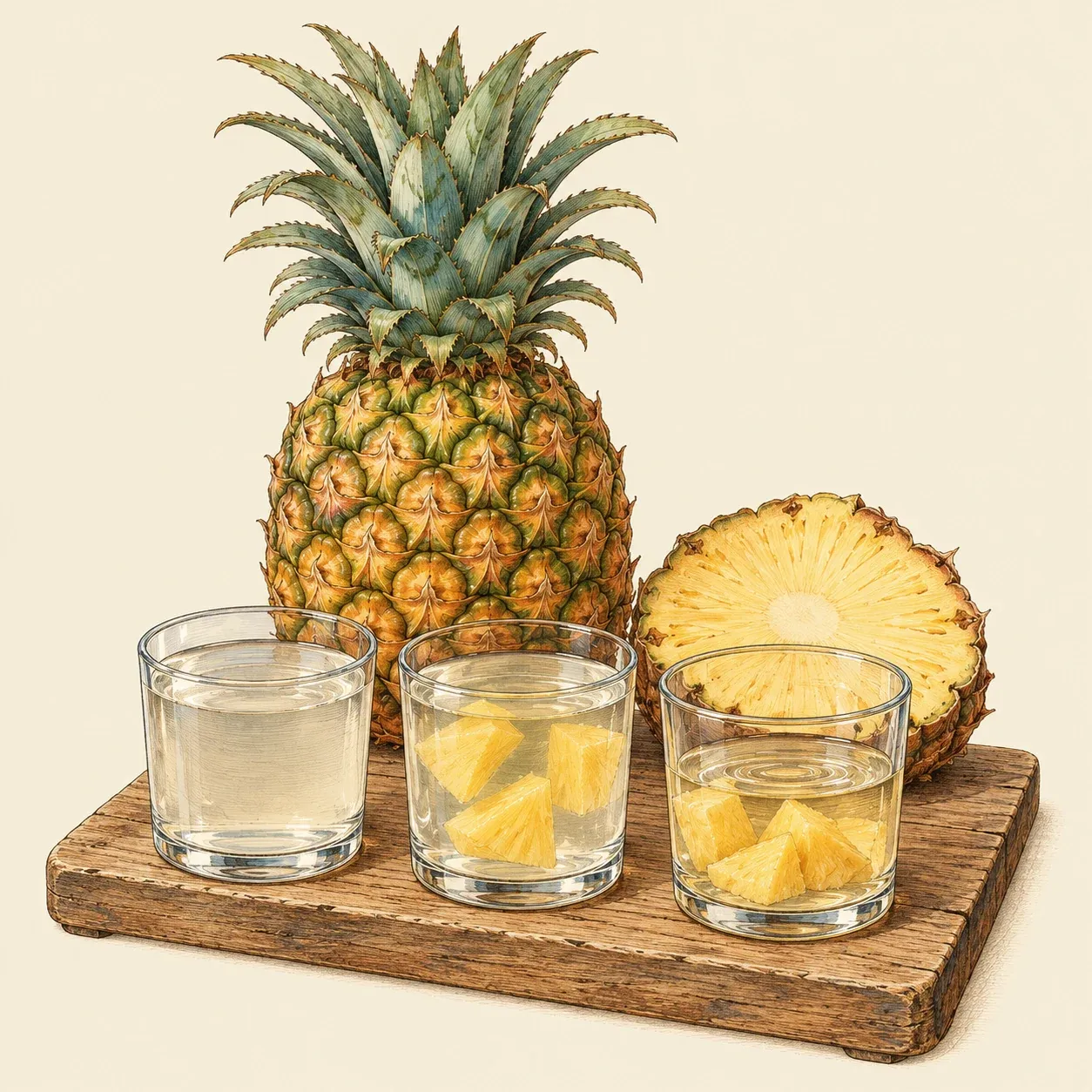 Fresh pineapple stops gelatin setting; tinned pineapple, already heated, does not.
Soak two or three sheets of leaf gelatin in a bowl of cold water. Within a few minutes they swell and turn soft, because the dry chains take up water without dissolving. Squeeze them, put them in a cup with a little hot water from the kettle, poured by an adult, and stir: they dissolve completely. Add cold water, with a spoonful of sugar if you like, and pour the liquid into three small glasses.
Leave the first glass as it is. Put a few pieces of tinned pineapple in the second and a few pieces of fresh pineapple in the third, then place all three in the refrigerator. The next day the first two have set and the third is still liquid. Fresh pineapple contains an enzyme, bromelain, that cuts protein chains into pieces too short to form a network; the heat used to preserve tinned pineapple has destroyed it. Finally, stand the first glass in a bowl of warm water: the jelly melts, and back in the refrigerator it sets again.
History and evolution
In the cave of Nahal Hemar, in Israel, a human skull is covered with a thin coating that contains collagen and a resin from the storax tree, with threads of the same paste laid over it in a net pattern. The coating has been dated directly to 8920 to 8430 BCE. Baskets from the same layer, whose finds date from 8210 to 7300 BCE, carry coatings of cattle collagen on their inner and outer faces, most likely as a lining or to make them watertight. In Europe, hide glue has been identified on a yew bow from a Neolithic lakeside village in Zurich, dated to the late 4th millennium BCE. Strips of bark were stuck to it with a glue whose proteins point to the skin of cattle and of sheep or goats. In Egypt, collagen glue was used in the 3rd millennium BCE to assemble furniture and veneers and to bind paints.
Medieval cooks knew the same substance as a food. They simmered calves’ feet, deer antler and meat to make broths that set into jelly, and the Viandier, a French cookery book of the late Middle Ages, begins its jelly with legs or feet of veal.
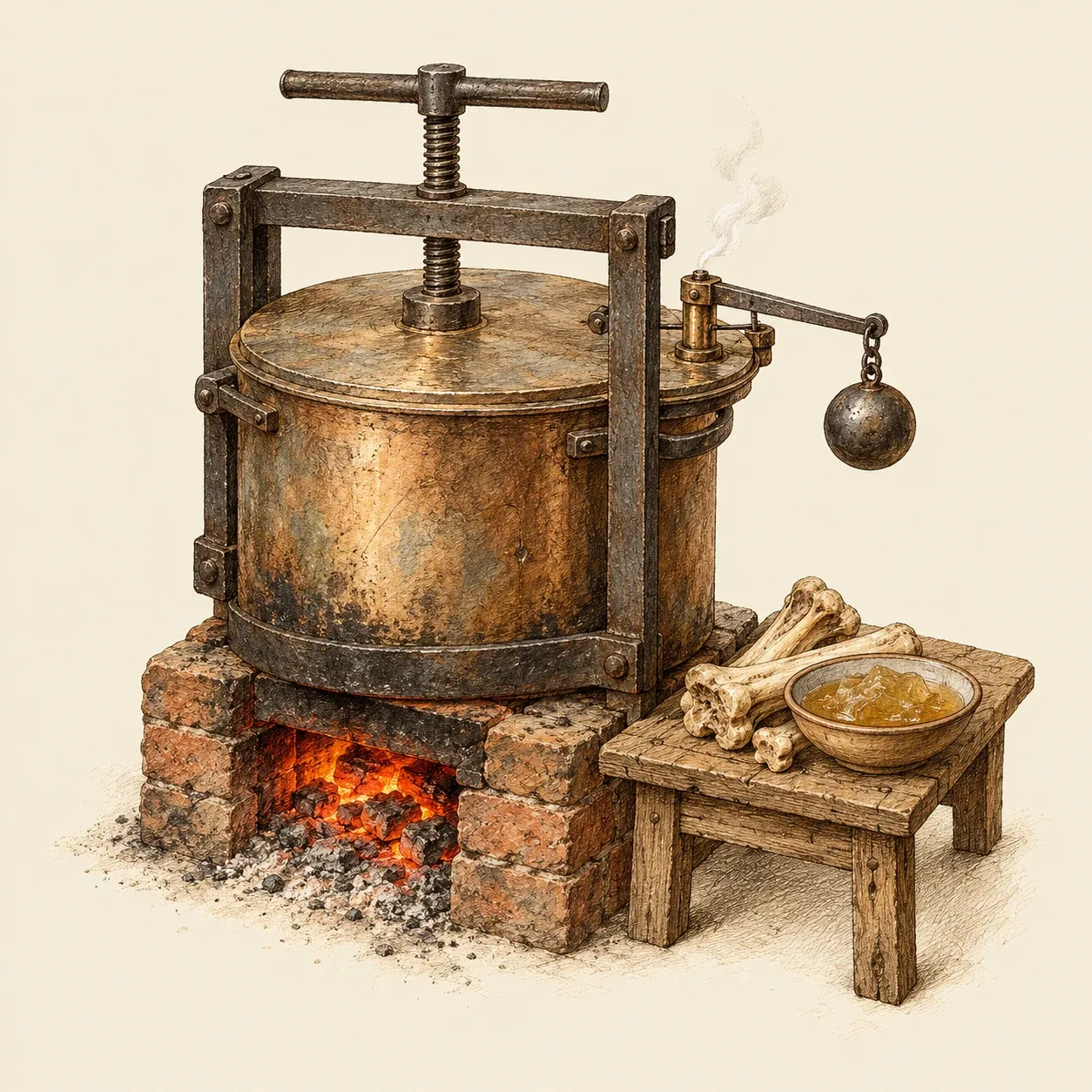 Papin’s digester held its lid down with a screw, and a weighted valve let out excess steam, so that bones could be cooked above the boiling point of water.
In 1681 Denis Papin, working in London, described a closed pot with a lid screwed down tight, which cooked bones in water hotter than its ordinary boiling point until they softened and gave up their jelly; a French edition followed in 1682. From 1812 Jean-Pierre-Joseph d’Arcet used a process in a Paris factory that extracted gelatin from bones with the help of hydrochloric acid, which dissolves the minerals of the bone.
Gelatin then became an industrial product. In 1845 the American glue maker Peter Cooper patented a “portable gelatine”, a clear jelly that could be cast in moulds. In 1871 Richard Leach Maddox proposed gelatin to hold the light-sensitive silver salts of photographic plates, and gelatin became the binder of photographic film. Today gelatin is made in large plants that steep, extract, filter, evaporate, sterilise and dry continuously, and the same steps, shorter or longer, give gelatins for food, medicine and technical uses.