Shoemaking
From bark sandals to shoes built on a last
Contents
- 1Wooden last
- 2Upper
- 3Heel of stacked leather lifts
- 4Insole with its ridge for the inseam
- 5Welt and inseam
- 6Outsole and outseam
A shoe protects the underside of the foot with a sole held in place by an upper. Sewn leather shoes are built around a last, a wooden model of the foot: the wet leather of the upper is stretched over it and the sole is then sewn or nailed on. The oldest footwear dated directly, sandals of twined sagebrush bark from Fort Rock Cave in Oregon, is about 10,500 years old.
What it is
A shoe has two main parts. The sole lies under the foot and takes the wear of walking. The upper wraps the toes, the instep and the heel and holds the sole against the foot. It is usually cut from several pieces, the vamp over the front of the foot and the quarters round the heel, lined inside and closed with laces or a strap. A sandal keeps the sole and ties it on with cords or straps. A boot is a shoe whose upper rises above the ankle, and it is built in the same way.
Sewn shoes like the one drawn here are made on a last, a solid model of the foot, traditionally carved from wood. Footwear can also be made without one: the Fort Rock sandals are twined flat, and the one-piece shoe made below is gathered round the wearer’s own foot. The last sets the length, the width, the shape of the toe and the room over the instep. The shoemaker builds the shoe on it and pulls it out when the work is done. Medieval shoes were already made for the right and the left foot. From the early seventeenth century “straight” shoes, the same for both feet, were the rule, and right and left shapes came back from the 1790s.
How it works
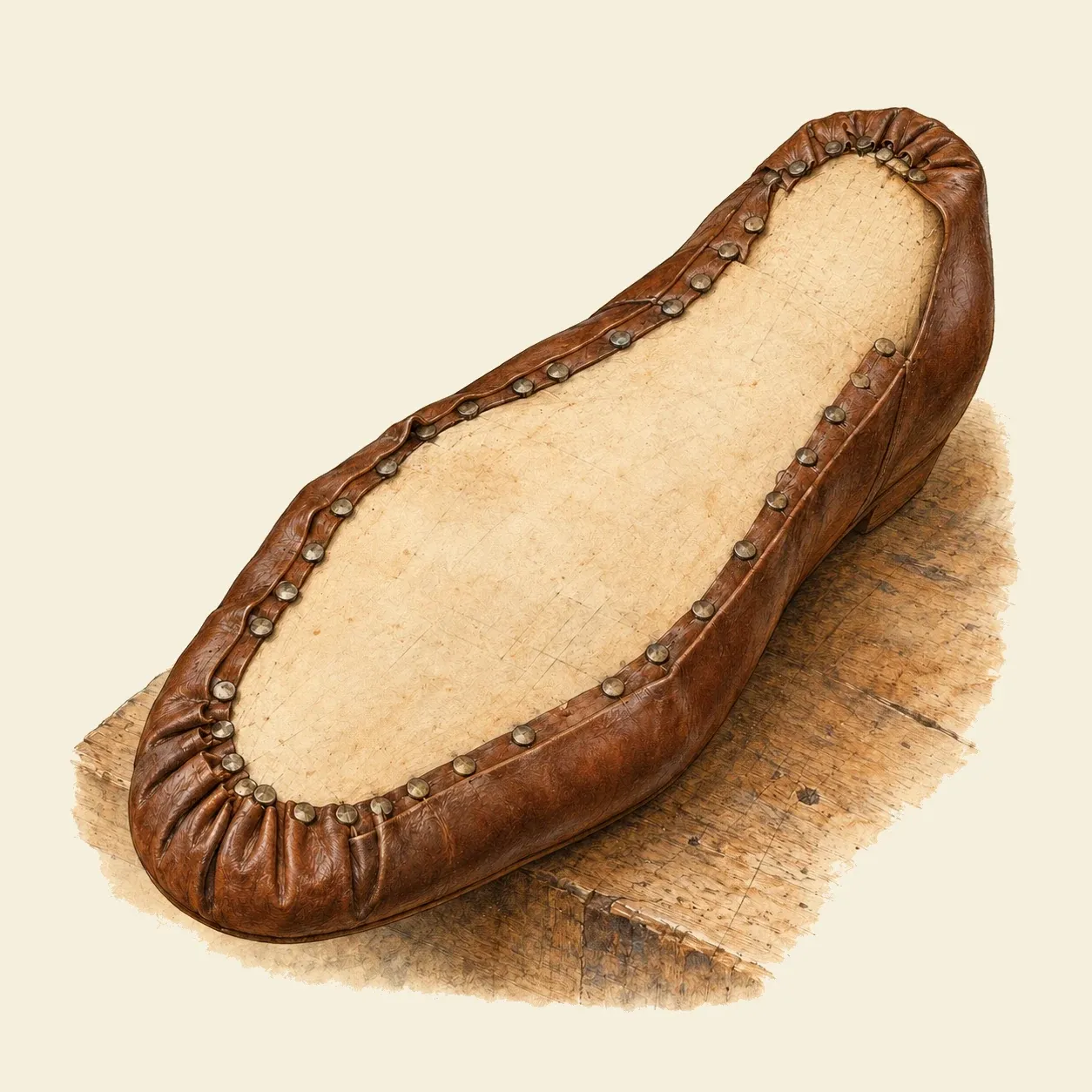 The damp upper is pulled over the last and its edge folded onto the insole, held by temporary tacks.
Leather softens when it is wet and holds its new shape once it dries. To last a shoe, the maker sets an insole on the bottom of the last, pulls the damp upper down over the last and folds its lower edge under, onto the insole, holding it with temporary tacks. As the leather dries, it keeps the form of the last. Joining the upper to the sole is the second half of the work, and shoemakers have done it in several ways.
The medieval turnshoe was made inside out. The sole and the upper were fixed to the wooden last with their inner faces outwards, sewn together along the edge, and the shoe was then taken off the last and turned right side out, which hid the seam inside. The sole could only be a single layer of leather, about 2 to 3 mm thick, so the shoe was light and supple but wore through quickly. Roman shoemakers built up soles of several layers of leather held together with thongs, stitching and iron hobnails.
The welted shoe on the plate needs no turning. A narrow strip of leather, the welt, runs round the edge of the forepart. One seam, the inseam, passes through the welt, the edge of the upper and a ridge cut in the insole, and joins all three. A second seam, the outseam, sews the outsole to the part of the welt that sticks out, so it never pierces the insole. Cork fills the hollow between insole and outsole. A worn sole can be cut off and a new one sewn to the same welt without disturbing the upper. The heel is built up from stacked layers of leather, called lifts.
How to do it
This makes a simple shoe from a single piece of soft leather, gathered round the foot with a thong, of the type found in the Areni-1 cave and known in the Aran Islands of Ireland as pampooties. Such shoes wear out fast: pampooties were reported to last a month at most. You need a piece of soft, supple leather large enough for the foot, paper, a pencil, scissors, a sharp knife, a cutting board, a leather hole punch or an awl, and a long leather thong.
Stand on the paper and trace round your foot. Around this outline draw a second, wider one that leaves enough leather to come up over the toes, the sides of the foot and the back of the heel. Cut the pattern out of paper and wrap it round your foot to check it before you cut any leather. Lay the pattern on the leather, draw round it and cut it out on the board.
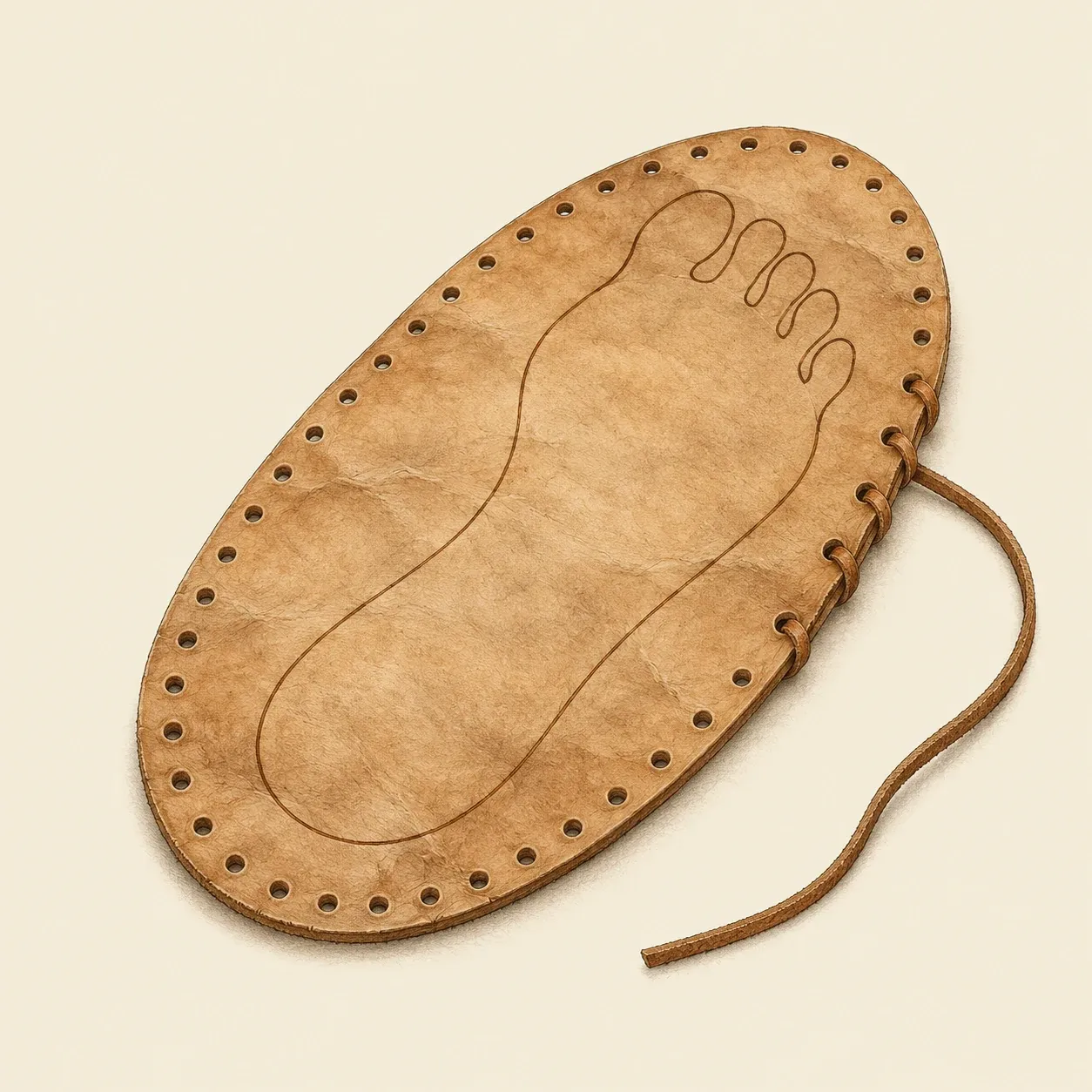 The flat piece, punched all round its edge, before it is drawn up round the foot.
Punch a row of small holes all round the edge, at an even distance from it. At the heel, bring the two back edges up together and lace them with a separate length of thong to close the back of the shoe. Thread the long thong through the holes along the sides and over the toes, put the shoe on and pull the thong gently so the leather gathers over the toes and the instep, then tie it round the ankle. The Areni shoe had its smooth grain side inwards and was found stuffed with grass. A little dry grass or a felt insole makes the shoe more comfortable. The leather will slowly take the shape of the foot.
Safety. Cut on a board and draw the knife away from your hand and body. Hold the punch or awl so that its point is never aimed at your fingers. A shoe like this has a thin, smooth sole with little grip and no protection against sharp stones or nails: wear it indoors or on soft ground, and take care on wet floors.
History and evolution
Signs of footwear are older than any shoe. Erik Trinkaus studied the toe bones of Ice Age humans: the middle toes grew more slender while the legs stayed robust, as happens when shoes protect the forefoot. In his reading, footwear was already worn in the Middle Palaeolithic and became more common about 27,500 years ago.
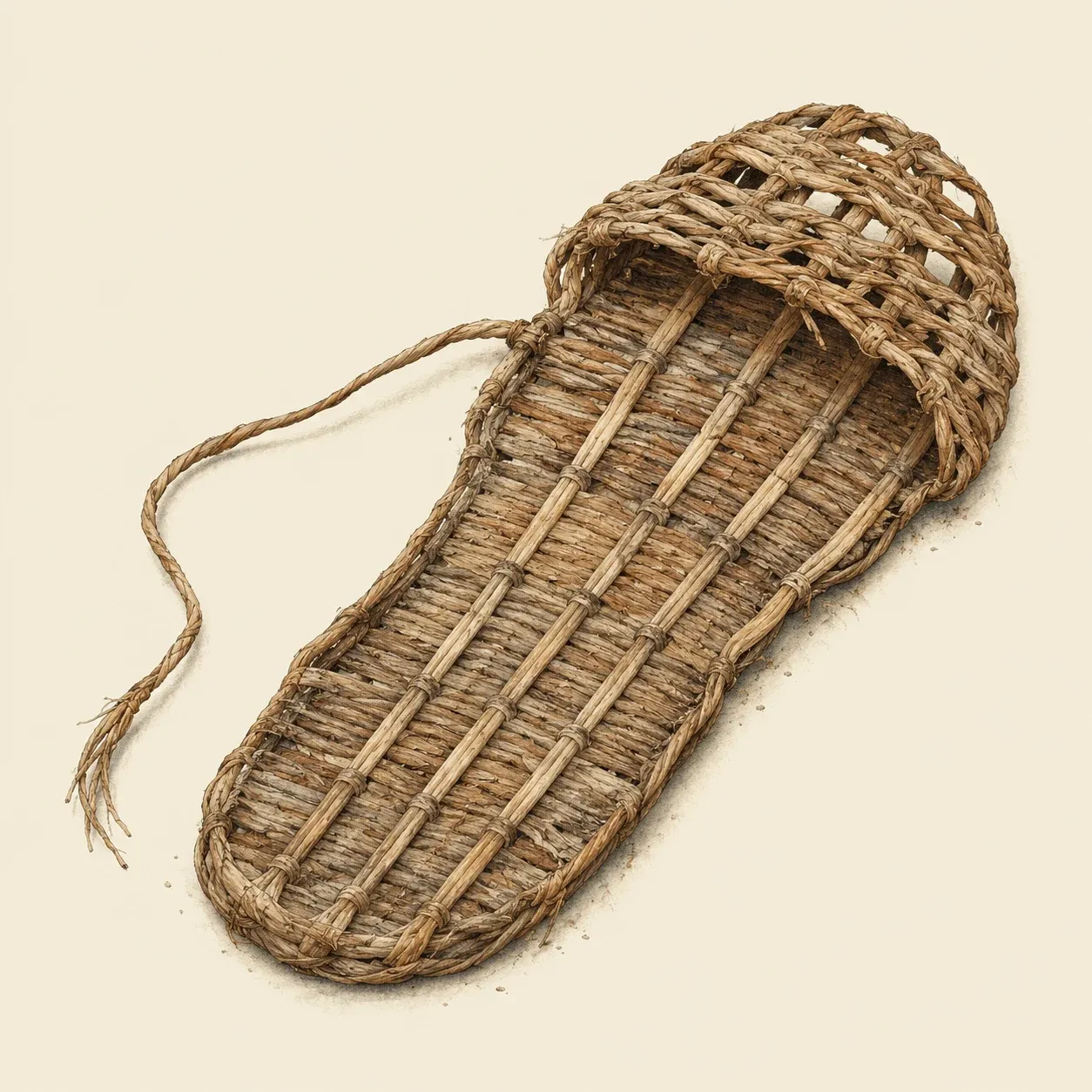 A Fort Rock sandal: shredded sagebrush bark twined over lengthwise cords, with a looser flap folded over the toes.
The oldest footwear dated directly comes from Fort Rock Cave in Oregon. In 1938 the archaeologist Luther Cressman found dozens of sandals there under a layer of volcanic ash. They are made of shredded sagebrush bark, twined into a flat sole with an open flap over the toes and ties to hold them on, and ten of them have been radiocarbon dated to between about 10,500 and 9,300 years ago.
The oldest leather shoe dated directly was found in 2008 in the Areni-1 cave in Armenia. Its leather is dated to 3627–3377 BCE. It was cut from a single piece of hide that wrapped the right foot, 24.5 cm long, laced over the top and up the back with a leather thong through rows of eyelets, and it was stuffed with grass. Ötzi, who died in the Alps a few centuries later, wore shoes with a lining of grass and an outer part of deer and bear leather.
In the Roman fort of Vindolanda, near Hadrian’s Wall, more than 5,000 shoes have been recovered. Many of their soles were built up of several layers of leather held by thongs, stitching and hobnails, sometimes set in decorative patterns. Through the Middle Ages most shoes in Europe were turnshoes made on wooden lasts. Marquita Volken links the next change to paved streets, which wore out thin soles quickly: between about 1490 and 1510 shoemakers developed stronger constructions with two or more sole layers, among them the welted shoe. Raised heels followed in the early seventeenth century. John Nicholl places the shift from turnshoe to welted shoe in Ireland towards the end of the sixteenth century.
Shoes were made by hand until the nineteenth century. In 1858 Lyman Blake patented a sewing machine that joined soles to uppers. Gordon McKay bought it, improved it and leased the machines to factories for a fee on every pair; by the late 1870s they made half the shoes in the United States. Lasting was still done by hand until Jan Ernst Matzeliger patented a lasting machine in 1883. It held the shoe on its last, pulled the leather tight round the heel and drove in the tacks, and it made 150 to 700 pairs a day, where a skilled hand laster made about 50.