Igloo
A vault of snow blocks laid in a spiral
Contents
- 1Snow blocks laid in a rising spiral
- 2Ventilation hole at the top
- 3Ice window above the entrance
- 4Entrance tunnel lower than the floor
- 5Raised sleeping platform covered with skins
- 6Soapstone seal-oil lamp (qulliq)
An igloo is a dome of snow blocks laid in a rising spiral, so that it closes over itself without a frame or scaffold. Inuit of the central Canadian Arctic lived in large ones through the winter and still build small ones as shelters on hunting trips. Snow houses melt every spring, and the clues to their age are the knives used to cut the blocks. Snow knives became common in the eastern Arctic with the Dorset culture, which took shape between about 800 and 500 BCE. The Thule people, ancestors of the Inuit, who arrived from Alaska around the thirteenth century, also built snow houses.
What it is
An igloo is a house built entirely of snow. Blocks cut from a hard drift are set in a circle and then in courses that lean further inward as they rise, until a last block closes the top. The word comes from the Inuktitut iglu, which means a house of any kind. In English it usually means the snow house.
Inuit from Smith Sound to Labrador and west to Victoria Island built snow houses in winter. A hunting party on the move put up a small one for a night or a few days. A family settling for the winter built a larger dome, often joined to others and to small side vaults for meat and gear, with an entrance made of one or two low domes and a passage. Inside, the floor was divided in two. The rear part was a raised platform where people sat and slept on skins, and the lower front part around the door held stores and work. A lamp of soapstone burning seal oil gave heat and light.
How it works
Snow packed by the wind is made of small grains locked together. Cut from a drift laid down by a single storm, it gives blocks that hold together and can be trimmed with a knife. Drifts made of several layers split along them when cut. Much of a block’s volume is air trapped between the grains, and this is what makes snow a good insulator.
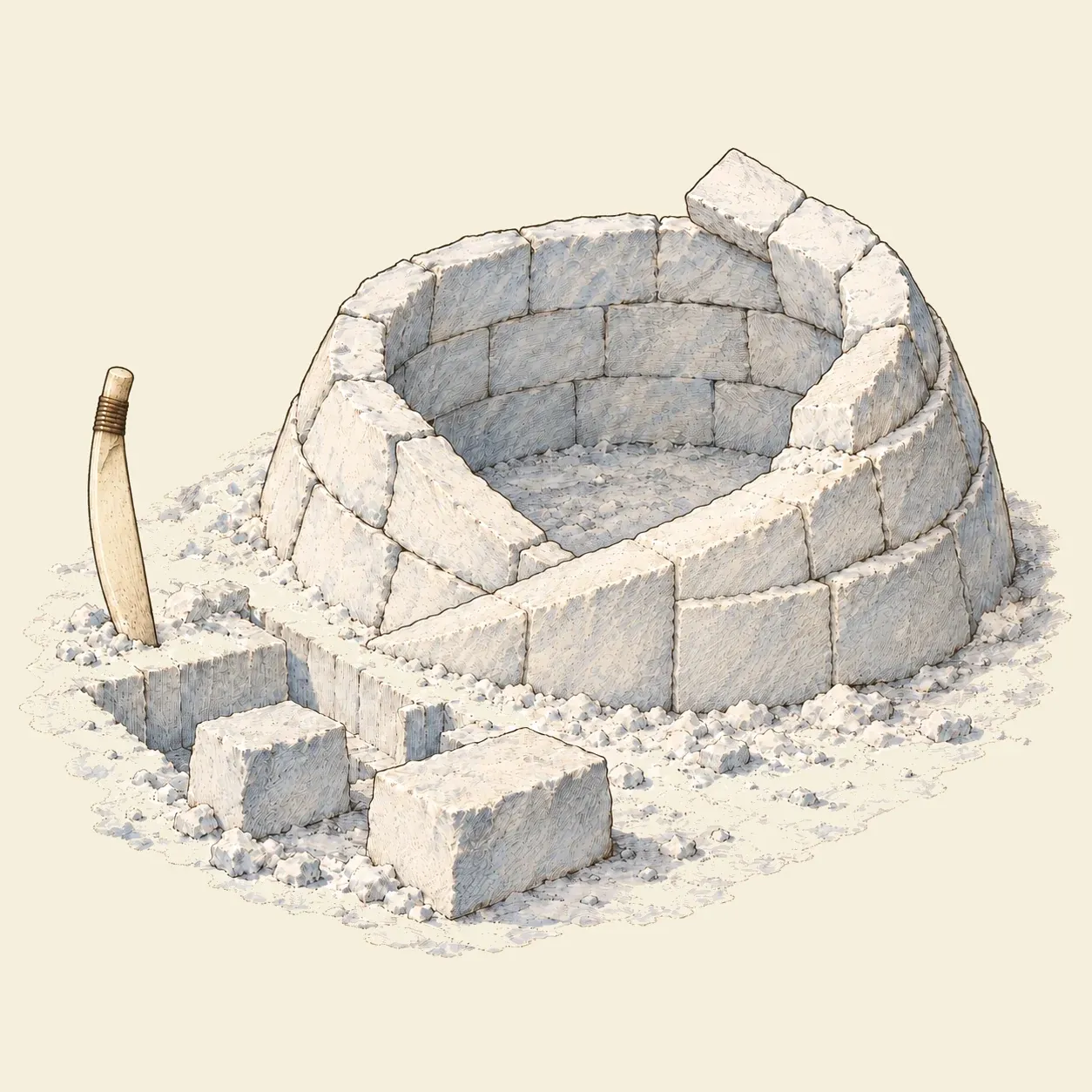 The first ring is cut down to the ground at one point, and every later block follows the rising course.
The builder does not lay the blocks in level rings. After the first ring is set, its top is cut on a slant so that it rises like the first turn of a screw, and every later block is laid on that rising edge. Each new block rests on the course below and leans against the block placed just before it, so it is held on two sides even when it leans far inward near the top. This is why an igloo needs no scaffold or frame. The joints are bevelled with the knife so the blocks press against each other, and once the key block is in place the gaps are packed with loose snow. The finished dome is taller than half a sphere. Its walls rise steeply at the base and curve over at the top. In that shape the weight of the snow presses the blocks together all the way down, where a half sphere would tend to spread outward at the foot.
The entrance does a different job. It is cut lower than the floor of the room, often as a trench or a passage of small vaults, so the living space stands a step above it. Cold air is heavier than warm air and settles in the passage. The warm air stays in the room, rises around the lamps and leaves slowly through a small hole near the top, which also gives the flame the draught it needs. Franz Boas, who lived among Inuit of Baffin Island in 1883–1884, described the window cut above the door, covered with sewn seal gut or a slab of clear freshwater ice.
Heat comes from the ground, the people and the lamp. Snow lets little heat through, so an empty shelter takes on the warmth of the ground beneath it. In Alaska in 1956, Robert Elsner and William Pruitt measured about −8 °C inside an unheated snow shelter while the outside air fell as low as −40 °C. People and flames add far more. Elsner and Pruitt recorded a difference of about 40 °C with two people and two candles inside, and G. Peter Kershaw and his colleagues, at Resolute in 1993, up to 45 °C with seal-oil lamps burning. Boas reported that an unlined snow house stayed at 2 to 3 °C, while one lined with skins hung from the roof reached 10 to 20 °C. Moisture from breath and cooking freezes on the inner face of the wall and leaves a thin layer of ice that lets less air through the snow.
How to do it
A small snow shelter for two people is a winter project for a group with an experienced adult, after a period of cold weather, and it takes several hours. Choose a level place on a deep drift that the wind has packed hard, well away from slopes, cornices and roads. Push a pole or ski into the snow at several points to check that the drift is firm and has no soft layer.
Mark a circle about 2 m across with a cord fixed to a stick in the centre. Cut the blocks with a snow saw or a long knife, from a trench at the side of the circle that will become the entrance. Blocks about 15 cm thick are light enough to lift and thick enough to hold. Set a first ring on the circle, each block leaning slightly inward. Then cut the top of this ring down to the ground over the length of a few blocks, so that it climbs as a ramp, and carry on laying blocks along the ramp. Trim each block so that it sits on the one below and presses against the one beside it before you let go. As the walls rise the blocks lean more, and one person working inside supports them with the head and hands while another passes them in. Fit a last block into the opening at the top from inside, then pack every gap with loose snow, inside and out.
Cut a low door on the side away from the wind, at the level of the trench, and pile snow at the back so that the sleeping area is higher than the door. Push a ski pole through the roof near the top and turn it to make a ventilation hole as wide as the basket of a ski pole.
Safety: a dome that is too flat or badly packed can fall in, so never climb on it, test it before anyone sleeps inside and keep a shovel inside. Flames give off carbon monoxide, an odourless gas that can kill in a shelter whose inner wall has glazed with ice, so burn nothing inside unless the ventilation hole is open and at least the size of a ski pole basket, never bring in charcoal, a fuel heater or a barbecue, and cook outside. Stay dry while building, since wet clothes in the cold lead to frostbite and hypothermia.
History and evolution
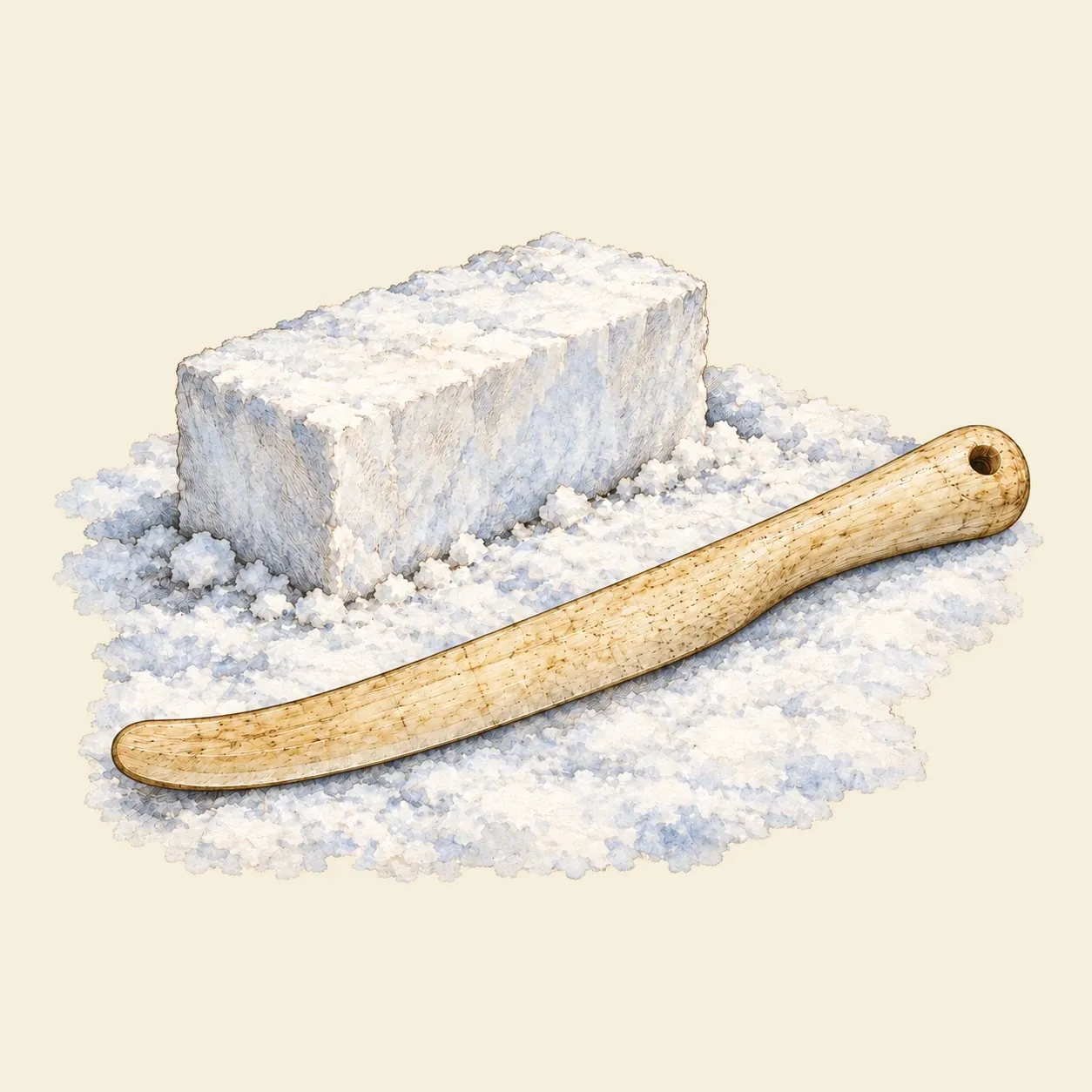 Snow knives of ivory, bone or antler are the main clue to snow houses at ancient Arctic sites.
Snow houses melt every spring and leave nothing for archaeologists to dig up, so the evidence for them is indirect. In the ancient sites of the eastern Arctic, Mikkel Sørensen writes, snow houses are shown by snow knives. The Canadian Encyclopedia says snow knives, used to build snow houses, became more common at the start of the Dorset period, together with sled runners and ice creepers. It places that start between about 800 and 500 BCE and the end of the Dorset culture around 1300–1400 CE; a genetic study led by Maanasa Raghavan begins the early Dorset phase around 800 BCE. Daniel Odess of the University of Alaska Museum also writes that early Dorset sites in Canada show snow knives in use to build houses of snow blocks, probably out on the sea ice. The Museum of Archaeology and Anthropology in Cambridge holds an ivory snow knife with a curved single edge, 27.5 cm long, excavated in 1939 by Graham Rowley and Aipiluk Innuksuk at a Dorset site near Igloolik. Sørensen considers a still older piece probably the earliest snow knife from the eastern Arctic: a fragment of walrus ivory that Jørgen Meldgaard found in House 3 at Kapuivik, near Igloolik, in a context he equates with late Pre-Dorset, the phase that came before Dorset. Max Friesen of the University of Toronto argues from house remains and the pattern of sites that Middle Dorset people, about 2,000 years ago, already lived in snow houses.
The Thule people, ancestors of the Inuit, moved east from Alaska. That migration was long dated to about 1000 CE; Max Friesen and Charles Arnold place it in the thirteenth century. In winter the Thule lived in houses dug partly into the ground, walled with stone and turf and roofed with whale bone, and entered through a sloping tunnel that kept the cold air low. They also built snow houses at times, and the Cambridge museum suggests they may have learned to build with snow from the Dorset. According to the Canadian Encyclopedia, the snow house became the main winter dwelling after the whale-bone houses were abandoned, possibly because the climate grew colder.
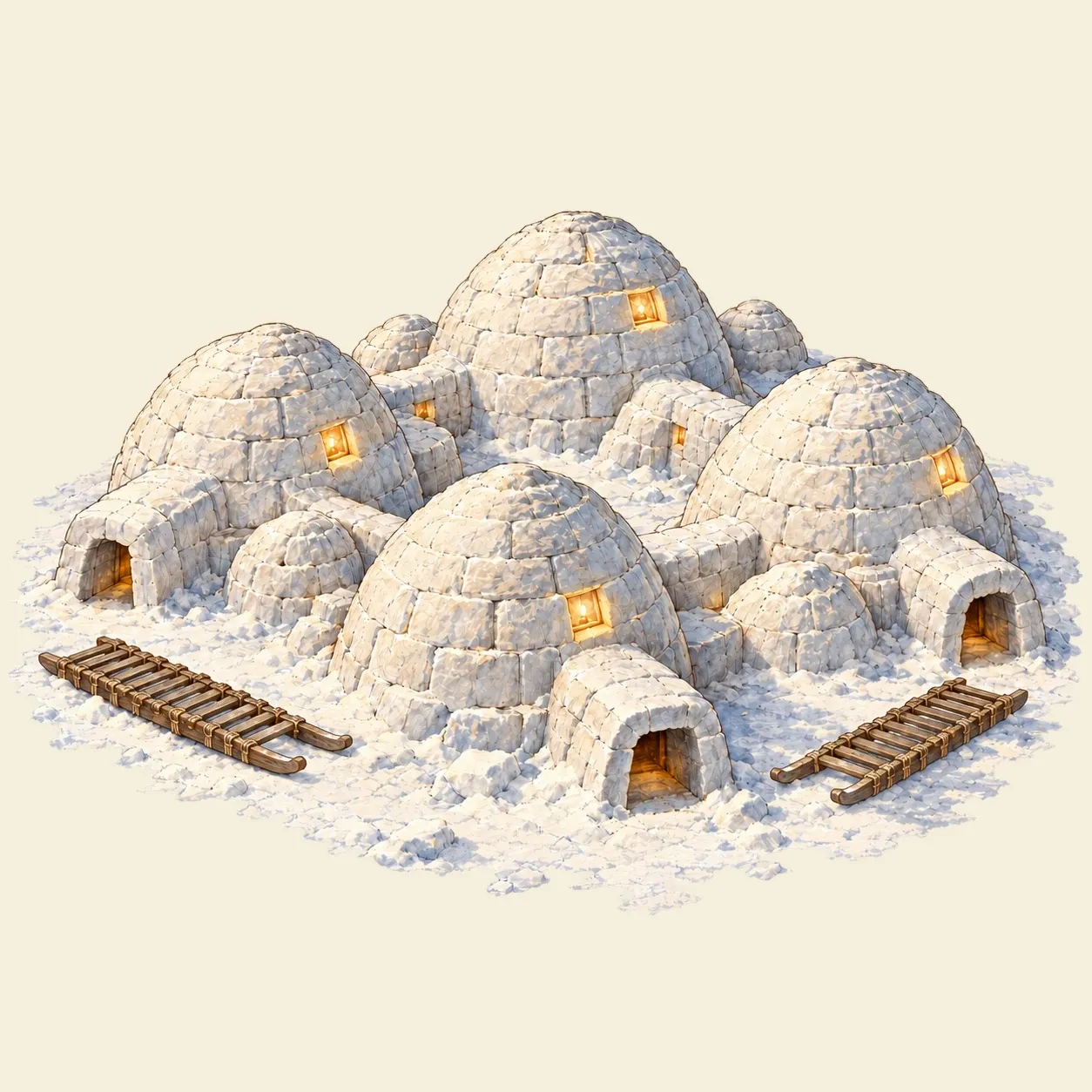 In winter several snow houses were often joined by passages, with small domes for stores.
Some of the earliest written descriptions of a snow house come from Labrador. The English trader George Cartwright visited one at Lyon Head, at the mouth of the Charles River, and on 26 February 1771 wrote in his journal that its room had been hollowed out of a snowdrift in the shape of an oven. Its porch was built of large oblong blocks of snow laid one on another and meeting at the top, and a small kitchen beside it was also made of snow blocks. Marianne Stopp has shown that William Richardson’s account of the same year, which gives its name as aneo-iggilo, “snow house”, was taken from Cartwright’s. William Edward Parry and George Lyon spent the winters of 1821 to 1823 near Inuit camps in the far north of Hudson Bay and in Foxe Basin, and their narratives of 1824, illustrated by Lyon, show whole villages of snow domes. Boas measured and drew them on Baffin Island and published his account in 1888. Inuit still build snow houses as shelters on the land.