Mycelium materials
Plant waste bound into solid shapes by a growing fungus
Contents
- 1Mould
- 2Chopped plant stalks
- 3White fungal threads binding the pieces
- 4Dense skin on the surface
- 5Dried block
Mycelium materials are solid shapes grown from plant waste. Chopped straw, stalks or sawdust are packed into a mould with a living fungus, whose fine threads spread between the pieces and knit them into one block. Drying the block stops the growth and leaves a light material used for packaging and insulation. Shigeru Yamanaka and Reiko Kikuchi of the Japanese firm Ajinomoto obtained in 1991 a United States patent, one of the earliest, on fibres bonded by a growing fungus.
What it is
A mycelium material is a solid made by a fungus. Loose plant waste, such as chopped straw, hemp stalks, corn stalks, husks or sawdust, is packed into a mould together with a living fungus. In the following days the fungus grows through the whole mass, binds the pieces to one another and takes the shape of the mould. The block is then taken out and dried, which stops the growth. What remains is a light, stiff material that can be shaped like moulded plastic foam and that rots away in compost at the end of its life.
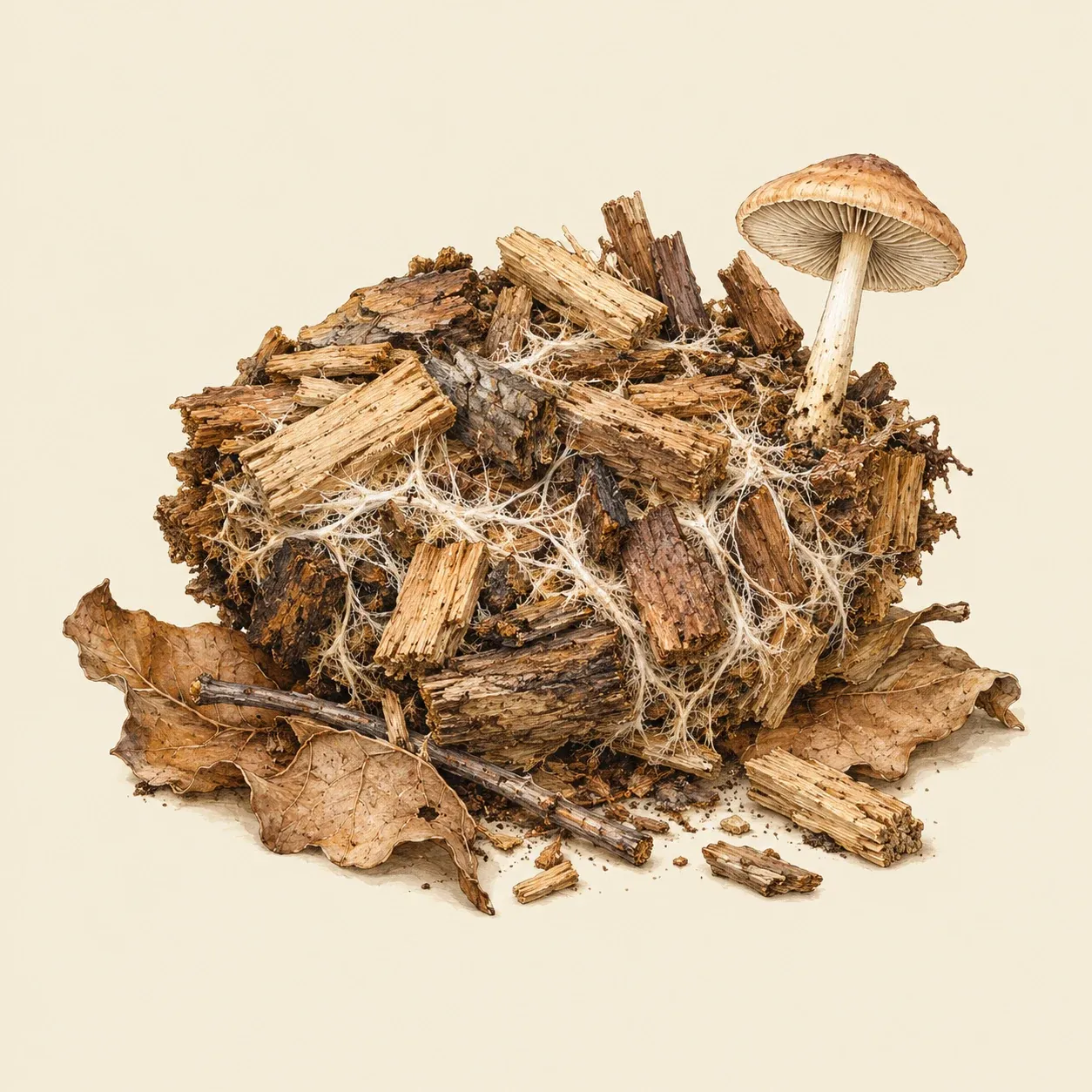 On a forest floor, fungal threads bind fallen wood chips into a single clump.
The same thing happens in any wood. A mushroom is only the fruit of a fungus. The body of the fungus is the mycelium, a mass of threads far finer than a hair, called hyphae, that grow through the food the fungus lives on. Pull apart a rotting log or a heap of wood chips and you find them as a white web holding the pieces together. Eben Bayer and Gavin McIntyre, who founded the American company Ecovative, said they got their idea from watching mushrooms grow on wood chips and seeing how strongly the mycelium stuck the chips together. A mycelium material uses that grip on purpose, in a shape chosen in advance.
How it works
Each hypha grows at its tip and branches as it goes. It releases enzymes that break down part of the plant matter around it and takes in what they free as food. As the threads multiply they wrap around each piece of straw or wood, push into its cracks and cross from one piece to the next, so that the loose filling becomes a felted mass. Where the mycelium meets the air at the surface of the mould, it grows thicker and forms a dense white skin. The cell walls of the hyphae are made of tough natural polymers, chitin and glucans, which give the material its strength once it has dried.
The plant waste has to be cleaned of other life first. Straw and sawdust carry spores of moulds and bacteria that would otherwise race the chosen fungus for the food, so the filling is steamed or heated before the fungus is added. Makers use fungi that grow fast and bind well, such as oyster mushroom or reishi. When the block is fully colonised it is dried. Drying at room temperature or gentle heat leaves the fungus dormant, and it can grow again if the block gets wet; baking at a higher heat normally kills it. Pressing the block while it dries, hot or cold, gives a denser and stiffer board.
The result is light and full of tiny air spaces, which makes it a good insulator against heat and noise. Against the expanded polystyrene it often replaces, it has usually tested weaker in compression, while some versions have matched or beaten it in tension or stiffness. It soaks up water unless it is coated. When it burns it tends to form a layer of char. Its properties change a great deal with the fungus, the plant waste and the way it is grown, pressed and dried.
How to do it
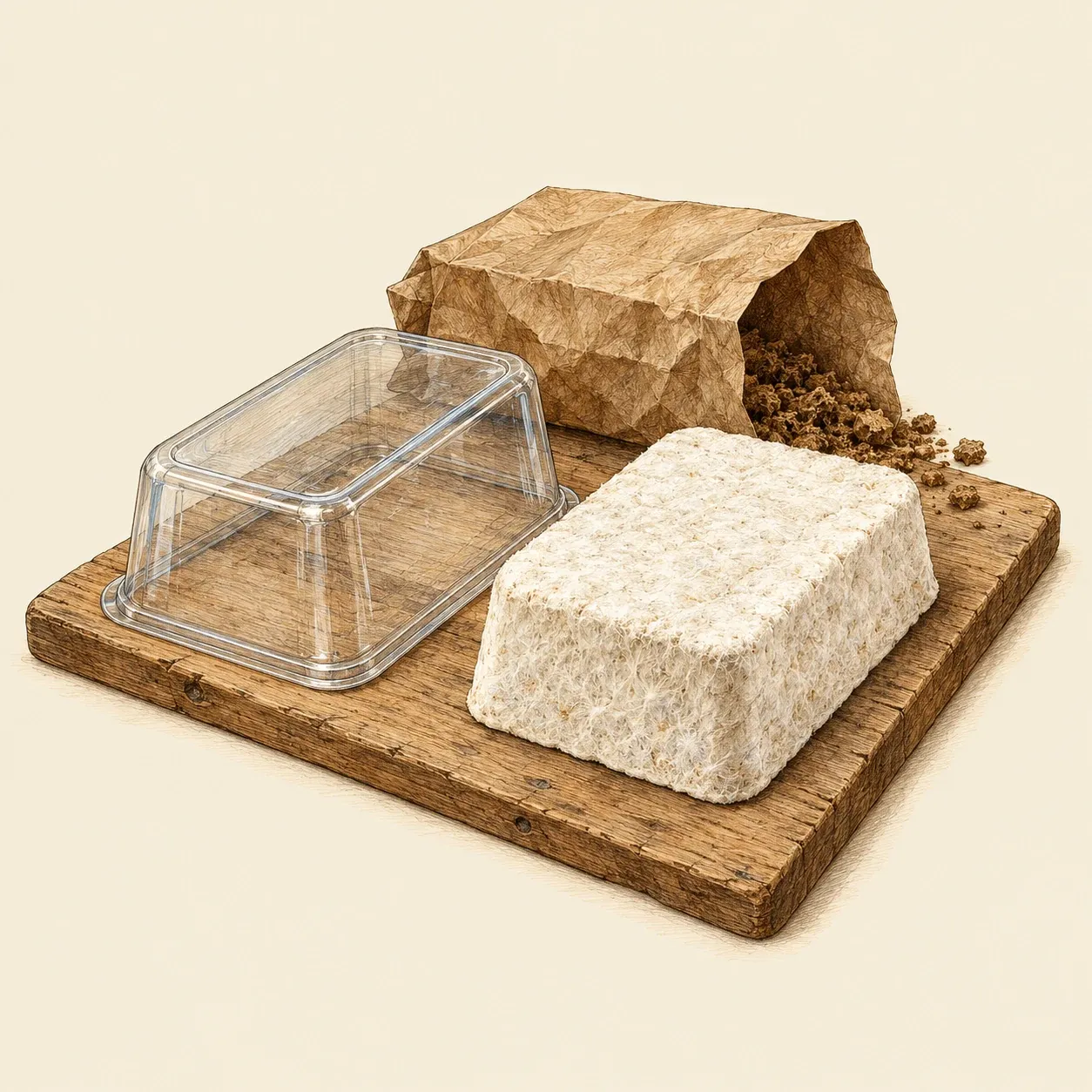 The block keeps the exact shape of the container it grew in.
The simplest way to grow a block at home is from a kit: a bag of plant waste, usually hemp stalks or straw, already colonised by the fungus and sold for making packaging and small objects. You also need a clean plastic food container with a lid to serve as the mould, a little plain flour if the kit asks for it, disposable gloves, a clean spoon, a sharp knife, and an oven or a warm, dry place.
Wash the container, the spoon and your hands well. Make a few small holes in the lid with the knife so that some air can get in. Wearing the gloves, break up the contents of the bag into crumbs, mix in the flour if the instructions say so, and pack the crumbs firmly into the container, pressing them into the corners. Put the lid on and leave the container in a dark place at room temperature. Over the next days the crumbs turn white and grow together. When the surface is covered with white and the block holds together, tip it out and leave it a few more days on a clean surface, loosely covered, so that a skin grows over the faces that were against the container. Then dry it in the oven on its lowest setting, or for several days in a warm, dry place, until it is light and hard right through. Follow the times and temperatures given with the kit, and keep the finished block dry: if it gets wet, the dormant fungus can start growing again.
Fungi release spores, and some people are allergic to them. Grow the block away from where food is prepared and from anyone with asthma, and wear a dust mask if you are sensitive. If green, black, pink or orange patches appear, another mould has taken over: put the closed container in a bag and throw it away without opening it indoors. Never eat any part of the block or anything that grows from it. Keep the oven low, stay nearby while the block dries and use oven gloves to take it out. Wash your hands after handling the material.
History and evolution
People have grown fungi on plant waste for a long time, for mushrooms to eat. One of the earliest patents for a material bound by a growing fungus came from Japan. Shigeru Yamanaka and Reiko Kikuchi, of the food company Ajinomoto, patented fibres, such as wood pulp, joined together by fungi grown among them, and proposed them for fibreboard, heat insulation, packing and paper. The patent was granted in the United States in 1991, and a 2019 review by Carolina Girometta and her colleagues places Yamanaka’s work among the early uses of fungi as materials, in the 1990s.
In California, the artist Phil Ross spent the 1990s and 2000s experimenting with growing mushrooms and testing them as a building material. For his work Mycotecture, shown in 2009, he steamed sawdust in airtight bags, added reishi fungus and let it grow into blocks, which he stacked into an arch and a small pavilion. In New York, Bayer and McIntyre, then engineering students at the Rensselaer Polytechnic Institute, grew an insulating material from mycelium and plant particles and set up their first laboratory in 2007.
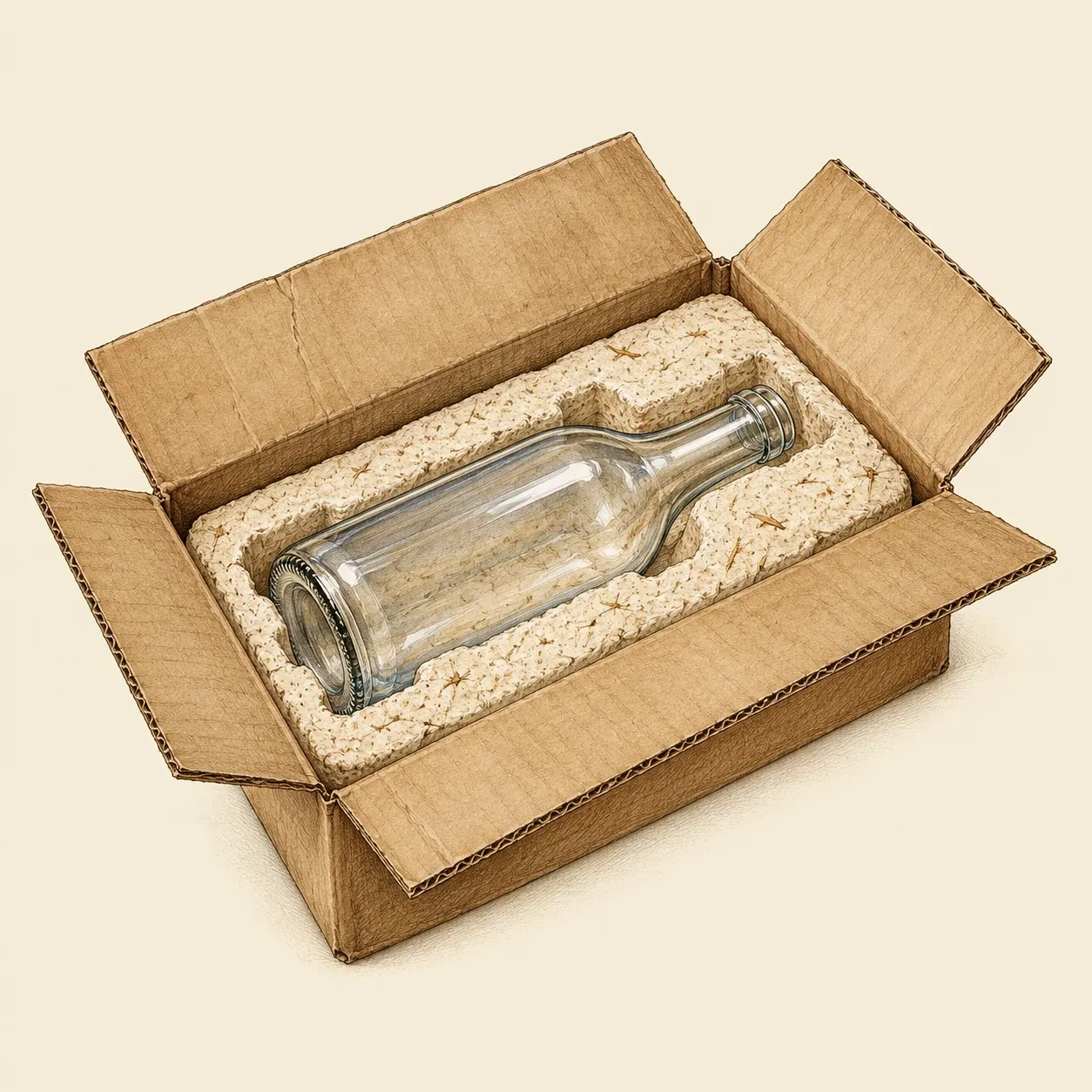 A moulded mycelium insert grows to the exact shape of the bottle it protects.
Insulation boards proved hard to sell, and Ecovative turned to moulded packaging, grown in moulds to fit the object it protects and meant to replace plastic foam. It made inserts for the American furniture maker Steelcase. In 2014 the architects of The Living built Hy-Fi, a round tower at MoMA PS1 in New York, from bricks of chopped corn stalks bound by mycelium, grown in trays and designed to be composted afterwards. Since then, companies and university laboratories in North America, Europe and Asia have made panels, tiles, furniture and packaging this way, and research continues on making the material stronger and more resistant to water.