Scarecrow
A human figure that keeps birds off the crop
Contents
- 1Upright pole driven into the ground
- 2Crossbar lashed to the pole
- 3Sack head stuffed with straw
- 4Old coat stuffed with straw
- 5Cloth strip moving in the wind
A scarecrow is a figure dressed as a person and set up in a field or garden to keep birds away from the seed and the ripening crop. Birds soon learn that it never moves, so it works only for a while unless it is moved and changed. The oldest clear mention is in the Letter of Jeremiah, a Jewish text probably written in the third or second century BCE, which compares idols to a scarecrow in a cucumber field. Roman poems from about 35 BCE describe wooden statues of the god Priapus guarding gardens against birds and thieves.
What it is
A scarecrow is a dummy in the shape of a person, put up among crops to keep birds from eating seed, seedlings or ripening grain and fruit. The usual European form is a pole with a crossbar for arms, dressed in old clothes stuffed with straw, with a stuffed sack for a head and a hat on top.
In a newly sown field, its pole (1) goes deep into the soil and the crossbar (2) is lashed across it. The head (3) and the coat (4) are filled with straw, and strips of cloth (5) hang from the arms and move in the wind.
Other times and places built it differently. Roman gardens had a carved wooden statue of the god Priapus. In Japan the word kakashi first named smelly things hung on bamboo poles, and later straw figures dressed in a straw raincoat and hat. Modern versions include dressed shop mannequins and figures that rise from cover when a gas cannon fires.
How it works
Birds that feed in fields are wary of people, and many also avoid any object they have not seen before, a reaction biologists call neophobia. A figure with a human outline and clothes plays on both. Natural England advises making it look as human as possible and setting it where birds see it from the air, so that it scares them before they land.
The effect fades. When a stimulus comes back again and again and nothing follows, an animal stops reacting to it; this is habituation. Wildlife biologists of the US Department of Agriculture write that birds quickly learn that an effigy left in the same place is no threat, and that scarecrows are of limited value unless they move or are combined with other measures. Species also differ: fluttering reflective ribbon keeps some birds off crops and leaves others unconcerned.
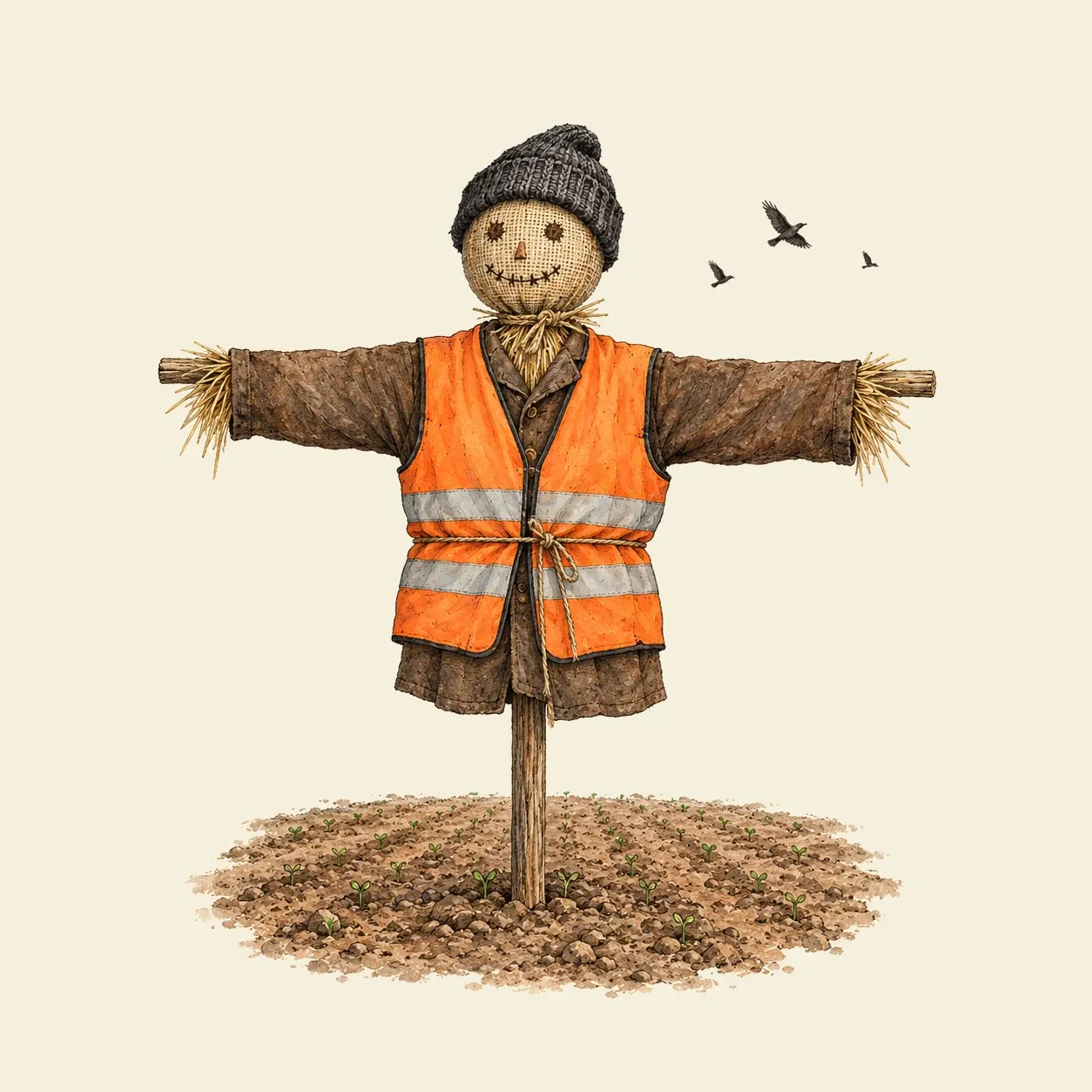 Dressed in the same orange high-visibility clothing as the person who scares the birds, the figure teaches them to link that look with danger.
A scarecrow therefore works best as part of a routine. Natural England’s advice is to move it every day if possible and at least every two or three days, and to back it up with shooting to scare from behind it. Dressing the figure like the person who does the scaring, for example in the same orange high-visibility jacket, teaches the birds to link that look with danger. Even the best visual scarers, figures that pop up beside a gas cannon, are thought to reach only about 200 m, so scarecrows suit gardens and small fields better than large areas.
How to do it
 A square lashing: the wraps hold the crossbar, and the turns between the poles pull them tight.
For the upright, take a straight pole about 2 m long and 4 to 5 cm thick, and cut its foot to a point. For the crossbar, take one about 1.2 m long. Lay the crossbar across the upright about 30 cm below its top and join them with a square lashing: a clove hitch round the upright just under the bar, three or four turns of twine round both poles, two or three tightening turns wound between the poles and pulled hard, then a clove hitch round the crossbar.
Stuff a sacking bag or an old pillowcase with straw, push it over the top of the pole and tie it firmly under the neck. Paint or stitch a simple face. Put an old coat or shirt on the crossbar, button it, fill it with straw and tie the cuffs and the waist with twine so that the straw stays in. Tie an old hat to the head and a few strips of cloth or reflective tape to the ends of the arms.
Open a hole with an iron bar where the figure will stand against the sky, drive the pole 40 to 50 cm deep with a mallet and tread the soil firm around it. Then keep it working: move it every day or two, turn it to face another way, change its coat or hat from time to time, and use it with other ways of protecting the crop. Take it in after the harvest and keep it dry until the next sowing.
Wear gloves to drive the pole and keep the hand that steadies it well away from the mallet. Straw catches fire easily, so keep the scarecrow far from bonfires, barbecues and garden incinerators.
History and evolution
The oldest clear mention of a scarecrow is a comparison. The Letter of Jeremiah, a short Jewish text probably written in Hebrew and preserved in Greek, now printed as the sixth chapter of Baruch, mocks idols of wood plated with gold and silver: like a scarecrow in a cucumber field, they protect nothing. Lutz Doering dates its composition probably to the third or second century BCE; Anthony Saldarini places it in the Hellenistic period, in the second century BCE or earlier. A Greek fragment of the letter found at Qumran, copied about 100 BCE, is its oldest manuscript. Saldarini traces the image to the Hebrew text of Jeremiah 10:5, where the same words have also been read as “upright as the palm tree”.
In the first book of Horace’s Satires, published around 35 BCE, a statue of Priapus carved from fig wood speaks from the new gardens of Maecenas on the Esquiline in Rome. His right hand and red phallus threaten thieves, and a reed fixed to his head frightens the birds and stops them settling. Virgil’s Georgics name Priapus the guardian against thieves and birds, armed with a willow sickle, and Tibullus asks for a red Priapus to stand in his orchard and scare the birds with his hook. All of this evidence is literary.
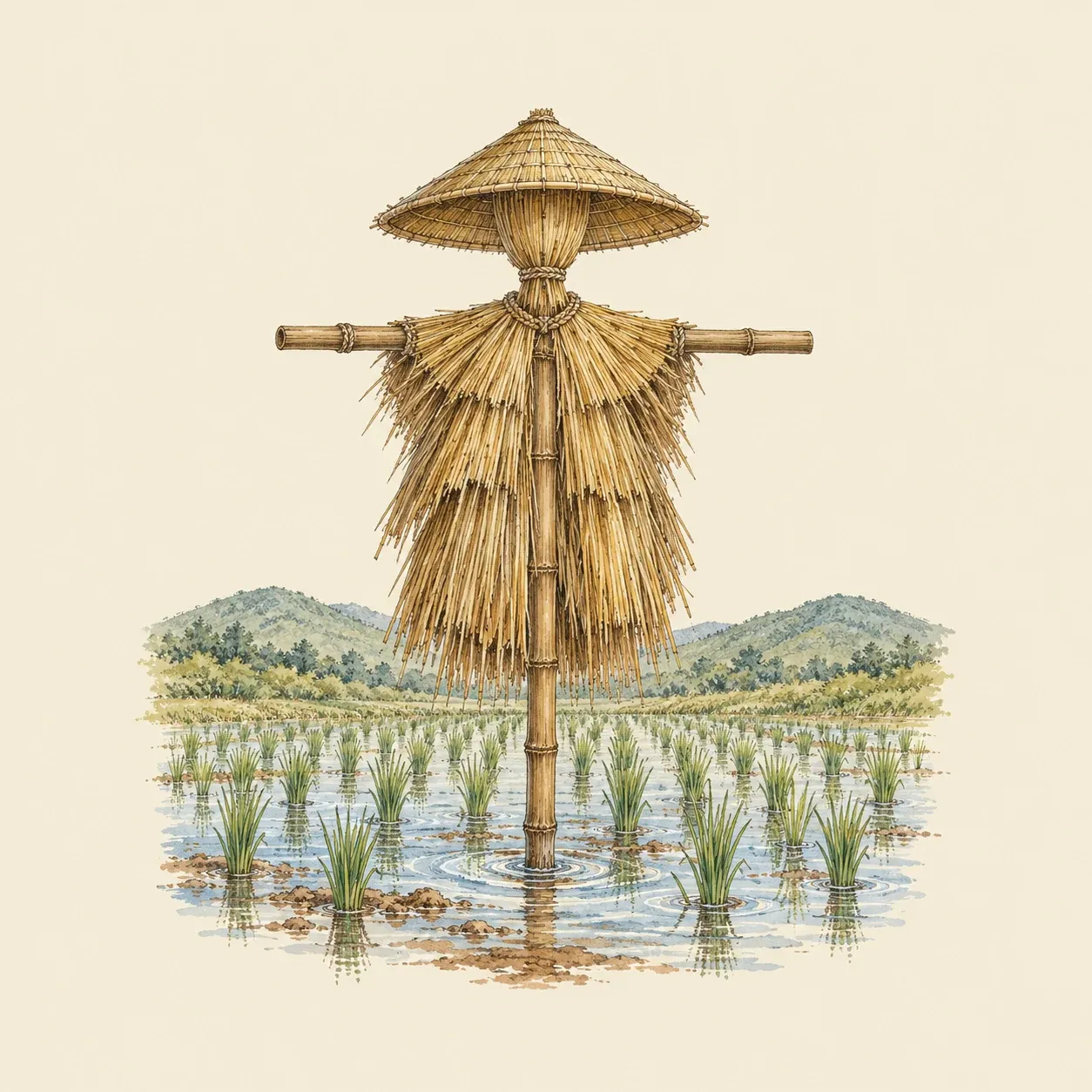 A kakashi dressed in a straw raincoat and a wide straw hat.
The Kojiki, compiled in Japan in 712, tells of Kuebiko, a god who cannot walk yet knows everything under heaven, and says that he is the one now called the scarecrow of the mountain fields, yamada no sohodo. Japanese dictionaries derive the later word kakashi from kagashi, “something to smell”: burnt hair, rags or meat hung from bamboo drove animals away by their stench, and the name later passed to figures made of straw. In parts of Japan the scarecrow was linked with the god of the fields and was brought indoors after the harvest and given offerings.
In English, the scarecrow appears in Shakespeare’s Measure for Measure, played at court in December 1604. Angelo warns against making the law a scarecrow set up to frighten birds of prey, which, if it keeps one shape, they come to treat as “their perch and not their terror”. People also did the work themselves. In nineteenth-century England boys were paid a few pence to frighten crows with wooden clappers when the corn was sown and again when it was in the ear.
Wildlife agencies now treat the scarecrow as one tool among several. Natural England describes a model of a man with a gun, attached to a gas cannon so that it rises from cover a few seconds before the cannon fires.