Waste sorting
Screens, magnets and air jets on the belt
Contents
- 1Infeed conveyor with mixed packaging
- 2Trommel, a rotating perforated drum
- 3Overband magnet lifting steel cans
- 4Eddy-current separator throwing aluminium forward
- 5Near-infrared sensor and air jets
Waste sorting splits mixed refuse or collected recyclables into streams that can be sold and used again. Conveyors carry the waste past rotating drums that sort it by size, magnets that lift out steel, spinning magnetic rotors that throw aluminium aside and sensors that blow chosen items off the belt with air. In 1876 the refuse works of Manchester's Health Committee were already sifting dry refuse on sieves worked by steam.
What it is
Waste sorting splits a mixed stream of refuse into fractions that can each go somewhere useful: steel, aluminium, paper and board, glass, several kinds of plastic, and a residue that is burnt or landfilled. In the home the first sort is done by people who put packaging, paper, glass and food scraps into different bins. A sorting plant, known in the trade as a materials recovery facility, takes what the collection trucks bring and separates it further, mostly by machine, with workers on the belts removing what the machines miss.
Each machine uses one physical difference between materials: size, shape, magnetism, electrical conductivity or the way a material reflects light. No single machine sorts everything, so they are set one after another along conveyor belts, each taking out one fraction and passing the rest on. The sorted materials are baled and sold to the mills and smelters that make new products from them, such as recycled paper.
How it works
Trucks tip their loads onto a reception floor, and the waste is fed onto the infeed conveyor and spread out so that pieces do not pile on top of one another. It then enters a trommel, a long drum with holes in its wall that turns slowly about a slightly sloping axis. The material tumbles along inside it: small pieces fall through the holes and larger items leave at the far end. In one plant described in an East Suffolk council report, the trommel takes out the small pieces, which are sent for energy recovery.
Flat things and round things are then parted. A ballistic separator is a sloping deck of paddles that move in a walking motion: flat paper and film ride up the deck, while bottles and cans roll back down. Disc screens, rows of shafts carrying rotating discs, push cardboard and newspaper upwards while smaller material falls between the shafts.
Metals are taken out by magnetism. An overband magnet, an electromagnet with its own belt running above the conveyor, pulls steel cans up out of the stream and carries them sideways to a chute. Aluminium is not magnetic, so it is removed by an eddy-current separator. At the end of the belt a rotor of strong magnets spins far faster than the belt pulley. Its changing magnetic field sets up electric currents in any conducting piece passing over it, and these currents make a field of their own that pushes against the rotor, so aluminium cans are thrown forward over a splitter plate while plastic and paper simply drop off the belt.
Plastics and paper of different kinds look alike to magnets and screens, and are sorted by light. A near-infrared sensor above a fast belt reads the light each object reflects, which differs between PET, polyethylene, polypropylene, paper and board, and a computer fires short blasts from a row of air jets that blow the chosen objects over a divider into their own stream. Glass is crushed and cleaned of labels and caps by air. At the end of each line, workers in sorting cabins check the stream by hand and take out what does not belong before the materials are baled.
How to do it
 A magnet lifts the steel can and leaves the aluminium one: the first rule of metal sorting.
The principles can be tried on a table with clean, dry packaging. Collect a mixture of rinsed food cans, aluminium drink cans, small plastic bottles and caps, scraps of paper and bottle tops, and spread them on a tray. Use only clean items, and leave out glass, batteries and anything that has held chemicals.
To sort by size, build a sieve from a wooden frame with a coarse wire mesh nailed across it, about as wide as a bottle top. Shake the mixture on it over a box: caps and small pieces fall through, larger items stay on top. Tilting the sieve and shaking it lets the larger items walk down to one end, as they do in a trommel.
To pull out steel, wrap a strong magnet in a plastic bag and pass it over the remaining items. Steel cans jump to it; aluminium cans stay put. Pull the magnet out of the bag over a box and the steel drops off, much as the belt of an overband magnet carries steel out of the field and lets it fall. To separate light from heavy, set a desk fan blowing across a gently sloping board and drop the mixture onto the board in front of it. Paper and film are blown off the side, while cans and bottles roll down to the bottom.
Rinse cans before you start, and wear gloves: the cut rim of a food can is sharp. Strong neodymium magnets snap together with great force and can pinch skin or shatter. Keep them apart, away from young children who might swallow them, and away from anyone with a pacemaker. Never put batteries in the mixture: a damaged lithium battery can catch fire.
History and evolution
People sorted waste by hand long before machines did it. Mechanised sorting is recorded at Manchester in 1876, in a magazine report of a visit to the works of the city’s Health Committee that the engineer Percy Boulnois reprinted in 1881 in his book on town refuse. Dry refuse was shovelled onto sieves worked by steam power, and the fine dust fell through. The coarse part was carried along a moving endless table to the furnaces, the boilers and the mortar mills, and the cinders were taken out on the way to fire the boilers. A deputation from Glasgow, which visited English towns from October 1876 to study the disposal of sewage and refuse, also records the steam-worked sieves in its 1878 report on the Manchester works. A newspaper account of the city’s Holt Town works describes the same sorting, with a contractor paying for the right to pick out rags, paper, tins and bottles.
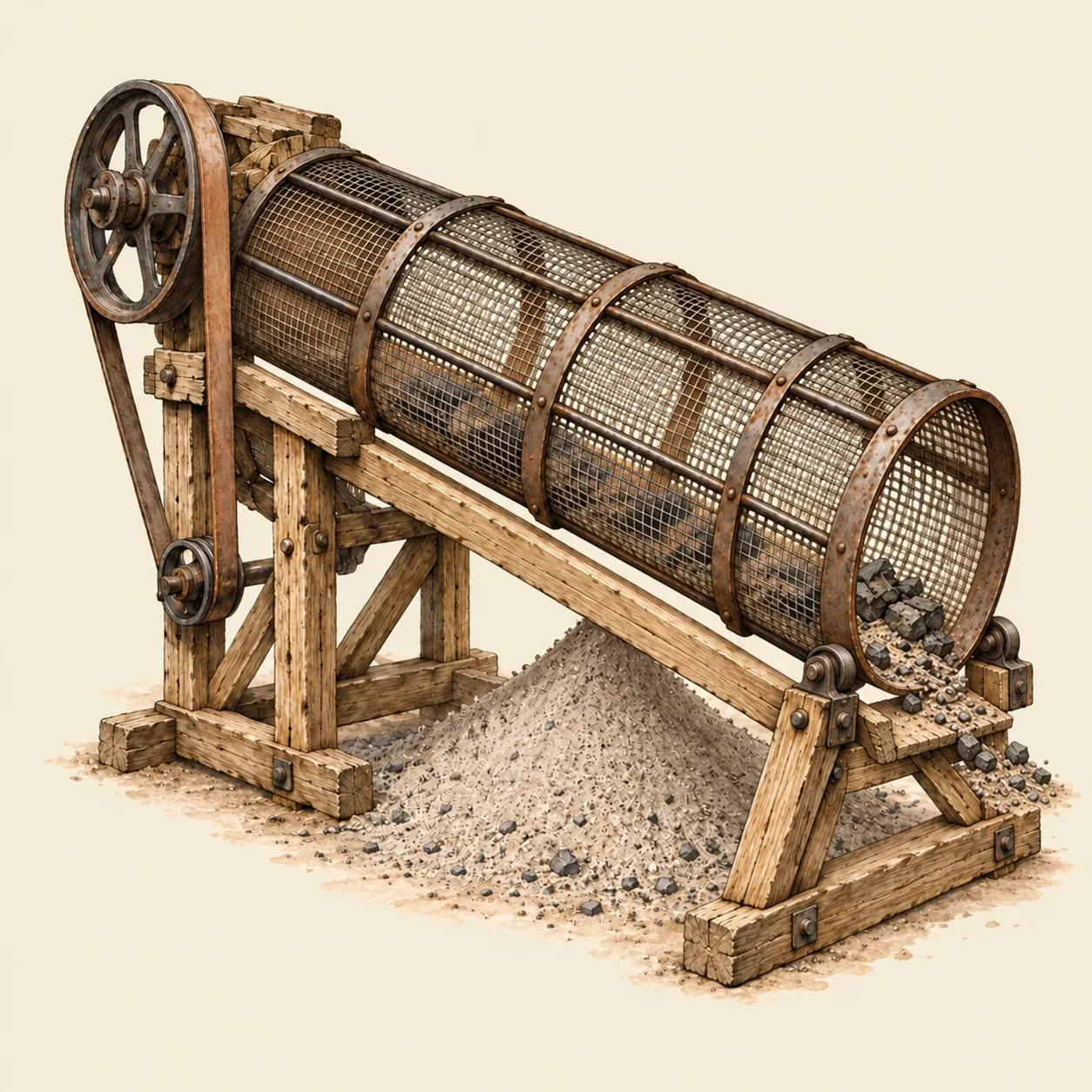 A revolving screen sorts refuse by size: the fine part falls through the mesh.
In the 1890s George Waring, New York’s commissioner of street cleaning, made households keep ashes, kitchen garbage and dry rubbish apart, and the right to pick the saleable paper, rags, glass and metal out of the rubbish was let to contractors. The city tried a system designed by A. W. Colwell beside the North River. An inclined conveyor of wooden slats carried the rubbish up to a furnace, and workers standing on both sides picked out newspapers, manila paper, cotton and woollen rags, bottles, old shoes, rubber, tin cans and other metals, which were baled and sold. What remained was burnt, and the heat raised steam that ran the conveyor and the fan. A larger plant followed, with a long belt of stitched canvas and pickers along both sides.
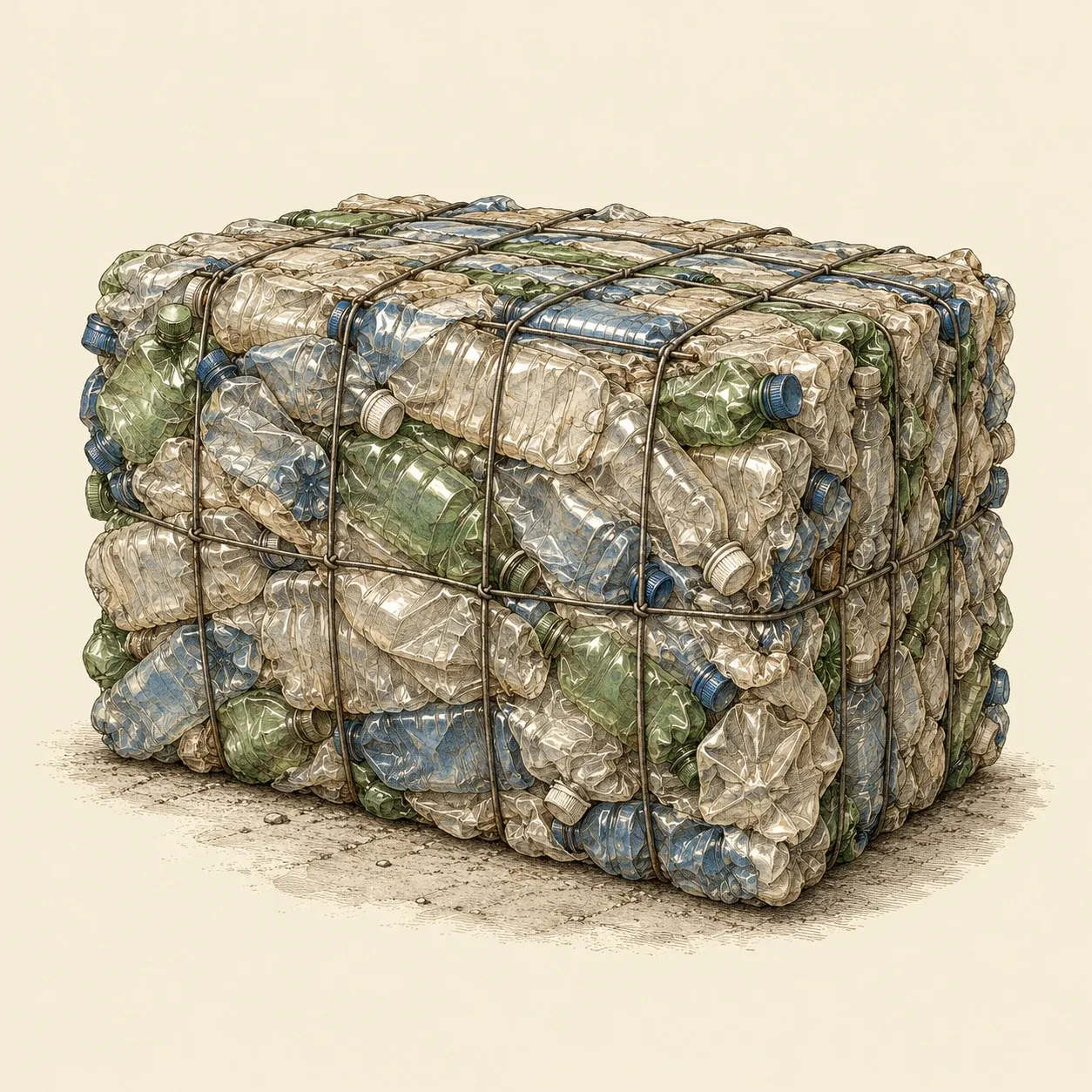 Sorted plastics leave the plant as tightly pressed bales.
Waring also described the works at Kleinpest, outside Budapest, run by the contractor Ignatius Fischer. Revolving screens of coarse and fine mesh first sorted the refuse by size; long picking tables with moving aprons of hemp cloth then carried it slowly between rows of women and children, each picking one kind of material, from bones and bottles to corks and nails. The rest became compost. In 1897 Munich signed a contract with a company that built a sorting plant at Puchheim. The city’s refuse went there by rail, and workers at conveyor belts picked out bones, glass, paper, rags, leather, rubber, cork, metals and wood.
Batteries hidden in the waste have become a serious and growing cause of fires at waste facilities, sorting plants included. In 2021 the US Environmental Protection Agency compiled the publicly reported fires that lithium-ion batteries had caused or probably caused at American waste facilities, and a study for the British waste industry estimated that these batteries start a large share of the waste fires in the United Kingdom. Both reports say that many such fires go unreported, so the true numbers are likely higher.