Paper recycling
Pulping used paper into new sheets
Contents
- 1Bale of waste paper
- 2Rotor at the bottom of the pulper
- 3Slotted screen basket
- 4Air bubbles rising through the pulp
- 5Grey froth carrying the ink
Paper recycling turns used paper back into pulp. The sheets are churned in water until the fibres come apart, cleaned of staples, plastic and ink, and formed into new paper. In Japan, shukushi, a grey paper remade from written sheets, is on record by the early eleventh century and was long used for imperial orders.
What it is
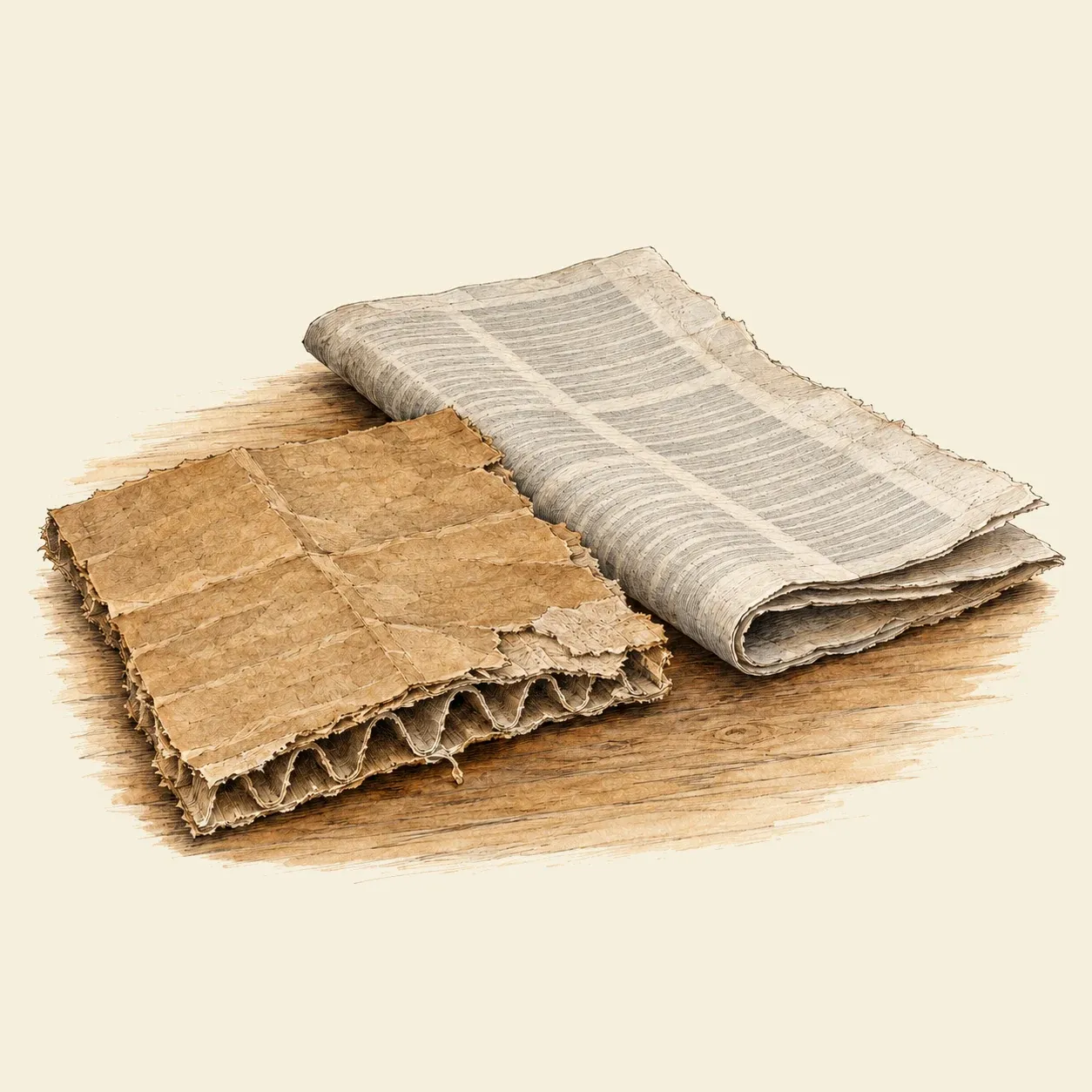 Brown board and printed newsprint come back to the mill as different grades of recovered paper.
Paper is a mat of plant fibres, mostly cellulose, that cling to one another as the wet sheet dries. Water loosens those bonds again, so a used sheet can be broken down into its fibres and made into paper once more. Recycling does this on a large scale. Newspapers, office paper, magazines, boxes and cartons are collected, sorted by grade and sold to mills, which turn them into pulp, remove whatever is not fibre and form new sheets on a paper machine.
What a mill can make depends on what comes in. Brown boxes go back into board and wrapping paper, where colour hardly matters. Printed papers that are to become newsprint, tissue or white office paper must first lose their ink, a step called de-inking.
How it works
The bales are tipped into a pulper, a large tank of water stirred by a rotor at the bottom. The churning wets the sheets and rubs them apart until they become a thin grey slurry of separate fibres, with the ink, fillers and everything else that came in still mixed through it.
The slurry then passes a series of cleaners. Screens with fine holes or slots hold back pieces of plastic, string and the sticky specks of glue that papermakers call stickies. Centrifugal cleaners spin the flow so that staples, grit and other heavy bits are flung outwards and drawn off.
For printed grades the ink comes out next, by washing or by flotation. In washing, water carries the finest ink particles away through slots too narrow for the fibres. Flotation is the more common method today. Air is blown into dilute pulp in a tank, and chemicals added in the pulper have freed the ink and made its particles shun water, so they cling to the rising bubbles and collect as a grey froth on the surface. The froth has to be skimmed off before the bubbles burst and drop the ink back into the pulp. The cleaned pulp is thickened, sometimes bleached, and sent to the paper machine.
Hans-Joachim Putz and Samuel Schabel, at the Technical University of Darmstadt, traced the common claim that paper can be recycled only four to seven times and found it repeated without a clear source. Their laboratory and a team at Graz University of Technology, working for the cartonboard industry body Pro Carton, each put packaging papers through twenty-five recycling cycles, and both concluded that the four-to-seven limit does not hold. The practical limits lie elsewhere: fibres and fines are lost with the water at every pass, some paper is never collected, and dirt must be kept out. Mills therefore keep adding fresh fibre.
How to do it
A recycled sheet can be made by hand at a kitchen table with water and clean waste paper. You need a mould, a wooden frame with a fine mesh such as window screen stretched and stapled across it, and a deckle, an open frame of the same size laid on top to give the sheet its edges. Plain papers such as printer paper, old notes, construction paper and envelopes work well, and their colour shows in the new sheet.
Remove staples and clips, tear the paper into pieces about the size of a postage stamp and leave them to soak in water for a few hours. Put a handful of soaked paper in a blender with plenty of water and blend in short bursts until no flakes remain. A potato masher or a fork in a bowl is slower but also works. Pour the pulp into a tub of water wide enough to take the mould. The thinner the mixture, the thinner the sheet.
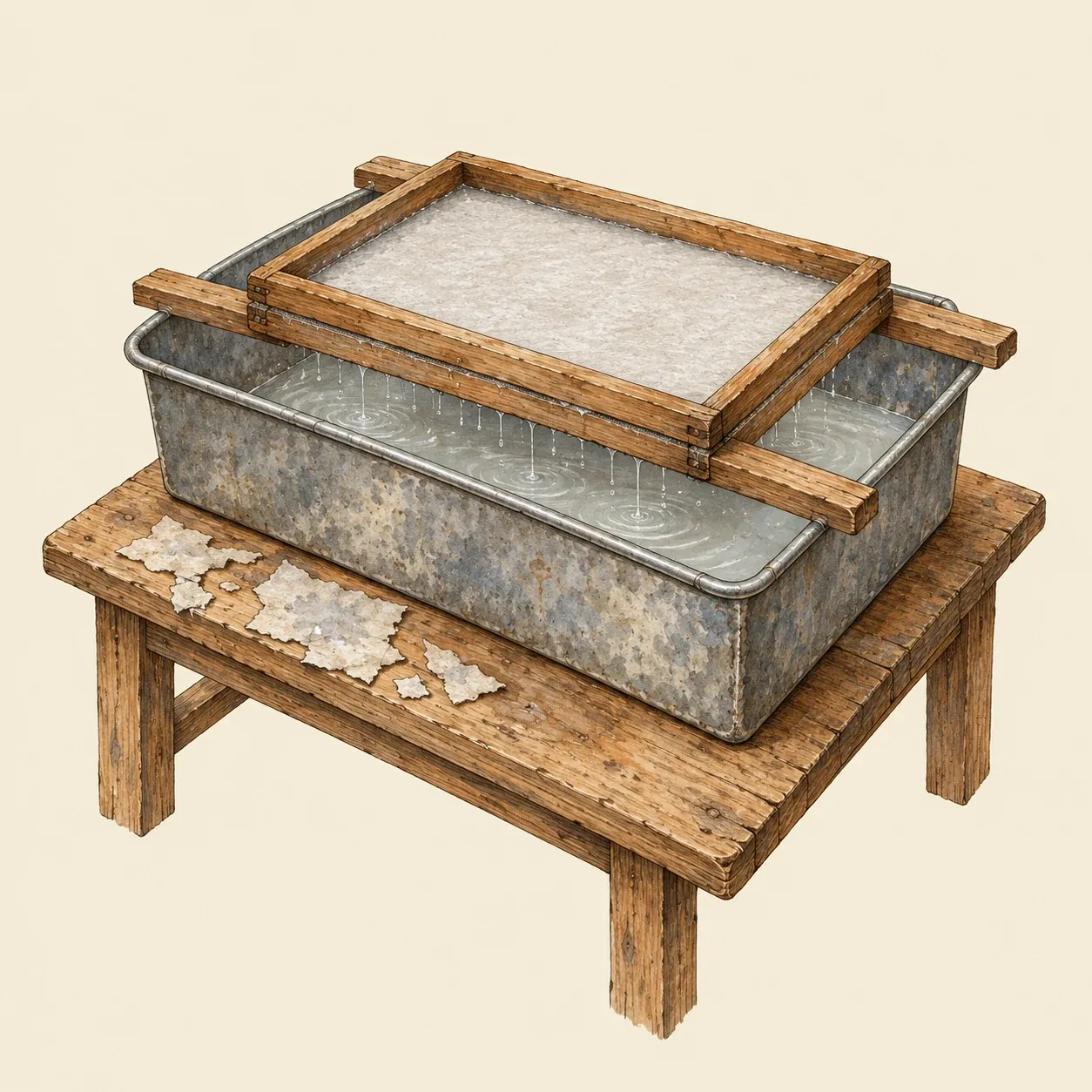 The mould is lifted out level so that an even layer of fibres stays on the mesh as the water drains.
Stir the tub, hold the mould with the deckle on top and slide it into the pulp at a slant, then bring it level under the surface and lift it straight up. Let the water drain, give a gentle shake from side to side to knit the fibres, and take off the deckle. Turn the mould over onto a damp cloth laid on a board and press the back of the mesh with a sponge to draw out water, then lift the mould away so that the sheet stays on the cloth. Lay a second cloth on top, press again and leave the sheet to dry flat.
A blender has sharp blades and runs on mains electricity next to a lot of water. Unplug it before reaching inside or clearing a blockage, keep it and its cable away from the tub and the wet table, and dry your hands before touching the plug. Keep a blender for this work only and do not use it again for food.
History and evolution
In Japan the blank backs of old documents were written on again, and used paper was also remade into new sheets. Shukushi, paper made by re-pulping sheets that had already been written on, was being made by the early eleventh century: the Nihon Kokugo Daijiten finds it in the Shōyūki, the diary of the courtier Fujiwara no Sanesuke, and the papermaking historian Dard Hunter cites a record of remade waste paper from the same period. In the Heian period much of it was made at the Kamiya-in, the government paper workshop in the capital, and “Kamiya paper” came to mean shukushi.
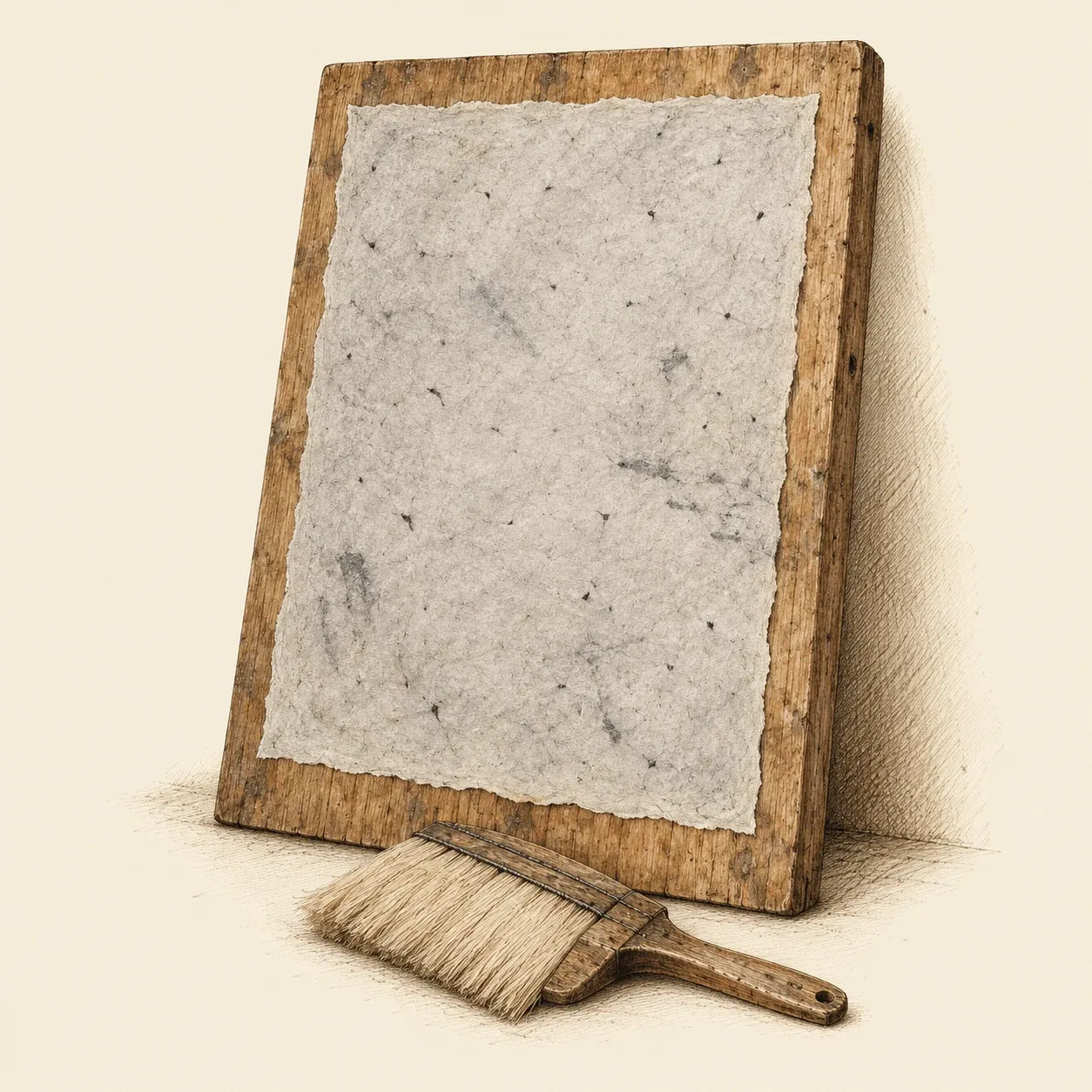 Shukushi kept traces of the ink of the sheets it was made from, which gave it its patchy grey colour.
The ink could not be taken out, so shukushi came out a patchy light grey. Orders of the emperor passed on by his secretaries were often written on it, and a decree of the emperor Go-Daigo, kept in Kyoto, still shows traces of earlier writing in the paper. Lucia Dolce notes that recycling long stayed in the hands of the Kamiya and that Buddhist sutras were also copied and printed on reclaimed paper.
In Europe, Justus Claproth, a jurist of Göttingen, described how to remove ink in 1774, in a short work on making new paper from printed paper; an English translation is kept in the archive of the Society of Arts in London. On 28 April 1800 Matthias Koops was granted an English patent for extracting ink from printed and written paper and turning it back into pulp, and he went on to patent paper made from straw and from wood. He worked at the Neckinger Mill in Bermondsey and then at Thames Bank, but the business ran into debt and was sold.
Flotation de-inking has become the main way of taking ink out of recovered paper worldwide. In Germany, Putz and Schabel note, paper and board are now made mostly from recycled fibre.