Canal lock
A water staircase for boats
Plate
- 1Upper gates
- 2Balance beam
- 3Paddle and its gear
- 4Chamber
- 5Lower gates
- 6Sill
Anatomy
Loading the figure…
A canal lock is a walled chamber with gates at each end, in which a boat is raised or lowered from one level of a waterway to the next by letting water in or out. It first appears in China in 984, took its modern form with the mitre gates of Renaissance Milan, and let canals climb over hills.
What it is
A canal must stay almost flat, so it is built as a series of level reaches, called pounds, stepped one above the other. The lock is the step: a masonry basin a little larger than the boats it serves, closed by gates at both ends. With a boat inside and the gates shut, the crew raises or lowers the water until it matches the next pound, then opens the far gates.
How it works
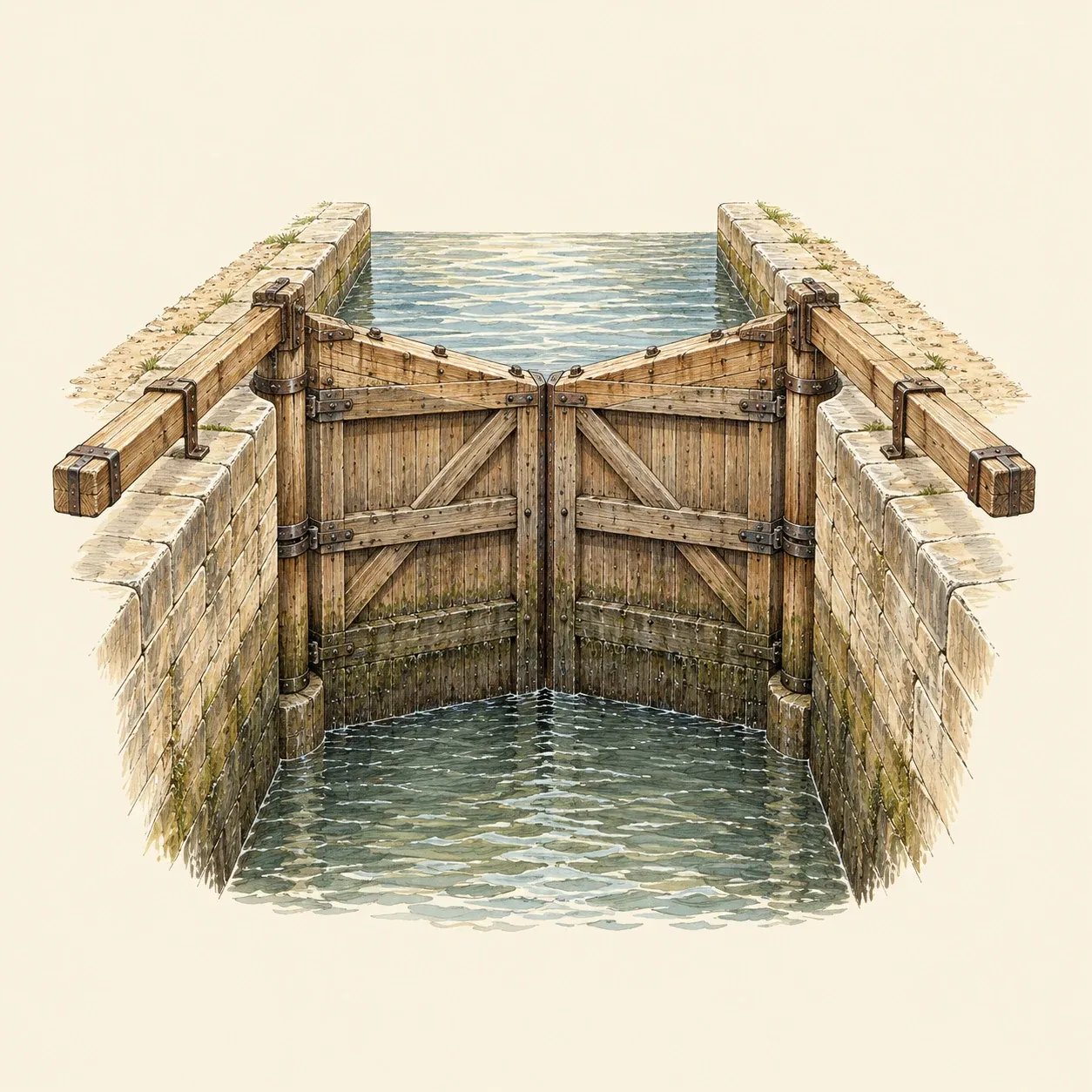 The two leaves meet in a V that points into the higher water, and the push of that water locks them together.
To go up, the crew empties the chamber through the lower paddles, opens the lower gates, brings the boat in, then closes the gates and the lower paddles behind it. Only then do they open the upper paddles. Water from the upper pound fills the chamber and lifts the boat, and once the levels match, the upper gates swing open easily. Going down is the same sequence in reverse, and one lock usually takes ten to twenty minutes.
Each pair of gates closes in a shallow V pointing upstream, each leaf set about 18 degrees off a straight line across the lock. The higher water pushes both leaves against each other at the point and against a step in the floor, the sill. The deeper the water, the tighter the seal. A leaf 3 m wide with 2 m more water on one side than the other is pushed with a force of at least 6 tonnes, so nobody can open it before the levels are equal. A long balance beam on each leaf gives the leverage to swing it.
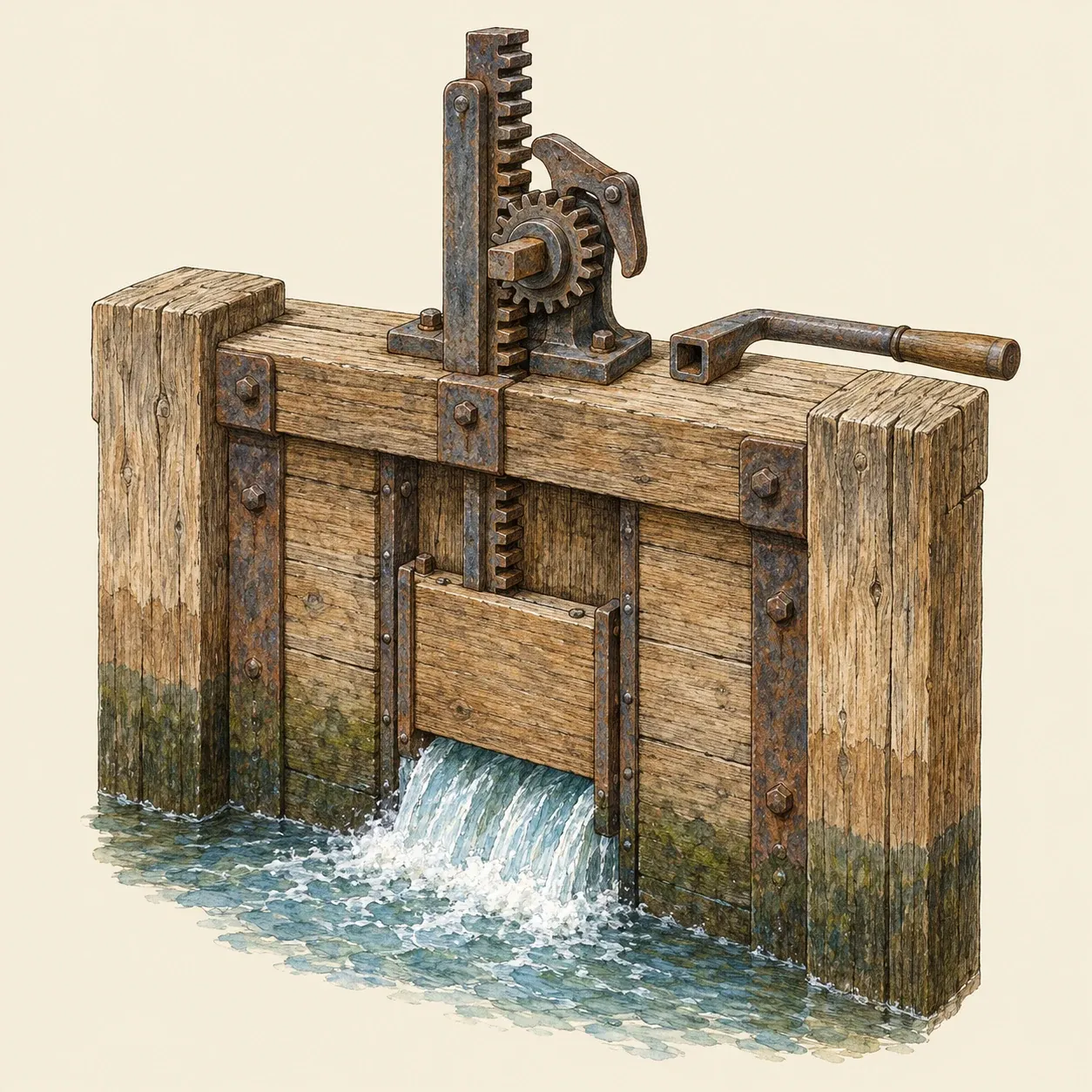 The crank turns a pinion, the pinion lifts a toothed rack, and the rack raises the paddle.
Water passes through paddles, small sluices set in the gates or, as ground paddles, in culverts through the side walls, which fill the chamber more gently. The crew lifts each one with a removable crank, the windlass, and a pawl holds it up.
Each time the chamber fills and empties, a slice of water as large as the chamber’s floor and as deep as its fall moves one step down the canal. For an English narrow lock about 22 m long and 2 m wide with a 2 m fall, that is roughly 90 tonnes. A boat going up draws a little more from the pound above, a boat going down a little less, because the boat displaces water too. All of it ends up at the bottom, so a canal that crosses a ridge needs water brought to its highest pound, the summit, from rivers and reservoirs through channels called feeders.
On a steep slope, locks follow each other in a flight with short pounds between them. In a staircase there are no pounds at all: the upper gates of one chamber are the lower gates of the next.
How to build
A real lock is a job for civil engineers. To learn the sequence, build a model, then learn to pass a real lock as a boater.
Make the channel. On a table, use a long wooden box sealed with exterior varnish. In a garden, lay two rows of concrete blocks on a level bed and line the channel with pond liner. Divide it into an upper pound, a chamber and a lower pound, the upper floor a few centimetres higher, each part checked flat with a spirit level.
Fit gates and paddles. Sliding boards in grooves are the simplest gates. For mitre gates, hinge one plywood leaf to each side wall at both ends of the chamber, so each pair meets in a V pointing towards the higher water and rests against a strip of wood across the floor. Drill a hole near the foot of each gate and cover it with a small sliding plate.
Run the water. Top up the upper pound from a hose, with an overflow notch to hold its level. Give the lower pound an overflow too, a few centimetres deep, draining to the garden or a bucket, so it keeps its level. Then float a wooden block through step by step.
On a real canal. Work slowly. Lift side fenders and wear a lifejacket on deck and at the lockside. Hold the boat with ropes fixed on board at one end, taken round a bollard and back on board, the free end held in the hand and never tied off, and pay them out or take them in as the level changes; a rope made fast can leave the boat hanging as the water falls. Going down, keep the stern well forward of the sill; going up, keep the bow clear of the gates. Open the first paddle only halfway. Where a lock also has ground paddles, open the gate paddles only once they are under water; where it has gate paddles alone, open them slowly and follow the local instructions. Never leave a windlass on its spindle, and never put any part of yourself between the boat and the wall.
Safety. A lock is deep, cold water with steep walls and strong currents, and a person who falls in can be pulled under a gate or crushed by the boat. Keep children supervised and away from the edge and the paddle gear. A swinging balance beam or a slipping windlass can break bones. Even the model can drown a toddler: never leave it full and unattended, and empty it after use.
History and evolution
Before the lock came the flash lock, a gap in a weir closed with boards. Pulling them out sent a rush of water that carried boats downstream; boats going up were hauled against it. It wasted water and endangered crews.
In 984 Qiao Weiyue, an official in charge of grain transport, set two gates about 76 m apart on the Grand Canal near Huai’an in China, making the first recorded pound lock.
In Europe, a basin lock at Vreeswijk, in the Netherlands, is recorded from 1373, and a true pound lock at Damme, near Bruges, from 1396. The San Marco lock in Milan, completed in 1497, had mitre gates, a design drawn in Leonardo da Vinci’s papers and often credited to him.
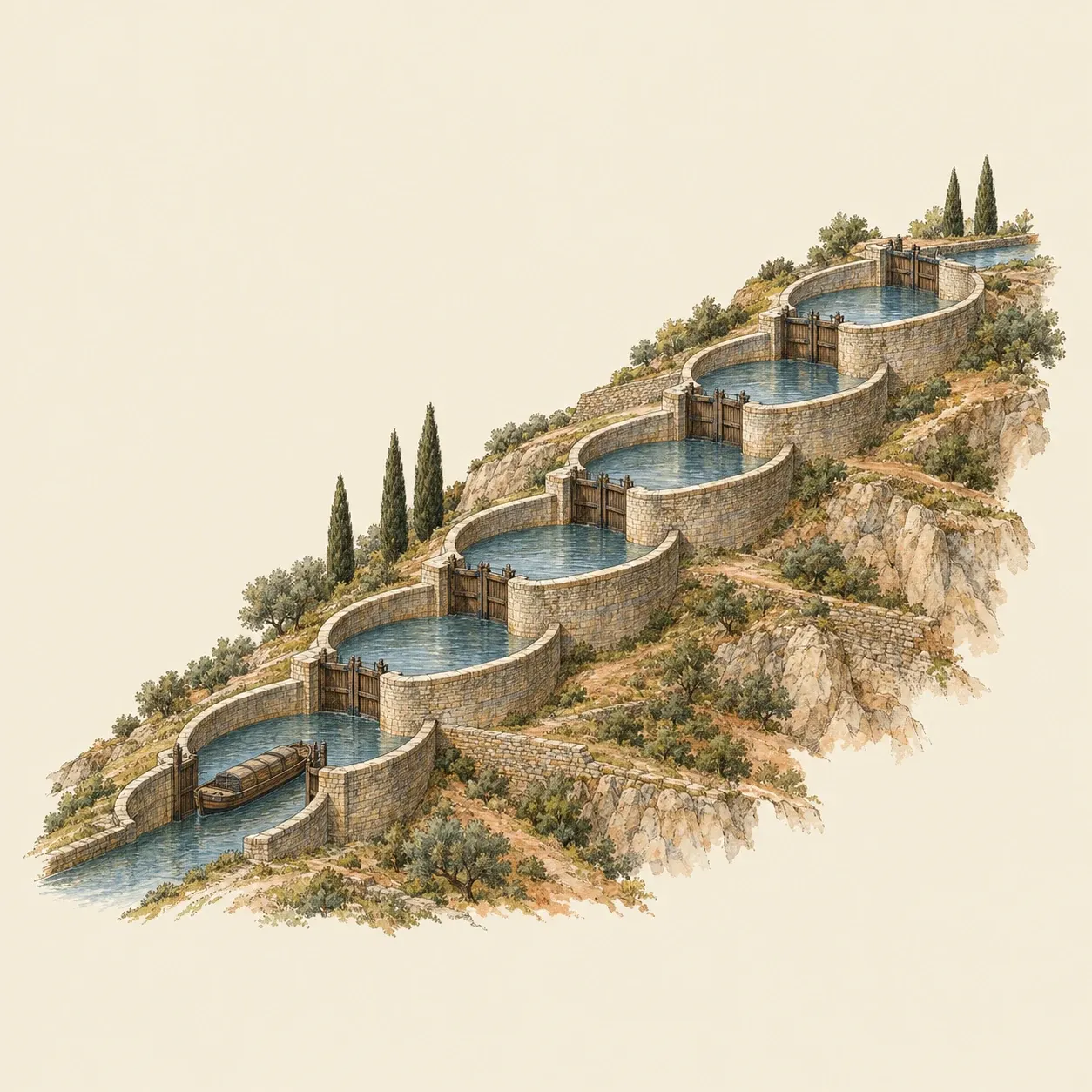 A staircase of locks: each chamber opens straight into the next.
The Canal du Midi, built by Pierre-Paul Riquet and opened in 1681, joined the Atlantic to the Mediterranean over a summit of about 190 m. Its summit pound draws on the streams of the Montagne Noire, gathered by feeder channels and stored behind the Saint-Ferréol dam, then the largest in the world. At Fonserannes, near Béziers, Riquet built a staircase of eight chambers rising about 21 m; since the Orb aqueduct was built, in 1854–1858, boats use only six of them.
Where locks would cost too much water or time, engineers later built boat lifts, such as the one at Anderton in England (1875), which raises boats about 15 m in two counterbalanced iron tanks.