Water clock
Measuring time with flowing water
Contents
- 1Sloping wall, wider at the top
- 2Column of hour marks inside the wall
- 3Water surface, falling as the vessel drains
- 4Outflow hole near the bottom
- 5Basin catching the water
A water clock measures time with water running out of a vessel or into it, read against marks on its wall. The oldest written record is the tomb inscription of the Egyptian official Amenemhet, around 1500 BCE, and the oldest surviving clock was carved for Amenhotep III in the fourteenth century BCE.
What it is
A water clock, or clepsydra, measures time by the movement of water. In the commonest form a vessel with a small hole near the bottom is filled at a set moment, and the time is read from how far the level has fallen against marks on the inside wall. In the inflow form, water drips at a steady rate into a vessel, and the time is read from how far the level, or a float on it, has risen. A third kind is a bowl with a hole in its base, set floating in a basin: it fills slowly and sinks after a fixed interval.
Some water clocks told the hour, others only measured an agreed interval, like a stopwatch. Egyptian temple clocks gave the hours of the night, when a sundial is useless. In Athens a pot of water timed each speech in a lawsuit, and in North Africa sinking bowls shared out turns of irrigation water.
How it works
Water leaves a hole faster when there is more water above it. Evangelista Torricelli stated the rule in 1643: the speed of the jet grows with the square root of the depth. An outflow clock therefore slows down as it empties. In a straight-sided pot the level drops quickly at first and creeps at the end, so equal hours need marks that crowd together toward the bottom.
Egyptian makers shaped the vessel to correct this. The clock found at Karnak is a cone turned upside down, wider at the top than at the base, with walls that slope inward by about one unit for every three of height. The top layers of water drain fastest, but they are also the widest, so the level falls more evenly. A perfectly even fall would need walls that curve outward, the radius growing with the fourth root of the height, and the straight cone only comes close. In 1920 Ludwig Borchardt calculated that such clocks were badly wrong. A plaster copy tested in 1978 did better: it ran about ten minutes slow over the first six hours, then gained, and was ten to twenty minutes fast after twelve hours. Surface tension and the shape of the outlet, left out of the calculation, affect the flow.
Egyptian hours were twelfths of the night, so a winter hour was longer than a summer one. The Karnak vessel has twelve scales inside, one for each month, with the name of the month on the rim above it. Each scale is a column of small drilled points, the longest belonging to the month of the longest nights, and the scales that survive whole carry eleven marks.
The hole is the weak point. Dirt, scale or wear changes the flow, and surface tension holds back the last of the water, so an outflow clock never quite empties. According to the Roman architect Vitruvius, Ctesibius of Alexandria pierced it in gold or in a gem, materials that neither wear away nor clog.
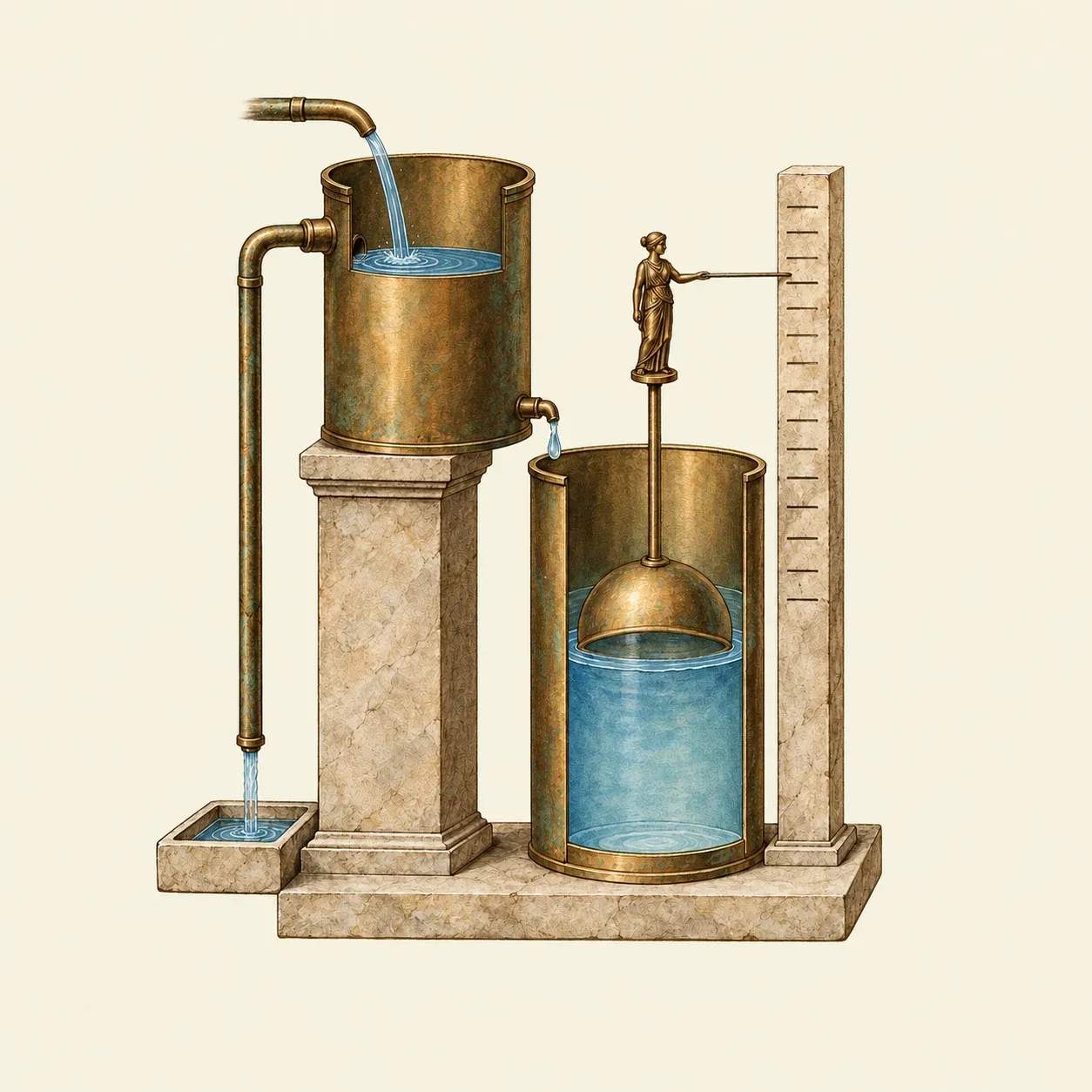 In an inflow clock the float rises at a steady pace because the tank above it is kept full.
An inflow clock turns the problem around. Water drips from a supply tank into a tall vessel, and a float rises with it. The drip stays steady only if the depth in the supply tank stays the same, so the tank is fed faster than it empties and the surplus runs away through an overflow pipe. In the clocks that Vitruvius attributes to Ctesibius, the float lifted a small figure whose rod pointed to the hours marked on a column. Toothed racks and drums driven by the float could also turn other figures. Wedges, or a column that turned with the months, adjusted the scale to the unequal hours of each season.
How to do it
This outflow clock is made from plastic cups and shows why Egyptian vessels have sloping walls. You need a clear plastic cup that is wider at the top than at the base, a clear straight-sided plastic bottle with its top cut off, a drawing pin, a cork or an eraser, a jar to catch the water, a wire rack or two stacks of books to stand the cup on, a waterproof marker and a timer.
Pierce the hole. Rest the base of the cup on the cork and push the drawing pin through its centre from the inside, so that the point goes into the cork. One clean pinhole is enough. Do not use a heated needle: melting plastic gives off fumes. Draw a filling line 2 cm below the rim.
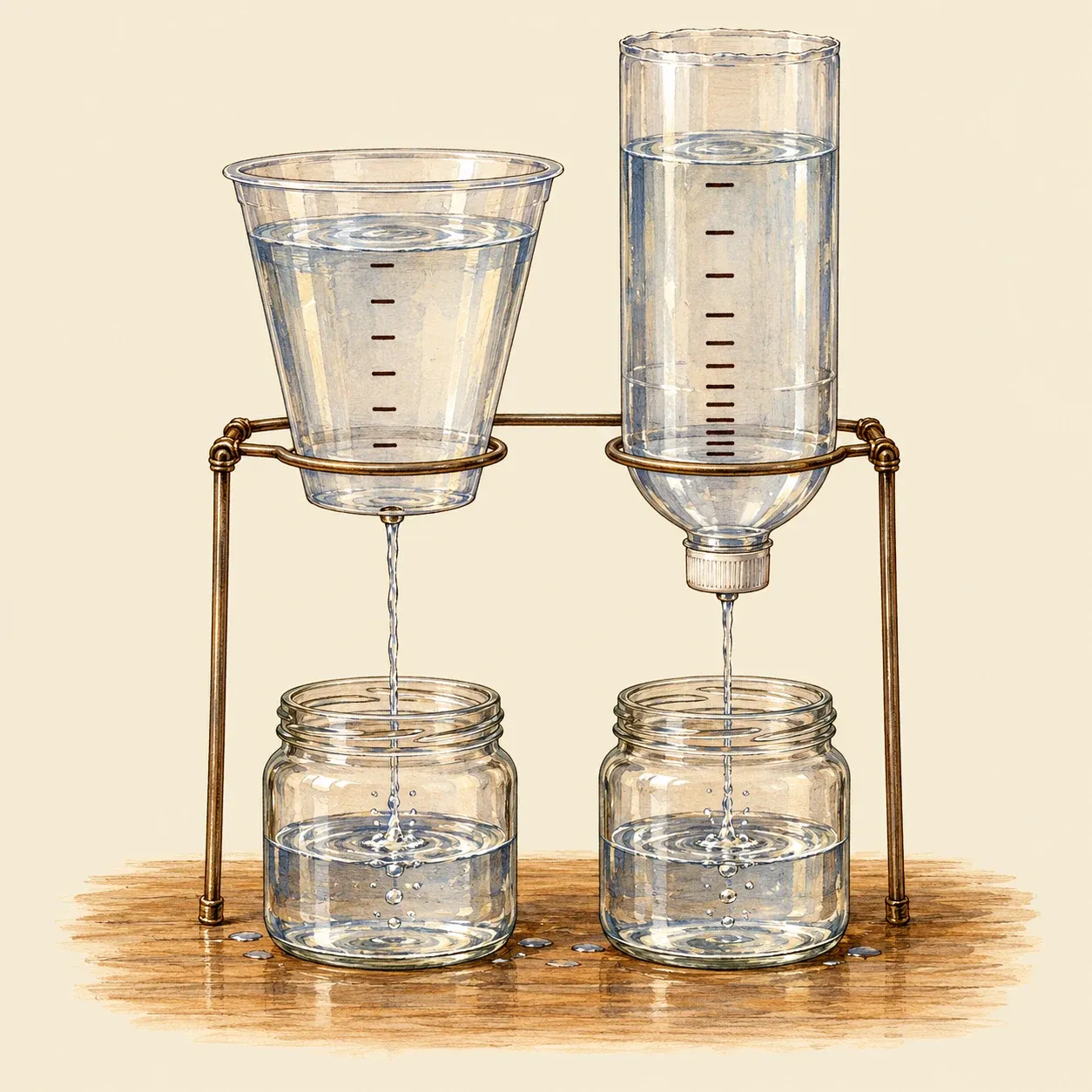 With a mark every two minutes, those on the bottle crowd toward the bottom and those on the cup stay nearly even.
Mark the scale. Stand the cup on the rack above the jar, hold a finger under the hole and fill it to the line with water at room temperature. Start the timer as you take your finger away, and every two minutes mark the water level on the outside of the cup. Stop when the jet turns to drops. Pour the water back, fill to the line again and check that the level reaches each mark at the same time. If it does not, the hole is partly blocked: rinse the cup and start again.
Compare. Pierce and mark the straight bottle in the same way. On the bottle the marks crowd together toward the bottom, because the flow slows as the depth falls. On the tapered cup the spacing is closer to even. Use clean water, as a hair or a crumb is enough to stop a pinhole.
History and evolution
The oldest written record of a water clock comes from Thebes in Egypt. Amenemhet, an official who served the kings Ahmose I, Amenhotep I and Thutmose I around 1500 BCE, wrote in his tomb that he had noticed the night growing longer and shorter from month to month and had made an instrument to tell the time. Its water ran out through a single opening, its outside bore figures of the sky, and he claimed it had no forerunner. The tomb was found at Sheikh Abd el-Qurna in 1885 and has since been lost. A fragment of the inscription is in the Egyptian Museum in Berlin, and the rest is known from two copies made at the time. Cotterell, Dickson and Kamminga read the text as describing a flowerpot-shaped outflow clock, while Alexandra von Lieven, who edited it again in 2016, thinks the device was more elaborate, with moving figures.
The oldest clock that survives was made for Amenhotep III in the fourteenth century BCE. It was found in pieces at Karnak in 1904, in a pit of buried temple objects, and is now in the National Museum of Egyptian Civilization in Cairo. It is carved from alabaster, 34.5 cm high, 46 cm across the top and 26 cm across the base. The outside shows stars, constellations and the king making offerings to the sun god Re-Horakhty and to Thoth, a god linked with the moon. Anette Schomberg found that its month scales fit the Egyptian calendar of about 1700 to 1600 BCE, so the pattern they record is older than the clock itself. Vessels of the same shape and decoration were made for temples for more than a thousand years, and some were sent to Egyptian sanctuaries in the Roman Empire.
In Mesopotamia, tablets from the early second millennium BCE onward give the length of day and night in minas, a unit of weight. Historians of astronomy take it to be the weight of water run out of a clock, but no Mesopotamian water clock has been found.
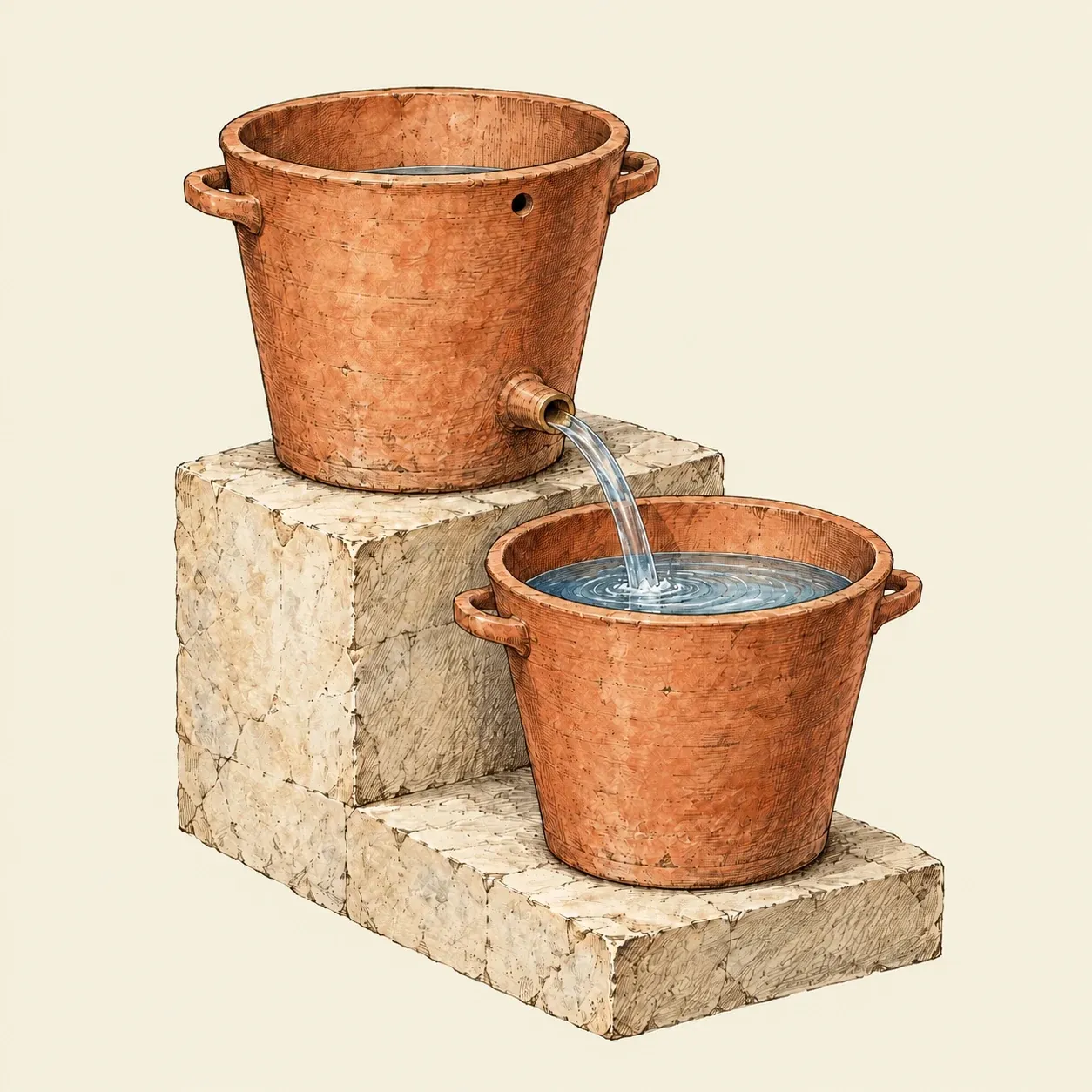 Athenian courts measured each speech with a pot of water like this one.
Athens used water clocks in its law courts from the late fifth century BCE to share speaking time between the two sides. One was found in the Agora, in a well filled in around 400 BCE. It is a clay pot with a spout near the base lined with a small bronze tube, and a hole just below the rim that fixed the filling level. Painted on it are the name of the tribe Antiochis and the sign for two choes, a measure of volume. Filled to the hole, it holds 6.4 litres and empties in about six minutes.
In the third century BCE Ctesibius built his inflow clocks in Alexandria, and their floats moved toothed racks and drums, an early use of the gear. The Tower of the Winds in Athens, built in the first century BCE, held a large water clock fed from a spring. In China, Su Song built an astronomical clock tower almost 12 metres high, driven by water, and described it in a treatise of 1092. In Europe, weight-driven mechanical clocks spread from the late thirteenth century, and the hourglass, with its steady flow of sand, came into use at about the same time.