Alarm clock
A signal set to sound at a chosen hour
Contents
- 1Incense stick lying in the trough
- 2Thread laid across the incense
- 3Pair of metal balls hanging from one thread
- 4Metal tray under the body
- 5Boat-shaped body with a dragon's head
An alarm clock gives a signal at a time chosen in advance, to wake a sleeper or to mark the moment for a task. Vitruvius, writing after 27 BCE, describes water clocks by Ctesibius of Alexandria, an engineer of the 3rd century BCE, whose wheels sounded trumpets and threw out stones. In 1198 a water clock at the abbey of Bury St Edmunds, in England, sounded before matins and woke the monk in charge of the vestry. Later alarms dropped metal balls when burning incense cut a thread, rang a bell when a pin set in the dial of an iron clock came round, or lit a candle.
What it is
An alarm clock is a timekeeper joined to a signal. The timekeeper measures the hours, and at the moment chosen beforehand it sets off something much louder or brighter than itself: a bell, a rattle of falling metal, a light. It was made to wake people at night, for prayers, a watch or work, and to remind them of a task during the day.
Every alarm has three parts. The first measures time steadily: water running from a vessel, incense burning along a stick, or the gears of a mechanical clock. The second is a store of energy kept ready, such as a raised weight, a wound spring or a few metal balls hanging on threads. The third is the trigger, a small movement that releases that store at the right moment. The skill lies in the trigger: it must hold the store firmly for hours, then let it go all at once.
An incense alarm works without any wheels. A boat-shaped body holds a stick of incense lying in a trough of ash. Threads are laid across the stick, each with a small metal ball tied to either end, hanging over a tray. When the glowing tip of the incense reaches a thread, it burns through, and the two balls drop into the tray with a clatter.
How it works
In an incense alarm the stick burns at a fairly even pace, so the distance between the glowing tip and a thread stands for a length of time. Placing the thread further along sets the alarm later. How long that takes depends on the kind of incense, so the alarm is set by trial with the incense that will be used. Each thread gives one signal; a row of threads can mark several hours of the night in turn.
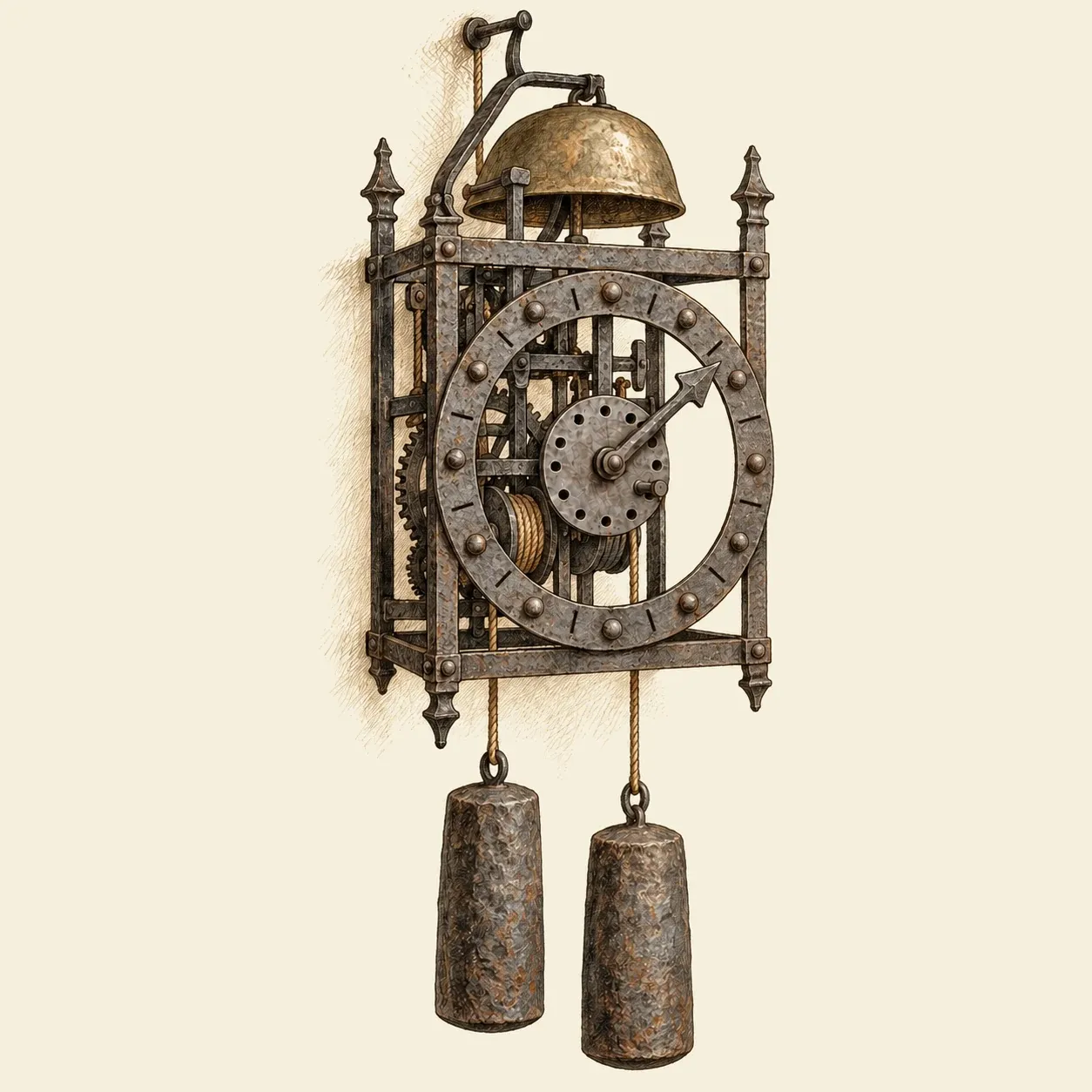 An iron clock of the 15th century: the pin set in the disc decides at which hour the bell will ring.
In a mechanical clock the trigger is linked to the hour wheel. On some iron wall clocks of the 15th century, an inner disc on the dial was pierced with holes, one for each hour. A pin pushed into one of the holes turned with the disc, and when it came round it lifted a lever that freed the striking train, so that a weighted hammer beat the bell. The Historisches Museum Basel keeps such a clock, made around the middle of the century, which told the bell ringer when to toll the bell.
Later spring-driven alarm clocks use a cam that turns with the hour hand and has a notch cut in its rim. A light lever rests on the rim. The alarm hand sets the position of the notch, and when the notch reaches the lever, the lever drops into it and releases a second spring. That spring drives a hammer to and fro against a bell until it runs down or the sleeper presses the stop. An American patent of 1877 describes this arrangement, with a notched cam moving with the hour hand and a spring lever holding the alarm until the notch comes round.
How to do it
A small alarm can be made with water and a falling marble, with no flame and no electricity. Water gathers slowly in a cup until it outweighs a counterweight and tips a lever.
Make the lever from a stiff wooden ruler. Glue a short round pencil across a block of wood as a pivot and lay the ruler on it so that it balances near its middle. Fix a light plastic cup to the left end of the ruler. At the right end, tape a few coins as a counterweight, so that this end rests down on the table. Tape a small card gate to the right end, hanging down past the edge of the block. Build a ramp from folded card that slopes gently down to the right, starting just behind the gate, and set a metal baking tray or a tin lid at its foot.
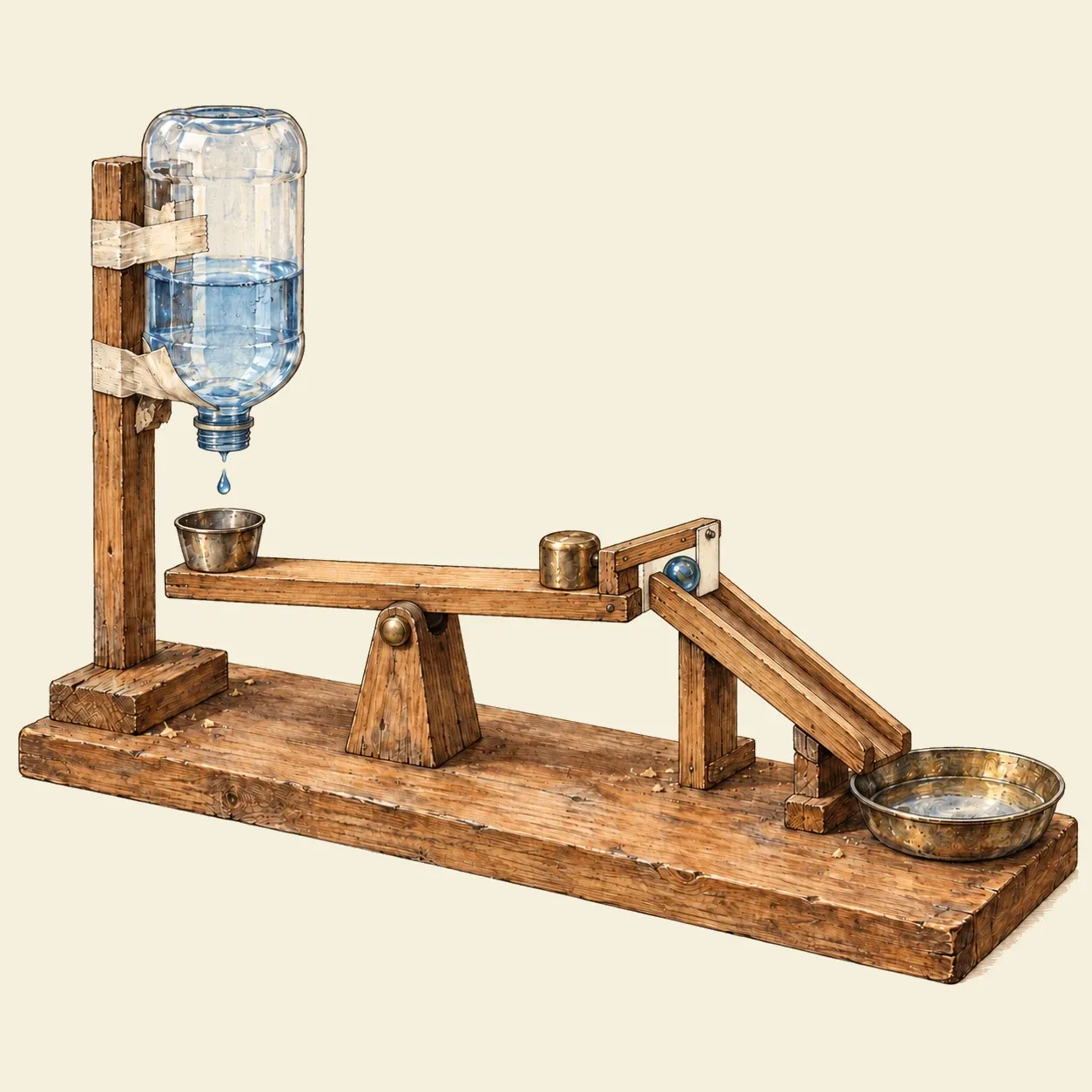 When the cup has gathered enough water, the ruler tips, the gate lifts and the marble rolls down into the bowl.
Place a marble at the top of the ramp, held back by the gate. Pierce a small hole in the cap of a plastic bottle and a second one in its base, which will face upwards and let air in as the water runs out. Fill the bottle while holding a finger over the hole in the base, screw on the cap, fix the bottle upside down on a stand above the cup, then uncover the air hole so that it drips steadily. As the cup fills, the left end of the ruler grows heavier. When it outweighs the coins, the ruler tips, the right end rises and lifts the gate, and the marble rolls down and lands on the tray with a bang.
Time the first runs with a watch. A larger hole or fewer coins make the alarm go off sooner; a smaller hole or more coins delay it. The drip slows as the bottle empties so always start with the bottle filled to the same mark. Empty the cup and reset the ruler before each run.
Work on a tray or a towel and keep the water well away from sockets, chargers and other electrical devices. Marbles and coins can choke small children, so keep the model and its parts out of their reach. Never use a candle, incense or any other flame as a timer, and never leave anything burning in a room where someone is asleep.
History and evolution
The Greek writer Athenaeus, around 200 CE, reports a story that Plato made a night clock resembling a water organ, “like a very large water clock”. The passage does not say how it signalled. Modern reconstructions, such as one at the Kotsanas Museum in Athens, make it a whistling water alarm, but the text alone does not show that it woke anyone.
Vitruvius, a Roman architect writing after 27 BCE, credits Ctesibius of Alexandria, an engineer of the 3rd century BCE, with water clocks in which a float, raised by water flowing in at a steady rate, drove toothed racks and wheels. Other wheels, driven by the same water, moved figures, turned cones, threw out stones or egg-shaped pieces and sounded trumpets. Vitruvius does not say at which moments these signals came.
The oldest account of a clock waking someone comes from England. Jocelin of Brakelond, a monk of the abbey of Bury St Edmunds, wrote that on a night in 1198 a candle fell and set fire to the shrine of St Edmund while its keepers slept. Then “the clock struck before the hour of matins”, and the master of the vestry got up and saw the flames. Monks ran for water “some to the well, some to the clock”, which shows that the clock ran on water.
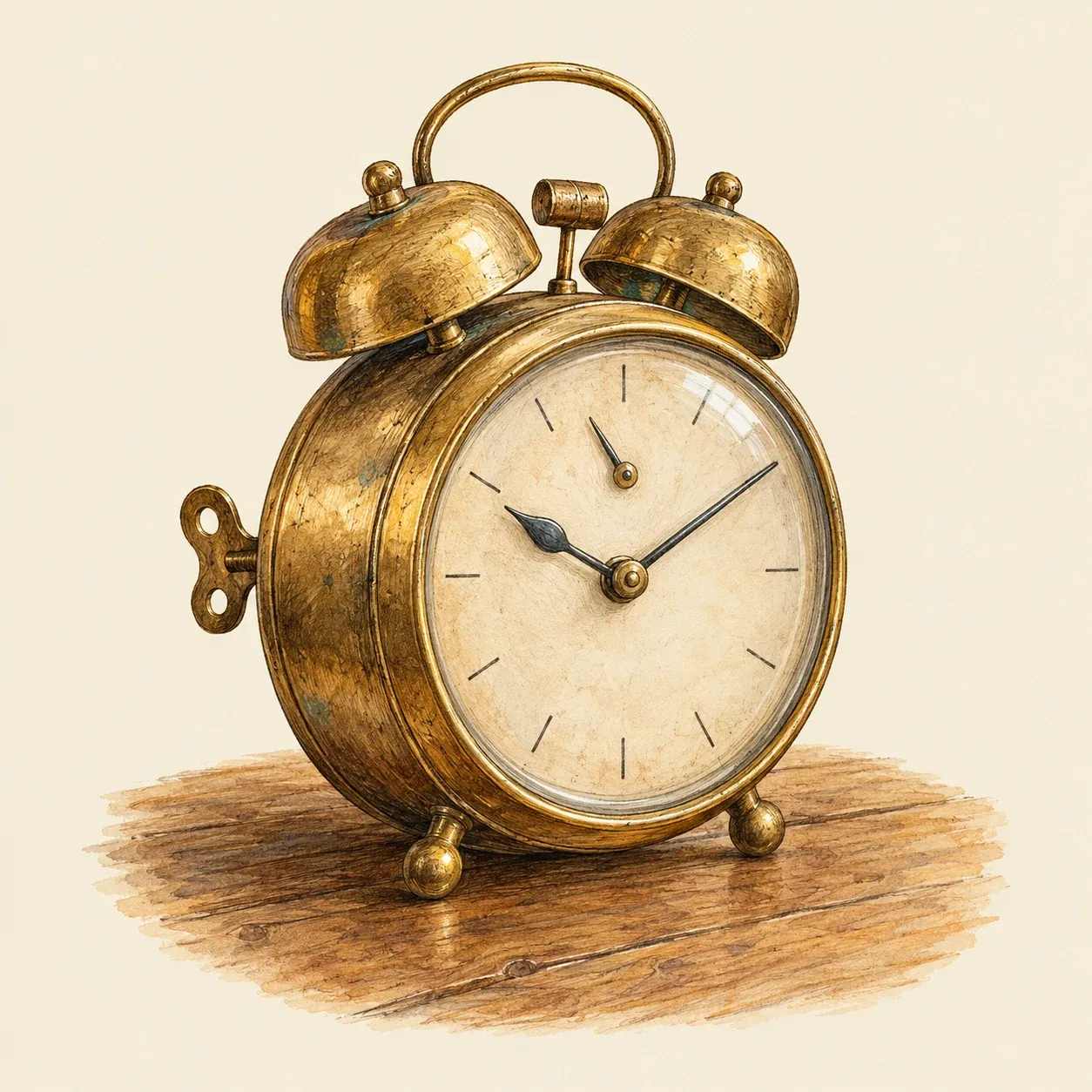 A wind-up alarm clock: at the set hour the hammer beats between its two bells.
Mechanical clocks later gave such signals in monasteries and towns. By the late 15th century, iron wall clocks hung in private houses, and their owners could set the hour of the bell with a pin. In China, the Jesuit Gabriel de Magalhães described incense timekeepers in the 1660s and called them a substitute for European alarm clocks. Incense alarms in the shape of a dragon or a boat, with threads and falling balls, were used in China and Japan.
Some alarms gave light rather than sound. In the 19th century the French clockmaker and conjurer Jean-Eugène Robert-Houdin made an alarm that lit a small candle at the chosen time, so that the sleeper woke to a lit room. Around 1900, American firms such as Seth Thomas and the Western Clock Company made small spring-wound alarm clocks with a bell, which stood by the bed in many homes. Electric and radio alarms followed, and many people now set their alarm on a mobile phone.