Nautical knots
Loops, hitches and bends that hold a ship's ropes
Contents
- 1Bowline (fixed loop)
- 2Clove hitch on a post
- 3Round turn and two half hitches on a ring
- 4Cleat hitch
- 5Figure-eight stopper knot
Sailors' knots are a small set of loops, hitches, bends and stoppers that tie a rope to a post, a ring, a cleat or another rope, hold under load and can still be untied by hand. A ship of about 2566 BCE, buried in pieces beside the pyramid of Khufu at Giza, had most of its parts tied together with knotted rope, and coils of knotted ship's rope were stored at Mersa Gawasis, an Egyptian harbour on the Red Sea, around 1800 BCE.
What it is
A ship carries a great deal of rope, and almost every piece of it ends in a knot or is made fast with one. Sailors sort their knots by what they do. A loop is a fixed eye tied in the end of a line, to drop over a post or to clip a load to. A hitch ties a rope to something else: a post, a ring, a spar, a rail. A bend joins two ropes end to end. A stopper is a knob tied in the end of a line so that it cannot run out through a block or a hole.
A knot used on board has to meet three demands at once. It must hold while the load comes and goes as the boat rolls and the wind gusts. It must not shake loose when the line goes slack. And it must come undone by hand afterwards, even after it has been hauled tight, since a jammed knot may have to be cut. A few knots cover most of the work. The bowline gives a loop that does not slip. The clove hitch makes a line fast to a post or rail in seconds. A round turn and two half hitches secure a mooring line to a ring. The cleat hitch belays a line on the horned fitting called a cleat, and the figure-eight knot stops a line from running out. Variants follow from these: the running bowline, whose loop slides along its own line to make a noose, two half hitches on their own, or the clinch knot that anglers use to tie a hook to fishing line.
How it works
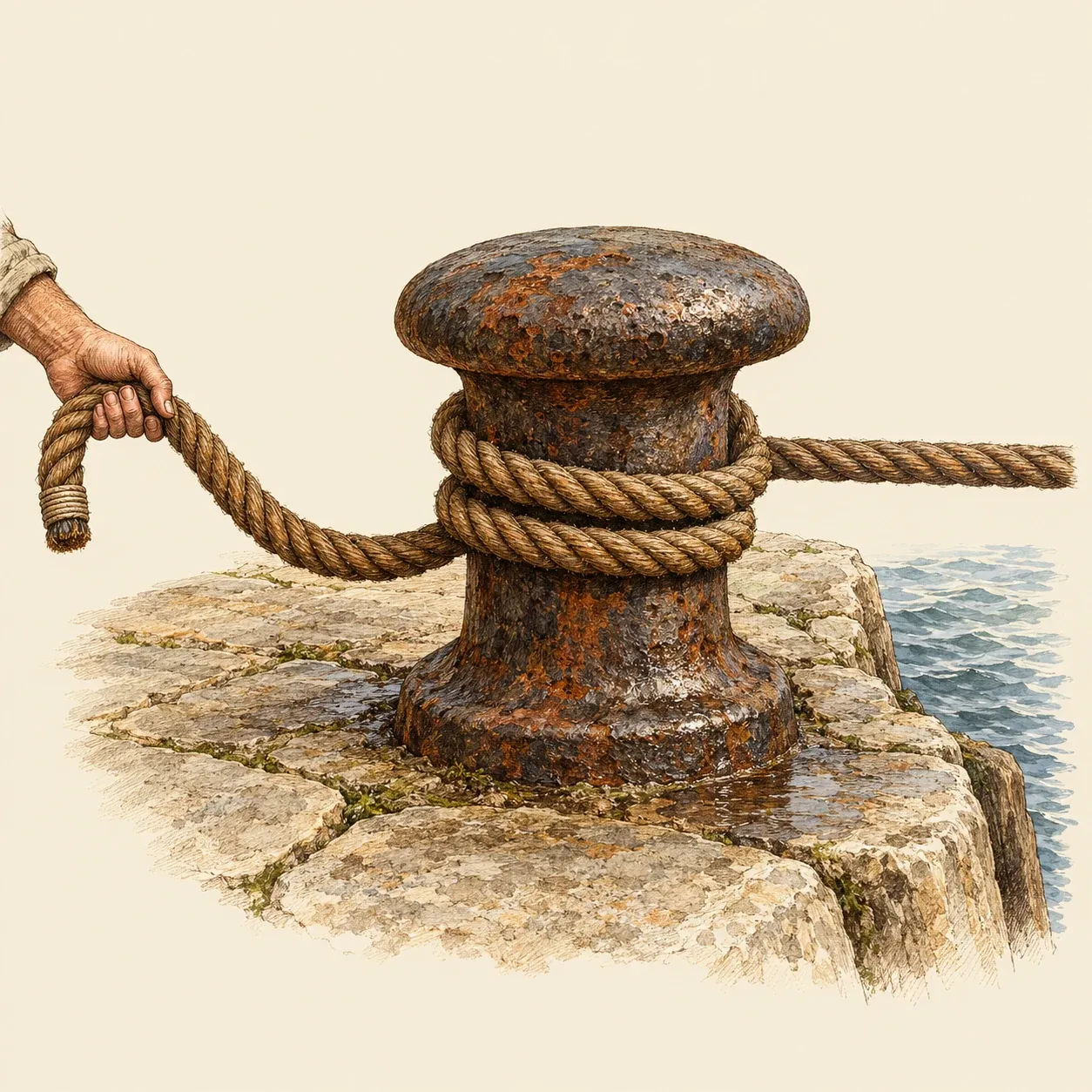 A turn and a half round a bollard: the tight side pulls hard, the slack side needs only a light hold.
Every knot holds by friction. Where a rope bends round a post or round another part of itself, the pull presses the two surfaces together, and the pressure lets them resist sliding. On a smooth post the effect grows very fast with the length of contact: in the standard model of a rope wrapped round a cylinder, the force it can hold back is multiplied by the same factor with each extra turn. This is why a sailor can hold a heavy boat with a couple of turns round a bollard and a light grip on the free end, and why a round turn takes the strain before the half hitches are tied.
A knot adds crossings, places where the rope passes over itself and is nipped by its own turns. Loading a well-made knot tightens these nips, so the harder it is pulled, the harder it grips. A badly chosen knot does the reverse. The reef knot and the granny knot look alike, but in the reef knot the turns lie in opposite senses and lock, while in the granny they lie in the same sense and can roll out under load. In 2020 a team at the Massachusetts Institute of Technology tied knots in fibres that change colour under strain and saw where the stress concentrated. They found that knots hold better when they have more crossings and when the twist of the rope reverses from one crossing to the next.
The working parts of a rope have names. The standing part is the long part that takes the load, the working end is the free end used to tie the knot, and a bight is any U-shaped fold. Most knots are a set order of turns and tucks of the working end round the standing part. A knot is finished by dressing it, that is, arranging the turns so that none cross where they should not, and then setting it by pulling every part tight.
How to do it
Use a few metres of soft rope about as thick as a finger, three-strand or braided, natural fibre or synthetic. Bind both ends with tape or thin twine so they do not fray. You also need something to tie to: a round wooden post or the leg of a heavy table, a metal ring or a smooth bar, and a cleat screwed to a board.
Start with the figure-eight. Make a loop near the end of the line, pass the end behind the standing part and back down through the loop from the front. Pulled tight, it looks like the figure 8, with a short tail left beyond it. It stays easy to untie even after a hard pull, which makes it a good stopper at the end of a line.
For a clove hitch, pass the working end round the post, cross it over the standing part and take a second turn round the post. Tuck the end under this second turn so that it comes out in the opposite direction to the standing part. Pull both parts. A clove hitch can work loose when the pull keeps changing direction, as on a moored boat, so a half hitch round the standing part is often added.
For a round turn and two half hitches, pass the end twice through the ring so that two turns lie side by side, then take the end round the standing part and back through the turn it has made: that is one half hitch. Make a second one the same way, in the same direction, and slide both up to the ring. The round turn carries the load and the half hitches only keep it from unwinding.
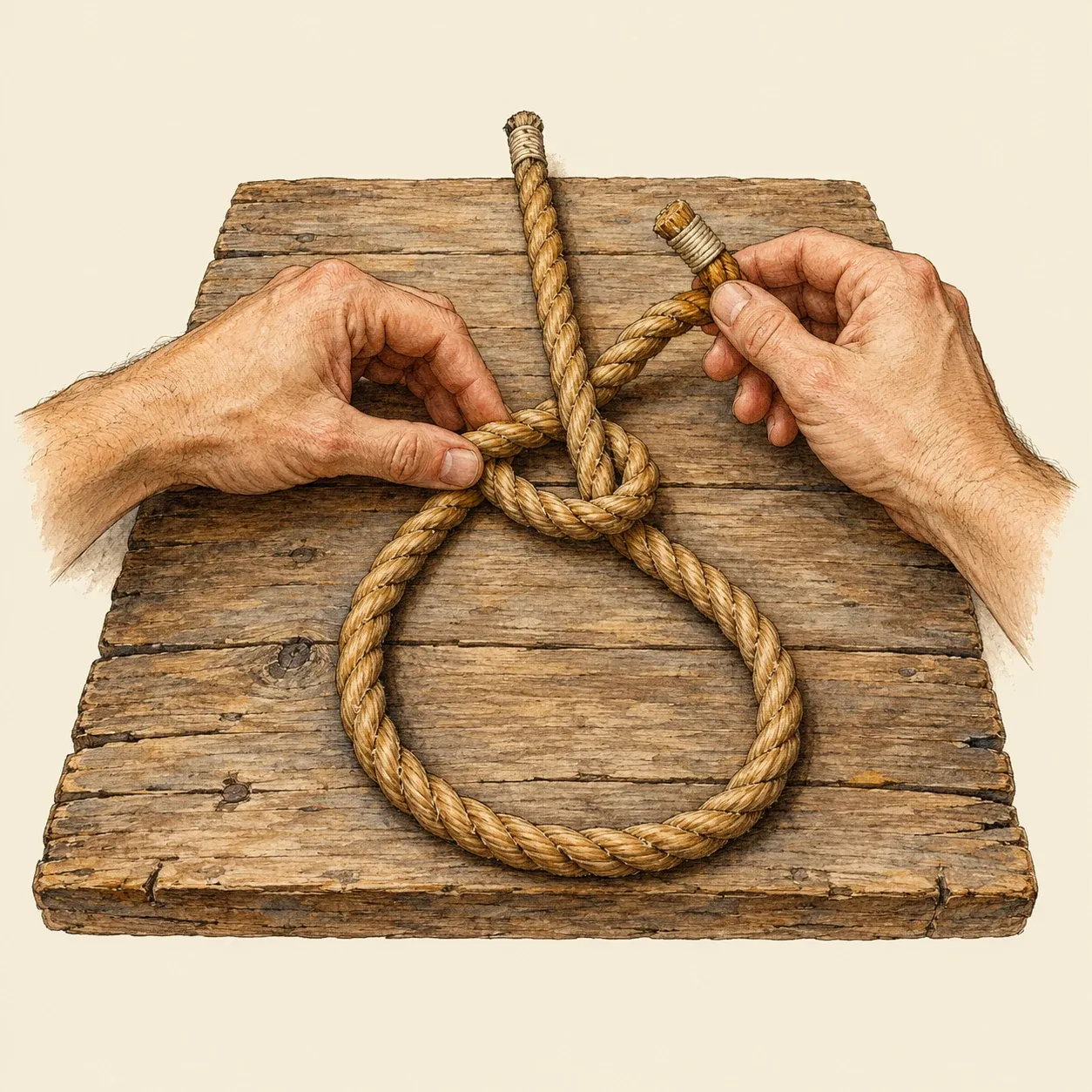 The bowline: up through the small loop, round behind the standing part and back down the same way.
For the bowline, hold the standing part upright and make a small loop in it, with the part towards the working end lying on top. Bring the working end up through the small loop from underneath, take it round behind the standing part and back down through the small loop. Hold the end against the side of the big loop and pull the standing part. The end should finish inside the big loop. The loop keeps its size whatever the load, and a bowline can be loosened afterwards by pushing back the collar round the standing part.
For the cleat hitch, lead the line to the horn of the cleat farthest from where it comes from and take a full turn round the base, under both horns. Then cross over the top in figures of eight, from one horn to the other, a few times. Most present-day guides finish with a locking hitch, a twisted loop dropped over one horn so that the last turn lies parallel to the others. Arthur Aldridge, in a manual of 1918, warned against any half hitch over a cleat because it can jam, and Animated Knots advises against a locking turn on the halyard of a large boat, where extra figures of eight are used instead. To cast off, lift the locking hitch off the horn first, then unwind the figures of eight.
Test each knot by pulling hard with your hands only, then untie it. Repeat each until you can tie it without looking. Safety: these exercises teach knots, not climbing, rescue or lifting. Never use a knot learned this way to hold a person, to climb, or to lift anything above someone’s head. A loaded rope that breaks or slips whips back, so do not stand in line with it. Never wrap a rope round your hand or wrist, keep your fingers out of the turns on a cleat or bollard while the line is under load, and wear gloves if you let a loaded rope run through your hands, as friction burns quickly.
History and evolution
Knots leave few traces, because rope rots. In a pit cut beside the pyramid of Khufu at Giza, archaeologists found a large wooden ship of about 2566 BCE, taken apart. Mats and ropes lay on top of the timbers, and most of the wooden parts had been tied together with knots. The builders had joined the hull planks with rope passed through V-shaped channels cut in their inner faces, and some of their original knots survive.
Knotted ship’s rope also survives at Mersa Gawasis, a harbour of the Middle Kingdom on the Red Sea coast of Egypt, used by expeditions to the land of Punt. Inscriptions at the site name Amenemhat III, who reigned around 1800 BCE.
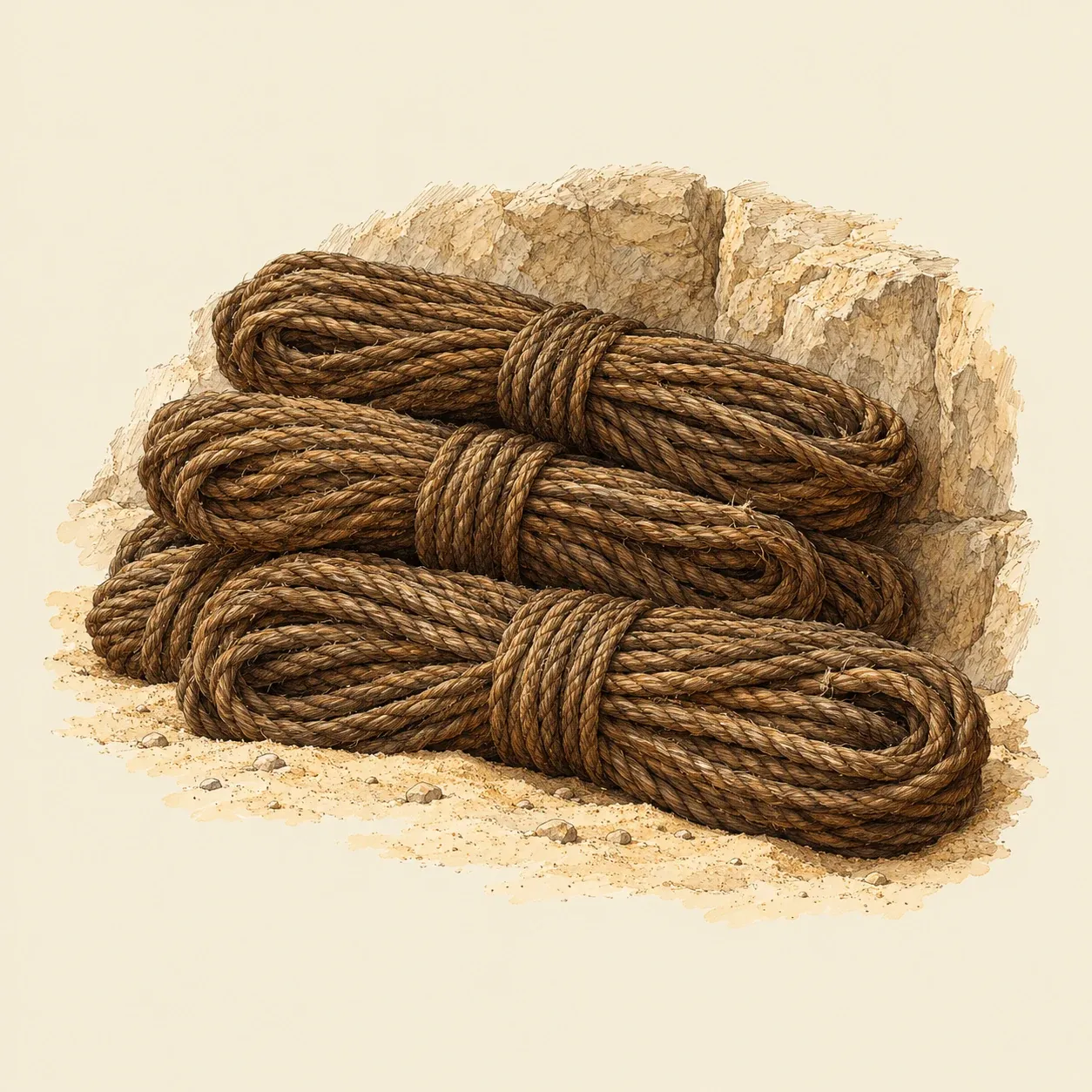 Ship’s rope was coiled, bound round the middle and stored in rock-cut caves until the next voyage.
In one of the caves cut into the cliff, archaeologists led by Kathryn Bard and Rodolfo Fattovich found dozens of coils of ship’s rope, many still neatly bound as the sailors had left them. Each coil had been laid lengthwise and wound round the middle for storage. The excavators read them as equipment for the ships that made the voyage to Punt under sail and oar. Among smaller rope fragments at the site, the excavators recorded reef knots, simple overhand knots and knots tied at the ends of lines.
In 1769 William Falconer’s dictionary of the marine already defined a hitch as a knot by which one rope is fastened to another or to a post, ring or mast, named the half hitch and the clove hitch among others, and called a bend the knot that joins two ropes. For Falconer a knot proper was a knob worked into the end of a rope by unlaying its strands and weaving them together, such as the wall knot or the diamond knot. Seamanship manuals then described the common knots one by one. Aldridge’s of 1918 noted that the bowline cannot slip and was used to sling a man working aloft.
Clifford Ashley spent eleven years on The Ashley Book of Knots, published in 1944, which describes about 3,900 knots in some 7,000 drawings. The mechanics of knots later became a research subject in its own right, and the colour-changing fibres of 2020 measured the stresses behind rules that sailors had learned by practice.