Parachute
A canopy that slows a fall
Contents
- 1Pilot chute and bridle
- 2Vent at the apex
- 3Silk canopy
- 4Suspension lines
- 5Risers and harness
- 6Pack and ripcord handle
A parachute slows a fall by opening a wide cloth canopy above the load, so that the drag of the air soon balances its weight. An Italian engineer drew the idea around 1470. In 1783 Louis-Sébastien Lenormand tried it at Montpellier and gave it its name, and in 1797 André-Jacques Garnerin came down under one from a balloon over Paris.
What it is
A parachute is a canopy of cloth that opens above a falling person or load and slows the descent enough for a landing without serious harm. Suspension lines join the edge of the canopy to a few straps called risers, and the risers to a harness or to the load. An emergency parachute for aircrew is stowed in a container worn on the back. When the wearer pulls a handle, the ripcord, a small pilot chute springs out and draws the main canopy into the air.
The Type A back pack parachute was the first model standardized by the United States Army Air Service, and Leslie Irvin made the first jump with this type in 1919. Its canopy was silk.
Emergency and reserve parachutes are regulated equipment. In the United States they must be of an approved type and be packed by a certificated rigger, and jumping is taught by certified instructors.
How it works
A falling body speeds up until the resistance of the air equals its weight, then falls at a steady speed. That resistance, the drag, grows with the area the body presents to the air and with the square of its speed. A person falling with arms spread presents little area and reaches a high speed. Under an open canopy with an area of several tens of square metres, the drag equals the weight at a few metres per second. The performance standard used to certify American emergency and reserve parachutes requires an average rate of descent no faster than 7.3 m/s with the heaviest load the parachute is approved for.
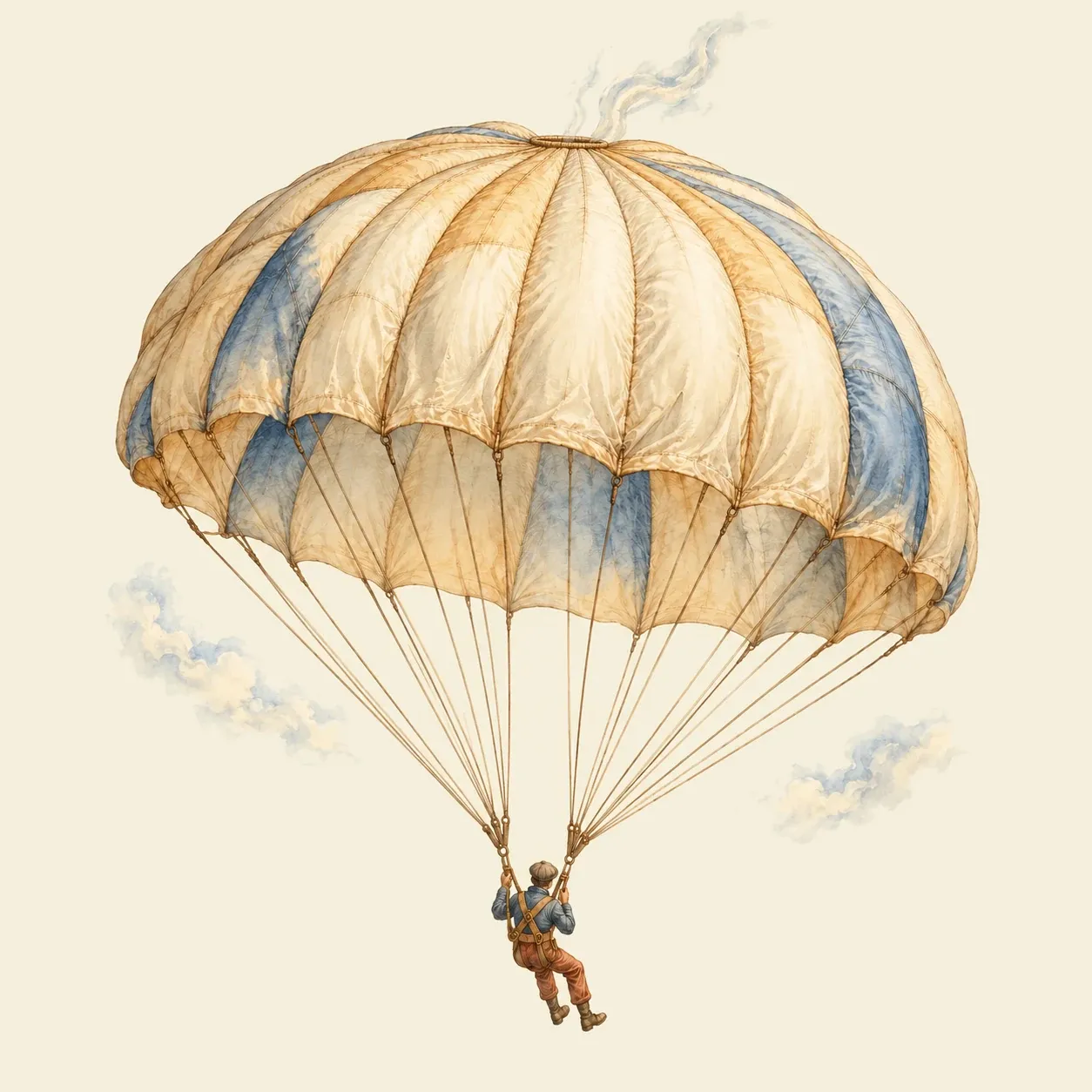 A vent at the apex lets part of the trapped air out steadily.
The canopy fills into an inverted bowl, and the air held beneath it is at a slightly higher pressure than the air above. The suspension lines share the load around the whole edge. The trapped air has to escape somewhere. Without an opening it spills out under one side of the edge, then the other, and the parachute swings. A vent at the top, the apex, lets part of the air out steadily and reduces the swinging. The canopy of André-Jacques Garnerin in 1797 had no vent, and he swung violently all the way down.
Early in the twentieth century, parachutes were usually pulled open by a static line, a cord tied to the balloon or aircraft. On a parachute opened by the wearer, the ripcord holds the container shut. Pulling it releases the flaps, and a spring launches the pilot chute into the airstream. Its drag pulls the canopy and lines out of the container as the wearer falls away, and keeps them taut until the canopy fills.
Since the 1970s most sport parachutists have used a ram-air canopy, a rectangular wing of two fabric skins joined by ribs. Air entering the open cells at the front inflates it, and it glides forward and can be steered. Round canopies are still used for emergency and military parachutes.
History and evolution
The oldest known drawing of a parachute is in an anonymous Italian manuscript of about 1470, now in the British Library. The historian Lynn White, who published it in 1968, described a man hanging under a conical canopy, and on another page a man slowing his fall with two long streamers of cloth. Around 1485 Leonardo da Vinci drew a pyramid of linen and noted that with a cloth 12 braccia wide and 12 high a man could drop from any height without harm.
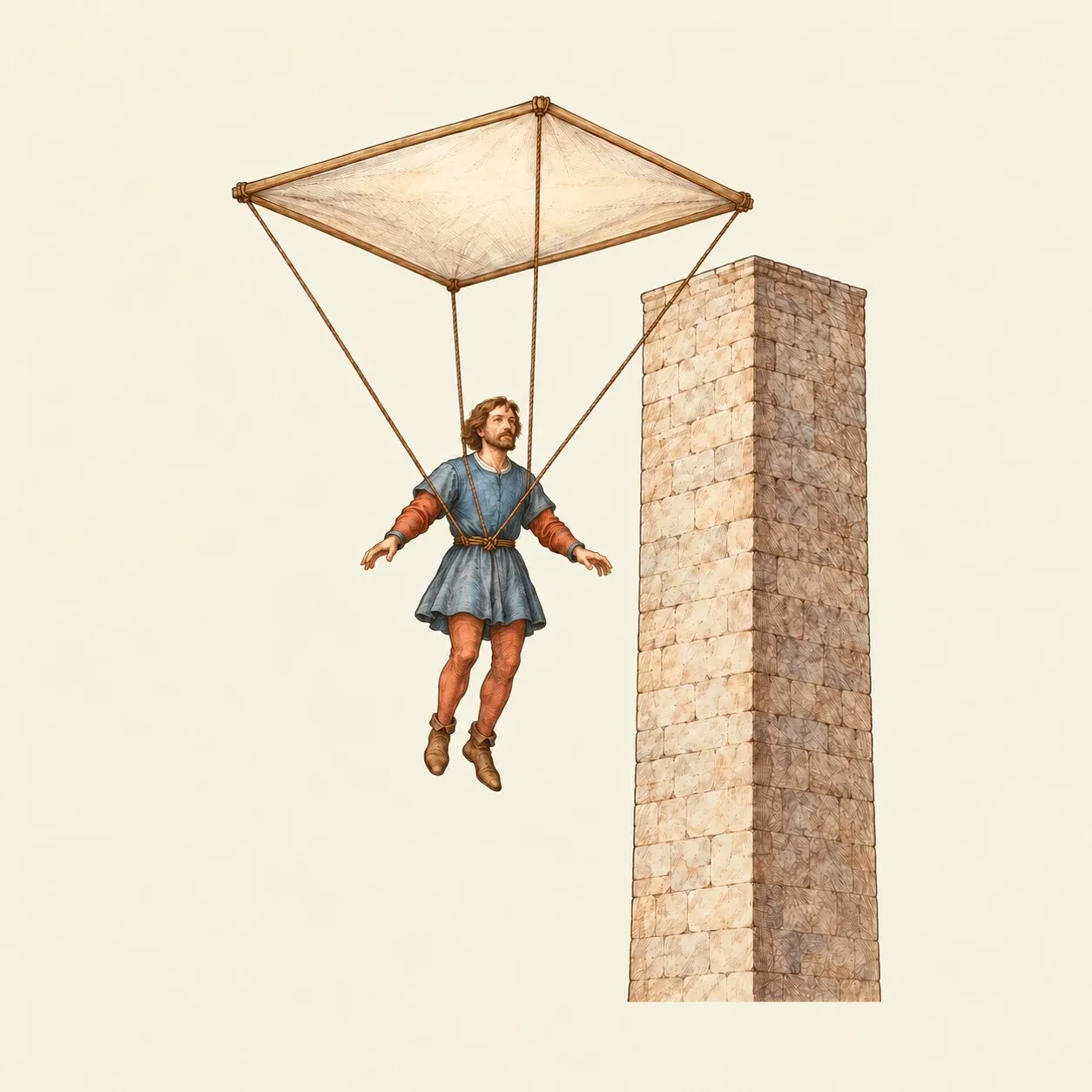 The flying man of Fausto Veranzio’s book of machines: a square sail on a frame, held by four cords.
In Venice, the bishop and engineer Fausto Veranzio printed a book of machines, Machinae novae, with an engraving of a flying man under a square sail held by cords at its four corners. The book carries no date. Letters of July 1616 thanking him for copies place the printing around 1615 to 1616, while several library catalogues still give about 1595.
Louis-Sébastien Lenormand, a young physicist from Montpellier, had read of an acrobat at the court of Siam who leapt from a height holding two parasols. His own account, published in 1800, dates his first trial to 26 November 1783. Many later accounts say he jumped from the tower of the Montpellier observatory. The historian Olivier de Bernon writes that from the tower he only dropped a weight and animals. Lenormand gave the device its name, parachute, from para-, against, and chute, fall.
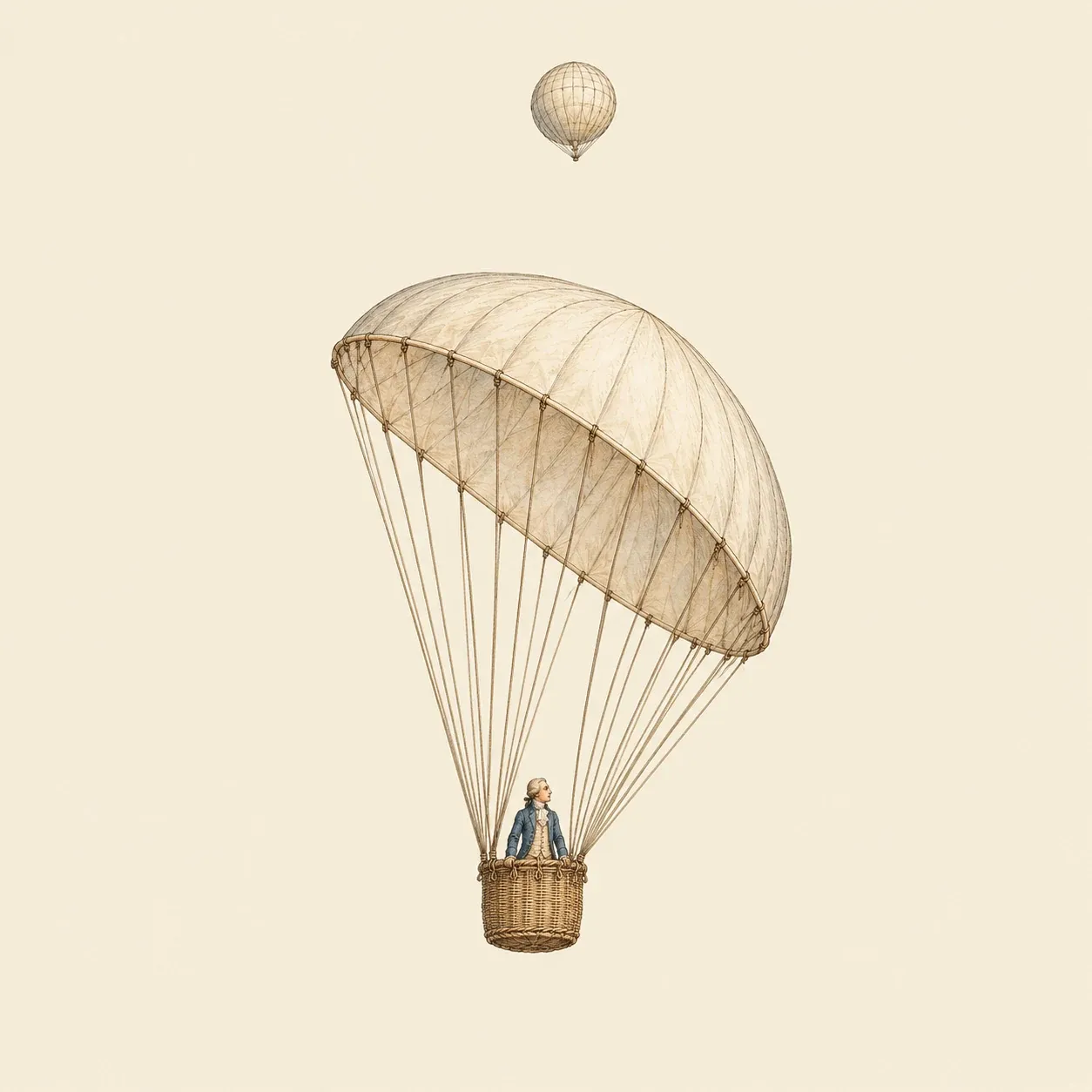 Garnerin’s first canopy had no vent at the top, so it swung from side to side as it came down.
On 22 October 1797, André-Jacques Garnerin rose from the Parc Monceau in Paris under a hydrogen balloon, with the parachute and a small basket hanging below it. High above the park he cut the parachute free. Accounts put the height at between about 600 and 900 m. The canopy opened, swung hard, and set him down unhurt. Two years later, on 12 October 1799, Jeanne-Geneviève Labrosse became the first woman to descend by parachute, and she later married Garnerin.
During the First World War the observers in tethered balloons used parachutes, but almost no aeroplane pilots carried them until German airmen were given them in 1918. Static lines could tangle with a falling aircraft, so engineers of the Army Air Service at McCook Field, Ohio, turned to a parachute the wearer opened himself after falling clear. In 1914, during demonstration jumps for the Army, the parachutist Georgia Broadwick, known as Tiny, had cut a static line caught on the aircraft and opened her parachute by hand. Floyd Smith had applied for a patent on such a parachute in July 1918, and on 28 April 1919 Leslie Irvin made the first jump with the new parachute that he and Smith had built, pulling the ripcord in free fall. Irvin’s company made the Type A for the Army. In October 1922, Lieutenant Harold Harris jumped from a test aircraft that was breaking up over Dayton and landed safely, and the Army then required parachutes on nearly all its flights.
In the Second World War, Japan’s silk no longer reached the United States, and on 6 June 1942 Adeline Gray, a rigger at the Pioneer Parachute Company, made the test jump with the first nylon parachute. Nylon soon replaced silk. In 1966 Domina Jalbert patented a fabric wing of several cells inflated by the air entering at its front, the principle of the ram-air canopies that spread through sport parachuting in the 1970s.