Terrace farming
Level fields built up a slope
Contents
- 1Dry-stone wall leaning back into the slope
- 2Footing stones in a trench
- 3Drainage stones behind the wall
- 4Level bed of soil
- 5Stone-lined spillway to the terrace below
Terrace farming turns a hillside into a staircase of level fields. Each step is held up by a wall of stone or earth, and its flat bed keeps the rain where it falls instead of letting it run off with the soil. Low walls across the slopes east of the Dead Sea have been dated to about 6000 BCE, and dated terraces in Yemen and Judea go back to the fourth millennium BCE.
What it is
A field on a hillside loses its soil. Each heavy rain runs down the slope, gathers speed and carries off the fine earth that crops need, until bare rock or stones are left. Terracing cuts the slope into a series of steps. Each step is a flat bed of soil held up on its downhill side by a wall, called a riser, of dry stone or of earth faced with grass. Seen from below, a terraced hillside looks like a staircase whose treads are fields.
Terraces exist from the Mediterranean and Yemen to China, Southeast Asia and the Andes. Some are rain-fed and carry olive trees or cereals. Others take water from a spring or a canal and hold it as flooded rice fields, a case described in paddy rice cultivation. Whatever the crop, the terrace makes level ground where there was none and holds the soil in place, and its builder decides where the water goes.
How it works
On a level bed, rain no longer has a slope to run down. It spreads, slows and soaks into the soil, which stays moist longer than on the open hillside. Ann Kendall, an archaeologist who has excavated Inca terraces in Peru, found their soil still damp six months after they had been irrigated. The wall also changes the climate of the bed: stone warms in the sun during the day and gives back its heat at night, which protects the roots on cold nights in the high Andes.
The wall carries the push of the soil behind it, and that push grows when the soil is soaked. A good terrace wall leans back into the slope, so that its weight presses against the bank instead of tipping outwards. The stones are laid dry, without mortar, with their longest side running into the bank. Behind the wall the builders pack a layer of fist-sized stones or gravel. Water reaches this layer, runs down through it and leaves through the joints of the wall. In highland Yemen this layer is still built today to drain surplus water, which would otherwise waterlog the soil, weaken it and finally push the wall over. Kendall says the same of the gravel in Inca terraces.
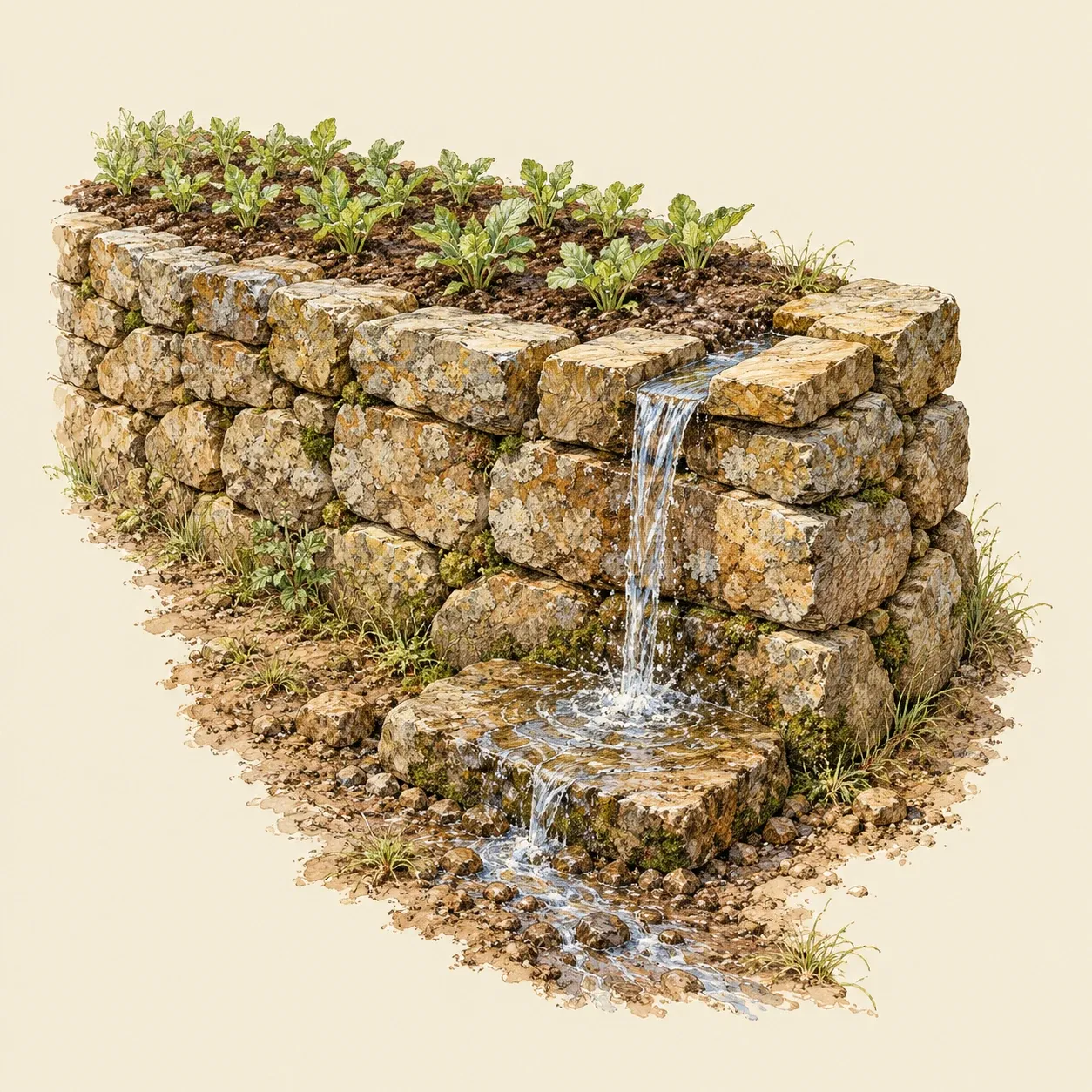 The surplus leaves by a low point lined with flat stones and falls onto a stone below.
Heavy storms bring more water than the soil can take. The surplus has to leave by a path that does not cut the next wall. Farmers leave a low point at one end of the bed, lined with flat stones, so the water spills onto a stone at the foot of the wall below instead of onto bare earth. FAO guidance for bench terraces built today asks for the same things: drains at the foot of each riser, a protected waterway to carry the water off the hillside, and stones where the water falls. It tilts the beds slightly back towards the slope in wet climates and slightly outwards in dry ones. In dry country, terraces also collect water. In the Yemen highlands the old terraces below the hilltop site of Hammat al-Qa, probably of the Bronze Age, were set so that each received the runoff from the slope above it.
How to do it
A low dry-stone wall can turn a gentle garden slope into one or two level beds. Collect stones of all sizes before starting, and keep the flat ones for the top of the wall and for the spillway.
Mark the line of the wall along the slope with a string stretched level between two stakes, or with the A-frame described under irrigation. Strip the topsoil from the whole area of the future bed and pile it aside: it goes back on top at the end. Along the line, dig a shallow trench into firm ground and set the largest stones in it as footings.
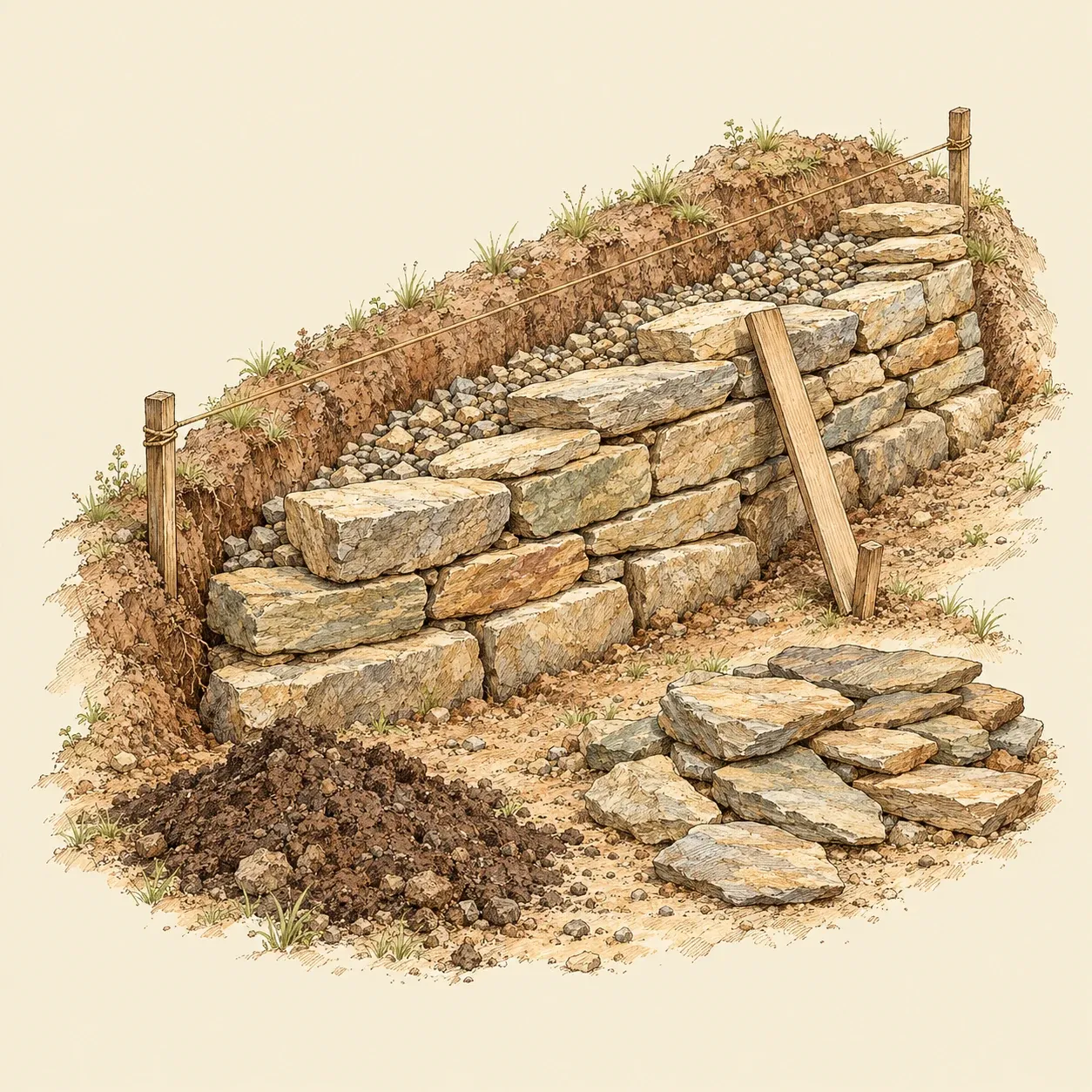 The string keeps the course straight and the sloping board gives the lean of the face.
Lay the wall in courses. Put each stone with its long side into the bank, so that it sits across each joint of the course below, as bricks do. Lean the face back towards the slope as you rise. A board cut to the chosen slope and held against the face helps to keep it even. FAO’s manual for hand-built stone risers gives a slope of half a unit back for each unit of height. Behind every course, pack a band of fist-sized stones about a hand’s width deep, then fill behind them with subsoil, tamped in thin layers. FAO recommends compacting about every 15 cm, because loose fill settles and leaves the bed lower than planned. Finish the wall with large flat stones, spread the topsoil back on the bed and rake it level.
At the end where water collects, lower the top of the wall slightly over the width of a spade and line that notch and the ground below it with flat stones. After the first heavy rain, check that the water leaves through the spillway and the joints of the wall, and that the bed has no puddles. Rebuild at once any stone that has moved.
Safety. Never stand or let anyone work below loose stones or an unfinished wall. Before digging, check for buried pipes and cables. Keep a garden terrace low: a wall higher than your knee, or one that holds up a path, a road or a building, should be designed and built by a professional, and may need a permit.
History and evolution
At Dhra’, on the slopes east of the Dead Sea in Jordan, Ian Kuijt, Bill Finlayson and Jode MacKay found low walls running across the hillside, which they interpret as terrace walls built to hold soil and control water, and date to about 6000 BCE. Shimon Gibson and Rafael Lewis cite this date as a claim. In the deserts of the southern Levant they find no terracing that can be shown to be older than the seventh century BCE. On the steep hillside of Sataf, west of Jerusalem, Gibson’s team excavated a well-built terrace of the Early Bronze Age, late in the fourth millennium BCE. Gibson and Lewis also suggest that small pockets of soil among the rocks, planted with olive trees from the Chalcolithic period onwards, led the way to built terraces. Most Judean terraces have been rebuilt many times. In the hills south-west of Jerusalem, optically stimulated luminescence, which measures when buried grains of soil last saw daylight, gave terrace fills Roman, Byzantine, Islamic and Ottoman ages. Gibson argues that the method dates the last use of a terrace, not its first construction.
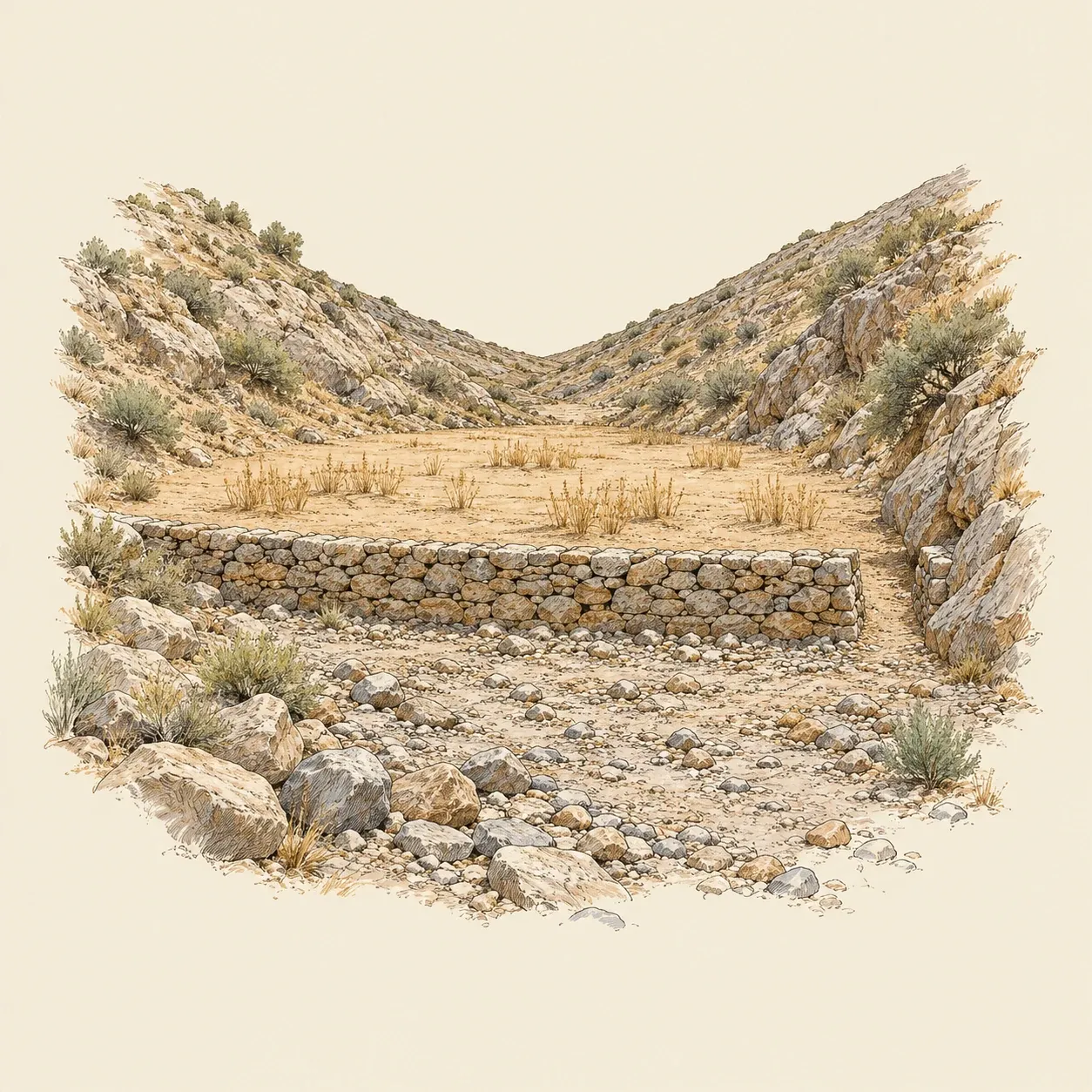 A cross-valley wall traps silt and water and turns a stream bed into a field.
The oldest wall dated directly comes from the highlands of Yemen. Tony Wilkinson’s team found a small field terrace wall, or check dam, buried deep in the sediments of a valley floor at Sedd adh-Dhra’ah. Charcoal in the soil that had built up against it gave 3955–3630 BCE, and the wall was backed with fist-sized stones like those Yemeni farmers still use for drainage. Terraces on the valley slopes appear later, probably by the end of the third or the start of the second millennium BCE, and by the first millennium BCE much of the Yemeni highland had been terraced.
In the Andes, Sarah Brooks dated terraces in the Japo basin of the Colca valley in Peru to at least 4350 ± 80 radiocarbon years before present. She traced a sequence from walls across gullies to sloping fields, then to rain-fed bench terraces, and later to irrigated ones. The Inca state built terraces on a large scale. Kendall found that their builders chose stones of different heights and shapes for the walls and for drainage, and filled the beds with soil, gravel and sand. The charity she founded in 1977, the Cusichaca Trust, has since repaired and irrigated 160 hectares of terraces and canals in the Patacancha valley near Cuzco, where local families now maintain them.
In southern Yunnan, the Hani people have cut irrigated rice terraces out of the forest of the Ailao mountains over the past 1,300 years, according to UNESCO, with up to 3,000 terraces on a single slope between the forest and the valley floor. The dating of the Ifugao rice terraces in the Philippines is disputed. UNESCO’s description of the site says they were built 2,000 years ago, while Stephen Acabado and Marlon Martin, from radiocarbon dates and historical sources, place their origin in the sixteenth century, at the time of Spanish contact.