Winemaking
Turning grapes into wine by fermentation
Contents
- 1Grapevine tied to a stake, with ripe bunches
- 2Clay treading basin with a raised rim
- 3Spout pouring out the juice
- 4Fermentation jar sunk in the ground
- 5Cap of skins floating on the fermenting must
- 6Lees and pips settled at the bottom
Wine is made by letting yeasts ferment the sugar of crushed grapes into alcohol and carbon dioxide. The oldest chemical traces of grape wine come from pottery jars of about 6000–5800 BCE found in two Neolithic villages of Georgia, in the South Caucasus.
What it is
Wine is the drink obtained by fermenting fresh grapes, crushed or whole, or their juice. The International Organisation of Vine and Wine adds a threshold to that definition: a wine must contain at least 8.5% alcohol by volume, with lower limits allowed by law in some regions. The work has two parts. In the vineyard, growers raise the domesticated grapevine, Vitis vinifera, and in the cellar the ripe fruit is turned into a drink that keeps.
A vineyard is planted with vines raised from cuttings, often grafted today onto another root. Each winter the grower cuts away most of the wood the vine grew the year before, often around 90%, and leaves only a few buds to bear fruit. This pruning sets the size of the next crop. In the cellar the grapes are crushed, left to ferment, separated from their skins and stored in closed vessels.
How it works
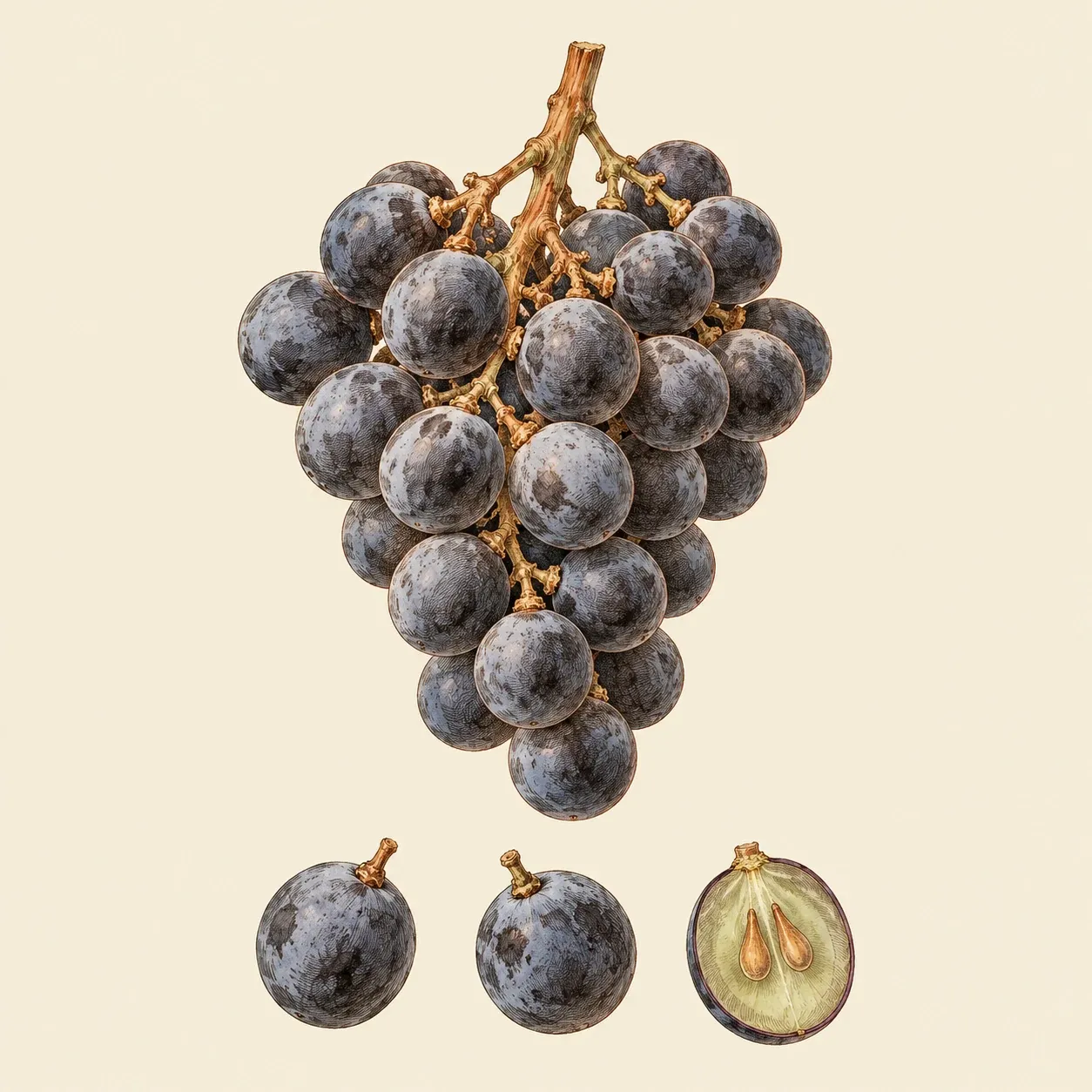 The pulp holds the sugar and the juice; the colour of a red wine comes from the skins.
A ripe grape holds water, sugars (glucose and fructose), acids and, in black varieties, pigments in the skin. Its main acid, tartaric acid, occurs in large amounts in no other fruit of the Near East, which is why chemists use it to recognise ancient wine. Crushing breaks the berries and lets the yeasts reach the juice.
Yeasts are single-celled fungi. In a vessel with little air they turn sugar into ethyl alcohol and carbon dioxide, which rises as bubbles. In a spontaneous fermentation several wild yeasts start the work, then give way to Saccharomyces cerevisiae, the main wine yeast, which is rarely found on intact grapes. The more sugar the must contains, the stronger the wine: about 17 g of sugar per litre gives 1% of alcohol, so a juice with about 200 g of sugar per litre ferments to about 12%.
Red wine ferments with its skins, which give it colour and tannin. The skins float up and form a thick cap, which has to be pushed back into the liquid so that it stays moist and gives up its colour. For white wine the juice is pressed off before fermentation. Once the sugar is used up, dead yeast and fragments of fruit sink to the bottom as lees.
Air is the enemy of finished wine. Exposed to it, the wine oxidises, and acetic bacteria turn its alcohol into vinegar. Winemakers have always kept their vessels full and closed: ancient jars were sealed with clay, and some Neolithic wine was mixed with tree resin, probably to make it keep.
How to do it
A small batch of red wine can be made at home from about 5 kg of ripe, sound wine grapes. You need a food-grade plastic bucket of about 10 litres, clean cloth, a glass jug of about 4 litres with a fermentation lock, a length of food-grade tubing and a strainer bag. Wash everything in hot water without soap, rinse it and sanitise it with a product sold for wine or beer making. Do not use copper or aluminium containers.
Pick out leaves, unripe and rotten berries, strip the grapes from their stalks and crush them by hand in the bucket. Wine yeast is a better choice than baker’s yeast; add it as its packet says. Cover the bucket with a double layer of cloth tied round the rim to keep out fruit flies, and keep it at about 16 to 21 °C. Fermentation should start within a day and the cap forms on the second day. Push it down with a clean spoon at least twice a day.
After three to seven days, when the colour is deep enough, ladle the liquid into the jug through a funnel, then squeeze the skins gently in the strainer bag and add that wine too. Fill the jug almost to the neck, fit the lock with water in it and leave it in the same cool place for about a month, until the bubbling has nearly stopped.
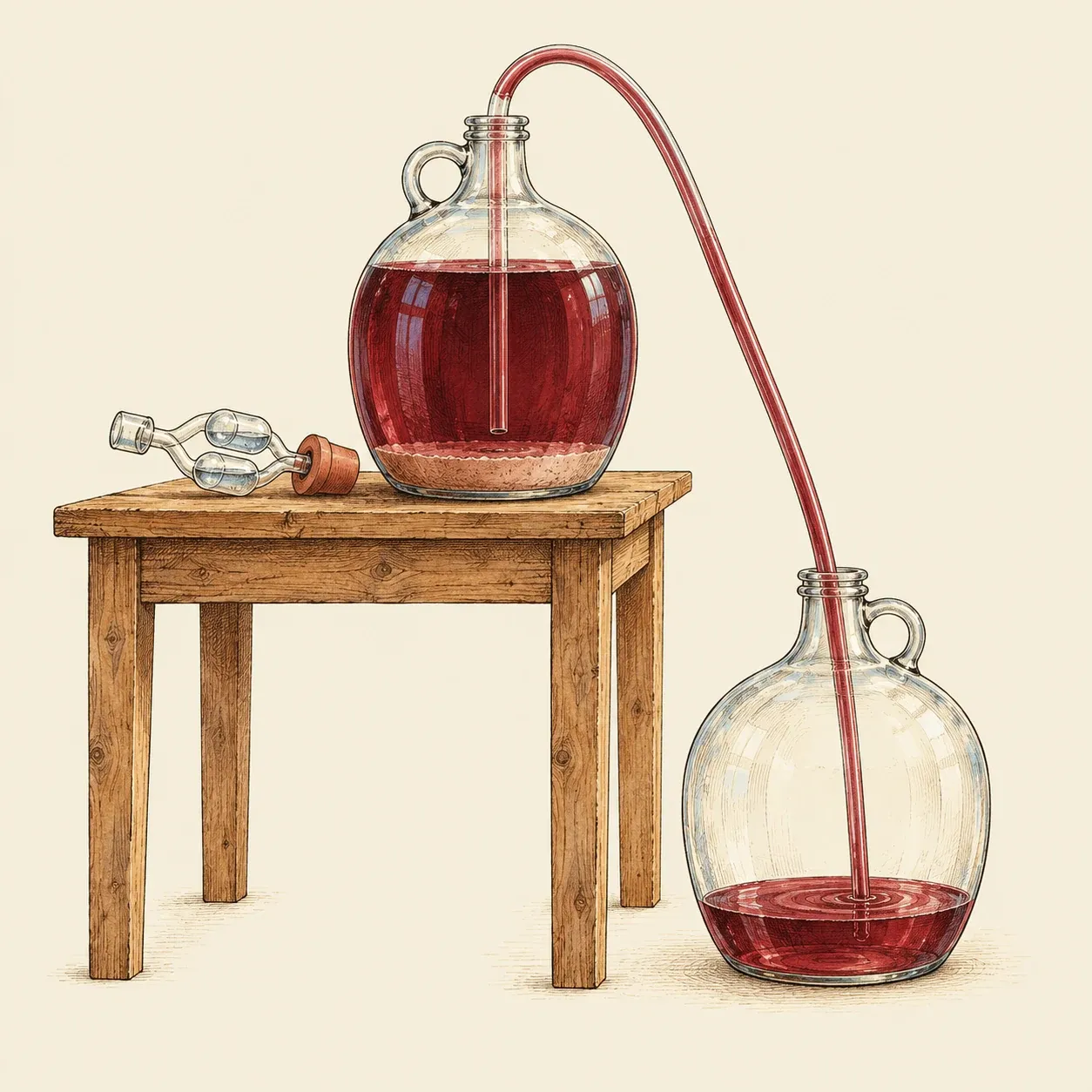 Racking: the clear wine is siphoned off the lees into a clean jug standing lower.
Then rack the wine. Set the jug on a table, put a clean jug on the floor and siphon the wine across, keeping the end of the tube above the lees. Top up the new jug, refit the lock and repeat about a month later. A clear wine may still hold sugar, because a fermentation can stop before it is finished. A hydrometer reading that stays below 1.000 for several days is a first sign of a dry wine, but a wine can read that low and still hold enough sugar to start fermenting again in the bottle. Check it with a reagent-tablet sugar test sold for winemaking and bottle only when the residual sugar is below about 0.2%, or 2 g per litre. Otherwise keep the wine in its jug under the lock and do not seal it in bottles.
Safety. Use only sound fruit and clean, sanitised, food-grade equipment, and throw away a batch that smells of vinegar or nail varnish or grows mould. Bottling before fermentation has finished can make bottles burst.
History and evolution
At Jiahu, in Henan in China, pottery jars of the seventh millennium BCE held a fermented drink of rice, honey and fruit, hawthorn or grape or both. The oldest certain grape wine comes from the South Caucasus. At Gadachrili Gora and Shulaveris Gora, two villages about 50 km south of Tbilisi in Georgia, Patrick McGovern’s team found tartaric acid in eight jar bases of about 6000–5800 BCE, along with grape pollen and grape starch. Genetic work published in 2023 by Yang Dong and colleagues places the domestication of the grapevine about 11,000 years ago, at the same time in western Asia and in the Caucasus.
At Hajji Firuz Tepe, in the Zagros mountains of Iran, six jars of about 9 litres were found in the kitchen of a mud-brick house of 5400–5000 BCE; two held residues of wine with terebinth resin. The oldest complete winemaking installation was found in the Areni-1 cave in Armenia and dates from 4100–4000 BCE. It has a shallow clay basin about 1 m long with a raised rim, where grapes were trodden, placed so that it drained into a vat about 60 cm deep. Pips of the domesticated grape, pressed skins and dried vines lay around it, and the potsherds carried malvidin, the pigment of red wine.
Egypt imported wine early. In the tomb U-j at Abydos, built about 3150 BCE probably for a ruler called Scorpion I, hundreds of jars made in the southern Levant had held wine; 47 still contained grape pips, and some of the wine had been flavoured with herbs and resin. In Georgia the old method survives: grapes are pressed and the juice goes with its skins, stalks and pips into a large egg-shaped clay jar, the qvevri, which is sealed and buried in the ground for five or six months. UNESCO listed it in 2013.
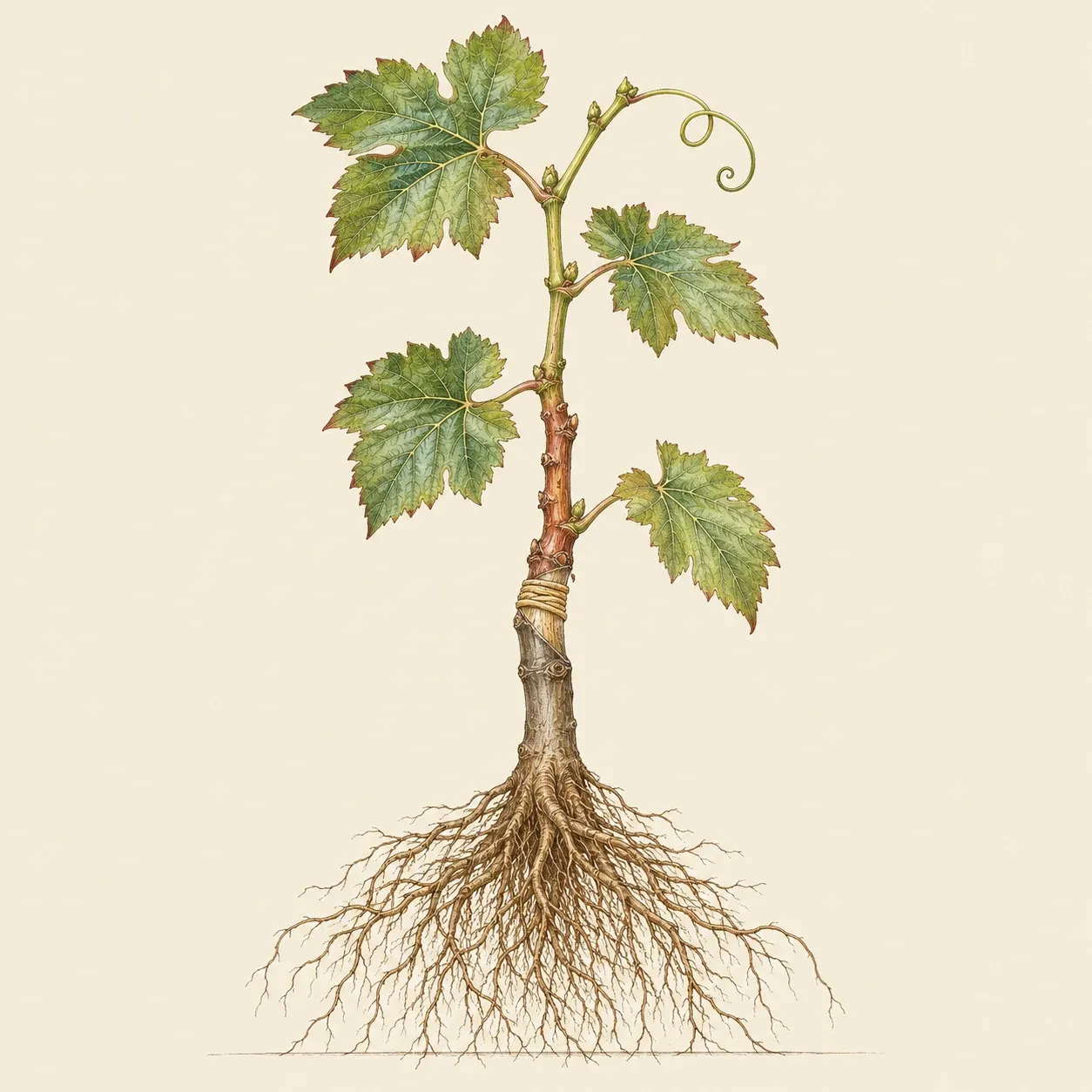 Grafting European varieties onto resistant American rootstocks saved the vineyards.
In 1863 Napoleon III asked Louis Pasteur to find out why French wines spoiled. Pasteur traced the faults to microbes, patented in 1865 a way of heating wine after fermentation to preserve it, and published his Études sur le vin in 1866. Phylloxera, an aphid-like insect from North America that is deadly to European vines, reached France with imported American vines; its first damage was seen at Pujaut, in the Gard, in 1863, and it broke out near Bordeaux in 1867. Growers saved their vineyards by grafting European varieties onto American rootstocks that resist the insect; in 1887 the French government sent Pierre Viala to the United States to find species that would also grow in chalky soil.