Tofu
Soy milk set into a block
Contents
- 1Hand-operated rotary stone quern for wet soybeans
- 2Cooking pot
- 3Filter cloth and okara
- 4Coagulation basin
- 5Cloth-lined wooden mould, lid and stone pressing weight
Tofu is a fresh food made by setting cooked soy milk into a soft gel, sometimes drained and pressed into blocks. Heat, a coagulant and a cloth turn dry beans into something that can be sliced. A Chinese text from around 965 gives its earliest surviving written mention.
What it is
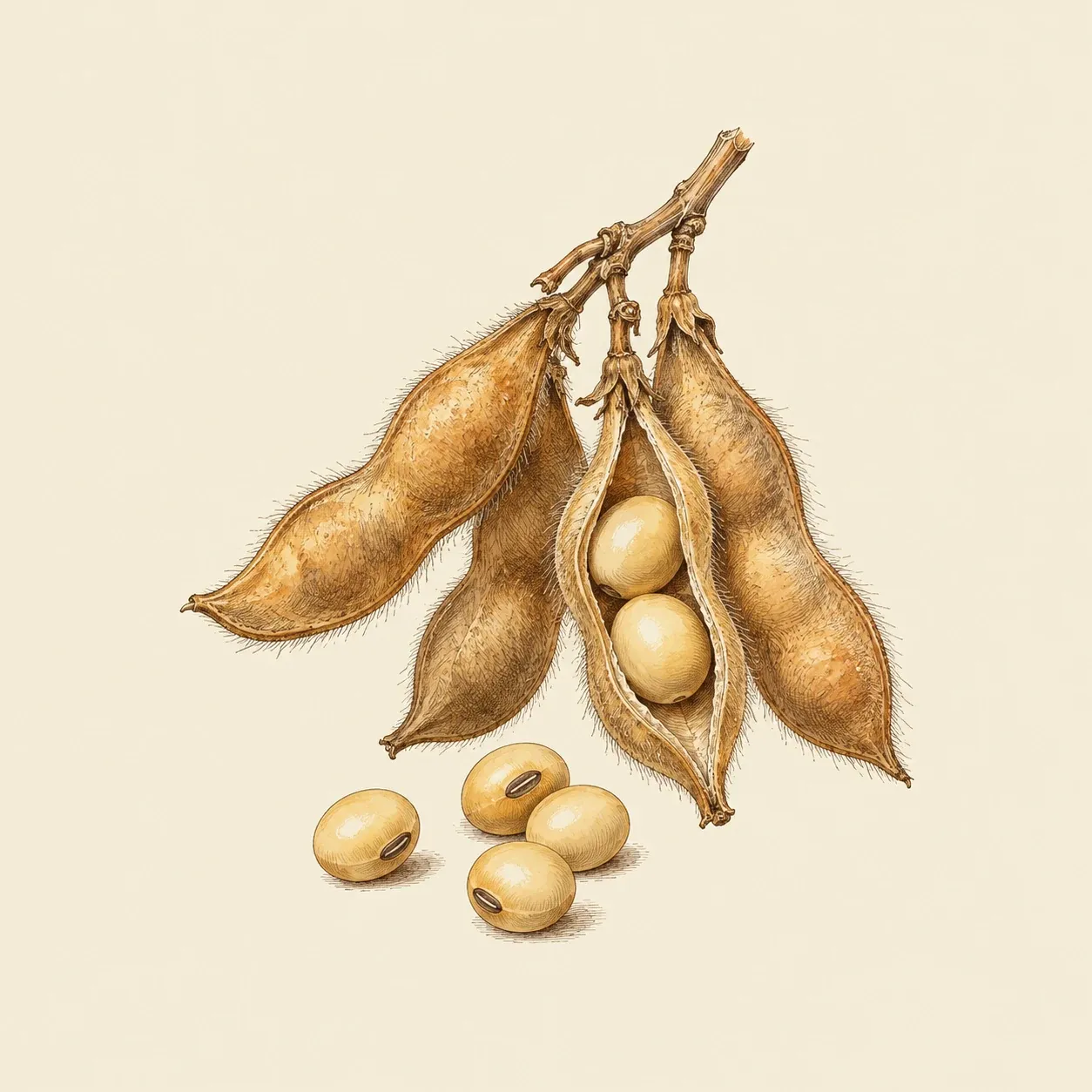 Dry soybeans supply the milk from which tofu is made.
Tofu is the set protein of soy milk, with water and fat held inside it. A firm block carries the weave of its pressing cloth on its surface. Silken tofu breaks under a spoon. Both begin with soybeans, and neither is fermented, unlike tempeh or fermented tofu.
The dry seed is a compact store of material that water alone will not release. Soaking softens it; grinding breaks its structure open. The plate shows the tools for that work: a rotary quern, a cooking pot, a straining cloth, a setting basin and a weighted wooden mould. Some methods strain the ground beans before cooking, others afterwards.
How it works
Grinding wet beans with clean water makes a suspension. Straining removes much of the insoluble pulp, called okara, while proteins and fine droplets of fat remain in the milk. Cooking changes the proteins’ folded shapes, allowing them to join into a network when a suitable coagulant is added.
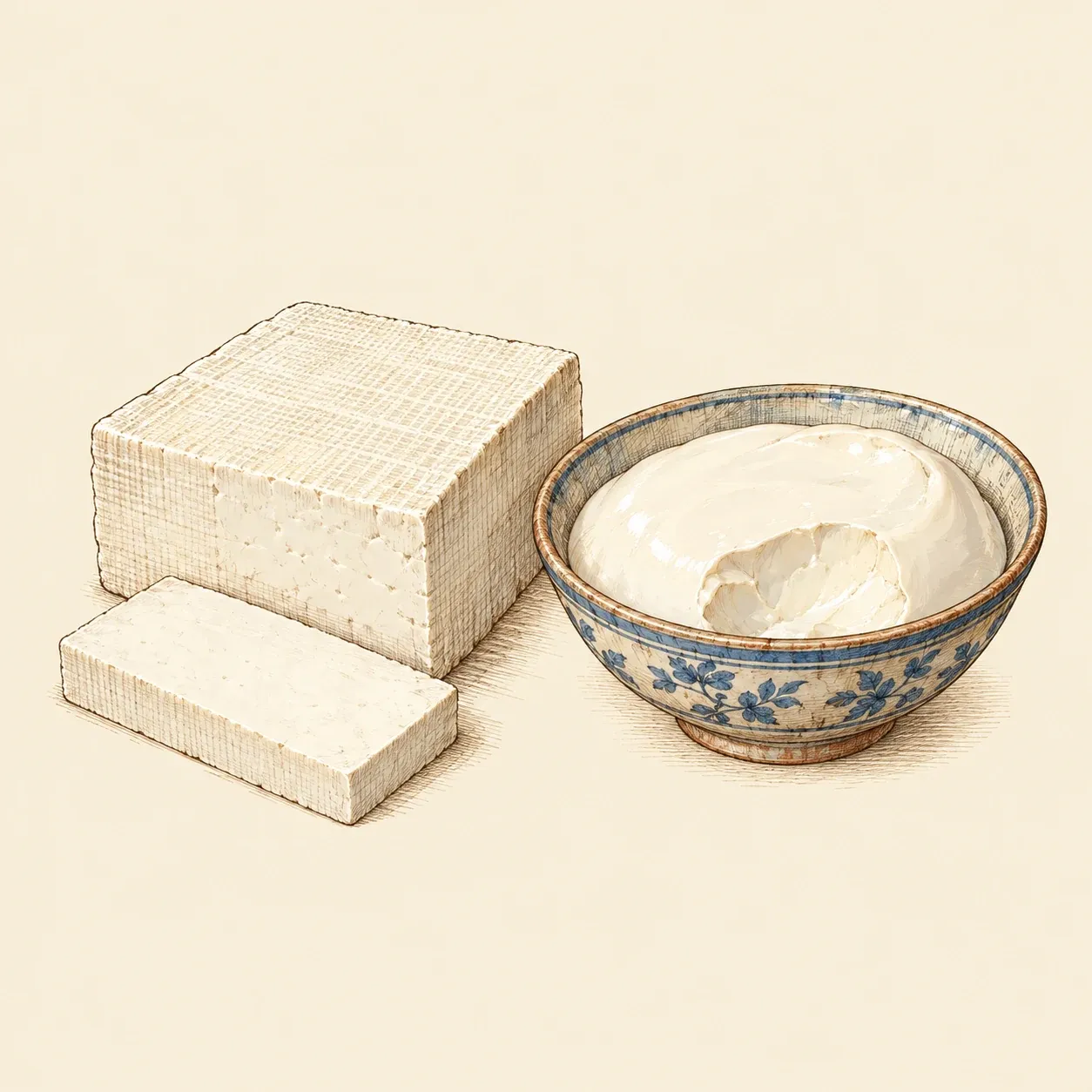 Pressing gives a sliceable block; an unpressed gel can stay spoon-soft.
Calcium sulfate, sold as food-grade gypsum, supplies calcium ions that help the proteins aggregate. Nigari, the brine left when salt is made from seawater, is chiefly magnesium chloride, and its strength varies between products. Acids can also set soy milk; glucono-delta-lactone is used for some silken tofu. Each agent works in its own way and at its own dose, so they cannot be swapped spoon for spoon.
The network traps water and fat. Draining and pressing remove some of that water and bring the curds together. More pressure or longer drainage generally makes a firmer block, and the strength of the milk and the coagulant also count. Silken tofu sets in one piece and is never broken up or pressed, which keeps it soft.
How to do it
For a small kitchen batch, use a tested tofu recipe with dry soybeans, drinking water and a food-grade coagulant. Gather a large pot, a thermometer, a grinder, a clean straining cloth and a draining mould with a stable lid and weight. A modern grinder can do the quern’s job. Choose tools you can wash thoroughly.
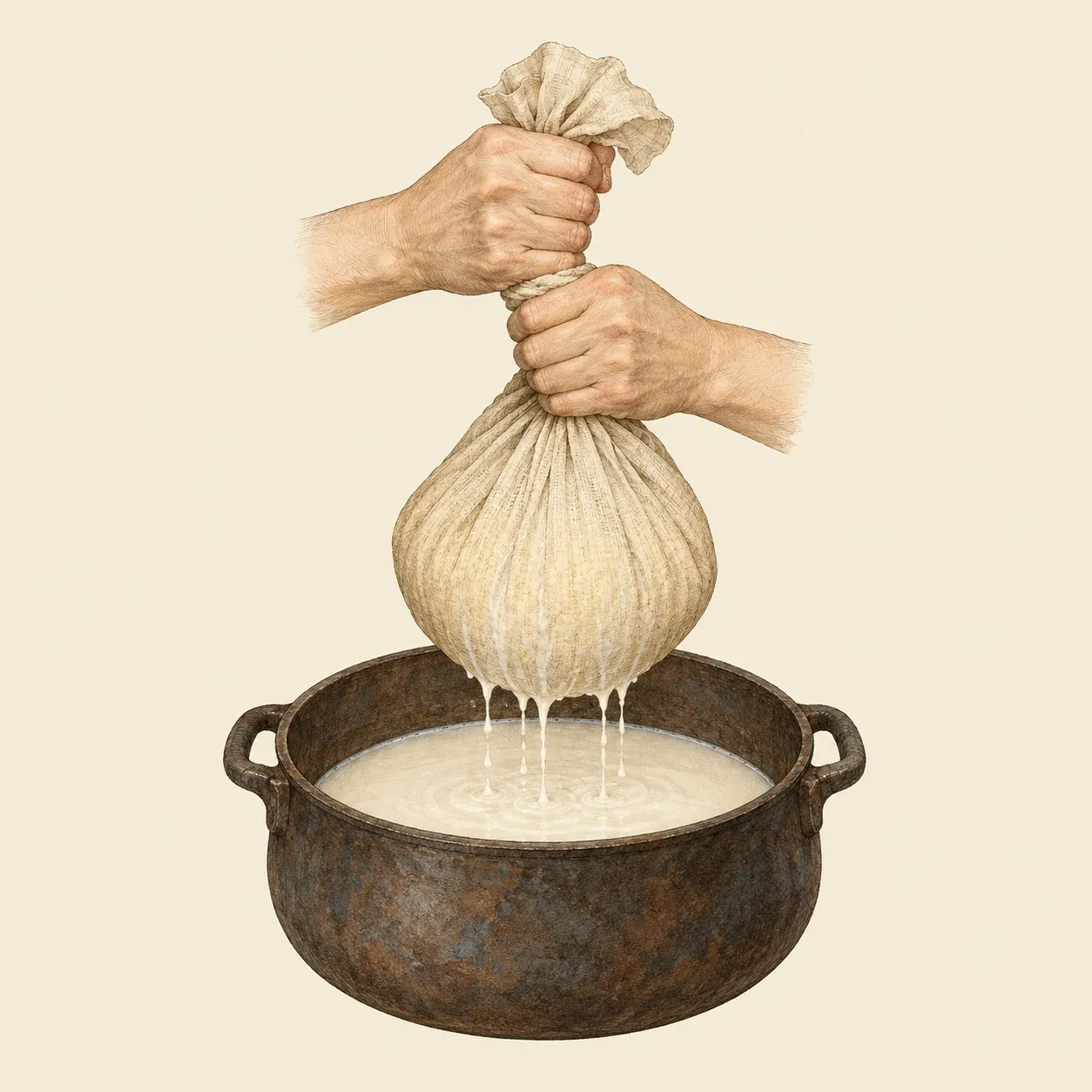 Squeezing the slurry through the cloth gives the milk and leaves the okara inside.
Soak the beans for 8 to 12 hours, discard the soaking water, rinse and grind with fresh water in the quantities specified by the recipe. In a strain-first method, squeeze the slurry through the cloth into the pot. The pulp left behind is okara. It still needs cooking before eating; do not taste the raw milk either.
Bring the milk to a full boil, stirring to prevent sticking and watching for sudden foam. Then simmer for 15 minutes, as in the tested method cited here; the first rise of foam comes well before the milk is cooked. Use a roomy pot and stay beside it while it heats.
Let the cooked milk cool to 70 to 80 °C for a recipe designed for that range. Measure the coagulant according to its manufacturer’s instructions for the volume of prepared milk, add gently and leave undisturbed for 5 to 15 minutes. Scoop the set curds into the cloth-lined mould, fold over the cloth and press under a modest, stable weight for about 20 to 30 minutes.
Safety. Use only food-grade coagulant, never building gypsum or untreated seawater. Keep hands and equipment clean, refrigerate promptly and within two hours at 4 °C or below, and eat within 3 to 4 days. Throw out tofu that smells sour, turns slimy or changes colour.
History and evolution
The Qing Yilu, attributed to Tao Gu and dated around 965, contains the earliest surviving Chinese written reference identified in the Soyinfo Center’s 2022 history.
Tradition credits Liu An, a prince of the second century BCE, with the invention, but the story first appears roughly a thousand years after his lifetime. A Japanese record of 1183 mentions tofu as an offering at the Kasuga shrine in Nara, showing that it had reached Japan by then.
Modern factories mechanise grinding and pressing, and some pasteurise the finished tofu to extend its refrigerated life. The different textures still come from the concentration of the soy milk, its setting agent and how much water the maker drains away.