Roofing
Shedding rain with overlapping tiles
Contents
- 1Rafters
- 2Battens
- 3Flat tile with raised side flanges (tegula)
- 4Curved cover tile over the joint (imbrex)
- 5Ridge tiles
- 6Eaves, where the water drips clear of the wall
A roof covering sheds rain from a building. Overlapping pieces laid on a sloping frame, each one covering the joint below it, carry the water from the ridge to the eaves: bundles of reed or straw in a thatched roof, plates of fired clay in a tiled one. Fired clay tiles already roofed large houses in mainland Greece in the middle of the third millennium BCE.
What it is
A roof covering is the skin that keeps rain out of a building. It lies on a sloping frame of rafters and is made of many separate pieces, each laid so that it overlaps the one below and covers the joint beside it. Water that falls anywhere on the roof can only run downhill from piece to piece until it drips off the lower edge, the eaves, which stand out beyond the wall so that the water falls clear of it.
The pieces can be almost anything that sheds water and can be fixed to the frame: bundles of reed, straw or grass in thatch, slabs of stone, split wooden shingles, turf, or plates of fired clay. Clay tiles have been made in two main forms. Plain tiles are flat and overlap like scales. Pan and cover tiles work in pairs: a flat or hollow tile with raised edges carries the water, and a curved tile laid upside down over the joint between two of them keeps it from running in. The Roman tegula and imbrex are the best-known pair.
How it works
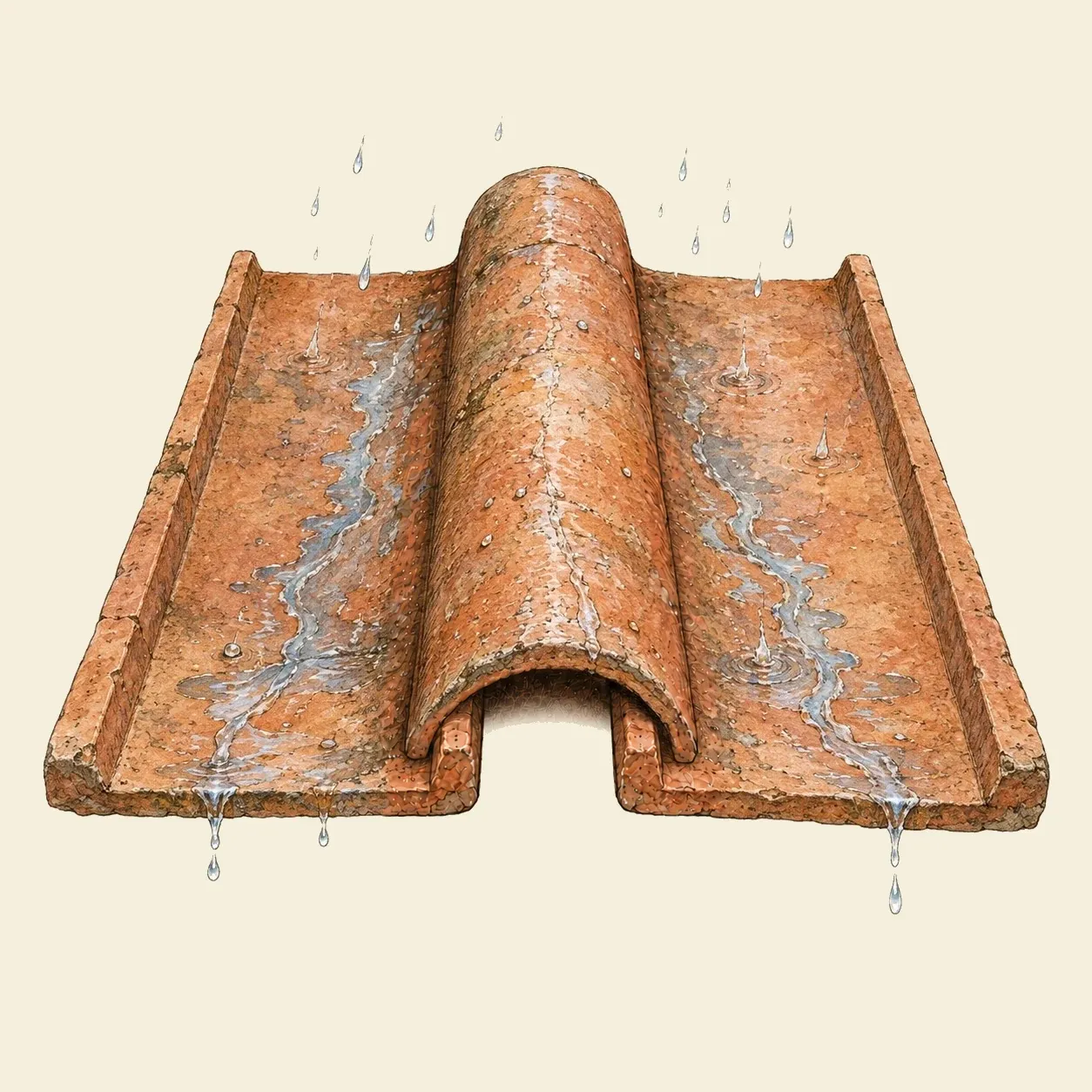 Across the slope, the flat tiles carry the water in their channels and the curved tile covers the joint between their raised edges.
Water on a sloping surface runs straight down it. A roof covering works because every gap between its pieces faces downhill and is covered by the piece above. Rain landing on a tile runs onto the tile below it, never into the joint, as long as the overlap is long enough and the slope steep enough. On a flat or nearly flat roof, water lingers, wind drives it uphill under the overlaps, and the roof leaks.
Thatch works by its thickness and by the slope. The bundles are laid from the eaves upwards with the stems pointing down the roof, each course overlapping the one below, and tied or pegged to battens. Rain wets only the outer part of the layer and runs from one stem to the next towards the eaves, while the inside stays dry. On a shallow slope the water lingers and soaks in, so thatched roofs are steep.
Fired clay takes up little water and does not rot. A pan tile carries the water in the channel between its flanges, and the cover tile sheds it from the joint between two pans onto them. Because the tiles are rigid and their joints are covered, a tiled roof can be laid at a lower slope than thatch: Roman tiled roofs were low, and the weight of the tiles held them in place, although imbrices were sometimes bedded in mortar. That weight calls for a strong frame of rafters and battens, and for walls able to carry it. The ridge, where two slopes meet, is covered by a row of curved ridge tiles, and the lowest tiles hang a little over the eaves.
How to do it
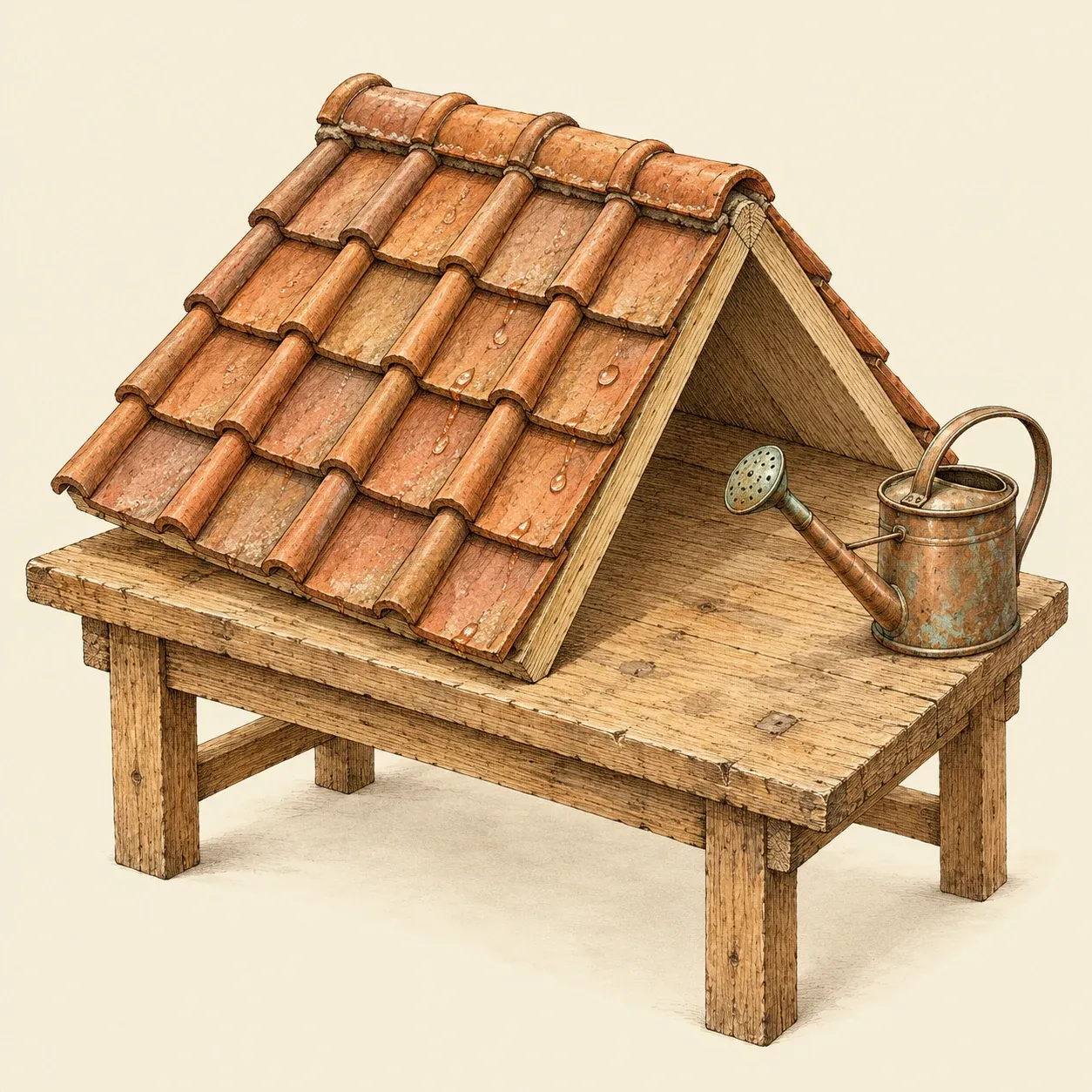 A model roof of fired clay pan and cover tiles: water poured on the ridge runs off at the eaves.
A model roof the size of a shoebox shows how tiles shed water. Make the frame from two pieces of plywood about 30 by 20 centimetres, joined along one edge at the ridge and set on a tray so that each side slopes at about forty degrees. Glue thin strips of wood across each side as battens, about four centimetres apart.
Roll out potter’s clay about six millimetres thick. Cut flat rectangles four centimetres wide and six long, and pinch up a low flange along each long side. For the cover tiles, wrap strips of clay round a broom handle dusted with flour, so they set as half-pipes. Let everything dry slowly for a week, then ask a pottery studio or a school with a kiln to fire them. Lay the pan tiles from the eaves upwards, each row overlapping the one below by about a centimetre, with a small gap between neighbours. Cover each gap with a cover tile, then cap the ridge with a row of cover tiles. Pour water slowly onto the ridge from a watering can: it should run down and drip off at the eaves, and the frame underneath should stay dry. Try it again with the frame at a much lower slope and watch where it leaks.
History and evolution
The first roofs were of branches, grass, reeds, bark or hides laid over a frame, as on the huts of the Palaeolithic. Yijing Xu and her colleagues describe wattle-and-daub houses with thatched roofs as typical of early Neolithic sites in northern China.
In mainland Greece, fired clay tiles were in use in the Early Helladic II period, around 2650 to 2200 BCE. They covered corridor houses, large buildings with a second storey known at Lerna, Akovitika, Kolonna on Aegina, Thebes and Zygouries. At Lerna the best preserved of them, the House of the Tiles, takes its name from the mass of terracotta tiles that fell from its roof, and stone slabs lay along its eaves. Christine Shriner and her colleagues traced the clay of the tiles to deposits near the site and identified the eaves slabs as a shale or siltstone from a local sedimentary bed. These tiles were usually flat and rectilinear and did not interlock.
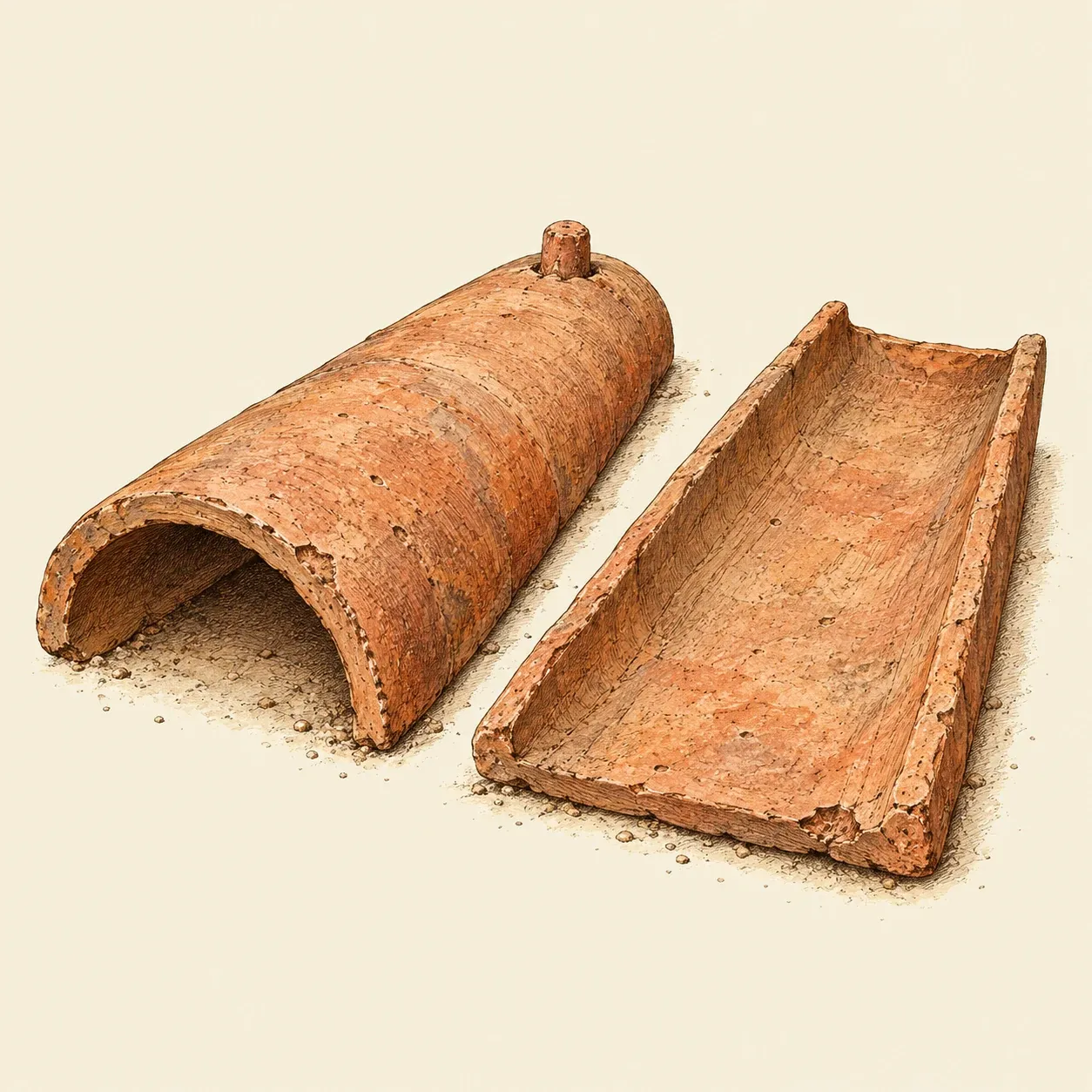 Tiles of the Qiaocun type: a half-cylinder cover tile with a clay peg, and a pan tile with raised sides.
In China, excavators at Beiyangping, a settlement of the Yangshao period in Henan, have found many pieces of tile-shaped pottery; if they prove to have been laid on roofs, they will be the oldest tiles yet found. At Qiaocun, a site of the Longshan period on the Loess Plateau in Gansu, Xu and her colleagues studied a large deposit of clay tile fragments from a single ditch. Half-cylinder cover tiles, often with a clay peg near the narrow end, lay over trapezoidal pan tiles with raised sides. They roofed large communal buildings with thick walls of rammed earth, and the authors suggest that the need to keep rain off those earth walls led to the tiled roof.
In the first half of the 7th century BCE, temples at Corinth and at nearby Isthmia were roofed with large, heavy terracotta tiles. Philip Sapirstein has shown that the tiles of the Old Temple at Corinth were shaped on a mould, and that the Corinthians may have copied a roofing system with separate pan and cover tiles invented elsewhere. Roman builders used the pairing of flat tegulae and curved imbrices from Italy to Britain. Tegulae had a raised flange along each long side and were laid side by side on wooden battens, their flanges trimmed near the upper end so that each slid under the tile above, and imbrices covered the joints between them. Tiles were left out in the open to dry before firing, which is why many carry the footprints of animals and people.