Torch
A bundle of burning wood carried by hand
Contents
- 1Bundle of dry juniper branches
- 2Binding of green ivy stem
- 3Strips of birch bark as tinder
- 4Pine resin on the split ends
- 5Flame at the burning head
A torch is a bundle of dry wood that burns at one end while the other end stays cool enough to hold. It casts a light all around that moves with its bearer. Torch marks on the walls of Chauvet cave show that people carried such lights underground about 30,000 years ago.
What it is
A torch is a fire that can be carried. One end of a bundle of dry wood burns, and the other end serves as a handle. A hearth stays where it was built, as the control of fire entry describes, and a fat lamp keeps a small flame in one place. A torch goes wherever its bearer walks and lights the ground, the walls and the ceiling around them at once.
The simplest torch is a single resinous stick. Those that archaeologists have rebuilt from cave finds are bundles of several thin branches tied together, with strips of dry birch bark slipped in at the head to catch the first flame. Some were also smeared with pine resin or animal fat. The bundle is held low, near its base, and only the head burns, so a torch shortens as it is used and has to be replaced.
How it works
Heat from the flame breaks down the wood at the head into flammable gases and tar, which burn as they mix with the air. A bundle of thin branches burns better than one thick stick, because air reaches more of the wood through the gaps between them. Resin burns fast and fiercely and brightens the flame for a short time, while animal fat burns slowly, makes the torch last longer and gives little smoke. In tests, juniper and oak gave a white smoke, while pine resin and birch bark gave a denser black one.
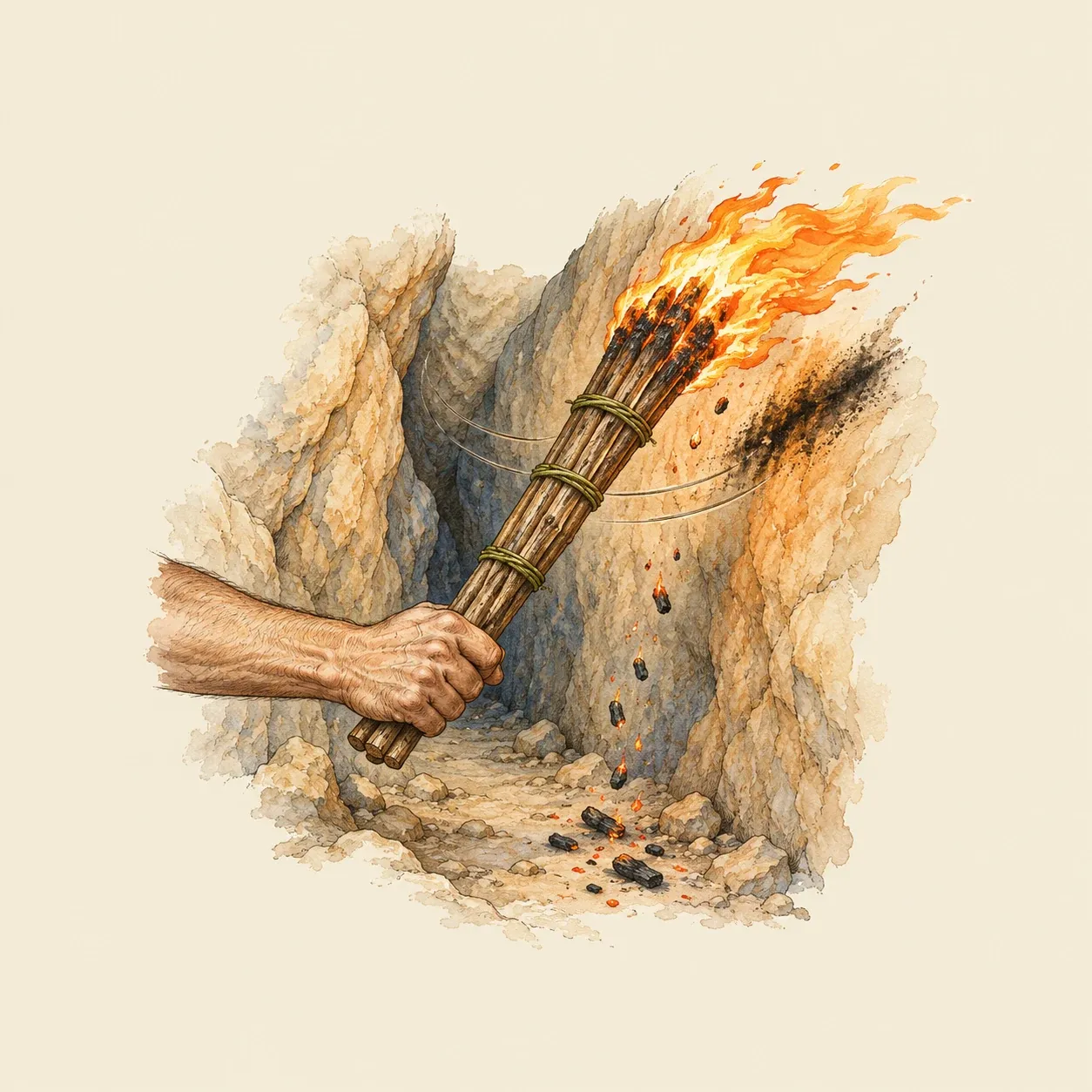 Swinging the torch feeds the flame with air and shakes off charcoal.
A torch burns unevenly and needs constant attention. In experiments in Isuntza I cave, in the Basque Country, published in 2021, a torch whose flame had sunk could be revived by swinging it sharply from side to side. The swing brought fresh air to the head and the light grew stronger. It was also the moment when most of the charcoal broke off and fell to the floor. Where a flame passed within about 5 cm of the rock, it left a black mark of soot. Scattered charcoal on cave floors and black marks on the walls are the traces archaeologists look for.
A fat lamp burns longer and without smoke, which suits work in one place. A torch is better suited to moving through a cave.
How to do it
Make this demonstration outdoors only, with an adult in charge, on a calm day when local rules allow fires. Choose bare earth or sand well away from trees, dry grass and buildings, and set a bucket of water and a bucket of sand within reach before you start.
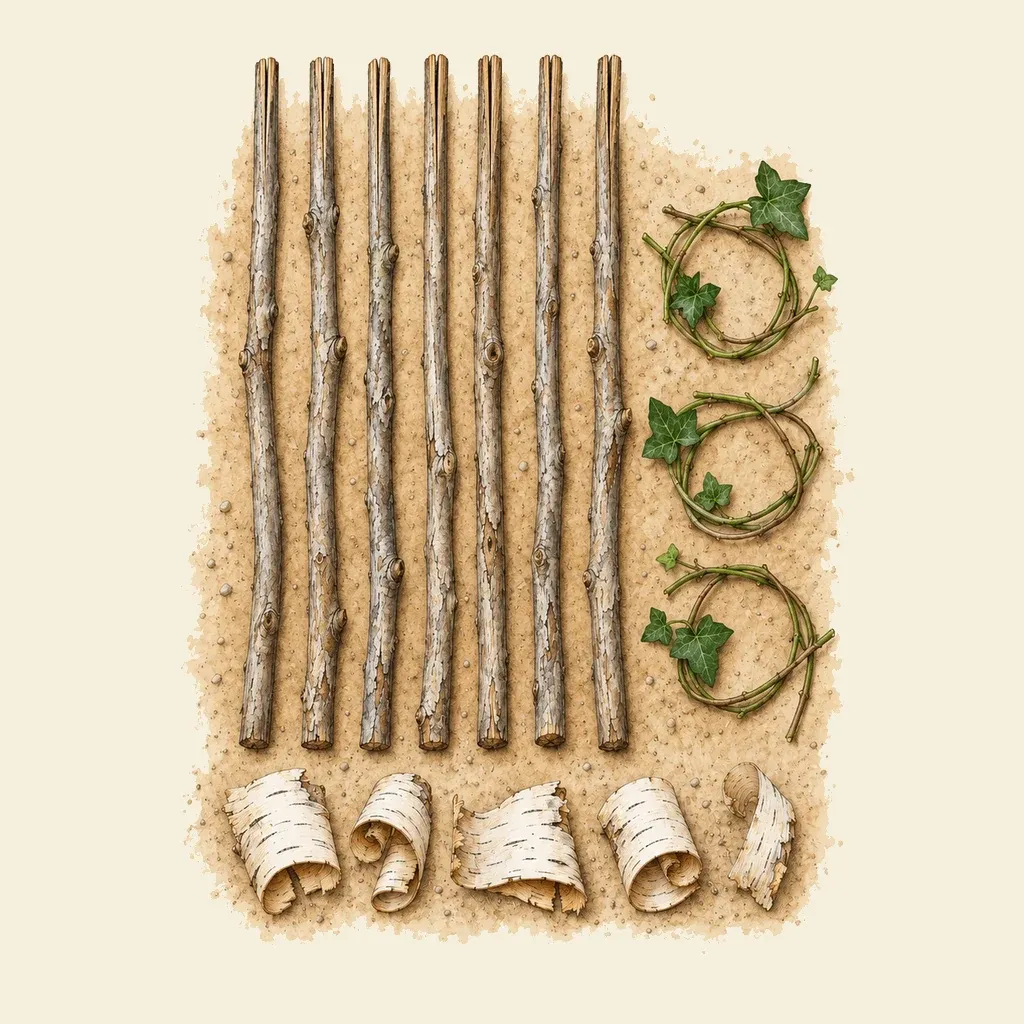 Dry branches split at the top, green ivy to tie them and birch bark as tinder.
Gather six to eight dead, dry branches a little thicker than a finger and about as long as your arm; juniper, pine or hazel will do. Split the top end of each a short way with a knife, cutting away from your body. Tie the branches into a bundle in three places with green ivy stems or wet hemp string, tightest at the bottom, and push strips of dry birch bark between the split ends. Leave out resin, fat and any bought fuel: resin flares up, melted fat can drip from the head while burning, and bought fuels catch far too fast.
Hold the torch at arm’s length by its lower end, head up and away from your face, and light the birch bark with a match. Keep it over bare ground, since charcoal falls from it as it burns. If the flame sinks, swing the torch gently from side to side, away from people. To put it out, push the head into the bucket of sand or water and leave it there until it is cold, then check the ground for embers.
Safety. Tie back long hair and wear cotton or wool, since synthetic fabrics melt onto the skin. Never take a lit torch into a cave, tent, shed or house, where smoke and carbon monoxide build up.
History and evolution
Torches leave little behind, because the wood burns away. What survives is charcoal on the ground and black marks where a torch brushed a wall. In Chauvet cave, in the Ardèche, charcoal from torch marks on the walls gave radiocarbon ages of about 26,000 to 27,000 years, which correspond to roughly 30,000 calendar years. A team led by Anita Quiles placed these marks in the second of the two periods when people entered the cave. At Nerja, in Andalusia, charcoal of Scots pine from torches is dated to about 27,000 years ago. In other decorated caves, smudges of soot on the walls led researchers to think that resinous torches were used alongside lamps.
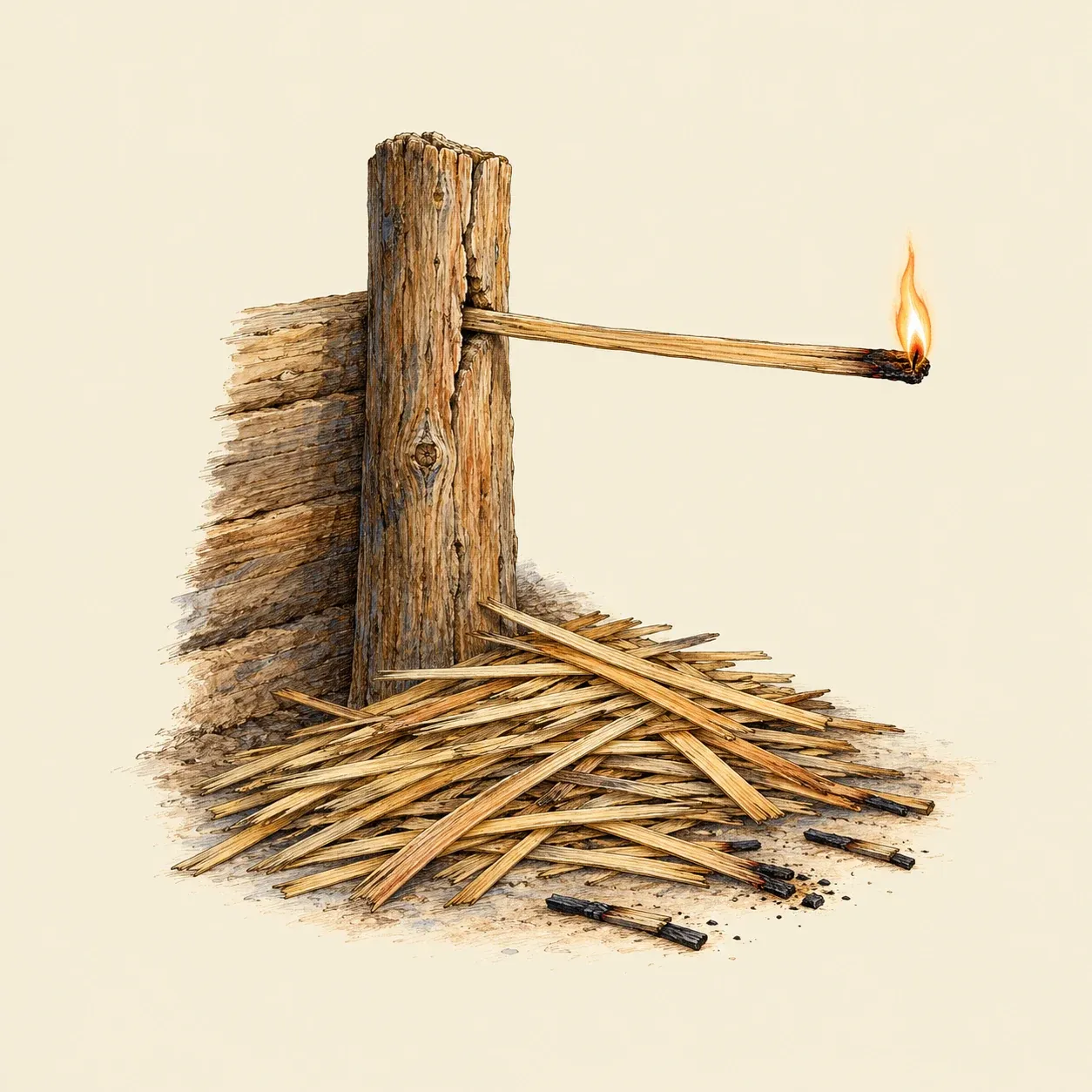 Bronze Age miners burned fir splints one at a time.
In the Bronze Age salt mine of Hallstatt, in Austria, miners lit their way with thin splints of fir wood. The Natural History Museum in Vienna counts the burnt splints left in the old spoil in millions and describes them as burned one at a time.
Roman sculptures and vase paintings show torches made of staves held by a cord wound in a spiral or by bands at intervals. In his dictionary of 1875, William Smith supposed that they were filled with tow and soaked in pitch, resin or wax. A Roman bride was led to her new home behind a torch lit at her parents’ hearth. In his London lectures on the candle, given at Christmas 1860, Michael Faraday showed a piece of “candle-wood” taken from Irish bogs and said that where it was found, people split it into splinters and torches.