War hammer and mace
A heavy head at the end of a short shaft
Contents
- 1Flanges of the mace head
- 2Shaft
- 3Hammer face
- 4Beak, a curved spike
- 5Belt hook
A mace is a short shaft with a heavy head, and a war hammer carries a hammer face and a spike on the same kind of shaft. Both strike with weight rather than with an edge. Stone maceheads appear in the Near East in the tenth millennium BC; in Europe, steel maces and war hammers were made from about 1300 to fight men in plate armour.
What it is
A mace is a club made for war: a short shaft with a heavy head of stone or metal at one end. The head may be round, pear-shaped or built up from flanges, thin plates set edgewise around the shaft. A war hammer has the same short shaft, but its head carries a small hammer face on one side and a pointed beak on the other. Both are blunt weapons. They do their work with the weight of the head, and they need no sharpened edge.
In late medieval Europe both were weapons for close combat, often on horseback. The Metropolitan Museum describes its steel mace of the late 15th century as a horseman’s weapon, carried along with a sword or other arms. The Victoria and Albert Museum distinguishes three kinds of war hammer: a throwing hammer, a short hammer for one hand used by mounted warriors from the 13th to the 16th century, and a long hammer for fighting on foot, used from the 14th to the 16th.
How it works
A mace puts most of its weight at the end of the shaft. Swung from the shoulder or the elbow, the head travels fast, and when it stops against the target it hands over its momentum through a small area. The Fitzwilliam Museum notes that a flanged mace was useful only at very close range, but that its weight and the swinging action made it very effective, and that horsemen kept it on the wrist with a leather strap.
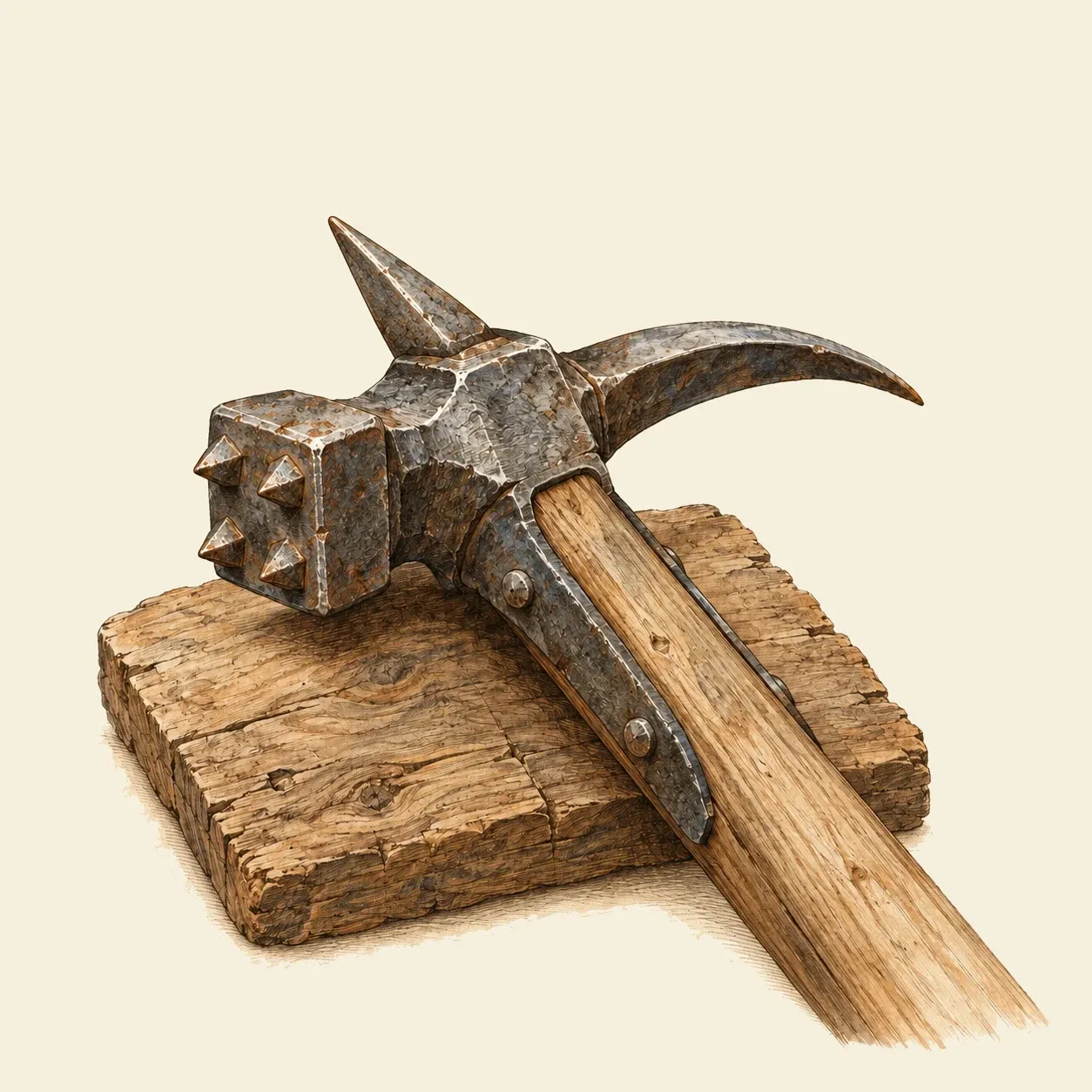 A war hammer for foot combat combined a hammer face, a beak and a top spike on one head.
Against armour, a blunt blow does not have to cut. The Paço dos Duques museum in Guimarães notes that war hammers struck more effectively than swords against men in plate armour, and the V&A that they were made to pound and tear at it. The flanges of a late medieval mace meet the target along narrow edges, so the force of the blow is concentrated there.
War hammers became common in the middle of the 14th century, as plate armour spread. According to the same museum in Guimarães, the flat or pointed hammer face rarely went through armour, while the beak could pierce it fairly easily but often stuck, leaving the attacker exposed until he freed it.
How to do it
A soft display model of a mace shows how weight is gathered at the end of a shaft, without anything hard. It needs a strong cardboard tube, such as the core of a roll of kitchen foil, a craft foam ball a little wider than the tube, a sheet of soft craft foam, cloth tape and glue, with scissors and a craft knife.
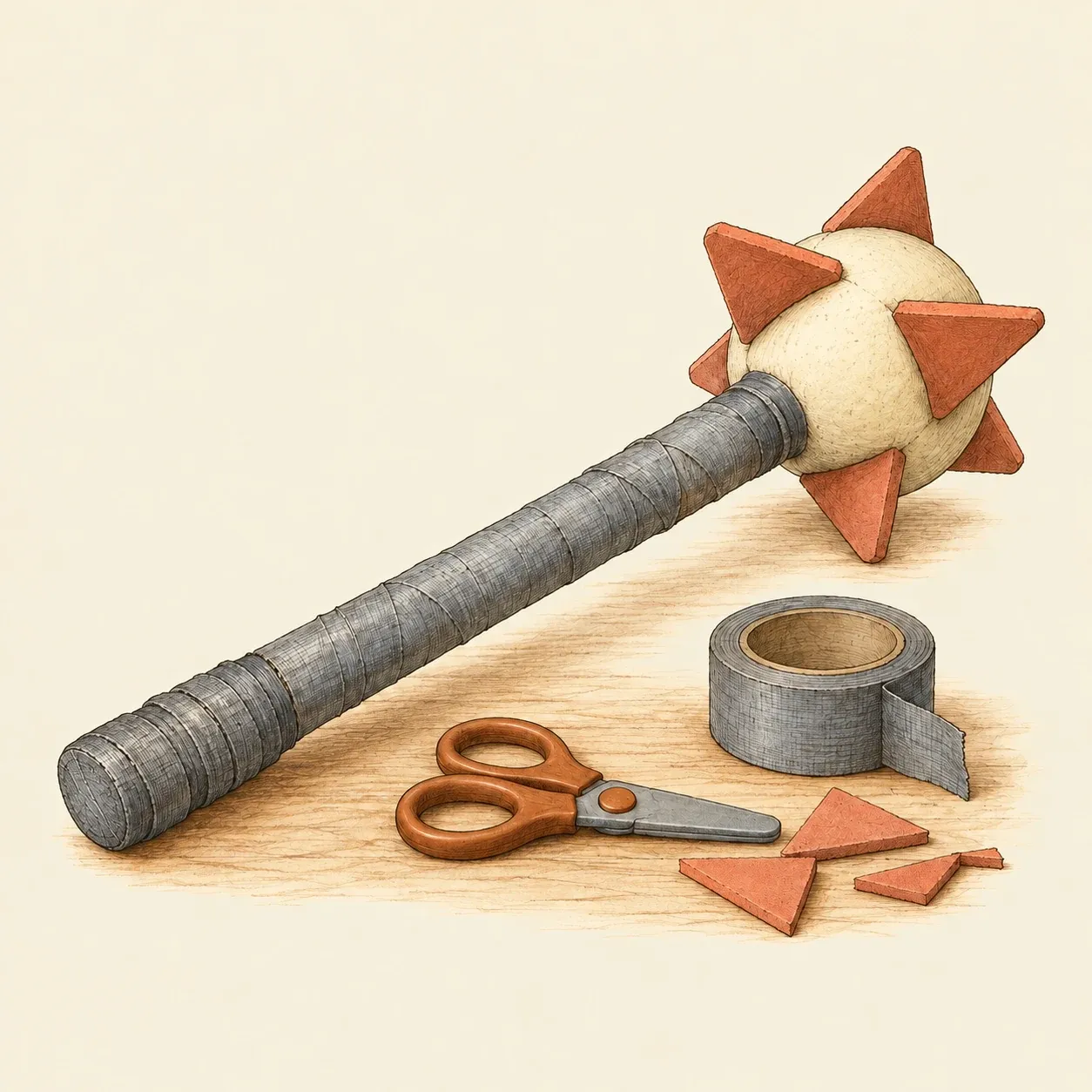 Soft foam flanges around a foam ball give the shape of a late medieval mace head.
Wrap the whole tube in cloth tape so that it has no sharp edges, and close both ends with tape. Cut a hole in the foam ball the size of the tube, push the ball onto one end and glue it. Cut six identical triangles from the foam sheet and glue them around the ball, like the flanges of a steel mace, spacing them evenly. Wrap the other end of the tube with more tape to make a grip. Squeeze the head: it should give easily under the fingers everywhere.
Safety. The model is for display only: never swing it at anyone. Do not put anything hard or heavy inside the head.
History and evolution
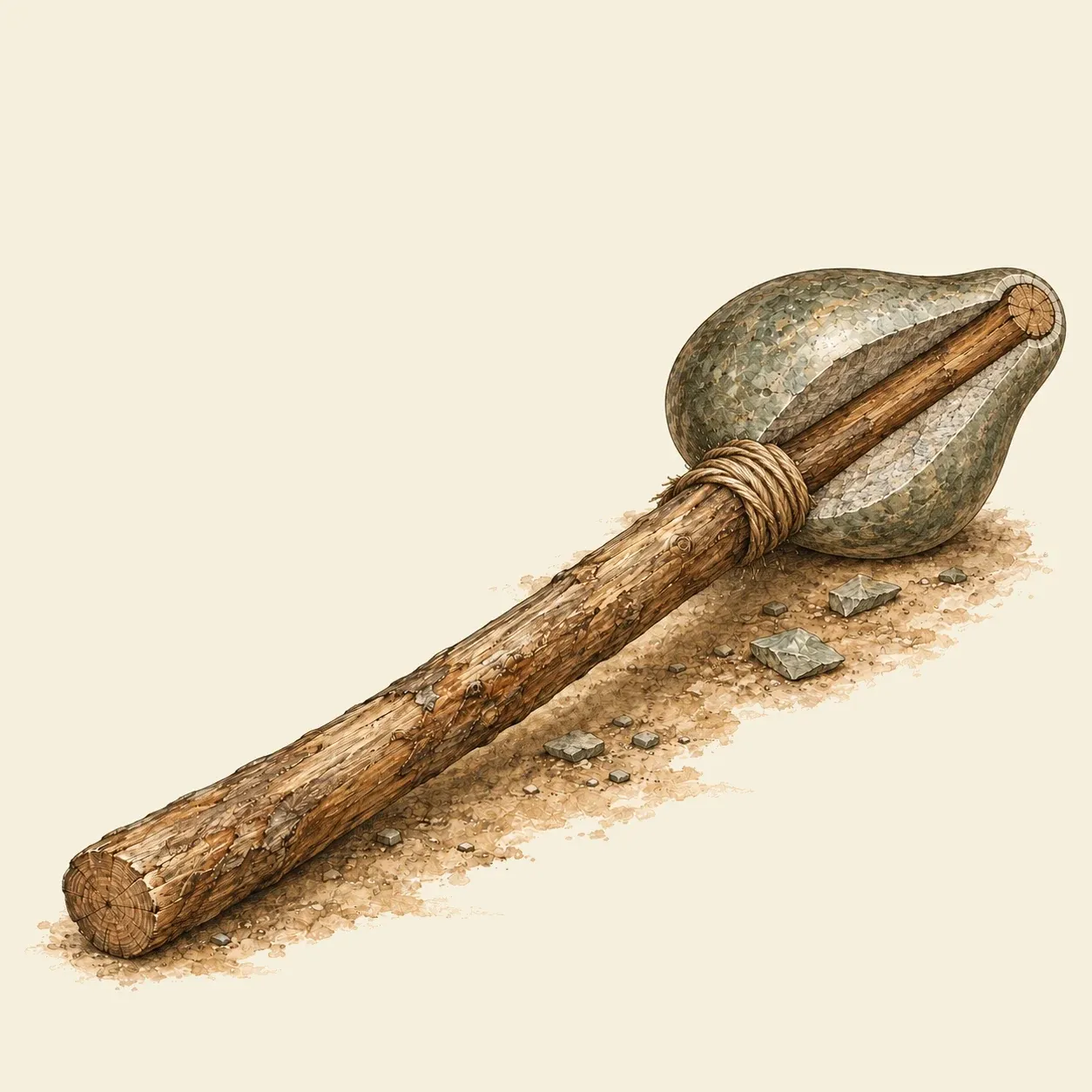 The first maceheads were stones shaped and pierced so that a wooden shaft could pass through them.
The mace is among the oldest weapons made for war. Michael Sebbane of the Israel Antiquities Authority, reviewing the finds, dates its first appearance to the tenth millennium BC, in the Pre-Pottery Neolithic A of the Near East, at sites in Anatolia and northern Mesopotamia such as Hallan Çemi, Körtik Tepe, Qermez Dere and Nemrik. Li Shuicheng of Peking University gives 9500 to 8500 BC for the stone macehead of Hallan Çemi. The heads were shaped from stone with stone tools and pierced to take a shaft. Sebbane considers that a head lighter than about 150 g, or with a hole narrower than 1 cm, would hardly have been used for fighting; many maceheads were also objects of rank and ritual.
Metal came later. Li cites a copper macehead from Can Hasan, in Turkey, as the oldest metal one known. It lay in a burnt house of layer 2B, which the excavator David French placed at the transition from the Early to the Middle Chalcolithic, and his radiocarbon dates of the 1960s put that transition at about 5000 BC. Li gives about 5000 BC for the macehead, and the archaeometallurgist Ernst Pernicka about 6000 BC. Li also counts many maceheads and sceptres among the more than 400 metal objects of the Nahal Mishmar hoard, found in 1961 in a cave near the Dead Sea and dated to the fourth millennium BC. In Egypt, before the first dynasties, maceheads were shaped like discs, pears or spindles, and the Narmer Palette shows the king raising a mace over a kneeling captive. The scene of a ruler striking with a mace was repeated in Near Eastern and Egyptian art for centuries.
In medieval Europe, iron and steel maces and hammers were the companions of the sword. The V&A dates the war hammer’s continuous use from about 1300 to the 17th century. The Met places its type of mace, with a short head of pierced triangular flanges, in western Europe from the middle of the 15th century to the early 16th. Both answered the spread of plate armour. Some were finely decorated: the V&A’s horseman’s hammer of about 1550, inlaid with gold and silver, may have been used mainly as a signalling baton by the leader of an army.